

10.3 - The nth Term Test for Divergence
Introduction
The nth term test for divergence (also called the divergence test) is a quick check that can sometimes prove a series diverges.
The basic idea: if the individual terms of a series don’t shrink toward zero, there’s no way the sum can settle on a finite value.
Statement of the Test
For :
If the series converges, then .
The contrapositive is the useful version:
Critical Warning: This Test Only Goes One Way
What it CAN tell you: if , the series diverges.
What it CANNOT tell you: if , you get no conclusion. The series might converge, or it might diverge.
The Trap
That’s bad reasoning. When the limit is zero, you need a different test.
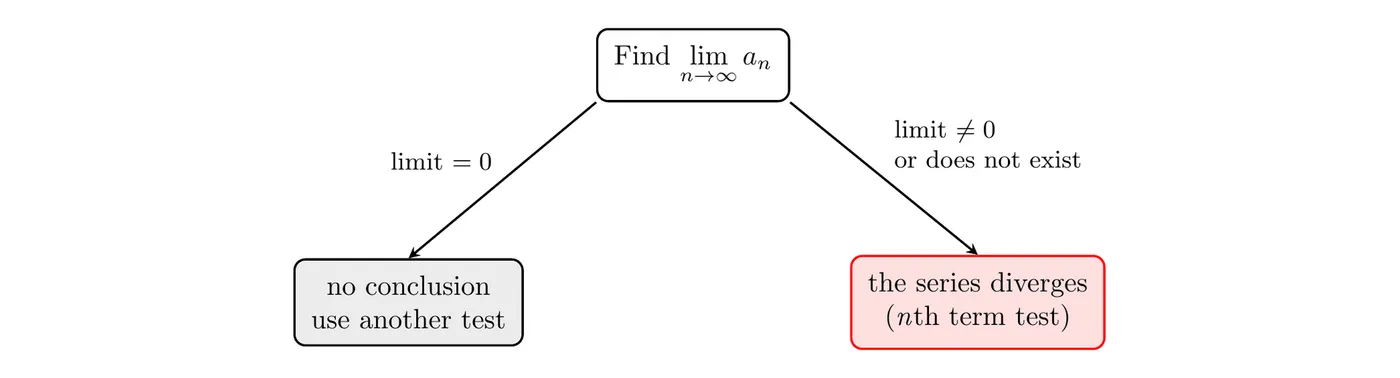
Using the Test
- Identify , the general term
- Calculate
- Decide:
- Limit means the series diverges (say “by the nth term test”)
- Limit means no conclusion, so reach for another test
Example 1: Clear Divergence
Does converge or diverge?
For a rational function, divide numerator and denominator by the highest power of :
Since , the series diverges by the nth term test.
Example 2: When the Test Gives Nothing
Does converge or diverge?
The nth term test gives no conclusion.
But we can recognize this as a geometric series with , so it converges, and
Key point: the nth term test was useless here, but geometric series knowledge wasn’t.
Example 3: Terms Go to Zero, Still No Conclusion
Does converge or diverge?
The nth term test gives no conclusion. (This series does actually converge, but you’d need a different test to prove it.)
Example 4: Simplify Before Taking the Limit
Does converge or diverge?
Step 1: Simplify. Since :
Step 2: Take the limit. For large , the is negligible next to :
Since , the series diverges by the nth term test.
Example 5: Exponential Growth
Does converge or diverge?
This is , so use L’Hôpital’s Rule:
Since the limit isn’t zero, the series diverges by the nth term test.
Exponentials in the numerator crush polynomials in the denominator.
Example 6: Oscillating Terms
Does converge or diverge?
The terms bounce between (odd ) and (even ) forever.
Since the limit doesn’t exist (and so certainly isn’t zero), the series diverges by the nth term test.
Common Limit Techniques
Rational functions. For with polynomials and : divide both by the highest power of , then compare leading coefficients.
Exponential vs. polynomial. Exponential growth wins:
L’Hôpital’s Rule. When you hit or :
You may need to apply it more than once.
Why the Test Fails When the Limit Is Zero
Intuition: just because the individual terms get small doesn’t mean you aren’t adding infinitely many of them.
Classic counterexample: the harmonic series.
Here , but the series diverges. The terms approach zero, just not fast enough to keep the total finite.
Summary Table
Condition | Conclusion | Why |
Diverges | Terms aren’t approaching zero | |
doesn’t exist | Diverges | Terms aren’t approaching zero |
Inconclusive | Need another test |
When to Use It
Always try the nth term test first, because it’s fast, and if it shows divergence you’re done. If it comes back inconclusive, at least you know you need something else.
Best for:
- Rational functions where numerator and denominator have the same degree
- Series with exponential terms
- Obviously divergent series
Useless for:
- Series where the terms clearly go to zero
Key Takeaways
- nth term test: if , then diverges
- One-way test: it can prove divergence but never convergence
- Limit equals zero means no conclusion
- Always try it first, it’s the quickest route to a divergence answer
- Common error: assuming implies convergence. It doesn’t.
- Geometric series can still be settled with even when this test is inconclusive
- State the conclusion as “the series diverges by the nth term test”
- L’Hôpital’s Rule is often handy for the limit
- If the limit doesn’t exist (like an oscillation), the series diverges
- When , you need the tests from the next lessons