

10.4 - Integral Test for Convergence
Introduction
The integral test decides convergence or divergence of certain series by tying them to improper integrals.
Key idea: if you can integrate the function easily, that integral tells you what the series does.
Conditions for Using It
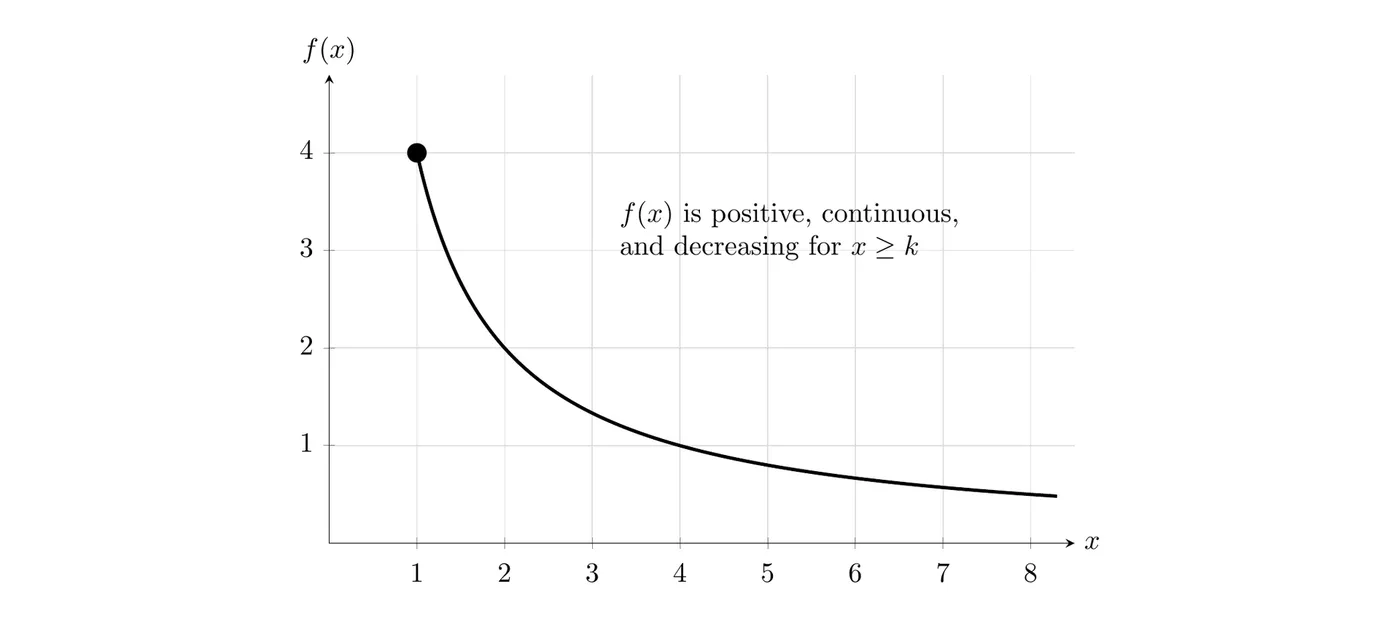
You can only apply the integral test when the function matching the terms satisfies three conditions on :
- Positive: for all
- Continuous: is continuous for all
- Decreasing: is decreasing for all
Statement of the Test
Let where is positive, continuous, and decreasing for . Then
both converge or both diverge together.
- If converges, the series converges
- If diverges, the series diverges
Proof Sketch
Take positive, continuous, and decreasing on .
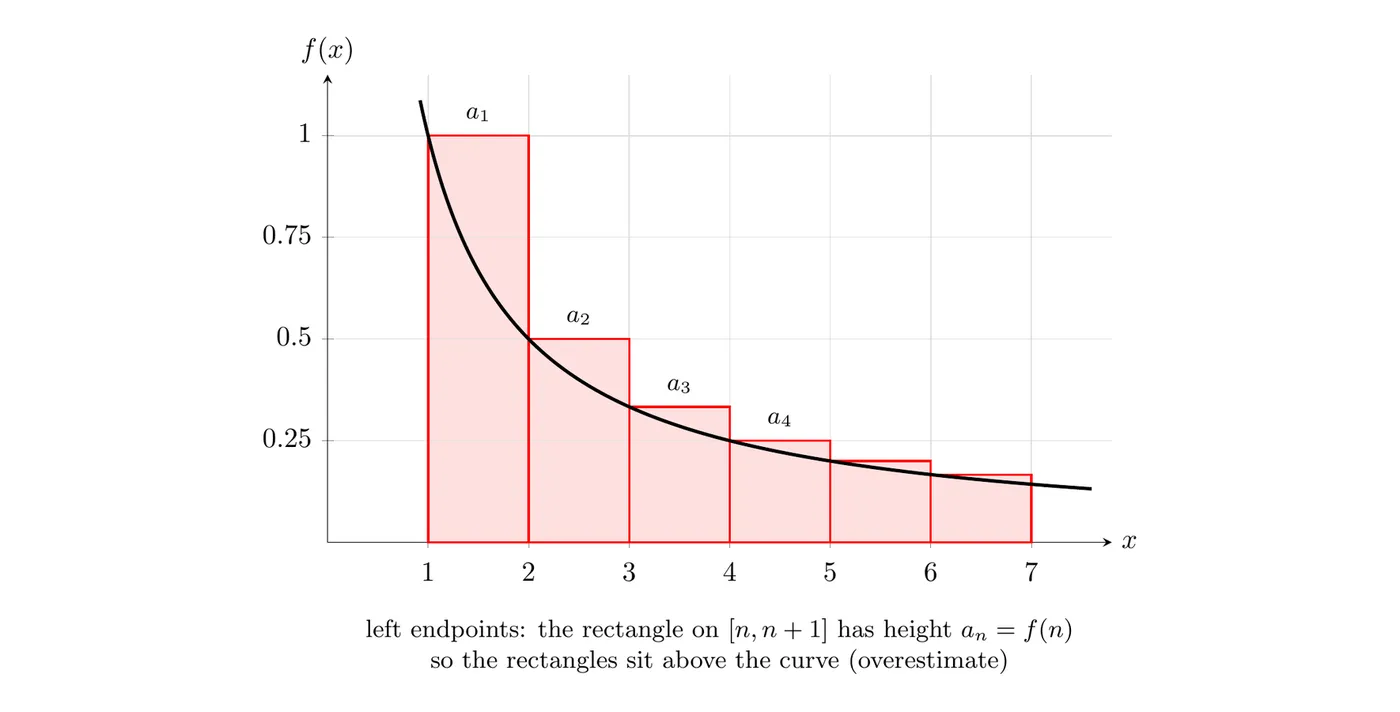
Left rectangles (overestimate). Each rectangle has width 1 and height . Since is decreasing, the left endpoint sits above the curve, so the rectangles overshoot:
Right rectangles (underestimate).
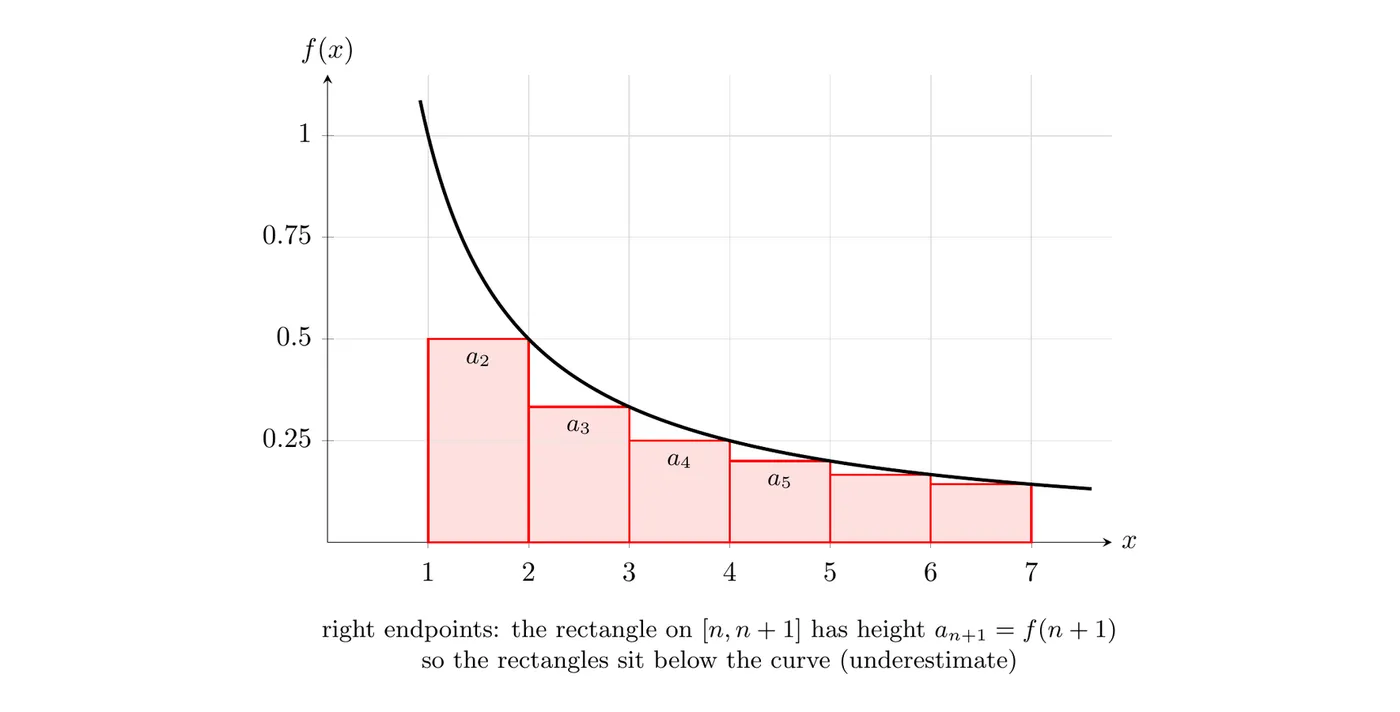
Combine. Add to both sides of the underestimate:
Put it together with the overestimate:
Take the limit as :
The series is sandwiched between the integral and the integral plus a constant. So if the integral is finite, the series is bounded and converges. If the integral blows up, so does the series.
Important: they converge or diverge together, but not necessarily to the same value.
Step-by-Step
- Verify the three conditions. Is positive, continuous, and decreasing for ? Graph it if you’re unsure.
- Set up the improper integral:
- Evaluate it. Find the antiderivative, apply the limits, see whether the result is finite.
- Conclude. Integral converges means series converges; integral diverges means series diverges.
Example 1: A Divergent Series
Test .
Step 1: Check conditions for on .
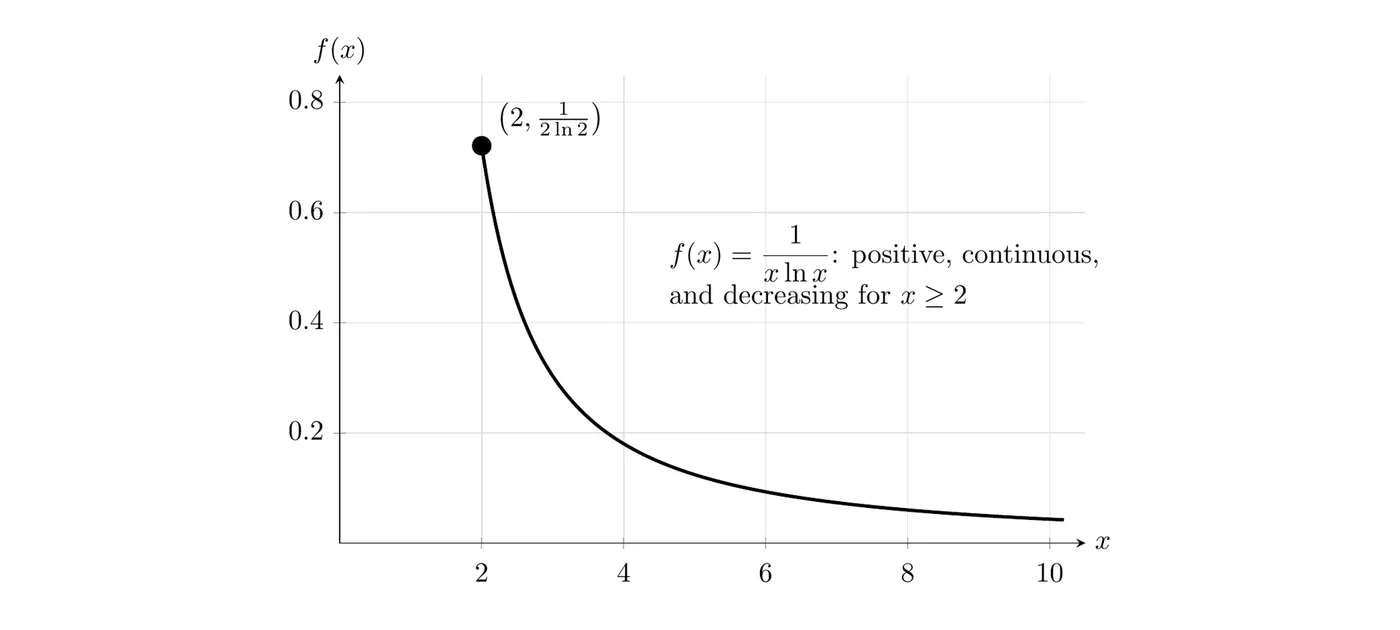
Positive, continuous (since is defined and nonzero), and decreasing. All good.
Step 2: Set up.
Step 3: Evaluate with -substitution. Let , so .
As , , so . The integral diverges.
Step 4: Conclude. The series diverges by the integral test.
Example 2: A Convergent Series
Test .
Step 1: Check conditions for on .
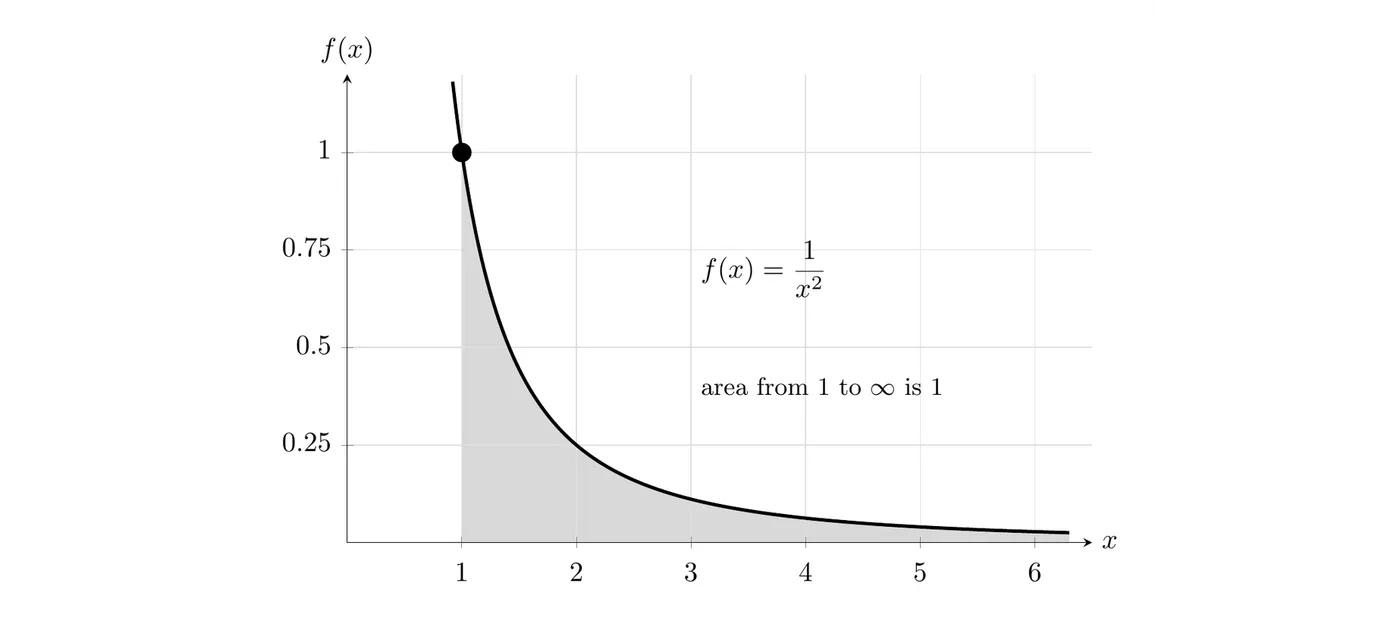
Positive, continuous, decreasing.
Step 2 and 3: Set up and evaluate.
Step 4: Conclude. The integral converges to 1, so the series converges by the integral test.
Note: the series converges, but not to 1. The integral is 1; the series is actually . The test tells you whether it converges, not what it converges to.
Example 3: Series with an Exponential
Test .
Step 1: Check conditions for on . Positive, continuous, and decreasing (you can confirm with the derivative).
Step 2 and 3: Set up and evaluate with , so and .
As , :
Step 4: Conclude. The integral converges to , so the series converges by the integral test.
When the Function Isn’t Decreasing at First
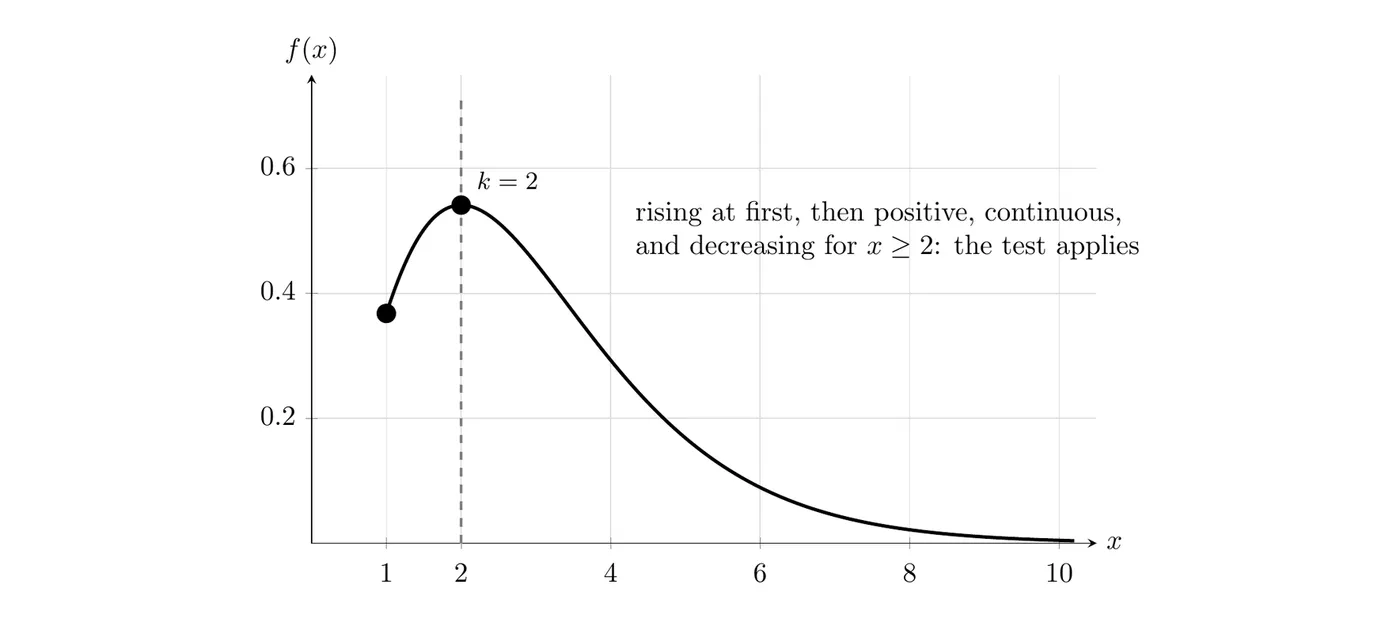
The integral test still works as long as the function is eventually positive, continuous, and decreasing.
If satisfies the three conditions for all (for some ), then
behave the same way, even though the series starts at .
Why? The first few terms are just a finite sum tacked onto both sides. A finite number can’t change whether something converges.
Common Candidates
-Series
For instance, converges, and the harmonic series diverges.
Good Candidates for the Integral Test
- Rational functions: ,
- Functions with logarithms:
- Exponentials:
Poor Candidates (use something else)
- Factorials:
- Alternating series:
- Anything that’s a nightmare to integrate
Strategy Hierarchy
When testing a series:
- Try the nth term test first, it’s the fastest way to show divergence
- Check if it’s geometric, since then you get an easy formula
- Use the integral test if the function is easy to integrate and the conditions hold
- Use other tests for the messier cases (later lessons)
Key Takeaways
- Integral test: if is positive, continuous, and decreasing, then and behave the same
- Three conditions required: positive, continuous, decreasing. Verify before using.
- Both converge or both diverge, but not necessarily to the same value
- Set it up as a limit:
- Reach for -substitution when needed
- “Eventually decreasing” is enough, the conditions don’t have to hold from
- Only use it when the integration is manageable
- State it as “the series converges/diverges by the integral test”
- The proof uses rectangles: left rectangles overestimate, right rectangles underestimate
- -series rule: converges if , diverges if