10.11 - Finding Taylor Polynomial Approximations of Functions
10.11 Finding Taylor Polynomial Approximations of Functions
Why Approximate Functions with Polynomials?
Motivation: polynomials are much easier to work with than most other functions. Taking derivatives and integrals of polynomials is simple, while exponentials, logarithms, and trig functions can get messy.
Goal: build a polynomial that closely approximates a more complicated function.
The Concept of Taylor Polynomials
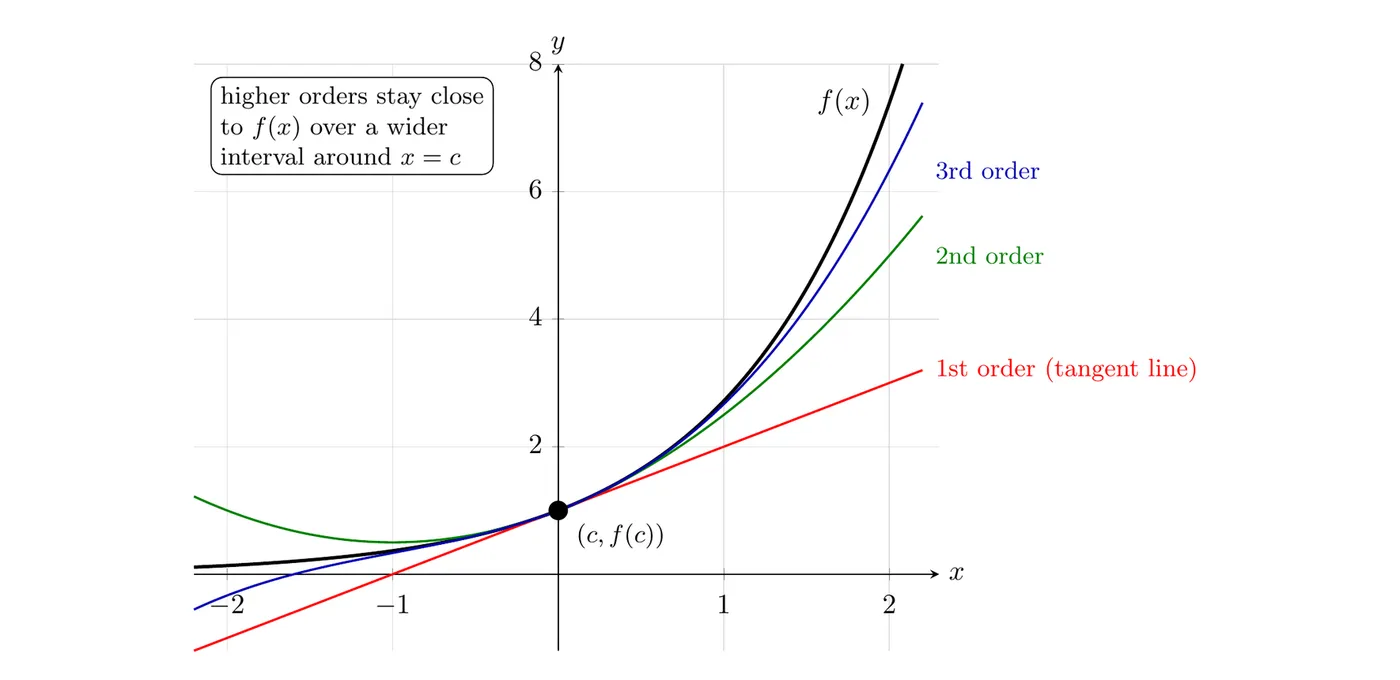
Suppose we have a function f(x) and we want to approximate it near a specific point x=c.
Strategy:
Start at the point (c,f(c)), since the polynomial has to pass through it
Match the slope at x=c (the first derivative)
Match the curvature at x=c (the second derivative)
Keep matching higher derivatives for better approximations
Terminology: we say the polynomial is centered at x=c, or expanded around x=c.
Building an Approximation Step by Step
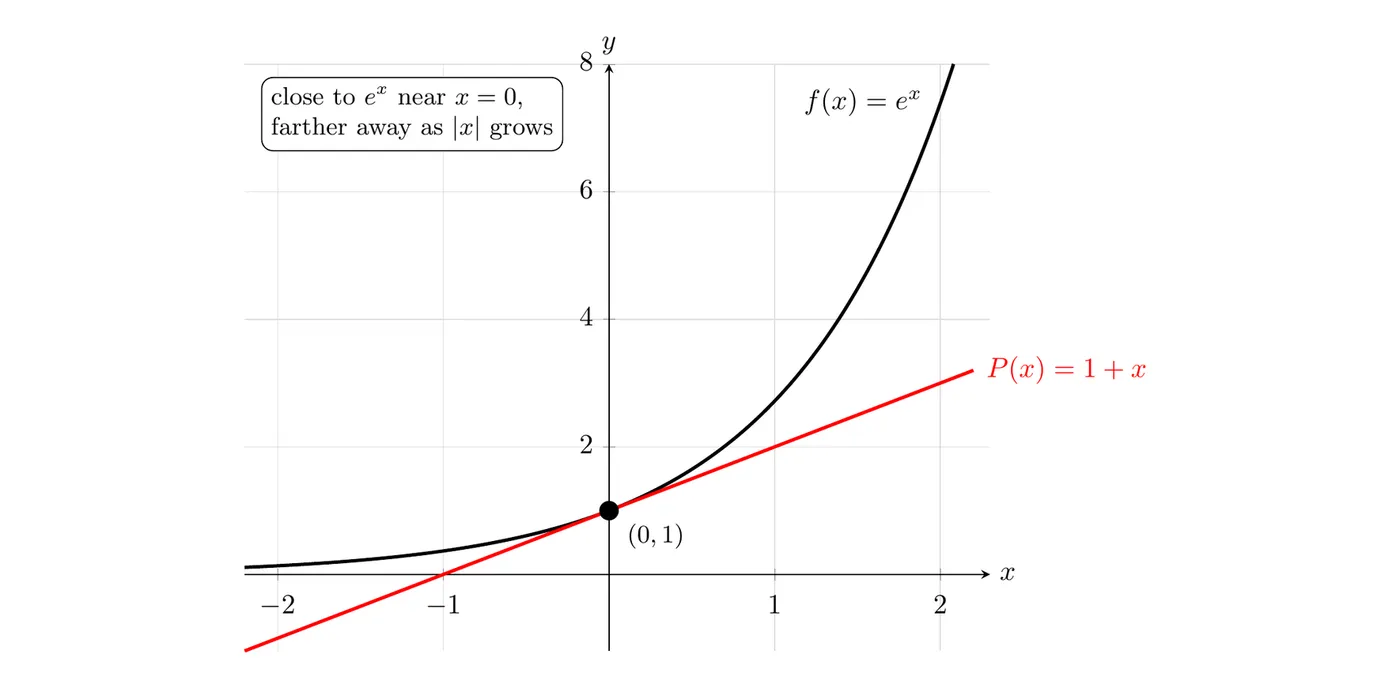
Let’s build approximations for f(x)=ex centered at c=0.
Matching the Function Value
Requirement:f(c)=P(c)
At x=0: f(0)=e0=1
So our polynomial has to satisfy P(0)=1.
First Order: Matching the Slope
Requirement:f′(c)=P′(c)
For f(x)=ex:
f′(x)=ex
f′(0)=e0=1
Using point-slope form:
P(x)−f(0)=f′(0)(x−0)P(x)=1+1⋅x=1+x
This is a first-order (linear) approximation, which is just the tangent line.
Limitation: it’s only a good approximation very close to x=0.
Second Order: Matching Curvature
Requirement:f′′(c)=P′′(c)
For f(x)=ex:
f′′(x)=ex
f′′(0)=1
After working through the algebra and matching all three conditions:
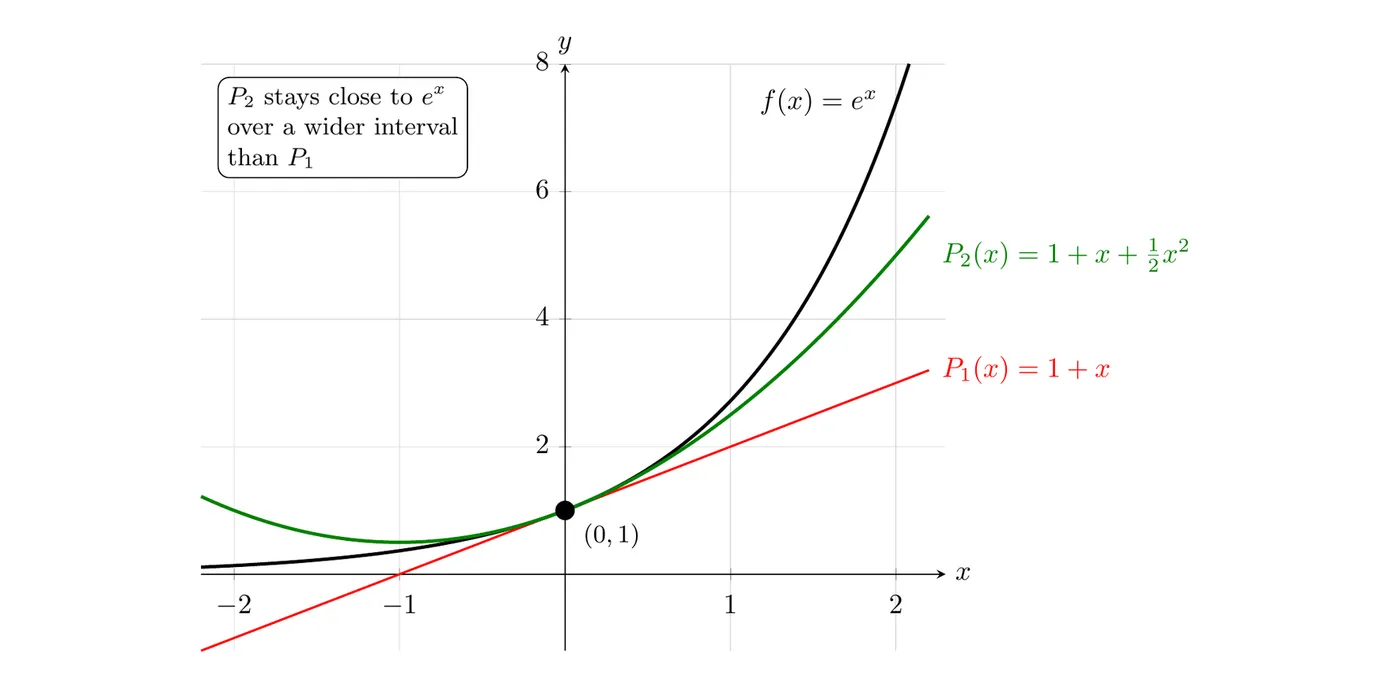
P2(x)=1+x+21x2
This is a second-order (quadratic) approximation.
Improvement: a better approximation over a wider interval.
Higher Orders
Third order:
P3(x)=1+x+2x2+3!x3
Fourth order:
P4(x)=1+x+2!x2+3!x3+4!x4
Pattern: notice the factorials showing up in the denominators.
The General Formula for Taylor Polynomials
For a function f(x) centered at x=c, the nth-order Taylor polynomial is
For free response questions: you can leave coefficients as n!f(n)(c) without simplifying. For example, 3!8(x−1)3 is acceptable.
For multiple choice questions: they usually expect the simplified form. For example, 68(x−1)3=34(x−1)3.
Common Patterns
For ex centered at x=0: since every derivative of ex is ex, and e0=1
Pn(x)=1+x+2!x2+3!x3+⋯+n!xn
For sin(x) centered at x=0:
Pn(x)=x−3!x3+5!x5−7!x7+⋯
Only odd powers, with alternating signs.
For cos(x) centered at x=0:
Pn(x)=1−2!x2+4!x4−6!x6+⋯
Only even powers, with alternating signs.
Accuracy of Approximations
General principle: higher-order polynomials give better approximations.
Factors affecting accuracy:
Order of the polynomial. Higher order means a better approximation
Distance from the center. Closer to x=c means a better approximation
Function behavior. Smoother functions approximate better
Example comparison: for ex centered at x=0, evaluated at x=0.5, where the actual value is e0.5≈1.6487:
Order
Approximation
Error
n=1
1.5
0.1487
n=2
1.625
0.0237
n=3
1.6458
0.0029
n=4
1.6484
0.0003
Each additional term dramatically improves the accuracy.
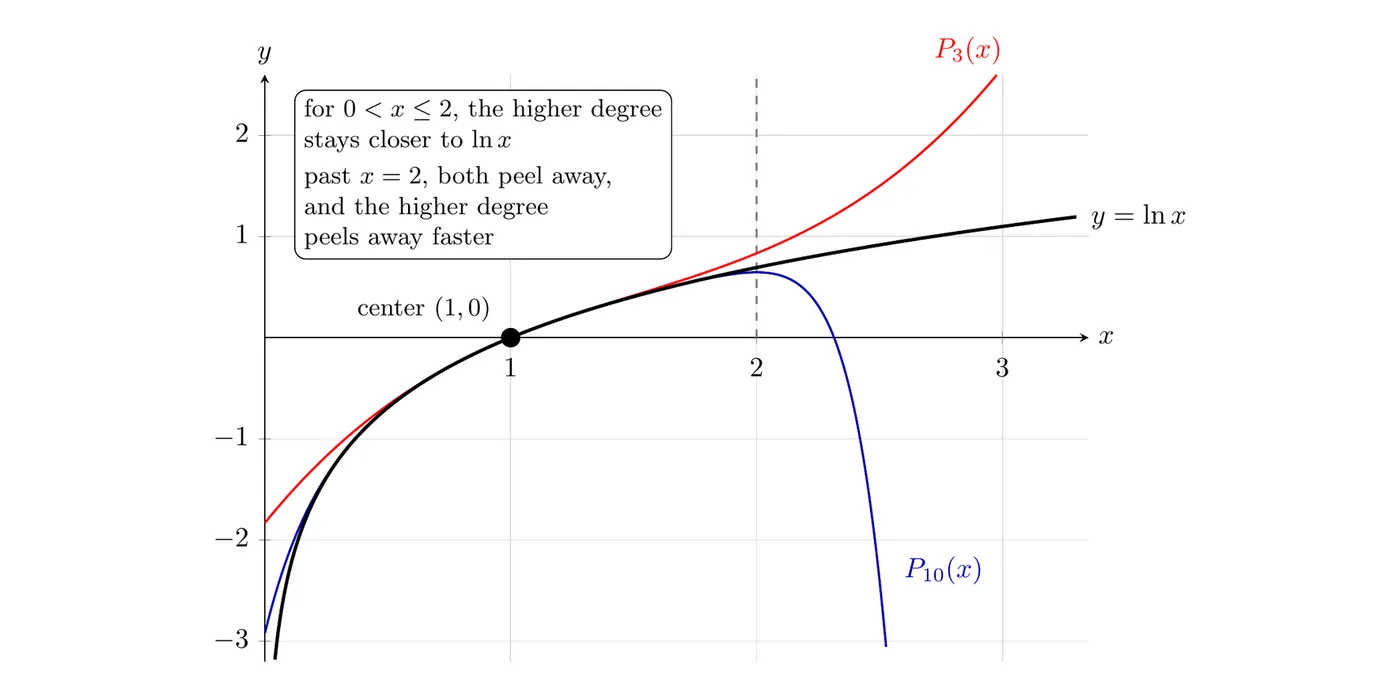
But only on some interval. For ex, the Taylor polynomials eventually close in on ex at every x, even far from the center. Not every function works that way. In many cases, as the degree goes up, Pn(x) approaches f(x) only for x in some interval around the center. Outside that interval, adding terms doesn’t help, and the values can swing farther and farther away.
Example:ln(x) centered at x=1, from Example 2. Its Taylor polynomials close in on ln(x) for 0<x≤2, but past x=2 they peel away. At x=3, where ln(3)≈1.099:
P1(3)=2,P2(3)=0,P3(3)≈2.667,P4(3)≈−1.333
The values swing farther from ln(3) each time instead of settling down.
That interval is the interval of convergence of the Taylor series, which you’ll learn to find in 10.13.
Step-by-Step Strategy
To find an nth-order Taylor polynomial for f(x) centered at c:
1. Write the template.
Maclaurin (c=0): use x terms
Taylor (c=0): use (x−c) terms
Include the factorials in the denominators
2. Calculate the derivatives. Find f(x),f′(x),f′′(x),…,f(n)(x) and list them clearly.
3. Evaluate at the center. Calculate f(c),f′(c),f′′(c),…,f(n)(c) and write the values in a column.
4. Substitute into the template. Plug in each evaluated derivative and keep the factorials for now.
5. Simplify if required. Free response often lets you leave it unsimplified, but multiple choice usually doesn’t.
Key Takeaways
Taylor polynomials approximate functions with polynomials, which are easier to work with
Centered at x=c means the approximation is best near that point
Maclaurin is Taylor at x=0, a special case with a simpler form
General formula:Pn(x)=∑k=0nk!f(k)(c)(x−c)k
Higher order means a better approximation. More terms follow the function more closely
Not everywhere, though. For functions like ln(x), more terms only help on an interval around x=c (the interval of convergence)
Factorials go in the denominators. Don’t forget the k! for the kth term
Powers of (x−c): raise the entire (x−c) to the power, not just the x
For the coefficient alone: it’s n!f(n)(c), without the (x−c)n part
Best near the center. Accuracy drops off as you move away from x=c
The most common mistakes are forgetting the factorial or using the wrong exponent
AP note: Maclaurin and Taylor approximation problems show up regularly
Simplification isn’t always required on free response, but usually is on multiple choice