

10.6 - Comparison Tests for Convergence
Introduction
Comparison tests let you figure out whether a complicated series converges by comparing it to a simpler series whose behavior you already know.
Use them when:
- The series looks nasty to integrate
- It isn’t geometric or a p-series
- You want to avoid ugly integration
Basic strategy: compare the unknown series to a known benchmark, usually a geometric series or a p-series.
The Direct Comparison Test (DCT)
Conditions: let and be series with positive terms, where for all .
Convergence rule: if the larger series converges, the smaller one does too.
Divergence rule: if the smaller series diverges, the larger one does too.
Visual Understanding
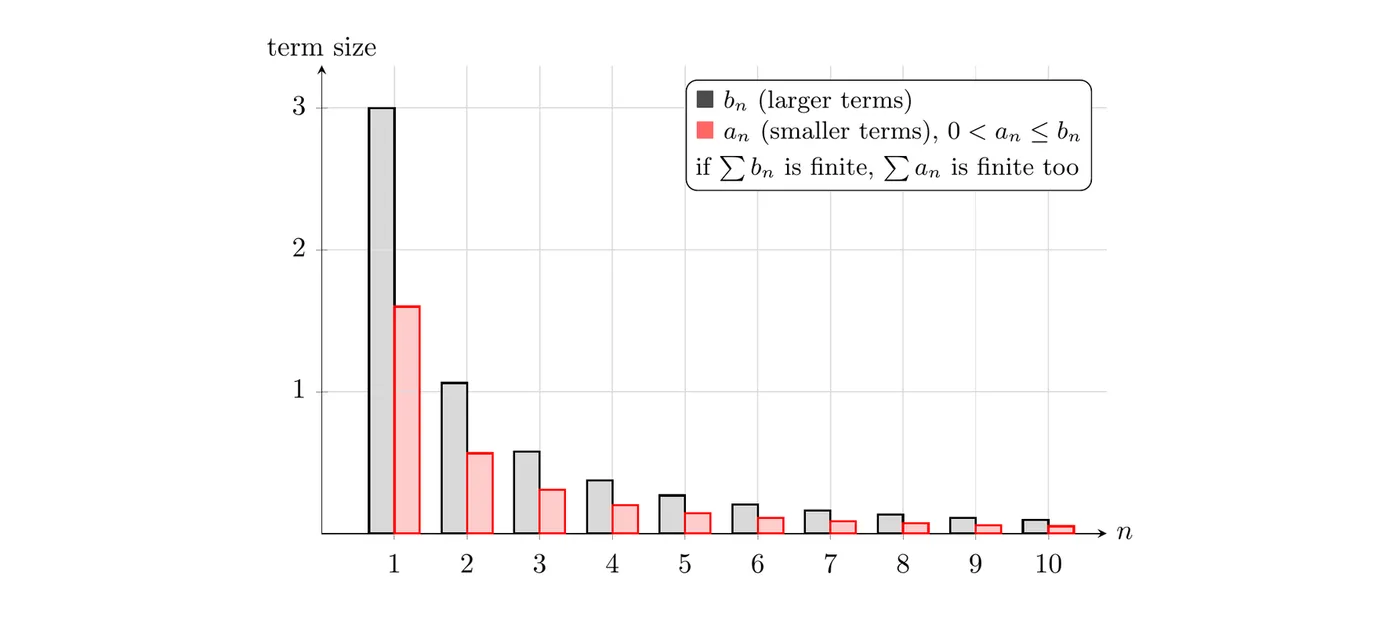
Intuition for convergence: if the bigger series adds up to something finite, the smaller series (squeezed underneath it) has to be finite too.
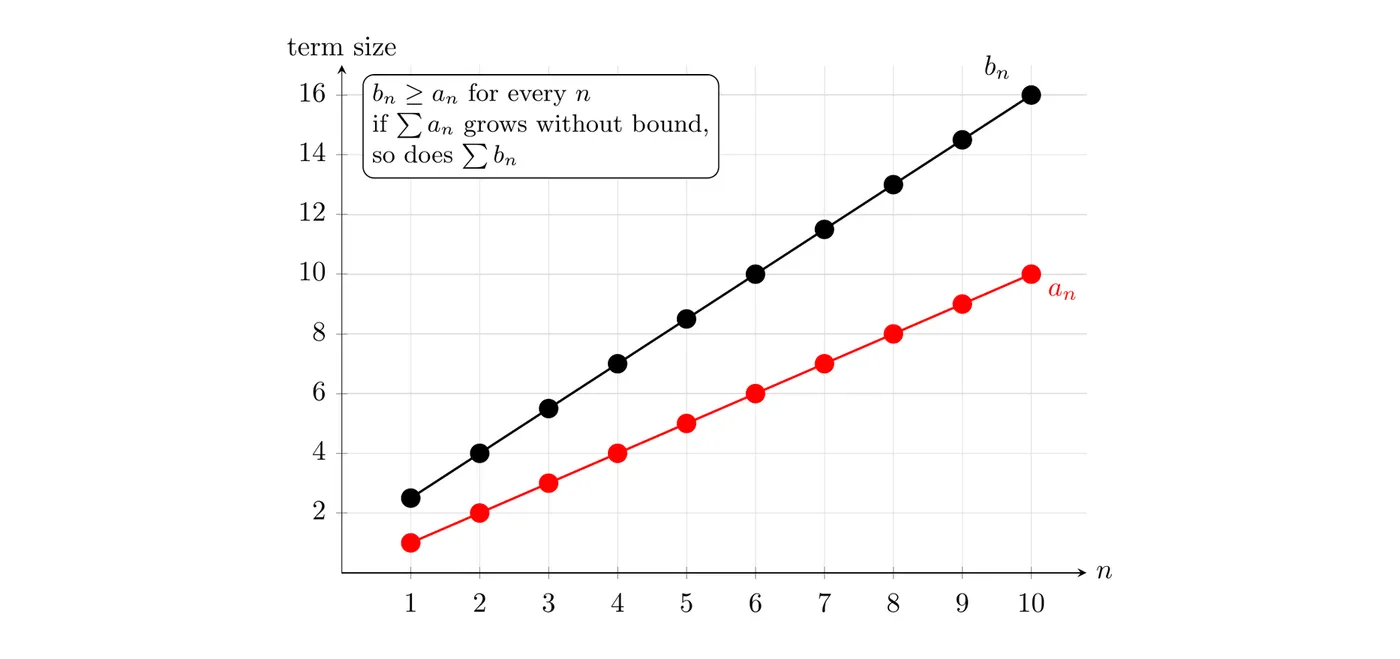
Intuition for divergence: if the smaller series blows up, the bigger series (which sits above it) has to blow up as well.
What to Compare To
Key principle: simplify by keeping only the dominant terms.
For large :
- Lower-order terms become negligible
- Constants don’t meaningfully affect the growth rate
- Focus on the highest power of in the numerator and denominator
Example: for , the dominant terms give:
Drop the constant and compare to , a p-series with , which converges.
Examples: Direct Comparison Test
Example 1: exponential comparison
Does converge or diverge?
Step 1: find a comparison series. For , , so:
Step 2: analyze the comparison series
Geometric with , and since , it converges.
Step 3: apply DCT. We have:
The larger series converges, so the smaller one converges by DCT.
Example 2: careful with the direction of the inequality
Does converge or diverge?
Attempt 1: compare to . For , , so:
We know converges, but our series is bigger than it. That tells us nothing. A smaller series converging says nothing about a larger one.
Attempt 2: find an upper bound instead. For :
so:
Now converges (geometric). Since:
the series converges by DCT.
What about the first two terms? At the term is , which is negative, and the inequality only starts at . That’s fine. DCT only needs from some point on, and the first two terms add a finite amount () that can’t change whether the series converges.
Example 3: using a p-series comparison
Does converge or diverge?
Step 1: identify the dominant behavior. For large :
Step 2: establish the inequality. For :
-
-
So:
Step 3: apply DCT. is a p-series with , so it converges. Since:
the series converges by DCT.
The Limit Comparison Test (LCT)
The LCT is usually easier, because you don’t have to figure out which series is bigger.
Let and be series with positive terms. If:
where is finite and positive (), then:
The big advantage: no inequality to establish.
Examples: Limit Comparison Test
Example 4: polynomial vs. p-series
Does converge or diverge?
Step 1: choose a comparison series. Keep the dominant terms:
Compare to , a p-series with , which converges.
Step 2: calculate the limit
Divide top and bottom by :
Step 3: apply LCT. Since is finite and positive, and converges, the original series converges by LCT.
Example 5: radical expression
Does converge or diverge?
Step 1: choose a comparison series
Compare to , a p-series with , which diverges.
Step 2: calculate the limit
Step 3: apply LCT. is finite and positive, and diverges, so the original series diverges by LCT.
Example 6: exponential vs. polynomial
Does converge or diverge?
Step 1: choose a comparison. Exponentials dominate polynomials, so for large , :
Compare to .
Step 2: confirm the comparison series converges. Note that for all , so:
And is geometric with , which converges. So converges by DCT. (You can also confirm this with the ratio test, coming up in 10.8.)
Step 3: calculate the limit
Divide by :
Step 4: apply LCT. is finite and positive, and converges, so the original series converges by LCT.
Example 7: fractional powers
Does converge or diverge?
Step 1: simplify and choose a comparison
Compare to , a p-series with , which diverges.
Step 2: calculate the limit
Step 3: apply LCT. is finite and positive, and diverges, so the original series diverges by LCT.
DCT vs. LCT
Feature | Direct Comparison Test | Limit Comparison Test |
Setup | Need (or the reverse) | Calculate |
Difficulty | Must establish an inequality | Just compute a limit |
When the larger converges | The smaller converges too | Both behave the same |
When the smaller diverges | The larger diverges too | Both behave the same |
Advantage | Direct logical connection | Don’t need the inequality direction |
Best for | Clear inequalities | Complicated expressions |
Strategy Guide
Step 1: identify the dominant behavior. Keep the highest power in the numerator and denominator, and drop the coefficients.
Step 2: choose a benchmark series.
- p-series:
- Geometric:
- Any other series you already know
Step 3: decide on a test.
- DCT if the inequality is easy to establish
- LCT if computing the limit is straightforward (usually the easier route)
Step 4: apply it.
- DCT: prove the inequality, then conclude
- LCT: compute the limit, check that , then conclude
Common Benchmarks
Geometric series: converges if . Use for exponential terms like or .
p-series: converges if , diverges if . Use for polynomial-like terms.
Harmonic series: diverges. Use for anything roughly like .
Key Takeaways
- Comparison tests: compare an unknown series to a known benchmark
- DCT requires an inequality: you have to show or
- DCT logic: larger converges → smaller converges; smaller diverges → larger diverges
- LCT uses limits: if is finite and positive, both series behave the same
- LCT advantage: you don’t need to know which series is bigger
- Dominant terms: focus on the highest powers when picking a comparison
- Drop constants: coefficients don’t affect convergence behavior for large
- Common benchmarks: p-series and geometric series
- p-series: converges if , diverges if
- Geometric: converges if , diverges if
- Both tests require positive terms throughout