

10.12 - Lagrange Error Bound
Introduction to Error Bounds
Last lesson we learned about Taylor polynomials, which are polynomial approximations of functions. Now we need to answer a follow-up question: how accurate is that approximation?
The Lagrange error bound tells us the maximum possible error when you use a Taylor polynomial to approximate a function.
Exact Value vs. Approximation
For any function and its Taylor polynomial approximation :
where:
- = the exact value
- = the Taylor polynomial approximation, of degree
- = the remainder, which is the error
Rearranging to find the remainder:
The error is the absolute value of the remainder:
The Lagrange Error Bound Formula
The Lagrange error bound, also called Taylor’s Remainder Theorem, says:
where:
- = the degree of the Taylor polynomial
- = the center of the Taylor polynomial
- = the point where we’re approximating
- = the maximum value of for between and
Full formula with the derivative written out:
Key idea: the error is bounded by the next term in the Taylor series, using the maximum value of the derivative on the interval.
Understanding the Variable
What is ?
is some unknown value between , the center, and , the point of approximation:
Why instead of ?
We don’t know the exact point where the derivative hits its maximum, so we look across the entire interval and take the largest value.
Important: we find over the interval , or if .
Step-by-Step Strategy
To find the Lagrange error bound:
- Identify the degree of the Taylor polynomial
- Find the derivative of
- Determine the interval for , which is between and
- Find the maximum of on that interval
- Calculate
- Interpret. That’s the maximum possible error
Example 1: Fourth-Degree Maclaurin Polynomial for Cosine
Use the fourth-degree Maclaurin polynomial to approximate , then find the Lagrange error bound.
Step 1: Identify the given information
- Function:
- Degree:
- Center: , since it’s a Maclaurin polynomial
- Approximating at:
Step 2: Find the approximation (not needed for the error bound, but useful)
Step 3: Find the derivative
We need the derivative:
Step 4: Determine the interval for
Step 5: Find the maximum of
Key shortcut for sine and cosine: since for all :
We use as an upper bound, even though is actually much less than 1.
doesn’t have to be the exact maximum. Any number that is at least as big as everywhere between and works. A bigger only makes the bound a little looser, and the bound is still true.
Step 6: Calculate the error bound
Interpretation:
The approximation is accurate to within . In other words, the actual value of differs from our approximation by at most .
Accuracy: you’d have to go out six decimal places before the digit might be off by 2 or 3 units. That’s an excellent approximation.
Example 2: Third-Degree Maclaurin for the Exponential
Use the third-degree Maclaurin polynomial to approximate , then find the Lagrange error bound.
Step 1: Find the Taylor polynomial for centered at
Since for every , and :
Step 2: Calculate the approximation at
Step 3: Find the derivative
Step 4: Determine the interval for
Step 5: Find the maximum of
Since is increasing, the maximum happens at :
Step 6: Calculate the error bound
Verification:
Actual error:
And sure enough, ✓
The actual error is less than the error bound, exactly as it should be.
Example 3: Finding the Minimum Degree for Required Accuracy
What is the smallest degree for a Taylor polynomial of centered at so that the error in approximating is less than ?
Step 1: Set up the error bound inequality
Step 2: Find the derivative
For , every derivative is the same:
Step 3: Determine the interval and find the maximum
Interval: . The maximum happens at :
Step 4: Set up the inequality
Step 5: Use a calculator to test values
Less than 1? | ||
1 | ✗ | |
2 | ✗ | |
3 | ✗ | |
4 | ✗ | |
5 | ✓ |
Answer: the minimum degree is , a fifth-order Taylor polynomial.
Special Shortcut: Sine and Cosine Functions
For anything involving or , all the derivatives are or .
Since and for every :
You can always use for sine and cosine derivatives, which simplifies things enormously.
Examples:
- If , then
- If , then
- If , then , by the triangle inequality
Calculator Tips for Testing Multiple Values
When you’re finding the minimum degree for a required error:
Method 1: Using the table feature
- Enter the formula in Y1:
Y1 = M*(X-C)^(N+1)/((N+1)!)
- Replace the variables with the values you know
- View the TABLE with
2nd→GRAPH
- Scroll to find where the value drops below your threshold
Method 2: Using the list feature
- Store the values in lists
- Calculate the error for each value
- Identify the first value that meets the criterion
Note: has to be a whole number, since it’s the degree of a polynomial. So don’t solve algebraically for decimal values.
Common Patterns and Shortcuts
Exponential Functions
For , all the derivatives are .
The maximum on happens at whichever endpoint makes largest.
Polynomials
Taylor polynomials of degree for polynomials of degree are exact.
Error bound: , meaning no error at all.
Logarithmic Functions
For :
The maximum depends on the interval and on the sign of .
Important Notes
Why Use the Maximum?
The derivative varies across the interval . To guarantee our error bound holds for any point in that interval, we use the maximum value.
Actual Error vs. Error Bound
The error bound is usually an overestimate, so the actual error tends to be smaller.
Increasing Accuracy
To reduce the error:
- Increase the degree , meaning use more terms
- Approximate closer to the center, meaning a smaller
- Choose a better center, one where the derivatives are smaller
Free Response vs. Multiple Choice
Free response: often just asks you to set up the error bound formula, not compute it all the way out.
Multiple choice: usually wants a numerical answer.
Visual Understanding of the Error Bound
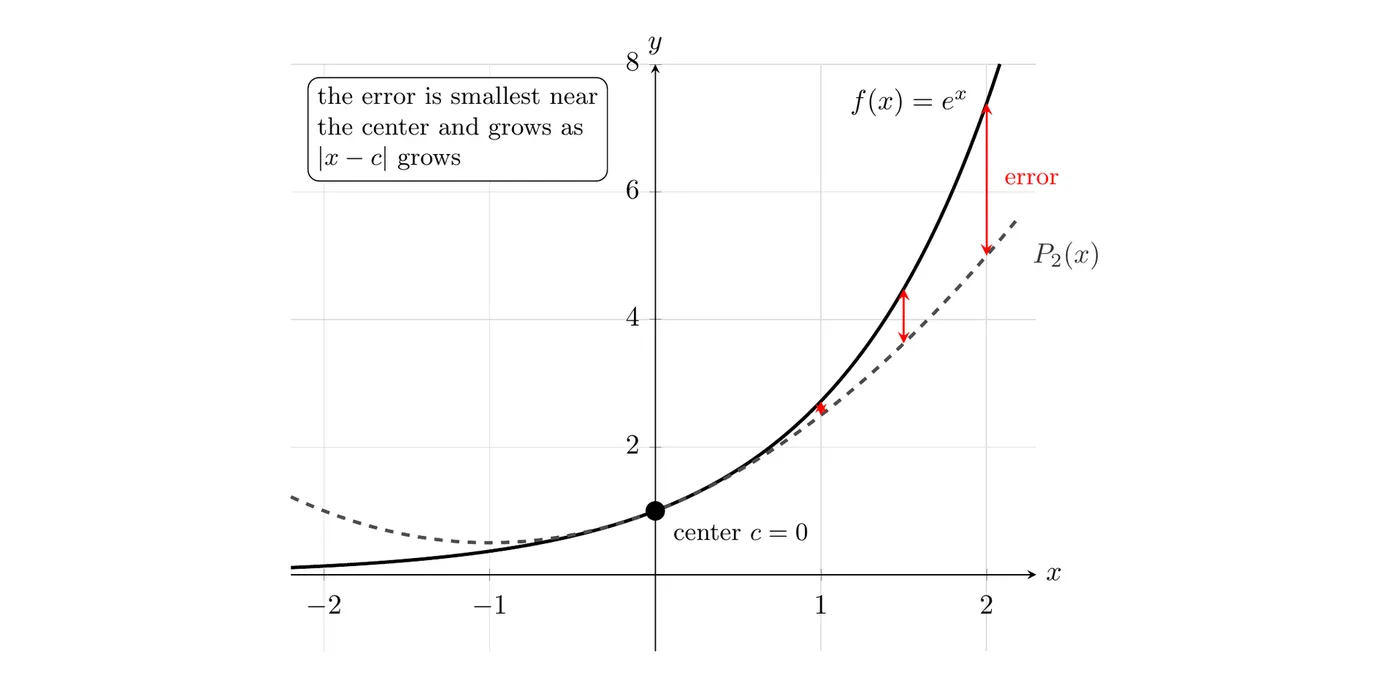
Key insight: the error is smallest near the center and grows as you move away from it.
Relationship to the Alternating Series Error Bound
For alternating series, which we covered earlier, the error bound is the magnitude of the next term.
For general Taylor polynomials (Lagrange), the error bound is the magnitude of the next term evaluated at the maximum over the interval.
Both use the same underlying principle: the next term bounds the error.
Using the Alternating Series Error Bound for a Taylor Polynomial
Sometimes you can skip Lagrange. If the Taylor series, with your value plugged in, is an alternating series whose terms keep getting smaller and approach 0 (the AST conditions from 10.7), then the error of the Taylor polynomial is at most the size of the first term you left out.
Example 4: Bound the error of for from Example 1, this time with the alternating series error bound.
Step 1: Put into the cosine series
Step 2: Check the conditions. The signs alternate, each term is smaller than the one before it, and the terms approach 0.
Step 3: Find the first term left out. stops at the term, so the next term is the term:
That’s much smaller than the Lagrange bound of from Example 1. Both bounds are correct. The cosine series has no term, so the first term left out is the term, which is tiny. Use whichever bound the question asks for.
When it doesn’t apply: for at (Example 2), every term of is positive, so the series isn’t alternating. Use the Lagrange error bound there.
Summary Table
Component | Meaning | How to Find It |
Degree of the polynomial | Given in the problem | |
Center | Given (Maclaurin means ) | |
Point of approximation | Given in the problem | |
The next derivative | Calculate the derivatives | |
Maximum of | Evaluate on and take the max | |
Distance to a power | Simple calculation | |
Factorial | Calculate it, or use a calculator |
Key Takeaways
- Lagrange error bound:
- is the maximum of on the interval between and
- is unknown, somewhere between the center and the approximation point
- Sine and cosine shortcut: always use for or derivatives
- The error bound is the maximum possible error. The actual error is usually smaller
- Higher degree means smaller error. More terms give a better approximation
- Closer to the center means smaller error, since the term shrinks
- Factorials grow fast. The in the denominator cuts the error down significantly
- Use a calculator to test multiple values when you’re finding the minimum degree
- Actual error error bound. The bound is typically an overestimate
- The formula is not given on the AP exam. There’s no formula sheet for AP Calculus, so memorize it and focus on applying it
- Common problem type: finding the minimum for a required accuracy