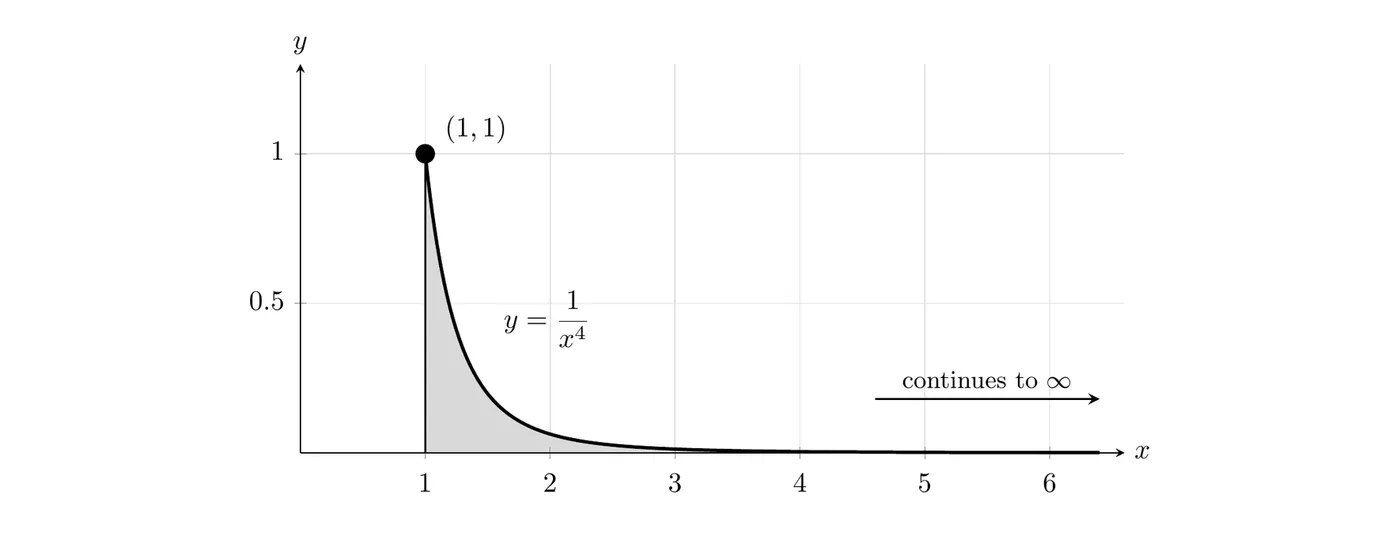
What is an Improper Integral? An integral is improper when either:
One or both limits of integration are infinite (± ∞ \pm\infty ± ∞ The integrand has an infinite discontinuity (a vertical asymptote) inside the interval Examples:
∫ 1 ∞ 1 x 2 d x \int_1^\infty \frac{1}{x^2} \, dx ∫ 1 ∞ x 2 1 d x ∫ − ∞ 5 e x d x \int_{-\infty}^5 e^x \, dx ∫ − ∞ 5 e x d x ∫ − 1 1 1 x d x \int_{-1}^1 \frac{1}{x} \, dx ∫ − 1 1 x 1 d x x = 0 x = 0 x = 0 Key question: can we find the area under a curve that stretches to infinity or has a vertical asymptote?
Answer: sometimes yes (it converges) and sometimes no (it diverges).
Type 1: Infinite Limits of Integration Upper Limit is Infinity ∫ a ∞ f ( x ) d x = lim t → ∞ ∫ a t f ( x ) d x \boxed{\int_a^\infty f(x) \, dx = \lim_{t \to \infty} \int_a^t f(x) \, dx} ∫ a ∞ f ( x ) d x = t → ∞ lim ∫ a t f ( x ) d x Strategy: replace
∞ \infty ∞ with a variable
t t t , then take the limit as
t → ∞ t \to \infty t → ∞ .
Lower Limit is Infinity ∫ − ∞ b f ( x ) d x = lim t → − ∞ ∫ t b f ( x ) d x \boxed{\int_{-\infty}^b f(x) \, dx = \lim_{t \to -\infty} \int_t^b f(x) \, dx} ∫ − ∞ b f ( x ) d x = t → − ∞ lim ∫ t b f ( x ) d x Strategy: replace
− ∞ -\infty − ∞ with a variable
t t t , then take the limit as
t → − ∞ t \to -\infty t → − ∞ .
Important: these only work if the limits actually exist.
Convergence vs. Divergence Converges
The integral approaches a specific finite number
lim = L \lim = L lim = L (finite)
Diverges
The integral doesn’t approach a finite number
lim = ± ∞ \lim = \pm\infty lim = ± ∞ or DNE
Example 1: A Convergent Improper Integral Evaluate
∫ 1 ∞ 1 x 4 d x \int_1^\infty \dfrac{1}{x^4} \, dx ∫ 1 ∞ x 4 1 d x .
Step 1: Set it up with a limit.
∫ 1 ∞ 1 x 4 d x = lim t → ∞ ∫ 1 t x − 4 d x \int_1^\infty \frac{1}{x^4} \, dx = \lim_{t \to \infty} \int_1^t x^{-4} \, dx ∫ 1 ∞ x 4 1 d x = t → ∞ lim ∫ 1 t x − 4 d x Step 2: Integrate.
= lim t → ∞ [ x − 3 − 3 ] 1 t = lim t → ∞ [ − 1 3 x 3 ] 1 t = \lim_{t \to \infty} \left[\frac{x^{-3}}{-3}\right]_1^t = \lim_{t \to \infty} \left[-\frac{1}{3x^3}\right]_1^t = t → ∞ lim [ − 3 x − 3 ] 1 t = t → ∞ lim [ − 3 x 3 1 ] 1 t Step 3: Evaluate at the bounds.
= lim t → ∞ [ − 1 3 t 3 − ( − 1 3 ( 1 ) 3 ) ] = lim t → ∞ [ − 1 3 t 3 + 1 3 ] = \lim_{t \to \infty} \left[-\frac{1}{3t^3} - \left(-\frac{1}{3(1)^3}\right)\right] = \lim_{t \to \infty} \left[-\frac{1}{3t^3} + \frac{1}{3}\right] = t → ∞ lim [ − 3 t 3 1 − ( − 3 ( 1 ) 3 1 ) ] = t → ∞ lim [ − 3 t 3 1 + 3 1 ] Step 4: Take the limit. As
t → ∞ t \to \infty t → ∞ ,
1 3 t 3 → 0 \frac{1}{3t^3} \to 0 3 t 3 1 → 0 , so
= 0 + 1 3 = 1 3 = 0 + \frac{1}{3} = \frac{1}{3} = 0 + 3 1 = 3 1 Conclusion: the integral
converges to 1 3 \frac{1}{3} 3 1 .
Example 2: A Divergent Improper Integral Evaluate
∫ 1 ∞ 1 x d x \int_1^\infty \dfrac{1}{x} \, dx ∫ 1 ∞ x 1 d x .
Step 1: Set it up.
∫ 1 ∞ 1 x d x = lim t → ∞ ∫ 1 t 1 x d x \int_1^\infty \frac{1}{x} \, dx = \lim_{t \to \infty} \int_1^t \frac{1}{x} \, dx ∫ 1 ∞ x 1 d x = t → ∞ lim ∫ 1 t x 1 d x Step 2: Integrate.
= lim t → ∞ [ ln ∣ x ∣ ] 1 t = \lim_{t \to \infty} \left[\ln|x|\right]_1^t = t → ∞ lim [ ln ∣ x ∣ ] 1 t Step 3: Evaluate.
= lim t → ∞ [ ln ( t ) − ln ( 1 ) ] = lim t → ∞ ln ( t ) = \lim_{t \to \infty} [\ln(t) - \ln(1)] = \lim_{t \to \infty} \ln(t) = t → ∞ lim [ ln ( t ) − ln ( 1 )] = t → ∞ lim ln ( t ) Step 4: Take the limit. As
t → ∞ t \to \infty t → ∞ ,
ln ( t ) → ∞ \ln(t) \to \infty ln ( t ) → ∞ .
Conclusion: the integral diverges , since the limit doesn’t exist.
Important Pattern: The p-Test For integrals of the form
∫ 1 ∞ 1 x p d x \int_1^\infty \frac{1}{x^p} \, dx ∫ 1 ∞ x p 1 d x :
∫ 1 ∞ 1 x p d x { converges if p > 1 diverges if p ≤ 1 \boxed{\int_1^\infty \frac{1}{x^p} \, dx \begin{cases} \text{converges} & \text{if } p > 1 \\ \text{diverges} & \text{if } p \leq 1 \end{cases}} ∫ 1 ∞ x p 1 d x { converges diverges if p > 1 if p ≤ 1 Examples:
∫ 1 ∞ 1 x 4 d x \int_1^\infty \frac{1}{x^4} \, dx ∫ 1 ∞ x 4 1 d x p = 4 > 1 p = 4 > 1 p = 4 > 1 ∫ 1 ∞ 1 x d x \int_1^\infty \frac{1}{x} \, dx ∫ 1 ∞ x 1 d x p = 1 p = 1 p = 1 ∫ 1 ∞ 1 x d x \int_1^\infty \frac{1}{\sqrt{x}} \, dx ∫ 1 ∞ x 1 d x p = 1 2 < 1 p = \frac{1}{2} < 1 p = 2 1 < 1 Note: this pattern shows up constantly in Unit 10 (Series).
Type 2: Both Limits Infinite When both limits are infinite,
split the integral at any point c c c (usually
c = 0 c = 0 c = 0 ):
∫ − ∞ ∞ f ( x ) d x = ∫ − ∞ c f ( x ) d x + ∫ c ∞ f ( x ) d x \boxed{\int_{-\infty}^\infty f(x) \, dx = \int_{-\infty}^c f(x) \, dx + \int_c^\infty f(x) \, dx} ∫ − ∞ ∞ f ( x ) d x = ∫ − ∞ c f ( x ) d x + ∫ c ∞ f ( x ) d x Critical rule: if either piece diverges, the entire integral diverges.
Example: ∫ − ∞ ∞ e x d x \int_{-\infty}^\infty e^x \, dx ∫ − ∞ ∞ e x d x ∫ − ∞ ∞ e x d x = ∫ − ∞ 0 e x d x + ∫ 0 ∞ e x d x \int_{-\infty}^\infty e^x \, dx = \int_{-\infty}^0 e^x \, dx + \int_0^\infty e^x \, dx ∫ − ∞ ∞ e x d x = ∫ − ∞ 0 e x d x + ∫ 0 ∞ e x d x First integral:
∫ − ∞ 0 e x d x = lim t → − ∞ ∫ t 0 e x d x = lim t → − ∞ [ e x ] t 0 \int_{-\infty}^0 e^x \, dx = \lim_{t \to -\infty} \int_t^0 e^x \, dx = \lim_{t \to -\infty} [e^x]_t^0 ∫ − ∞ 0 e x d x = t → − ∞ lim ∫ t 0 e x d x = t → − ∞ lim [ e x ] t 0 = lim t → − ∞ [ e 0 − e t ] = 1 − 0 = 1 (converges) = \lim_{t \to -\infty} [e^0 - e^t] = 1 - 0 = 1 \quad \text{(converges)} = t → − ∞ lim [ e 0 − e t ] = 1 − 0 = 1 (converges) Second integral:
∫ 0 ∞ e x d x = lim t → ∞ ∫ 0 t e x d x = lim t → ∞ [ e x ] 0 t \int_0^\infty e^x \, dx = \lim_{t \to \infty} \int_0^t e^x \, dx = \lim_{t \to \infty} [e^x]_0^t ∫ 0 ∞ e x d x = t → ∞ lim ∫ 0 t e x d x = t → ∞ lim [ e x ] 0 t = lim t → ∞ [ e t − e 0 ] = ∞ (diverges) = \lim_{t \to \infty} [e^t - e^0] = \infty \quad \text{(diverges)} = t → ∞ lim [ e t − e 0 ] = ∞ (diverges) Conclusion: since the second integral diverges, the entire integral diverges .
Type 3: Infinite Discontinuity at an Endpoint Discontinuity at the Upper Limit If
f ( x ) f(x) f ( x ) is continuous on
[ a , b ) [a, b) [ a , b ) but has an infinite discontinuity at
x = b x = b x = b :
∫ a b f ( x ) d x = lim t → b − ∫ a t f ( x ) d x \boxed{\int_a^b f(x) \, dx = \lim_{t \to b^-} \int_a^t f(x) \, dx} ∫ a b f ( x ) d x = t → b − lim ∫ a t f ( x ) d x Approach
b b b from the left (
b − b^- b − ).
Discontinuity at the Lower Limit If
f ( x ) f(x) f ( x ) is continuous on
( a , b ] (a, b] ( a , b ] but has an infinite discontinuity at
x = a x = a x = a :
∫ a b f ( x ) d x = lim t → a + ∫ t b f ( x ) d x \boxed{\int_a^b f(x) \, dx = \lim_{t \to a^+} \int_t^b f(x) \, dx} ∫ a b f ( x ) d x = t → a + lim ∫ t b f ( x ) d x Approach
a a a from the right (
a + a^+ a + ).
Example: ∫ 0 2 x + 2 x 2 + 4 x d x \int_0^2 \dfrac{x+2}{\sqrt{x^2+4x}} \, dx ∫ 0 2 x 2 + 4 x x + 2 d x Check for discontinuities. Factor the denominator:
x ( x + 4 ) \sqrt{x(x+4)} x ( x + 4 ) .
Discontinuities at
x = 0 x = 0 x = 0 and
x = − 4 x = -4 x = − 4 . Only
x = 0 x = 0 x = 0 is in
[ 0 , 2 ] [0, 2] [ 0 , 2 ] , and it sits at the
lower limit .
Step 1: Set it up with a limit.
∫ 0 2 x + 2 x 2 + 4 x d x = lim t → 0 + ∫ t 2 x + 2 x 2 + 4 x d x \int_0^2 \frac{x+2}{\sqrt{x^2+4x}} \, dx = \lim_{t \to 0^+} \int_t^2 \frac{x+2}{\sqrt{x^2+4x}} \, dx ∫ 0 2 x 2 + 4 x x + 2 d x = t → 0 + lim ∫ t 2 x 2 + 4 x x + 2 d x Step 2: U-substitution.
u = x 2 + 4 x , d u = ( 2 x + 4 ) d x = 2 ( x + 2 ) d x , d x = d u 2 ( x + 2 ) u = x^2 + 4x, \quad du = (2x + 4) \, dx = 2(x+2) \, dx, \quad dx = \frac{du}{2(x+2)} u = x 2 + 4 x , d u = ( 2 x + 4 ) d x = 2 ( x + 2 ) d x , d x = 2 ( x + 2 ) d u Step 3: Substitute.
∫ x + 2 u ⋅ d u 2 ( x + 2 ) = ∫ 1 2 u d u = ∫ 1 2 u − 1 / 2 d u \int \frac{x+2}{\sqrt{u}} \cdot \frac{du}{2(x+2)} = \int \frac{1}{2\sqrt{u}} \, du = \int \frac{1}{2}u^{-1/2} \, du ∫ u x + 2 ⋅ 2 ( x + 2 ) d u = ∫ 2 u 1 d u = ∫ 2 1 u − 1/2 d u Step 4: Change the bounds.
When
x = t x = t x = t :
u = t 2 + 4 t u = t^2 + 4t u = t 2 + 4 t When
x = 2 x = 2 x = 2 :
u = 4 + 8 = 12 u = 4 + 8 = 12 u = 4 + 8 = 12 Step 5: Integrate.
= lim t → 0 + [ 1 2 ⋅ u 1 / 2 1 / 2 ] t 2 + 4 t 12 = lim t → 0 + [ u ] t 2 + 4 t 12 = \lim_{t \to 0^+} \left[\frac{1}{2} \cdot \frac{u^{1/2}}{1/2}\right]_{t^2+4t}^{12} = \lim_{t \to 0^+} \left[\sqrt{u}\right]_{t^2+4t}^{12} = t → 0 + lim [ 2 1 ⋅ 1/2 u 1/2 ] t 2 + 4 t 12 = t → 0 + lim [ u ] t 2 + 4 t 12 = lim t → 0 + [ 12 − t 2 + 4 t ] = \lim_{t \to 0^+} \left[\sqrt{12} - \sqrt{t^2+4t}\right] = t → 0 + lim [ 12 − t 2 + 4 t ] Step 6: Take the limit. As
t → 0 + t \to 0^+ t → 0 + ,
t 2 + 4 t → 0 t^2 + 4t \to 0 t 2 + 4 t → 0 , so
= 12 − 0 = 2 3 = \sqrt{12} - 0 = 2\sqrt{3} = 12 − 0 = 2 3 Conclusion: it converges to
2 3 2\sqrt{3} 2 3 .
Type 4: Discontinuity Inside the Interval If
f ( x ) f(x) f ( x ) has an infinite discontinuity at
x = c x = c x = c where
a < c < b a < c < b a < c < b ,
split the integral :
∫ a b f ( x ) d x = ∫ a c f ( x ) d x + ∫ c b f ( x ) d x \boxed{\int_a^b f(x) \, dx = \int_a^c f(x) \, dx + \int_c^b f(x) \, dx} ∫ a b f ( x ) d x = ∫ a c f ( x ) d x + ∫ c b f ( x ) d x Then handle each piece with a limit:
= lim t → c − ∫ a t f ( x ) d x + lim t → c + ∫ t b f ( x ) d x = \lim_{t \to c^-} \int_a^t f(x) \, dx + \lim_{t \to c^+} \int_t^b f(x) \, dx = t → c − lim ∫ a t f ( x ) d x + t → c + lim ∫ t b f ( x ) d x Critical: if either limit diverges, the whole integral diverges .
Example: ∫ − 1 1 1 x d x \int_{-1}^1 \dfrac{1}{x} \, dx ∫ − 1 1 x 1 d x There’s a discontinuity at
x = 0 x = 0 x = 0 , which is inside the interval.
Split at the discontinuity:
∫ − 1 1 1 x d x = ∫ − 1 0 1 x d x + ∫ 0 1 1 x d x \int_{-1}^1 \frac{1}{x} \, dx = \int_{-1}^0 \frac{1}{x} \, dx + \int_0^1 \frac{1}{x} \, dx ∫ − 1 1 x 1 d x = ∫ − 1 0 x 1 d x + ∫ 0 1 x 1 d x Set up the limits:
= lim t → 0 − ∫ − 1 t 1 x d x + lim t → 0 + ∫ t 1 1 x d x = \lim_{t \to 0^-} \int_{-1}^t \frac{1}{x} \, dx + \lim_{t \to 0^+} \int_t^1 \frac{1}{x} \, dx = t → 0 − lim ∫ − 1 t x 1 d x + t → 0 + lim ∫ t 1 x 1 d x Evaluate the first integral:
= lim t → 0 − [ ln ∣ x ∣ ] − 1 t = lim t → 0 − [ ln ∣ t ∣ − ln ( 1 ) ] = \lim_{t \to 0^-} [\ln|x|]_{-1}^t = \lim_{t \to 0^-} [\ln|t| - \ln(1)] = t → 0 − lim [ ln ∣ x ∣ ] − 1 t = t → 0 − lim [ ln ∣ t ∣ − ln ( 1 )] As
t → 0 − t \to 0^- t → 0 − ,
ln ∣ t ∣ → − ∞ \ln|t| \to -\infty ln ∣ t ∣ → − ∞ , so this
diverges .
Conclusion: since the first integral diverges, the entire integral diverges . You don’t even need to check the second one, because one diverging piece is enough.
Key Takeaways Improper integrals involve ± ∞ \pm\infty ± ∞ Use limits. Replace the infinity or the discontinuity with a variable, then take the appropriate limitConverges: the limit exists and equals a finite numberDiverges: the limit is ± ∞ \pm\infty ± ∞ p-Test: ∫ 1 ∞ 1 x p d x \int_1^\infty \frac{1}{x^p} \, dx ∫ 1 ∞ x p 1 d x p > 1 p > 1 p > 1 p ≤ 1 p \leq 1 p ≤ 1 Split when needed. Two infinite limits, or a discontinuity inside the interval, means splittingOne piece diverges, everything diverges. If any piece of a split integral diverges, the whole thing doesCheck for discontinuities. Always look for vertical asymptotes in the intervalDirection matters. Use lim t → c − \lim_{t \to c^-} lim t → c − lim t → c + \lim_{t \to c^+} lim t → c + U-substitution still works and can be combined with improper integral techniquesJustification is required. You have to show the limit evaluation, not just the final answerBC only. Not tested on the AB exam