

6.4 - The Fundamental Theorem of Calculus and Accumulation Functions
Review: The Definite Integral
The definite integral is the area under the curve on a specific interval:
- is the lower limit (a constant)
- is the upper limit (a constant)
- The result is a number, the total area
Accumulation Functions
An accumulation function has a variable as its upper limit:
Key points:
- The lower limit is a constant
- The upper limit is a variable
- We use a different variable () inside to avoid confusion
- is a function that depends on where we stop
- As changes, the area accumulates
Why different variables? Because is already being used as the upper limit. The is a “dummy variable,” and it could be any letter except .
Example: Building an Accumulation Function
Given a piecewise linear function on :
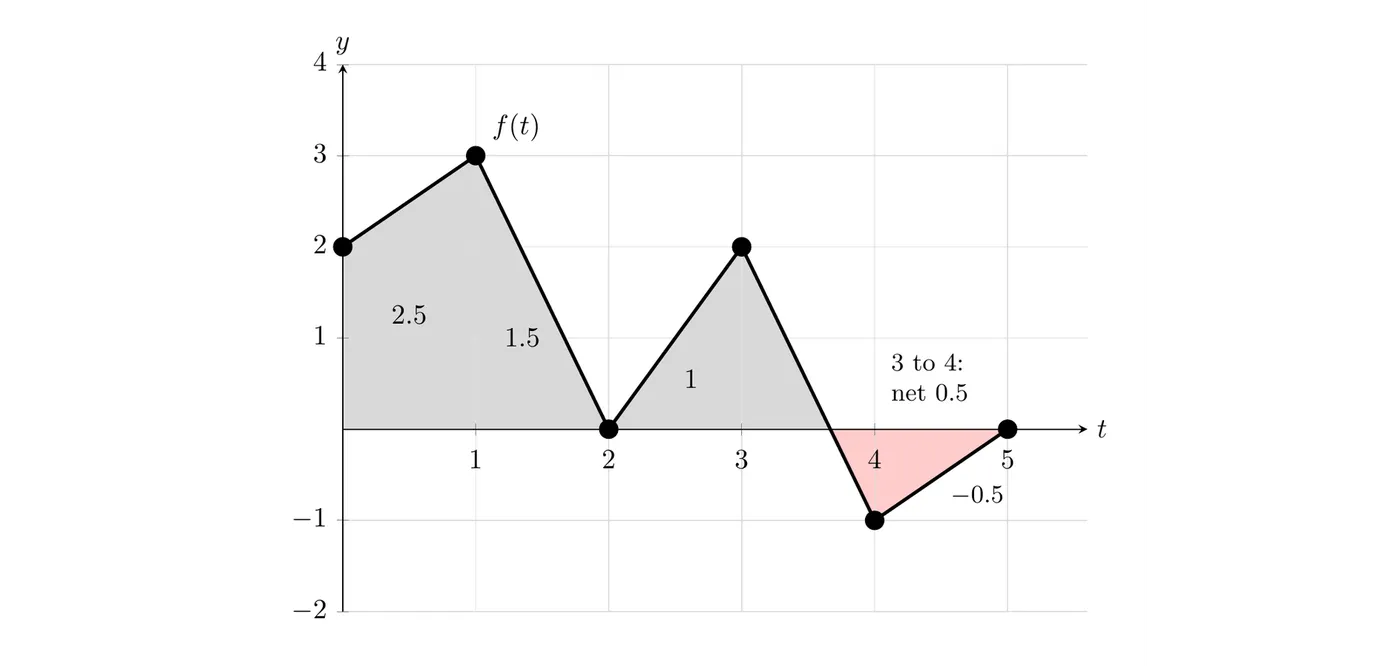
Define and accumulate the area:
Calculation | ||
0 | 0 | No area from 0 to 0 |
1 | 2.5 | Area from 0 to 1 |
2 | 4 | Previous (2.5) + new area (1.5) |
3 | 5 | Previous (4) + new area (1) |
4 | 5.5 | Previous (5) + new area (0.5) |
5 | 5 | Previous (5.5) − area below the axis (0.5) |
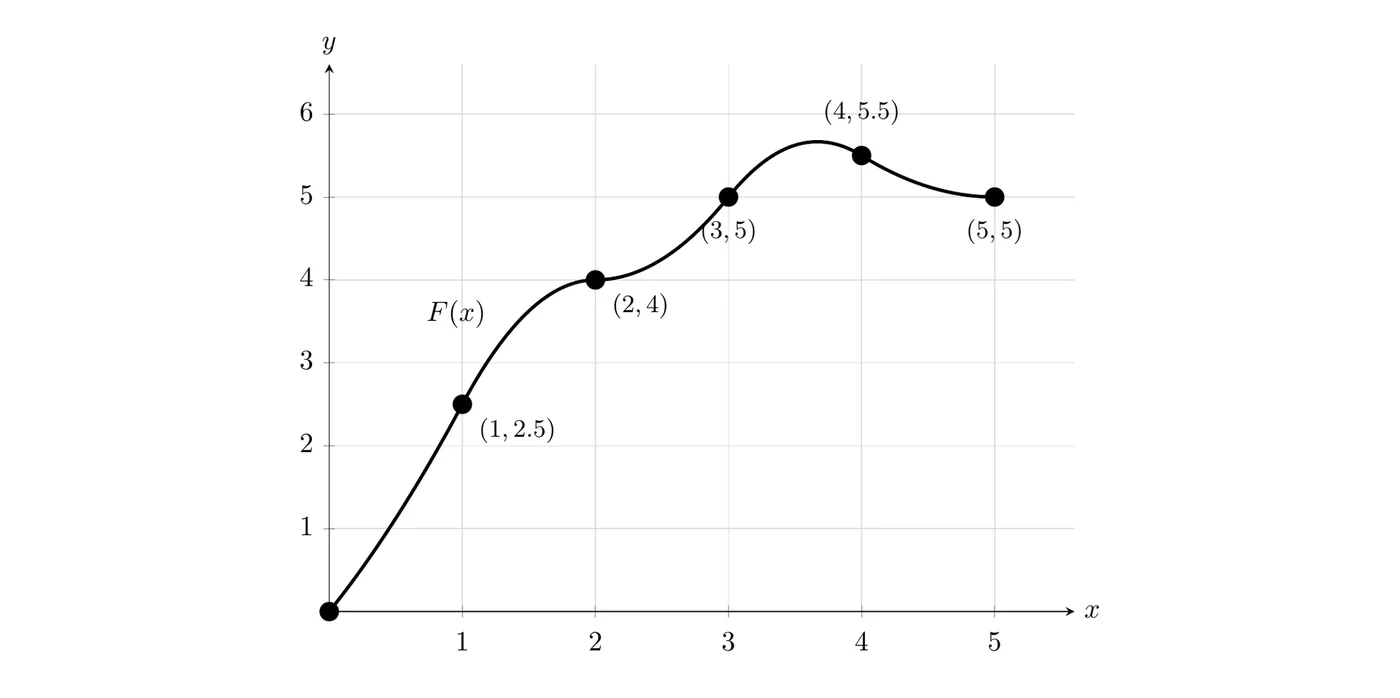
shows the total accumulated area from to .
Integrals can define new functions. Some functions can’t be written with powers, roots, trig, exponentials, or logs at all. For example:
There’s no algebra formula for , but it’s still a perfectly good function. Every gives one value (the net area from 0 to ), so you can graph it, evaluate it with a calculator, and find its derivative with the theorem below: .
The Fundamental Theorem of Calculus (Part 2)
In words: the derivative of an integral gives you back the original function.
Condition: this works when is continuous on an interval that contains , for any in that interval.
The big idea here is that derivatives and integrals are inverse operations. They undo each other, the same way division undoes multiplication.
Terminology
If , then:
- is an antiderivative of
- is the integrand (what’s inside the integral)
- Integral of = antiderivative =
- Derivative of = original function =
Applying the Theorem
Basic case: constant lower limit
Given , find .
Just plug in for :
Steps:
1. Recognize the constant lower limit (2)
2. Variable upper limit ()
3. Replace with in the integrand
4. Done
With the chain rule: upper limit is a function
Given :
Steps:
1. Plug in for in the integrand
2. Multiply by the derivative of
Example 1
Given , find .
Example 2
Given , find .
Notice we never needed to know what actually is. Just plug in and apply the chain rule.
Both Limits Are Functions
Given :
Steps:
1. Upper limit: plug in , multiply by
2. Subtract
3. Lower limit: plug in , multiply by
Mnemonic: “top minus bottom.”
Example 3
Given , find .
Upper limit contribution:
Lower limit contribution:
Combine (top minus bottom):
Why zero? The integral is symmetric about the origin, so the accumulated value never changes.
Example 4
Given , find .
Upper limit ():
- Plug in:
- Chain rule: multiply by 3
- Result:
Lower limit ():
- Plug in:
- Chain rule: multiply by 2
- Result:
Subtract lower from upper:
Summary of Cases
Type | Formula | Notes |
Constant lower, variable upper | Just plug in | |
Constant lower, function upper | Use the chain rule | |
Both variable | Top minus bottom |
Common Mistakes to Avoid
- Forgetting the chain rule when the upper or lower limit isn’t just
- Using the same variable inside and outside. Don’t write ; use a different variable inside
- Sign error with the lower limit. You SUBTRACT the lower limit contribution, you don’t add it
- Not applying the derivative to the limits. You have to multiply by or
Key Takeaways
- Accumulation function: accumulates area as varies
- FTC Part 2: , so the derivative undoes the integral
- Antiderivative: the integral of gives an antiderivative where
- Basic case: constant lower limit means you just plug in the upper limit
- Chain rule: when the upper limit is , multiply by
- Both limits variable: top contribution MINUS bottom contribution
- Different variables: use (or another letter) inside the integral, save for the limit
- Derivatives and integrals are inverses: they cancel each other out
- This theorem is genuinely fundamental. It’s the bridge between differentiation and integration