

4.2 - Net Ionic Equations
Overview
A chemical equation is chemistry's shorthand. It tells you which substances react, what they make, and in what amounts. This topic covers how to balance equations, how to write them for physical changes too, and the three ways to write a reaction that happens in water: molecular, complete ionic, and net ionic. Writing a correct net ionic equation is one of the most common tasks on the AP Chemistry free-response section.
Reading a chemical equation
- Reactants are on the left and products are on the right. The arrow means "react to form."
- Coefficients, the numbers in front, count particles: 2 molecules of react with 1 molecule of . They count moles too (Topic 4.5). A coefficient of 1 isn't written.
- Subscripts are part of each formula and tell you what the substance is. means two water molecules, but is hydrogen peroxide, a different substance. Never change a subscript to balance an equation.
- Phase labels: (s) solid, (l) liquid, (g) gas, and (aq) aqueous, meaning dissolved in water.
Every change can be written as a balanced equation
All physical and chemical processes can be represented by balanced equations. That covers three situations:
- Physical changes. The formula stays the same and only the phase changes, as in . Dissolving counts too: for glucose, and for an ionic solid, which breaks up into its ions.
- Reactions described in words. "Solid sodium reacts with chlorine gas to form solid sodium chloride" becomes . Write correct formulas first, and remember the seven diatomic elements: , , , , , , and .
- Ions in solution. Reactions between dissolved ions are written as ionic and net ionic equations, covered below.
Balanced means atoms and charge are conserved
A chemical change is a rearrangement of atoms into new combinations. No atom is created or destroyed, so a balanced equation has the same number of atoms of each element on both sides. Atoms keep their mass, so this is also why mass is conserved: the total mass of the reactants equals the total mass of the products.
Charge is conserved too. Add up the charges of all the ions on each side (coefficient times charge). The two totals must match. In a molecular equation every species is neutral, so this check is automatic, but in ionic equations it catches a lot of mistakes.
How to balance by inspection
- Write the correct formula for every reactant and product. From here on, only coefficients change.
- Start with an element that appears in just one reactant and one product.
- Treat a polyatomic ion that stays intact on both sides, like or , as a single unit.
- Save elements that appear by themselves, like or , for last. Changing their coefficient doesn't disturb anything else.
- Reduce to the smallest whole-number coefficients, then check every element and the total charge.
Example 1: Balancing a combustion reaction
Balance the combustion of propane:
Carbon: there are 3 C on the left, so put a 3 in front of .
Hydrogen: there are 8 H on the left, so put a 4 in front of .
Oxygen: the right side now has O atoms, so put a 5 in front of .
Element | Left side | Right side |
C | 3 | 3 |
H | 8 | |
O |
Example 2: Clearing a fraction
Balance the combustion of ethane, .
Balancing carbon and hydrogen gives . The right side has O atoms, which would take . Fractions aren't allowed in the final answer, so multiply every coefficient by 2:
Check: 4 C, 12 H, and 14 O on each side.
Three ways to write a reaction in water
When ionic compounds react in solution, the same reaction can be written three ways. Take mixing solutions of lead(II) nitrate and potassium iodide, which makes a yellow precipitate of lead(II) iodide.
Molecular equation: every compound is written as a complete formula, as if nothing had broken apart.
Complete ionic equation: every strong electrolyte that's dissolved (aq) is split into the ions it actually exists as in water. Solids, liquids, and gases stay as written.
Net ionic equation: cross out the spectator ions, the ions that appear unchanged on both sides. What's left is the chemistry that actually happens.
Here and are spectators. They start dissolved and end dissolved, untouched. and are not spectators, because they go from dissolved ions to part of a solid.
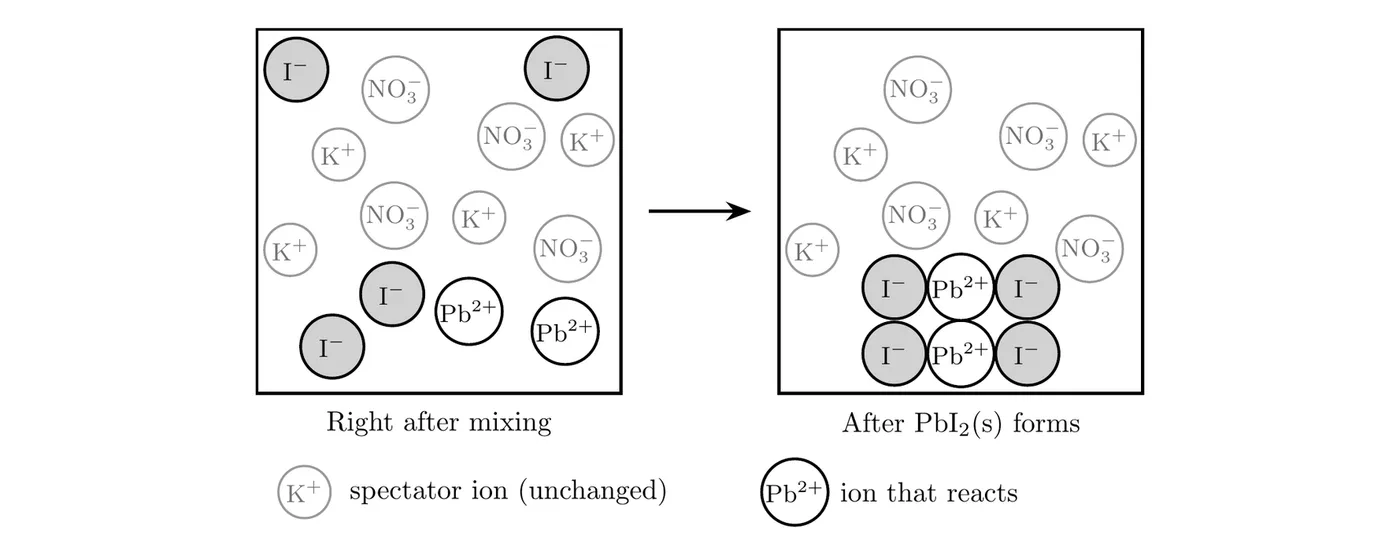
In the particle view, the gray spectator ions sit in the same places before and after. Only the and ions change, joining into solid : 2 lead ions and 4 iodide ions, the 1 to 2 ratio in the formula.
Which form to use
Form | Best for |
Molecular | Stoichiometry with the compounds you actually measure out, like grams of (Topic 4.5) |
Complete ionic | Showing every species in the solution, for example to draw a particle diagram or to find which ions are left after mixing |
Net ionic | Showing the reaction itself. Any soluble lead(II) compound mixed with any soluble iodide gives this same net ionic equation. |
When an AP question asks for a net ionic equation, spectator ions in your answer cost you the point.
What breaks into ions and what stays together
The whole skill comes down to knowing which species to write as separate ions.
Write as separate ions (when aqueous) | Keep together as written |
Soluble ionic compounds, like or | Solids (s), including precipitates |
Strong acids: , , , , , | Liquids (l), such as |
Strong bases: Group 1 hydroxides (like and ), plus , , and | Gases (g), such as and |
Weak acids and weak bases, such as acetic acid , , and | |
Molecular compounds that dissolve without forming ions, such as sugar |
- Polyatomic ions stay in one piece. becomes and , never separate N and O atoms.
- Hydrogen ion. A strong acid's hydrogen ion can be written as or . Both are accepted. Topic 4.8 and Unit 8 cover acids and bases in depth.
- Solubility. The only solubility rule the AP exam expects you to know is that all sodium, potassium, ammonium, and nitrate salts are soluble in water (Topic 4.7). Any other solubility information will be given to you, often by telling you that a precipitate forms.
Example 3: A precipitation reaction
Aqueous calcium chloride is mixed with aqueous sodium phosphate, and a white precipitate of calcium phosphate forms. Write the molecular, complete ionic, and net ionic equations.
Molecular. Calcium phosphate, , is the solid (the question tells you). Sodium chloride stays dissolved because it's a sodium salt. Balance the ions first: 3 for every 2 .
Complete ionic. Split every (aq) compound into its ions. Keep the coefficients: 3 gives 3 and 6 .
Net ionic. and appear unchanged on both sides, so cancel them.
Check: 3 Ca, 2 P, and 8 O on each side. The charge is on the left and 0 on the right.
Example 4: Strong acid versus weak acid
Write the net ionic equation for (a) nitric acid with potassium hydroxide and (b) acetic acid with sodium hydroxide.
(a) Nitric acid is a strong acid and is a strong base, so both split into ions. and are spectators, and water is a liquid:
Written with hydronium, the same equation is .
(b) Acetic acid is a weak acid. It stays mostly as whole molecules in water, so it's written as . The only spectator is :
Check: 2 C, 5 H, and 3 O on each side, and a charge of on each side. Writing plus for a weak acid is a classic mistake.
Example 5: Atoms balance but charge doesn't (AP-style)
A copper wire is placed in silver nitrate solution. Silver metal forms on the wire, and the solution turns blue from ions. A student writes this net ionic equation:
Is it balanced? If not, fix it.
Atoms: 1 Cu and 1 Ag on each side, so the atoms are fine.
Charge: on the left but on the right, so the equation is not balanced. Put a 2 in front of and :
Now there are 1 Cu and 2 Ag on each side, and the charge is on both sides. Topic 4.9 shows how to build equations like this from half-reactions.
Example 6: Checking a lab equation
The AP lab that finds the percent of hydrogen peroxide in a drugstore bottle can do it by reacting the peroxide with permanganate ion in acid. Verify that this net ionic equation is balanced:
Check | Left side | Right side |
Mn | 2 | 2 |
O | ||
H | ||
Charge |
Every element and the total charge match, so the equation is balanced.
Common mistakes
- Changing subscripts to balance an equation. That changes the substance.
- Splitting solids, liquids, gases, or weak acids into ions. Only dissolved strong electrolytes split.
- Breaking up polyatomic ions, or leaving off their charges.
- Checking atoms but not charge.
- Leaving spectator ions in a net ionic equation, or canceling an ion that changes phase, like , which ends up in .
- Writing oxygen or chlorine as single atoms instead of and .
- Leaving coefficients that can be reduced, like . Divide by 2.