

4.7 - Types of Chemical Reactions
Overview
Most reactions in AP Chemistry fall into three families: acid-base, oxidation-reduction (redox), and precipitation. Each is defined by what moves or combines at the particle level: protons, electrons, or ions. The AP exam asks you to classify a reaction and justify the classification with evidence from the equation, and the justification is where students lose points.
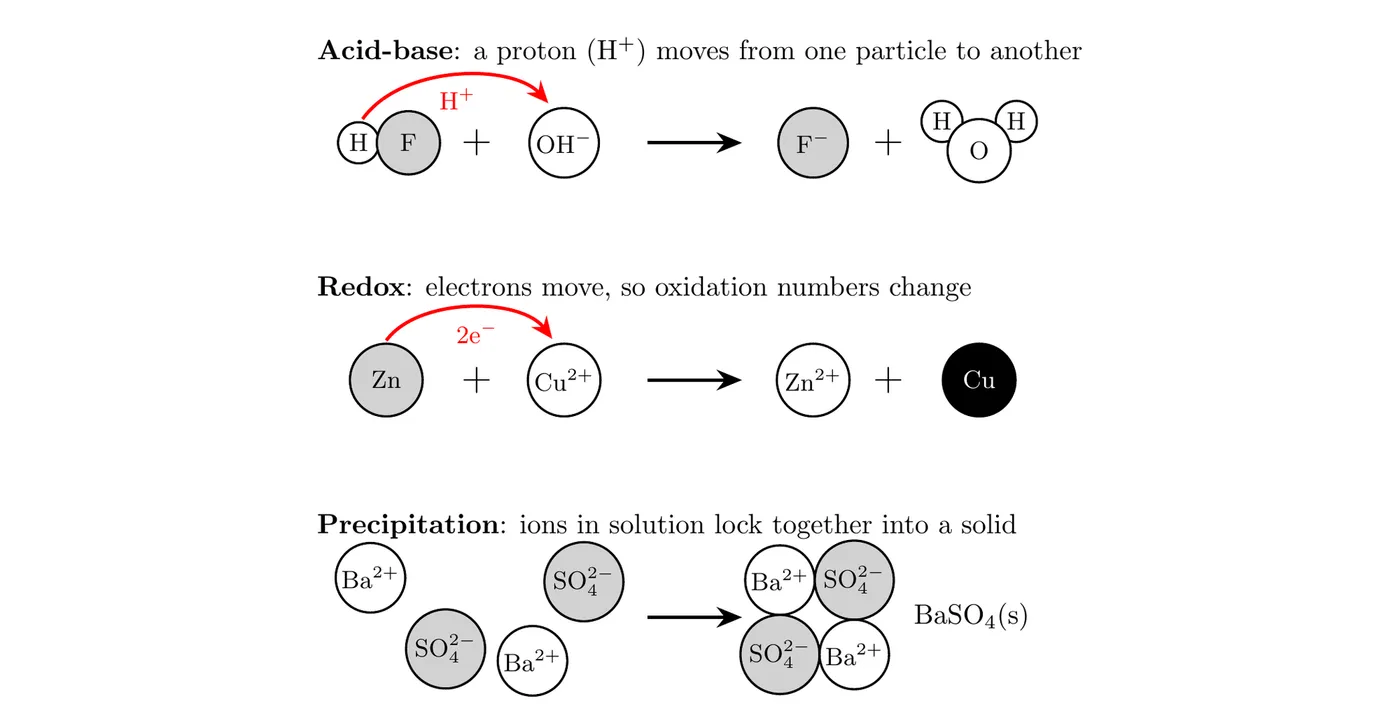
Acid-base reactions: protons move
An acid-base reaction transfers one or more protons ( ions) from one species to another. An ion is a hydrogen atom without its only electron, which leaves just a proton. The species that gives up the proton is the acid, and the one that takes it is the base. Topic 4.8 covers these reactions in detail.
HF hands a proton to . No oxidation numbers change: H is , F is , and O is on both sides. To spot an acid-base reaction, look for an H that starts on one species and ends up on another, usually with an acid (like , HCl, or ) meeting a base (like , , or ).
Oxidation-reduction (redox) reactions: electrons move
A redox reaction transfers one or more electrons between species. You can't see electrons in an equation, so you track them with oxidation numbers. If any element's oxidation number changes, electrons moved, and the reaction is redox.
- Oxidation is losing electrons. The oxidation number goes up.
- Reduction is gaining electrons. The oxidation number goes down (it is "reduced").
Electrons are transferred from the species that is oxidized to the species that is reduced, so one never happens without the other. A memory trick: OIL RIG (Oxidation Is Loss, Reduction Is Gain).
Zinc goes from 0 to , so it lost two electrons and was oxidized. Copper goes from to 0, so it gained those two electrons and was reduced.
Textbooks also call the oxidized species the "reducing agent" and the reduced species the "oxidizing agent." The AP exam doesn't test those two terms, so focus on which species is oxidized and which is reduced.
Assigning oxidation numbers
An oxidation number is the charge an atom would have if all of its bonds were fully ionic. It's bookkeeping, not a real charge. Apply these rules in order; when two rules conflict, the one higher on the list wins.
Rule | Example |
1. An atom of a free element is 0. | Zn(s), , and are all 0 |
2. A monatomic ion equals its charge. | is , is |
3. In a neutral compound the oxidation numbers add up to 0. In a polyatomic ion they add up to the ion's charge. | In : S + 4() = , so S is |
4. Group 1 metals are and group 2 metals are in compounds. | Na in NaCl is |
5. Fluorine is always in compounds. | F in HF is |
6. Hydrogen is with nonmetals and with metals (metal hydrides). | H in is ; H in NaH is |
7. Oxygen is usually , but in peroxides. | O in is ; O in is |
Assign every atom you can from rules 1 to 7, then use rule 3 to solve for the one that's left. For chromium in dichromate, :
Combustion
Combustion is an important kind of redox reaction in which a substance reacts with oxygen gas. Oxygen goes from 0 in to in the products, so it is always reduced. When a hydrocarbon (a compound of only carbon and hydrogen) burns completely, the products are carbon dioxide and water:
Carbon goes from in to in , so it is oxidized (8 electrons lost per C atom). Each O atom goes from 0 to and is reduced, and four O atoms gain electrons. With too little oxygen, burning is incomplete and also makes carbon monoxide or soot, but "combustion of a hydrocarbon" means complete combustion unless a problem says otherwise.
Precipitation reactions: ions combine into a solid
A precipitation reaction happens when you mix solutions of ions and some of the ions combine into an insoluble or sparingly soluble (only very slightly soluble) ionic compound. That solid is the precipitate, and you see it as cloudiness or as a solid settling to the bottom.
The and ions stay dissolved and don't take part; they're spectator ions (Topic 4.2). No protons move and no oxidation numbers change: Ba is and sulfate keeps its charge on both sides.
The one solubility rule you need
All sodium (), potassium (), ammonium (), and nitrate () salts are soluble in water. That's the only solubility rule the AP exam expects you to know. If a question needs any other solubility, it will give it to you.
This one rule goes a long way. When two solutions are mixed and a solid forms, the precipitate can't contain , , , or , so it must be made of the other two ions.
Classifying a reaction
Type | What moves or combines | Evidence in the equation |
Acid-base | A proton, | An H moves from one species to another, and no oxidation numbers change |
Redox | Electrons | At least one oxidation number changes. A free element (like Zn(s) or ) turning into a compound, or the reverse, is a giveaway |
Precipitation | Ions combine | Aqueous ions form a solid (s) product |
Check all three, because a reaction can fit two. When barium hydroxide reacts with sulfuric acid, protons move from the acid to (acid-base), and and form a solid (precipitation):
Example 1: Classify and justify
Classify each reaction as acid-base, redox, or precipitation, and justify your answer.
(a) Zinc metal in hydrochloric acid:
Redox. Zn goes from 0 to (oxidized), and H goes from in HCl to 0 in (reduced). HCl is an acid, but no proton is passed to a base here. The ions gain electrons instead. This one fools a lot of students.
(b) Silver nitrate and potassium chromate solutions:
Precipitation. is soluble (all potassium and nitrate salts are), so the solid must be . The oxidation numbers (Ag , Cr , O , K , N ) are the same on both sides, so it isn't redox.
(c) Ammonia and acetic acid:
Acid-base. Acetic acid gives a proton to , which becomes . No oxidation numbers change (N is in both and ).
(d) Magnesium burning in air:
Redox (a combustion). Mg goes from 0 to (oxidized), and O goes from 0 to (reduced). It makes a solid, but it isn't a precipitation reaction, because no dissolved ions combined.
Example 2: Tracking electrons with oxidation numbers
In acidic solution, permanganate reacts with sulfite:
Identify the species oxidized and the species reduced, and find how many electrons are transferred in the equation as written.
Step 1: Assign oxidation numbers to the atoms that might change.
H stays and O stays everywhere.
Step 2: Decide which way each one went. Mn drops from to , so is reduced (each Mn gains 5 electrons). S rises from to , so is oxidized (each S loses 2 electrons).
Step 3: Count the electrons.
Answer: Sulfite is oxidized, permanganate is reduced, and 10 electrons are transferred. The electrons lost always equal the electrons gained, which is a good check on your oxidation numbers.
Example 3: Gravimetric analysis (AP-style)
A precipitate can be filtered, dried, and weighed, so precipitation reactions can measure how much of an ion is in a sample. This is called gravimetric analysis.
A 0.7536 g sample of lawn fertilizer contains ammonium sulfate, , plus ingredients that contain no sulfate. The sample is dissolved in water, and excess is added. The precipitate is filtered, washed, and dried to constant mass (heated and weighed until its mass stops changing). Its mass is 1.1325 g.
(a) Identify the precipitate and write the net ionic equation. (b) Calculate the percent by mass in the fertilizer. (c) Why is added in excess?
(a) Swapping partners gives and . All ammonium salts are soluble, so the precipitate is barium sulfate.
(b) The molar masses are 233.39 g/mol for and 132.14 g/mol for . Each formula unit of ammonium sulfate supplies one sulfate ion, which ends up in one , so the mole ratio is 1:1.
The fertilizer is 85.08% ammonium sulfate by mass.
(c) Excess makes sulfate the limiting reactant, so every sulfate ion ends up in the precipitate. If some sulfate stayed dissolved, the mass of solid would undercount it.
Common mistakes
- Calling every reaction with an acid in it acid-base. Zinc with HCl is redox. Check for oxidation number changes first.
- Calling every solid product a precipitate. A precipitate forms from ions in solution. Magnesium burning to make MgO is redox.
- Justifying without evidence. "It's redox because electrons move" isn't enough. Name the element, its oxidation numbers before and after, and whether it was oxidized or reduced.
- Getting the direction backward. In oxidation the oxidation number goes up (losing negative electrons makes an atom more positive).
- Forgetting the exceptions. Oxygen is in peroxides, and hydrogen is in metal hydrides.
- Writing a precipitate that contains , , , or . Those salts are always soluble.