

4.3 - Representations of Reactions
Overview
A balanced equation and a particle diagram are two views of the same reaction. The equation uses symbols, and the diagram shows the actual atoms, molecules, and ions. AP questions often give you one and ask for the other, or give you a diagram and ask which reactant ran out. This topic is about drawing diagrams that agree with the equation and reading them correctly.
What a particulate representation is
A particulate representation, or particle diagram, shows a tiny sample at the level of particles. Atoms are drawn as circles with a key, and ions are often drawn as labeled circles. A diagram is consistent with an equation when it follows these rules:
- Atoms are conserved. Every atom in the before picture shows up in the after picture, so the count of each element stays the same.
- Ratios follow the coefficients. The particles that react and the particles that form are in the ratio of the balanced equation, or a whole-number multiple of it.
- Leftovers stay. Any reactant that isn't used up appears, unchanged, in the after picture.
- Each substance is drawn in its real form. Diatomic elements are pairs (, not H). Molecular compounds are bonded clusters. Ionic compounds dissolved in water are separate ions in the ratio of the formula. Solids are packed closely in order, liquids are close but disordered, and gases are spread out.
- There's a key, so a reader knows which circle is which element.
Water molecules in a solution are usually left out to keep the drawing readable. The question will tell you when they are.
From equation to diagram
Here is drawn with 4 and 2 molecules, exactly twice the coefficients:
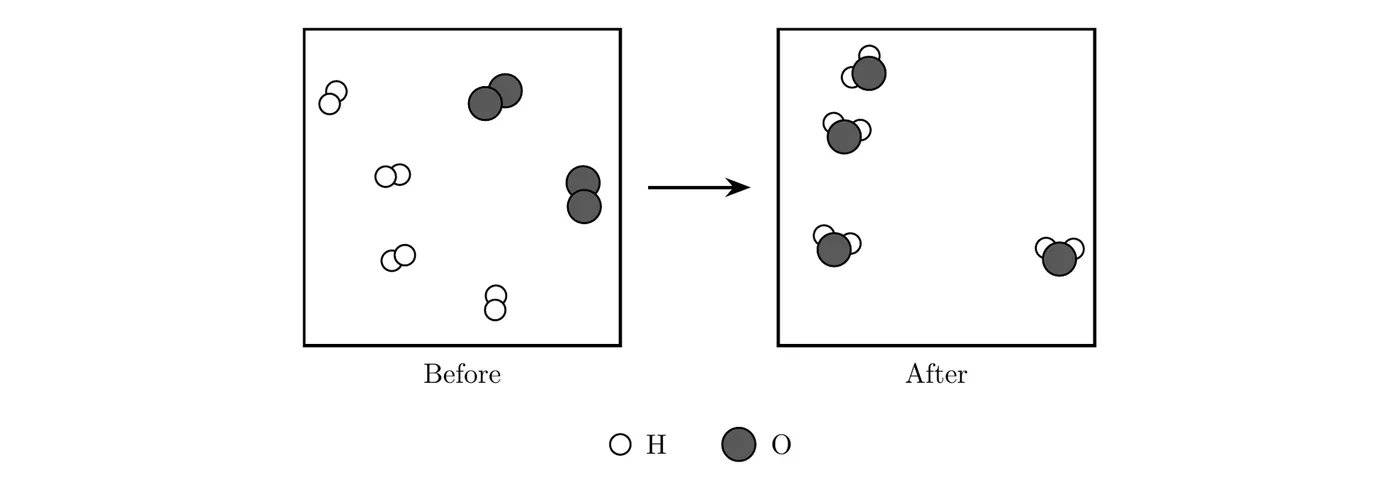
Atom | Before | After |
H | ||
O |
The atoms are the same; only their partners changed. Any whole-number multiple of the coefficients gives a correct diagram, because coefficients describe a ratio, not an exact count.
From diagram to equation
To write an equation from a before-and-after diagram:
- Use the key to identify every species in both pictures.
- Count how many of each reactant were used up: the number before minus the number left after.
- Count how many of each product formed.
- Use those numbers as coefficients, then reduce to the smallest whole numbers. Leftover reactant particles don't go in the equation.
- Check that the atoms balance.
Example 1: Ammonia with a leftover reactant
The diagram shows nitrogen and hydrogen before and after a reaction that makes ammonia.
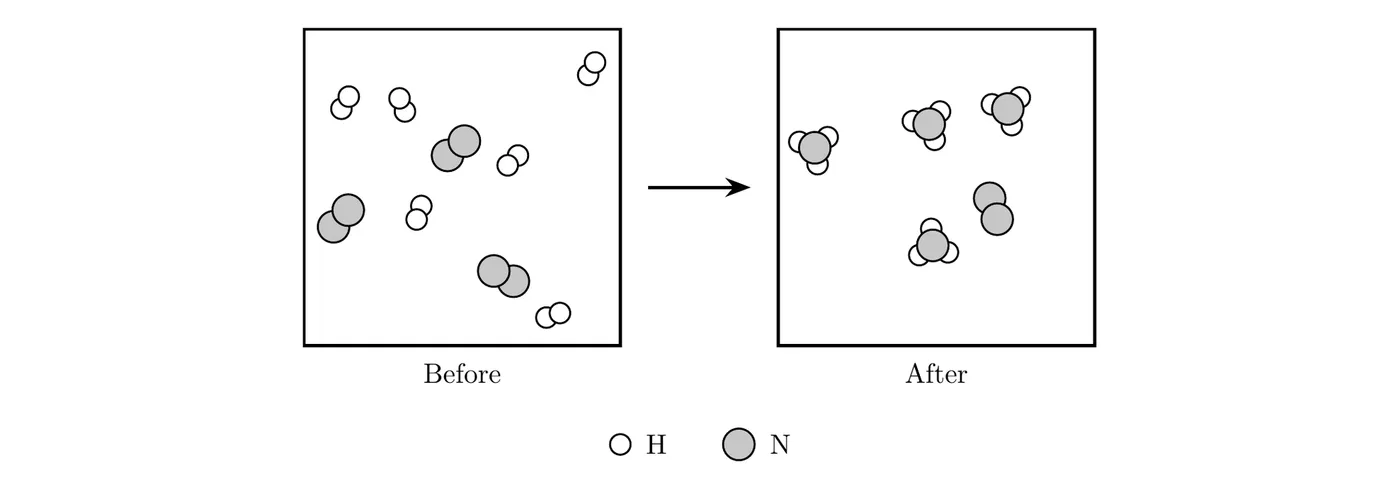
(a) Write the balanced equation.
Before: 3 and 6 . After: 4 and 1 . So 2 and 6 were used, and 4 formed. The ratio 2 : 6 : 4 reduces to 1 : 3 : 2:
(b) Which reactant is limiting?
Hydrogen. All 6 molecules reacted, and the reaction stopped when they ran out. One molecule is left over, so nitrogen is in excess. Topic 4.5 does the same reasoning with moles and grams.
(c) Check conservation.
N: 6 atoms before and after. H: 12 atoms before and after.
Example 2: Representing a dissolved ionic compound
Which diagram correctly shows calcium chloride dissolved in water? (Water molecules are not shown.)
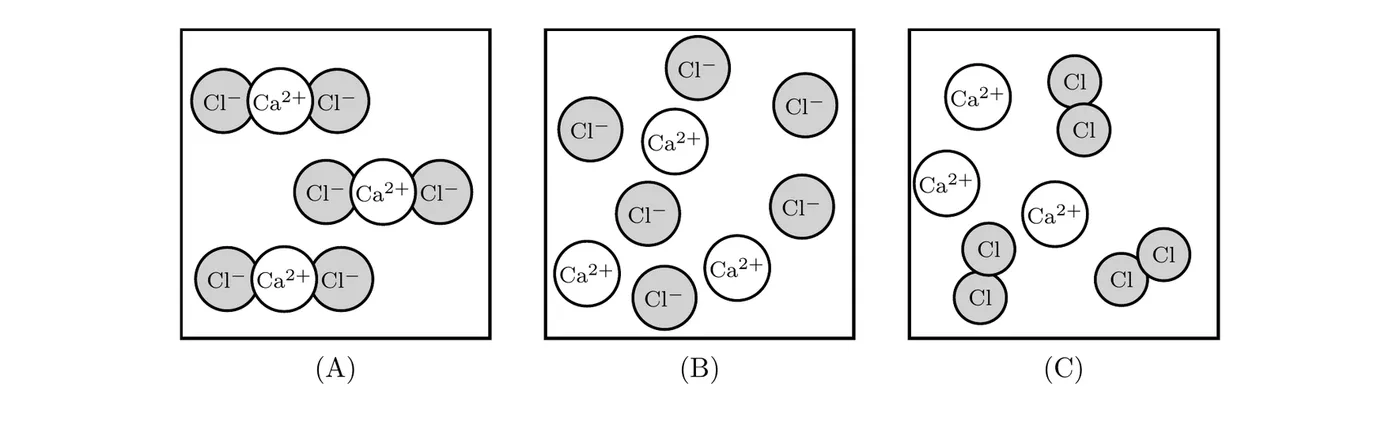
Answer: (B). Calcium chloride is a soluble ionic compound, so in water it exists as separate and ions, with two chloride ions for every calcium ion. Diagram (B) has 3 and 6 .
- (A) is wrong because the ions are still stuck together as formula units. That's closer to the solid than to the solution.
- (C) is wrong because the chlorine is drawn as neutral molecules. Dissolving doesn't make chlorine gas; the chlorine stays as chloride ions.
Dissolving is a physical process, and the same rules apply: same atoms, correct ratio, correct form.
Example 3: A precipitate with an excess reactant (AP-style)
Solutions of silver nitrate and sodium chloride are mixed. Silver chloride is insoluble. The left box shows the ions right after mixing, and the right box shows the result. (a) Write the net ionic equation. (b) Explain how the after box follows from the before box. (c) Which ion is limiting?
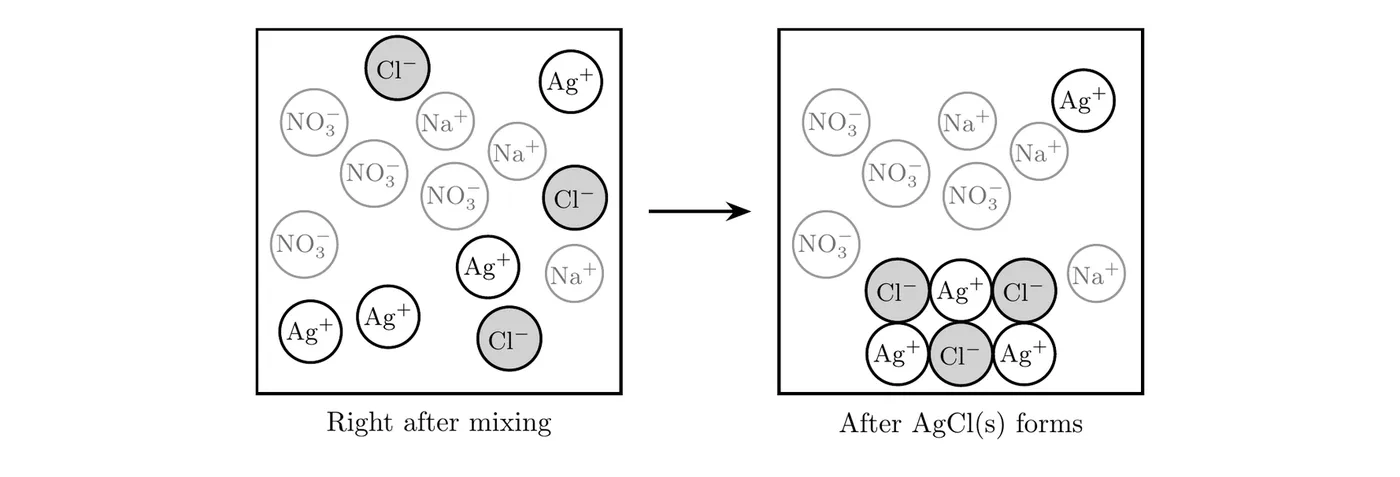
(a) Sodium and nitrate salts are soluble, so and are spectators:
(b) The box starts with 4 and 3 . They combine 1 to 1, so 3 units of form a solid, packed together at the bottom. One is left dissolved. The 3 and 4 are still there, unchanged.
(c) is limiting, and is in excess.
Check: the solution is still neutral overall. Dissolved positive charge: , from the leftover and the 3 . Dissolved negative charge: 4, from the 4 . The solid is neutral.
Common mistakes
- Drawing a different number of atoms after than before.
- Drawing a dissolved ionic compound as intact formula units, or in the wrong ratio (one per ).
- Drawing diatomic elements as single atoms, or turning ions into neutral atoms or molecules.
- Forgetting to show the leftover excess reactant in the after picture.
- Writing coefficients straight from the before picture, without subtracting the leftovers or reducing the ratio.
- Drawing a precipitate as scattered ions. A solid is drawn as particles packed together.
- Putting spectator ions into the solid.