

4.8 - Introduction to Acid-Base Reactions
Overview
Topic 4.7 said acid-base reactions move protons. This topic gives you the language for describing that move: Brønsted-Lowry acids and bases, the special role of water, and conjugate acid-base pairs. Unit 8 (pH, buffers, and titration curves) is built on these ideas, so it pays to get them solid now.
Brønsted-Lowry acids and bases
- A Brønsted-Lowry acid is a proton donor: it gives away an .
- A Brønsted-Lowry base is a proton acceptor: it takes an , bonding to it with one of its lone pairs of electrons.
These are roles in a particular reaction, not permanent labels. You decide which is which by following the proton:
HCl loses an H, so it's the acid. gains an H, so it's the base. A quick check: a species acting as an acid loses one H and its charge goes down by 1 (HCl becomes ). A species acting as a base gains one H and its charge goes up by 1 ( becomes ).
You may run into Lewis acids and bases, which are defined by electron pairs instead of protons. They aren't on the AP exam. AP uses the Brønsted-Lowry definitions, with the focus on reactions in water.
Water's role in acid-base reactions
In aqueous solution, water is often one of the reactants, because its structure lets it go either way. The O atom in has two lone pairs, so it can accept a proton and become hydronium, . Water also has two O-H bonds, so it can donate a proton and become hydroxide, . A species that can act as either an acid or a base is called amphiprotic (you'll also see "amphoteric").
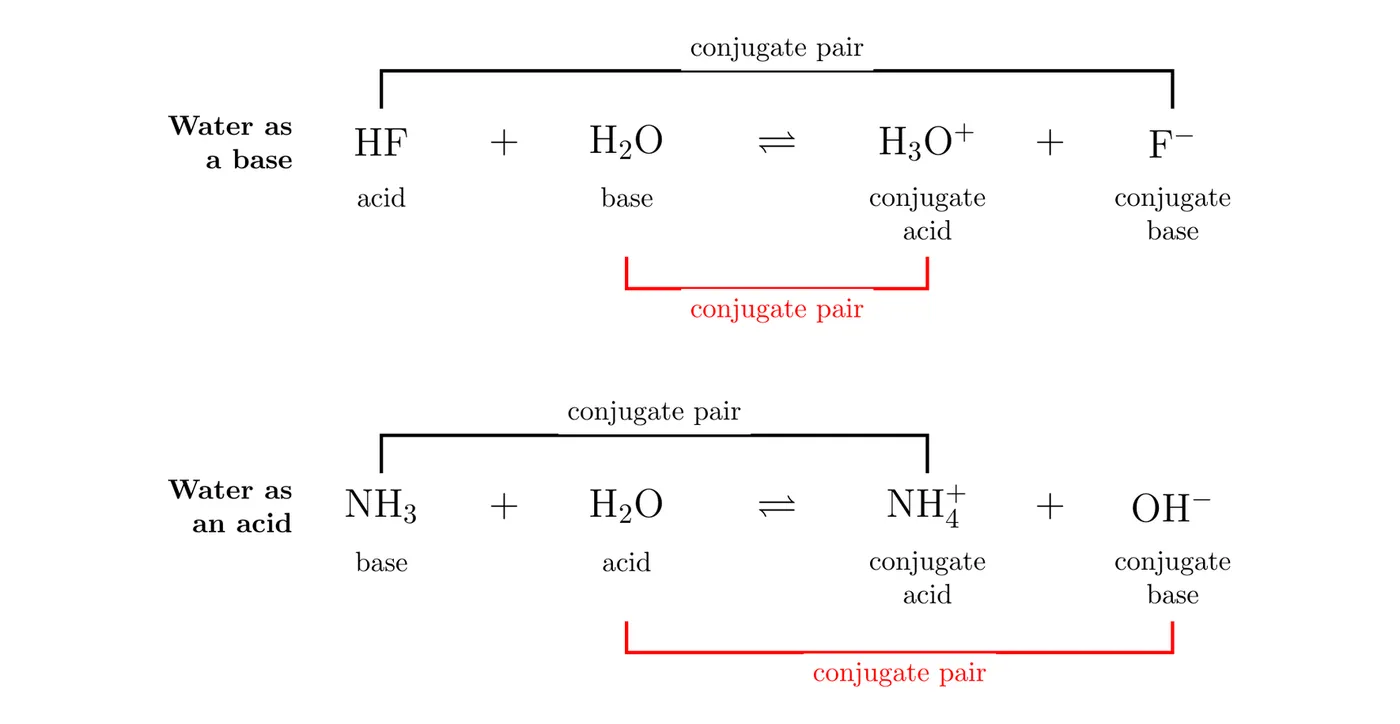
With HF, water accepts a proton (it's the base). With , water donates a proton (it's the acid). Water even does both with itself, a reaction called autoionization:
Autoionization happens only to a tiny extent, but it's the reason pure water contains a little and (more in Unit 8).
or ? A bare proton never floats around alone in water. It's always attached to a water molecule. Writing is shorthand for , and the AP exam accepts either one.
Conjugate acid-base pairs
When an acid gives away its proton, what's left behind can take a proton back, so it's a base. That leftover is the acid's conjugate base. In the same way, when a base accepts a proton, it becomes its conjugate acid. A conjugate acid-base pair is two species that differ by exactly one .
Acid | Conjugate base |
HF | |
Every acid-base reaction has two conjugate pairs: the acid with its conjugate base, and the base with its conjugate acid. In the figure above, HF and are one pair, and and are the other. To find a pair, look for two formulas that differ by one H and by one unit of charge. Don't pair HF with just because both are acids.
Comparing acid and base strength
When an acid ionizes in water, you can compare how strongly each side holds on to the proton.
- A strong acid ionizes completely in water: essentially every molecule gives up its proton, so the equation gets a single arrow. The strong acids to know are HCl, HBr, HI, , , and (its first proton).
- A weak acid ionizes only partly, so most of its molecules stay intact, and the equation gets an equilibrium arrow, . Most acids are weak, including HF, , , and .
- The strong bases are the group 1 hydroxides (like NaOH and KOH) and the hydroxides of Ca, Sr, and Ba. is the classic weak base.
The key relationship: the stronger the acid, the weaker its conjugate base. HCl gives up its proton completely, which means has almost no pull on a proton. It's too weak a base to take one back from . HF holds its proton more tightly, so is a real (weak) base that keeps pulling protons back, and a lot of HF stays intact.
An acid-base reaction favors the side with the weaker acid and weaker base. For HCl in water, the two acids are HCl and . HCl is the stronger one, so the reaction goes all the way to products. For HF in water, is the stronger acid, so the reactant side (mostly HF molecules) is favored.
Seeing strength at the particle level
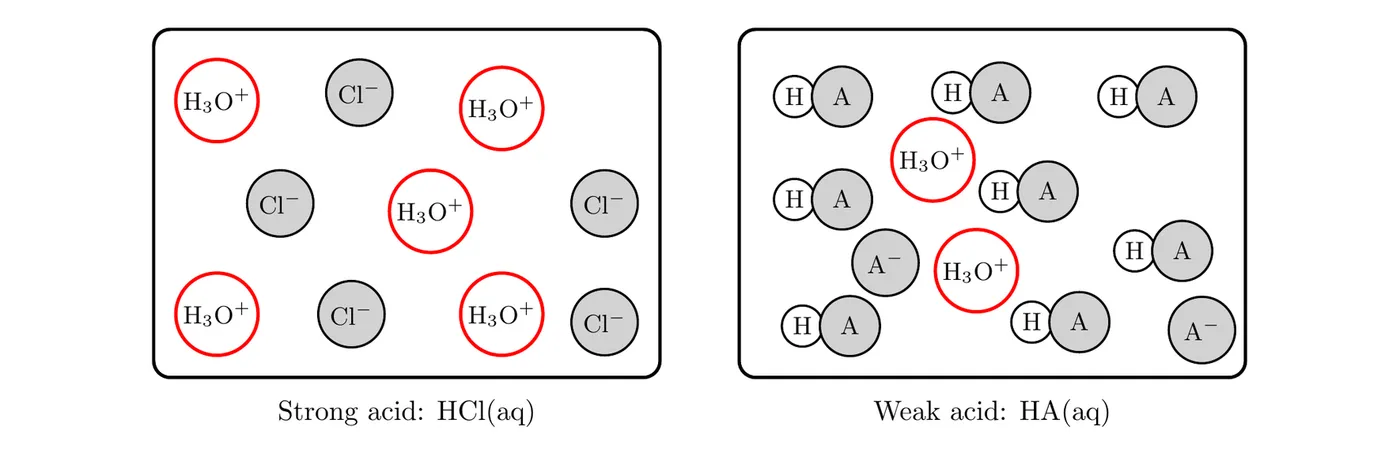
Water molecules aren't shown. In the HCl solution there are no HCl molecules left: every one has become and . In the weak acid solution, most particles are still intact HA molecules, with only a few and ions. Real weak acids are often even less ionized than this drawing.
Example 1: Identifying acids, bases, and conjugate pairs
For each reaction, identify the acid, the base, the conjugate acid, and the conjugate base.
(a) Nitrous acid in water:
loses an H, so it's the acid, and is its conjugate base. Water gains an H, so it's the base, and is its conjugate acid.
(b) Carbonate ion in water:
gains an H (its charge goes from to ), so it's the base, and is its conjugate acid. Water loses an H, so here it's the acid, and is its conjugate base.
(c) Dihydrogen phosphate ion with hydroxide:
loses an H, so it's the acid, and is its conjugate base. gains an H, so it's the base, and is its conjugate acid.
Example 2: An amphiprotic ion
The hydrogen carbonate ion, , is amphiprotic. Give its conjugate acid and its conjugate base, and write an equation that shows it acting as each.
Conjugate acid: add one to get . Conjugate base: remove one to get .
Acting as an acid (with a base such as ):
Acting as a base (with an acid such as ):
Ions that still have an H to give and can also take one, like , , and , are amphiprotic, just like water.
Example 3: Reading a particle diagram (AP-style)
Use the two particle diagrams above. (a) Which acid is weak? Justify your answer with the diagram. (b) What percent of the HA molecules have ionized? (c) Which is the stronger base, or ? Explain. (d) Write the equation for each acid reacting with water, using the correct arrow.
(a) HA is weak. 8 of the 10 HA units are still intact molecules. In the HCl box, no HCl molecules remain at all, because every one ionized.
(b) Each came from one HA molecule, so there were 8 + 2 = 10 HA molecules to start.
(c) is the stronger base. HA is a weaker acid than HCl, and the weaker the acid, the stronger its conjugate base. pulls protons back from , which is why most HA stays as molecules. doesn't, so no HCl molecules are left.
(d) The strong acid gets a single arrow, and the weak acid gets an equilibrium arrow:
Common mistakes
- Pairing the wrong species. Conjugates differ by exactly one : HF and , not HF and .
- Forgetting to change the charge. Removing an lowers the charge by 1, so the conjugate base of is , not .
- Leaving water out. Water is often the acid or the base in an aqueous reaction, not just the solvent.
- Using the wrong arrow. Strong acids get a single arrow. Weak acids and weak bases get .
- Thinking a strong acid has a strong conjugate base. It's the reverse: the stronger the acid, the weaker its conjugate base.
- Mixing up strong and concentrated. Strength is about how completely an acid ionizes. Concentration is how much is dissolved. A dilute HCl solution is still a strong acid.