

4.5 - Stoichiometry
Overview
Stoichiometry is the math of chemical reactions: using a balanced equation to figure out how much product you can make from the reactants you have, or how much reactant you need for the product you want. It pulls together moles (Topic 1.1), the ideal gas law (Topic 3.4), and molarity (Topic 3.7). You'll use it for the rest of the course, in titrations, equilibrium, thermochemistry, and electrochemistry.
Why stoichiometry works
Atoms are conserved in a reaction, so a balanced equation works like an exact recipe. If you know the amount of any one substance, you can calculate the amount of any other: product amounts from known reactant amounts, or reactant amounts from a product amount you need.
Coefficients are mole ratios
Coefficients count particles, and since a mole is a fixed number of particles (), they count moles too.
Molecules | 2 | 1 | 2 |
Moles | 2 mol | 1 mol | 2 mol |
Mass | 4.032 g | 32.00 g | 36.03 g |
Coefficients are not mass ratios: 2 g of hydrogen does not react with 1 g of oxygen. Mass is still conserved, though: .
From the coefficients you can write a mole ratio to use as a conversion factor, such as
Put the substance you want on top and the substance you have on the bottom.
The stoichiometry roadmap
Every stoichiometry problem passes through moles. You can't go straight from grams of A to grams of B, because the balanced equation relates moles, not grams.
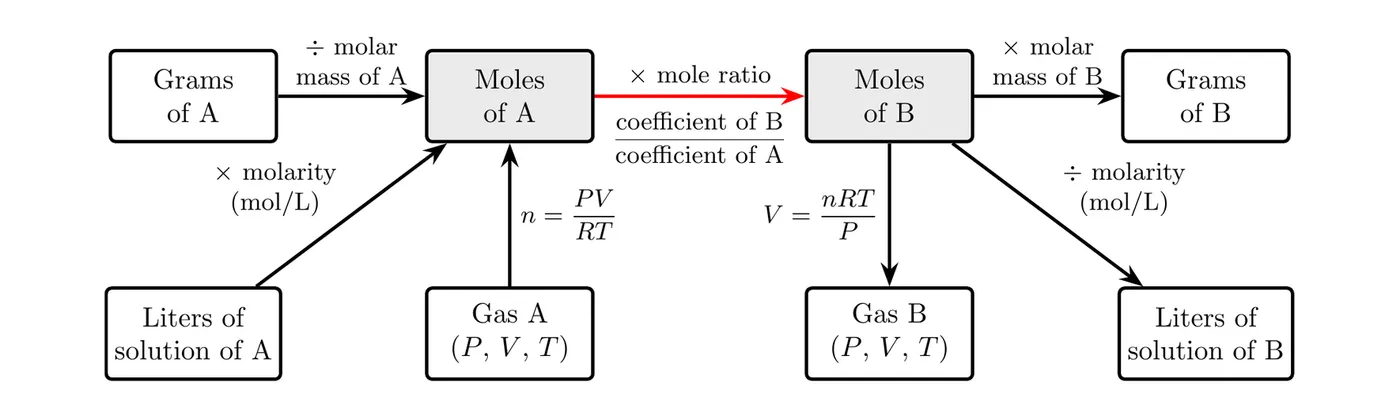
- Mass: .
- Solution: moles of solute molarity liters of solution, from .
- Gas: , from , with and in kelvins ( = °C + 273.15). At STP (273.15 K and 1.0 atm), one mole of an ideal gas takes up 22.4 L.
- Particles: moles number of particles .
The red arrow, the mole ratio, is the only step that uses the balanced equation.
Significant figures in stoichiometry
- Coefficients and mole ratios are exact numbers. They never limit significant figures.
- Carry extra digits through the calculation and round only the final answer, to the number of significant figures in the least precise measurement.
- When you subtract, as in finding leftover reactant, the answer keeps the decimal place of the least precise value. That can cut the number of significant figures.
Example 1: Grams to grams
Propane burns in excess oxygen:
What mass of forms when 22.0 g of propane burns completely? Molar masses: = 44.09 g/mol and = 44.01 g/mol.
Answer: 65.9 g of , with three significant figures because 22.0 g has three.
The same 0.4990 mol of propane uses g of and makes g of . Mass is conserved: the reactants total g, and the products total g, the same to within rounding.
Limiting reactant
Reactants are rarely mixed in the exact ratio of the equation. The reactant that runs out first is the limiting reactant, and it decides how much product forms. The other reactant is in excess, and some of it is left over.
Think of making sandwiches that each take 2 slices of bread and 1 slice of cheese. With 10 slices of bread and 8 slices of cheese, you can make only 5 sandwiches. Bread is limiting even though you started with more bread than cheese, and 3 slices of cheese are left over.
How to find it
- Convert every reactant amount to moles.
- Divide each reactant's moles by its coefficient. The smallest result belongs to the limiting reactant. (Or calculate how much product each reactant could make; the smaller amount wins.)
- Use the limiting reactant, and only the limiting reactant, to calculate the product.
- To find how much excess reactant is left, calculate how much of it reacted and subtract that from the starting amount.
Compare moles, not grams. The reactant with the smaller mass isn't necessarily limiting. Neither is the one with fewer moles, until you account for the coefficients. Topic 4.3 shows the same idea with particles.
Example 2: Limiting reactant from masses (AP-style)
Aluminum reacts with chlorine gas:
A 10.0 g sample of Al reacts with 35.0 g of . Molar masses: Al = 26.98 g/mol, = 70.90 g/mol, and = 133.33 g/mol.
(a) Which reactant is limiting? Convert to moles:
Divide by the coefficients:
Chlorine has the smaller value, so is the limiting reactant, even though there are more grams of chlorine than of aluminum.
(b) What mass of product can form? Start from the limiting reactant:
(c) How much aluminum is left over? Find how much reacted, then subtract:
The answer has one decimal place because 10.0 g has one decimal place.
(d) How does the mass of product change if the student doubles one reactant?
- Doubling the Al to 20.0 g (with 35.0 g of ) changes nothing. Chlorine is still limiting, so the product stays at 43.9 g. There's just more aluminum left over.
- Doubling the chlorine to 70.0 g (with 10.0 g of Al) increases the product, but doesn't double it. Now gives while Al still gives 0.1853, so aluminum becomes limiting. The product is of .
Adding more of the excess reactant never changes the amount of product. Adding more of the limiting reactant does, until it stops being the limiting one.
Stoichiometry with solutions and gases
Stoichiometry combines with molarity and the ideal gas law, so solutions and gases follow the same roadmap. Only the step into or out of moles changes.
Example 3: A precipitate from two solutions (AP-style)
A student mixes 50.0 mL of 0.200 M with 75.0 mL of 0.300 M . Yellow (molar mass 461.0 g/mol) precipitates:
(a) Moles of each reacting ion. Each gives one , and each gives one .
(b) Limiting reactant. Using up all the would take mol of . There are 0.0225 mol, which is more than enough, so is the limiting reactant and iodide is in excess.
(c) Theoretical yield.
(d) Ions left in solution. The total volume is mL, or 0.1250 L. The leftover iodide is mol.
The leftover iodide has only two significant figures because of the subtraction. and are spectators, so all of them stay in solution. As a check, the solution is neutral: 0.180 M of positive charge from , and M of negative charge.
The graph shows how the mass of precipitate depends on how much of the KI solution is added to the same 50.0 mL of 0.200 M .
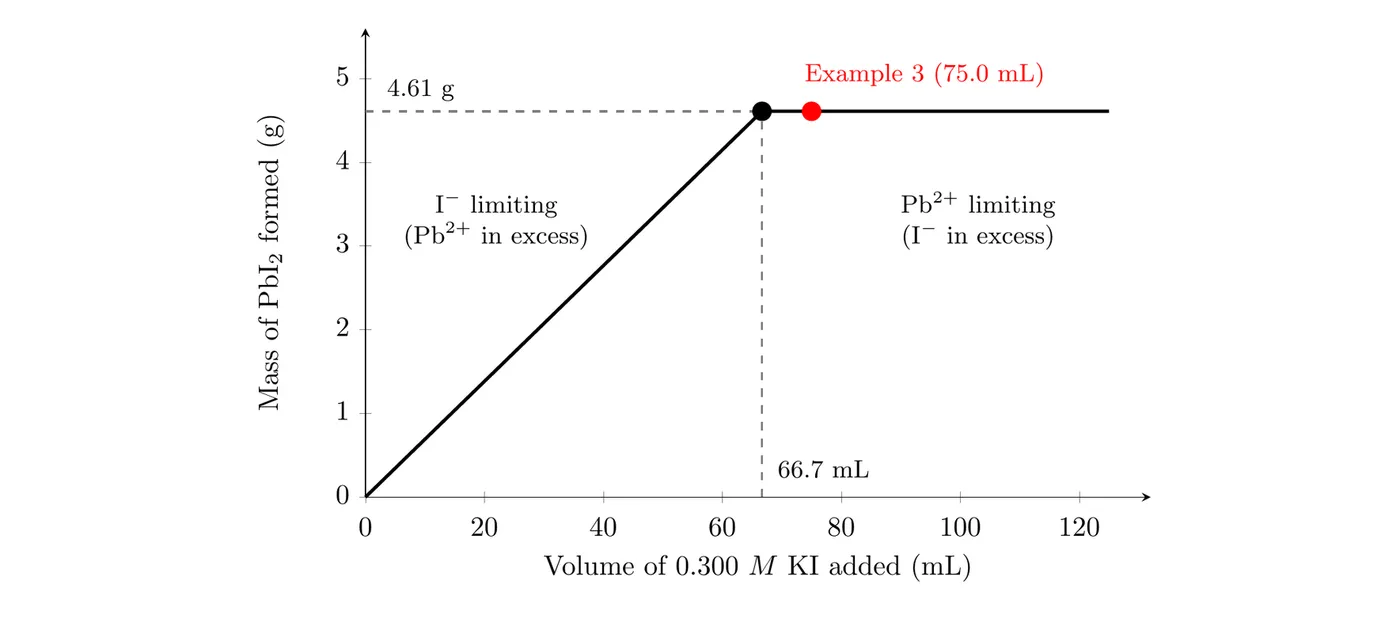
- Below 66.7 mL, iodide is limiting. Each extra milliliter of KI makes more , so the mass rises in a straight line.
- At 66.7 mL, the ions are in the exact 1 to 2 ratio of the equation: of KI supplies 0.0200 mol of for the 0.0100 mol of .
- Past 66.7 mL, is limiting. More KI only adds excess iodide, and the mass stays at 4.61 g. Example 3, at 75.0 mL, sits on this flat part.
Example 4: Percent yield and lab error
The theoretical yield is the most product the limiting reactant can make. The actual yield is what you really collect. The percent yield compares them:
The student in Example 3 filters, dries, and weighs the precipitate, and gets 4.38 g of .
A second student doing the same experiment reports 4.85 g, a percent yield of 105%. More than 100% is impossible for pure, dry product, so it signals an error, not a great result. Likely causes:
- The solid wasn't completely dry, so leftover water added mass.
- The solid wasn't rinsed, so dissolved dried onto it.
Yields below 100% come from product lost while transferring or filtering (some solid passes through the filter paper or sticks to the beaker), a reaction that didn't go to completion, or side reactions. In synthesis and purification labs, like the AP lab that purifies a mixture using green chemistry principles, you'll report how much product you recovered and explain errors like these.
Example 5: Gas stoichiometry
Car air bags inflate when sodium azide decomposes:
What mass of (65.02 g/mol) is needed to fill an air bag with 65.0 L of at 1.10 atm and 25 °C? This time you work backward, from a product to a reactant.
Step 1: moles of gas. Convert the temperature first: 25 °C + 273.15 = 298 K (rounded to the ones place, like 25 °C).
Step 2: mole ratio, then mass.
Answer: 127 g of sodium azide.
Common mistakes
- Comparing grams instead of moles to find the limiting reactant. The CED singles this out as a common error.
- Using coefficients as mass ratios.
- Flipping the mole ratio. The substance you want goes on top.
- Comparing moles without dividing by the coefficients first.
- Calculating the product from the excess reactant.
- Forgetting to convert mL to L, or °C to K.
- Rounding in the middle of a problem, or reporting too many significant figures at the end.
- Thinking a percent yield over 100% means a great experiment. It means the product was wet or impure.