

4.9 - Oxidation-Reduction (Redox) Reactions
Overview
Topic 4.7 showed that a redox reaction moves electrons from the species that is oxidized to the species that is reduced. This topic is about writing balanced equations for those reactions. Redox equations have to balance charge as well as atoms, which makes them hard to balance by guessing. Instead, you split the reaction into two half-reactions, balance each one, and add them back together. You'll use the same half-reactions again in Unit 9 for batteries and electrolysis.
Half-reactions
A half-reaction shows just one side of the electron transfer, with the electrons written in.
- In an oxidation half-reaction, electrons appear as a product (they're lost):
- In a reduction half-reaction, electrons appear as a reactant (they're gained):
Each half-reaction has to balance on its own, for atoms and for charge. In the zinc half-reaction, the left side has a total charge of 0, and the right side has .
The rule that ties the two halves together: electrons lost must equal electrons gained. Electrons don't pile up in a beaker, so a finished redox equation never shows free electrons.
Example 1: Aluminum in a copper(II) solution
When a strip of aluminum is placed in a solution of copper(II) ions, reddish-brown copper metal forms on the aluminum and the blue color of fades. Write the balanced net ionic equation.
Step 1: Write the two half-reactions.
Step 2: Make the electrons equal. Each Al loses 3 electrons and each gains 2. The lowest common multiple is 6, so multiply the oxidation by 2 and the reduction by 3.
Step 3: Add them, and cancel the 6 electrons that appear on both sides.
Step 4: Check. There are 2 Al and 3 Cu on each side. The charge is on the left and on the right.
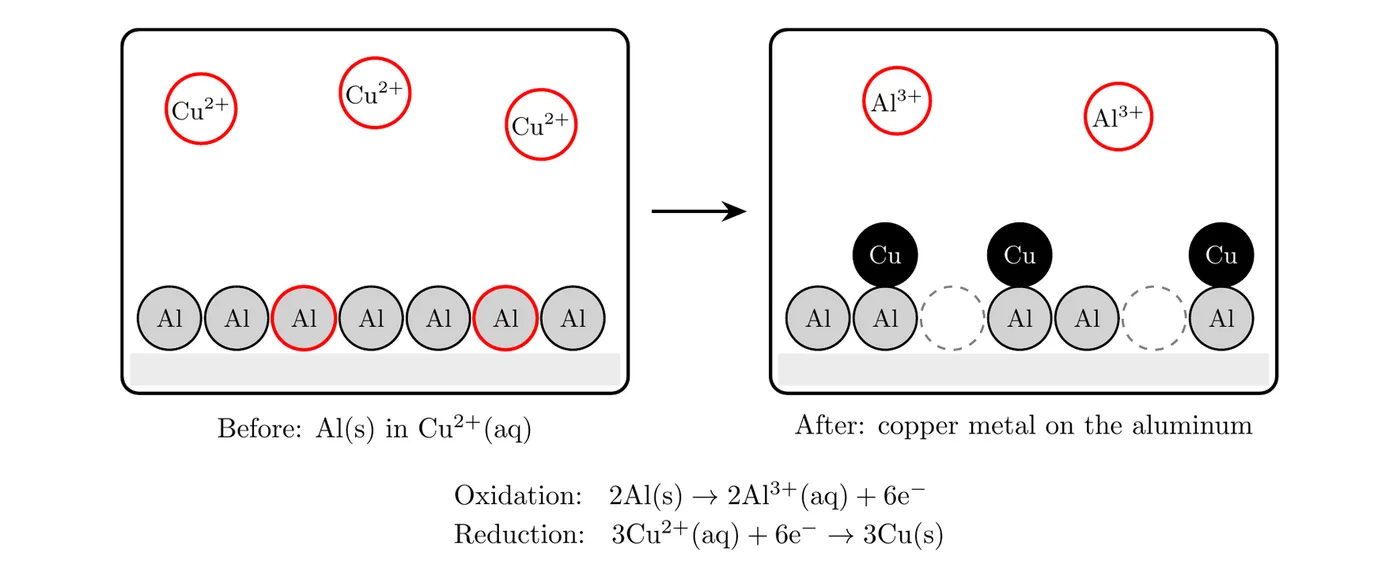
The particle picture shows why the ratio isn't 1:1. Each Al atom gives up three electrons, but each ion takes only two, so it takes three copper ions to use up the electrons from two aluminum atoms. A common wrong answer is . Its atoms balance, but its charge doesn't ( on the left, on the right).
Balancing in acidic solution
Many redox reactions involve ions that contain oxygen, like permanganate () or dichromate (), in acid. Their half-reactions need water and to balance. Work through each half-reaction in this order:
- Balance all atoms except O and H.
- Balance O by adding .
- Balance H by adding .
- Balance charge by adding electrons to the more positive side.
Then combine them:
- Multiply each half-reaction so the electrons lost equal the electrons gained. Multiply every species in it.
- Add the half-reactions and cancel anything that shows up on both sides (the electrons, plus any extra or ).
- Check that both the atoms and the total charge balance.
Example 2: Permanganate and iron(II)
In acidic solution, oxidizes to and is reduced to . Balance the equation.
Reduction half-reaction. Mn is already balanced. Add 4 to the right for the 4 O atoms, then 8 to the left for the 8 H atoms in that water:
The charge is on the left and on the right. Add 5 electrons to the left to bring it down to :
The 5 electrons match the change in Mn's oxidation number, from to .
Oxidation half-reaction. Each iron loses one electron, so multiply it by 5 to match the 5 electrons gained:
Add and cancel the 5 electrons:
Check: 1 Mn, 5 Fe, 4 O, and 8 H on each side. Charge: on the left and on the right.
Example 3: Dichromate and iodide
In acidic solution, reacts with to form and . Balance the equation.
Reduction half-reaction. Balance Cr (2 ), then O (7 ), then H (14 ). The charge is on the left and on the right, so add 6 electrons to the left:
Each Cr goes from to , and there are two of them: electrons. That matches.
Oxidation half-reaction. Balance I first (2 make one ), then charge:
Multiply it by 3 so 6 electrons are lost, then add and cancel:
Check: 2 Cr, 7 O, 14 H, and 6 I on each side. Charge: on the left and on the right.
Extra: balancing in basic solution
The CED doesn't ask for this method, but textbooks and labs use it. In basic solution there's essentially no free . Balance the equation as if it were acidic, then add one to both sides for each . On the side with , each and combine into . Then cancel any water that appears on both sides.
For example, permanganate oxidizes sulfite to sulfate in basic solution and is reduced to . Balanced as if acidic (6 electrons transferred), the equation is
Add 2 to both sides. The 2 and 2 on the left become 2 , and one of them cancels with the on the right:
Check: 2 Mn, 3 S, 18 O, and 2 H on each side. Charge: on the left and on the right.
Counting electrons transferred
The total number of electrons transferred in a balanced redox equation is the number that canceled when you added the half-reactions. It's 6 for aluminum and copper(II), 5 for permanganate and iron(II), and 6 for dichromate and iodide. You'll call this number in Unit 9, where it links a reaction to its cell potential and free energy ( on the reference sheet). You can always double-check with oxidation numbers: in the dichromate reaction, 2 Cr atoms each drop by 3 (6 electrons gained), and 6 I atoms each rise by 1 (6 electrons lost).
Example 4: Iron in a supplement tablet (AP-style)
An iron supplement tablet is dissolved in dilute sulfuric acid, so all of its iron is present as . The solution is titrated with 0.01000 M , and 23.28 mL is needed to reach the endpoint. The reaction is the one balanced in Example 2:
(a) Calculate the mass of iron in the tablet, in milligrams. (b) How many moles of electrons were transferred during the titration?
(a) Moles of permanganate, then the 1:5 mole ratio, then mass:
The tablet contains 65.01 mg of iron, which matches the 65 mg printed on a typical label.
(b) Each loses one electron, so the electrons transferred equal the moles of iron: mol of electrons. The other half agrees: each gains 5 electrons, and mol.
Common mistakes
- Balancing atoms but not charge. Add up the charges on each side every time.
- Putting electrons on the wrong side. Oxidation half-reactions have electrons as products, and reduction half-reactions have them as reactants.
- Leaving electrons in the final equation. If they don't cancel, the multipliers are wrong.
- Balancing O with O atoms or . In acid, balance O with and H with .
- Scaling only part of a half-reaction. When you multiply by 3, multiply every species, including and .
- Forgetting to cancel. After adding, remove anything that appears on both sides, like extra or .