

4.4 - Physical and Chemical Changes
Overview
Topic 4.1 sorted changes by what you can see. This topic explains the difference at the particle level. Chemical changes break and form chemical bonds. Physical changes usually change only intermolecular interactions, the weaker attractions between particles. You'll also see a case where the line is blurry, dissolving a salt, and how to argue it with evidence.
Bonds versus intermolecular interactions
Two kinds of attraction hold matter together:
- Chemical bonds hold atoms together within a substance: covalent bonds inside molecules, ionic bonds between the ions in an ionic solid, and metallic bonds in metals (Unit 2). They are strong.
- Intermolecular interactions, or intermolecular forces, are attractions between separate particles: London dispersion forces, dipole-dipole forces, hydrogen bonds, and ion-dipole interactions (Unit 3). They are much weaker.
That gives the general rule:
Chemical process | Physical process | |
What happens | Chemical bonds break and/or form | Only intermolecular interactions change |
Particles afterward | New substances with new formulas | The same particles, rearranged or spread out |
Energy involved | Large: breaking one mole of a typical covalent bond takes a few hundred kJ | Smaller: overcoming intermolecular forces usually takes a few to tens of kJ per mole |
Examples | Burning, rusting, decomposing, forming a precipitate | Melting, boiling, sublimation, dissolving sugar |
Watch the name: a hydrogen bond is an intermolecular interaction, not a chemical bond. Boiling water breaks hydrogen bonds between water molecules, while the O-H covalent bonds inside each molecule stay intact.
One substance, two kinds of change
Water shows the difference clearly. Boiling overcomes the hydrogen bonds between molecules, and every molecule leaves intact:
Decomposing water breaks the O-H covalent bonds and forms new H-H and O=O bonds, so the products are new substances:
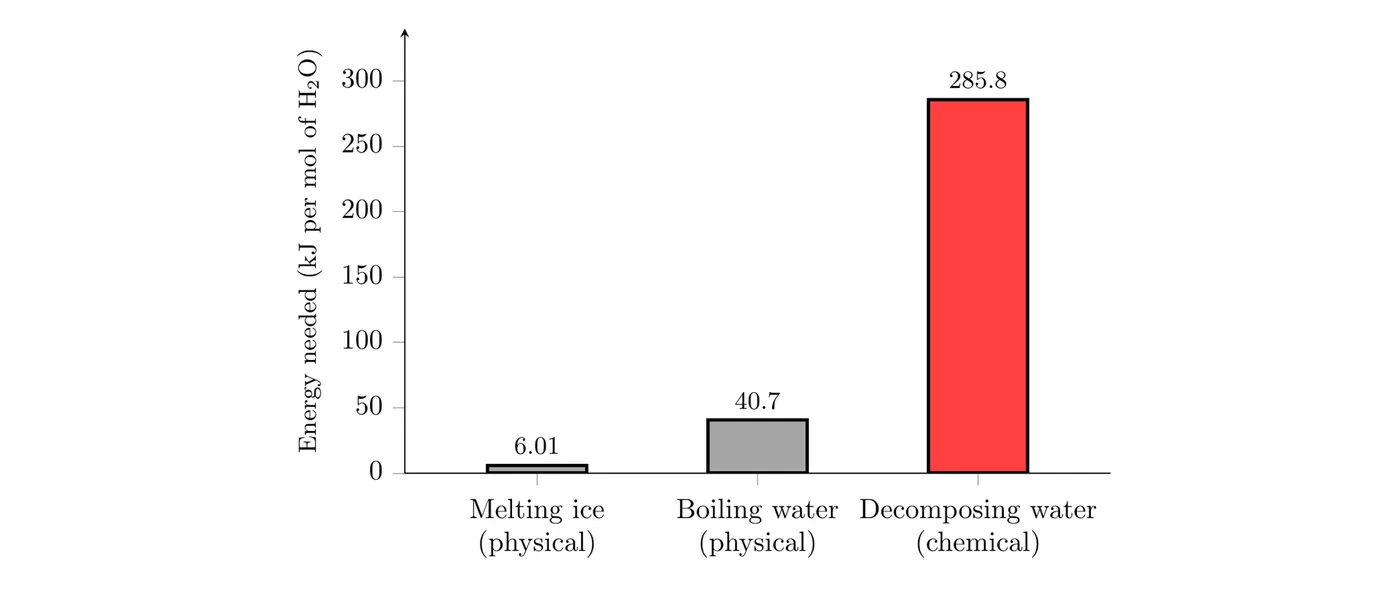
The energy needed shows how different these are. The bars below use standard values per mole of water: melting at 0 °C, boiling at 100 °C, and decomposing at 25 °C. Decomposing water takes about 7 times as much energy as boiling it, and more than 40 times as much as melting it. You'll work with energies like these in Unit 6.
Connecting what you see to bonds and forces
The CED asks you to explain how macroscopic characteristics, the things you can observe and measure, connect to interactions at the particle level.
- Physical properties such as melting point, boiling point, and vapor pressure depend on how strongly the particles attract each other. Stronger intermolecular forces mean a higher boiling point. Substances held together by bonds all the way through (ionic solids, metals, and network solids like quartz) have very high melting points.
- Chemical properties such as flammability and reactivity depend on which bonds can break and which new bonds can form.
- Energy and reversibility. Physical changes usually involve smaller energy changes and can often be reversed just by changing the temperature or pressure: cool the steam and you get liquid water back. Chemical changes make substances with new properties, and getting the original substances back takes another reaction.
When a physical process breaks bonds
The line isn't always sharp. Some processes that are usually called physical do break chemical bonds. The standard example is dissolving a salt:
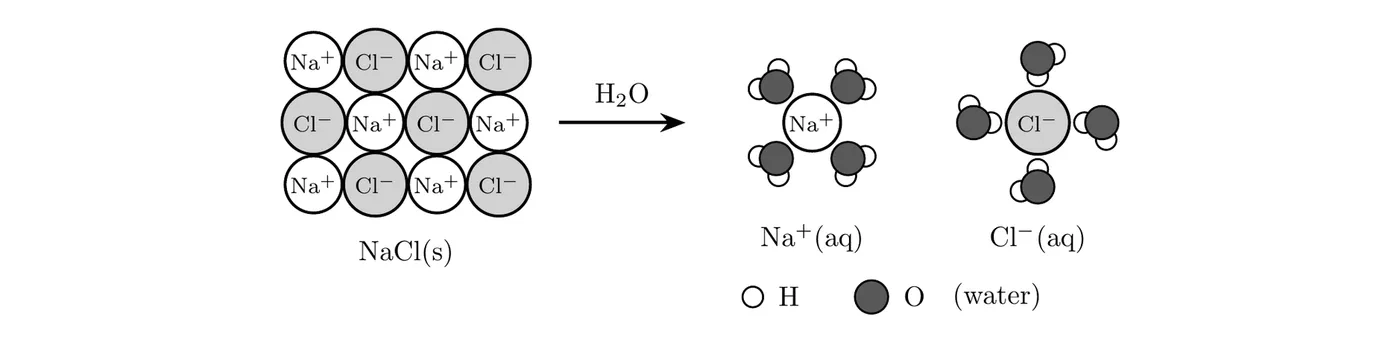
When dissolves, the ionic bonds holding and together in the crystal break, and new ion-dipole interactions form between the ions and water. Water is polar, so it lines up around each ion: the partially negative oxygen end points toward , and a partially positive hydrogen end points toward .
You could make a reasonable argument either way:
Argument that it's physical | Argument that it's chemical |
No new substance forms: the ions in solution are the same ions that were in the crystal | Ionic bonds, which are chemical bonds, are broken |
Evaporating the water gives back solid | New interactions (ion-dipole) form between the ions and water |
No ion changes its identity; only the attractions between particles change | The solution has a new property: it conducts electricity, and the solid doesn't |
On the AP exam, either classification can earn credit. What earns the point is the reasoning: name what breaks (the ionic bonds between ions) and what forms (ion-dipole interactions with water).
Melting an ionic solid, or a covalent network solid like quartz, , is a similar case. It's a phase change, so it's usually called physical, but it breaks some of the bonds that hold the solid together.
Example 1: Supporting a claim with lab data (AP-style)
A student heats two white solids in open crucibles and records these data.
Sample A | Sample B | |
Mass before heating | 2.50 g | 2.50 g |
While heating | Melts at 69 °C; no gas given off | Doesn't melt; gives off a gas that turns limewater cloudy |
Mass after cooling | 2.50 g | 1.59 g |
Heated a second time | Melts at 69 °C again | No further change in mass |
(a) Which sample went through a chemical change? Support your claim with evidence from the data.
Answer: Sample B. Its mass dropped from 2.50 g to 1.59 g, so something left as a gas, and that gas turned limewater cloudy, which is the test for carbon dioxide. A new substance formed. Sample A's mass didn't change, and it melted at the same temperature both times, so it was the same substance the whole time.
(b) Explain each result at the particle level.
Answer: Sample A is stearic acid, , a waxy solid. Melting only overcomes the intermolecular forces between its molecules (mostly London dispersion forces along their long carbon chains); the covalent bonds inside each molecule stay intact. Sample B is sodium hydrogen carbonate (baking soda), which decomposes:
Bonds inside the hydrogen carbonate ions break, and new substances (carbonate ions, water, and carbon dioxide) form. The water and carbon dioxide leave as gases, which is why the mass drops.
(c) Is Sample B's final mass consistent with this equation? Use 84.01 g/mol for and 105.99 g/mol for .
Answer: Yes. The predicted 1.58 g is very close to the measured 1.59 g, which supports the claim that the baking soda decomposed. Topic 4.5 covers calculations like this one.
Example 2: Classifying at the particle level
For each process, say what is broken and what is formed, then classify it.
Process | Broken | Formed | Classification |
London dispersion forces between molecules | Nothing new; the molecules spread out | Physical | |
(ethanol mixing with water) | Hydrogen bonds between ethanol molecules and between water molecules | Hydrogen bonds between ethanol and water | Physical |
The H-Cl covalent bond | A new O-H covalent bond in | Chemical | |
Ionic bonds in the crystal | Ion-dipole interactions with water | Either, with reasoning | |
C-H and O=O bonds | C=O and O-H bonds | Chemical |
Dissolving gas looks just like dissolving, but a covalent bond breaks and a new one forms, so it's a chemical change. It's an acid-base reaction, which Topic 4.8 covers.
Lab connection
Labs that separate or identify the parts of a mixture, like the AP lab that identifies the components of a pain reliever tablet, rely on physical properties such as solubility, melting point, and polarity. Those steps change only intermolecular interactions, so each component keeps its identity and can be recovered.
Common mistakes
- Saying that boiling water breaks the bonds in water molecules. It breaks hydrogen bonds between molecules; the O-H bonds inside them stay.
- Treating a hydrogen bond as a covalent bond because of its name.
- Claiming physical changes never break chemical bonds. Dissolving or melting an ionic solid does.
- Classifying the dissolving of a salt without saying what breaks and what forms. The explanation is what scores.
- Calling every dissolving process physical. Dissolving gas forms new covalent bonds, so it's a chemical change.