

4.1 - Introduction for Reactions
Overview
Matter changes all the time: ice melts, iron rusts, bread toasts. Chemists sort these changes into two kinds. A physical change alters how a substance looks or what state it's in, but it's still the same substance. A chemical change turns substances into new substances. This topic is about telling the two apart from what you can observe, and about predicting what you'd see in an experiment. Topic 4.4 explains the same difference at the level of bonds and particles.
Physical changes
A physical change happens when a substance's properties change but its composition doesn't. Composition means what the substance is made of: which atoms, in what ratio. Water is whether it's ice, liquid, or steam.
The two most common kinds of physical change:
- Phase changes. Melting, freezing, boiling (vaporization), condensation, sublimation, and deposition. Dry ice turning straight into a gas is the whole time.
- Forming or separating mixtures. Dissolving sugar in water, stirring sand into salt, or pulling a mixture apart by filtration, distillation, evaporation, or chromatography (Topic 3.9). Each component keeps its identity.
Changes in shape or size, like crushing a can or grinding a crystal into powder, are physical too.
Because the substance doesn't change, an equation for a physical change has the same formula on both sides. Only the phase label changes:
Chemical changes
A chemical change, also called a chemical reaction, happens when substances are transformed into new substances, typically with different compositions. The atoms rearrange into new combinations, so the products have new formulas and new properties: a different color, melting point, smell, or reactivity.
Magnesium is a shiny metal and oxygen is a colorless gas. The product, magnesium oxide, is a white powder. That's a new substance.
Evidence of a chemical change
You can't watch atoms rearrange, so you look for clues. The CED names four:
Evidence | What you observe | Example |
Heat or light is produced | The mixture gets hot, glows, or burns | Methane burning in a Bunsen burner: |
A gas forms | Bubbles or fizzing, when nothing is boiling | Zinc in hydrochloric acid: |
A precipitate forms | Two clear solutions are mixed and a solid appears, making the mixture cloudy | Silver chloride, a white solid: |
A color change | A new color appears that wasn't in the starting materials | Copper wire in silver nitrate solution: the solution turns blue and silver crystals grow, |
A precipitate is an insoluble solid that forms when solutions are mixed. You'll write equations for precipitation reactions in Topic 4.2 and classify them in Topic 4.7.
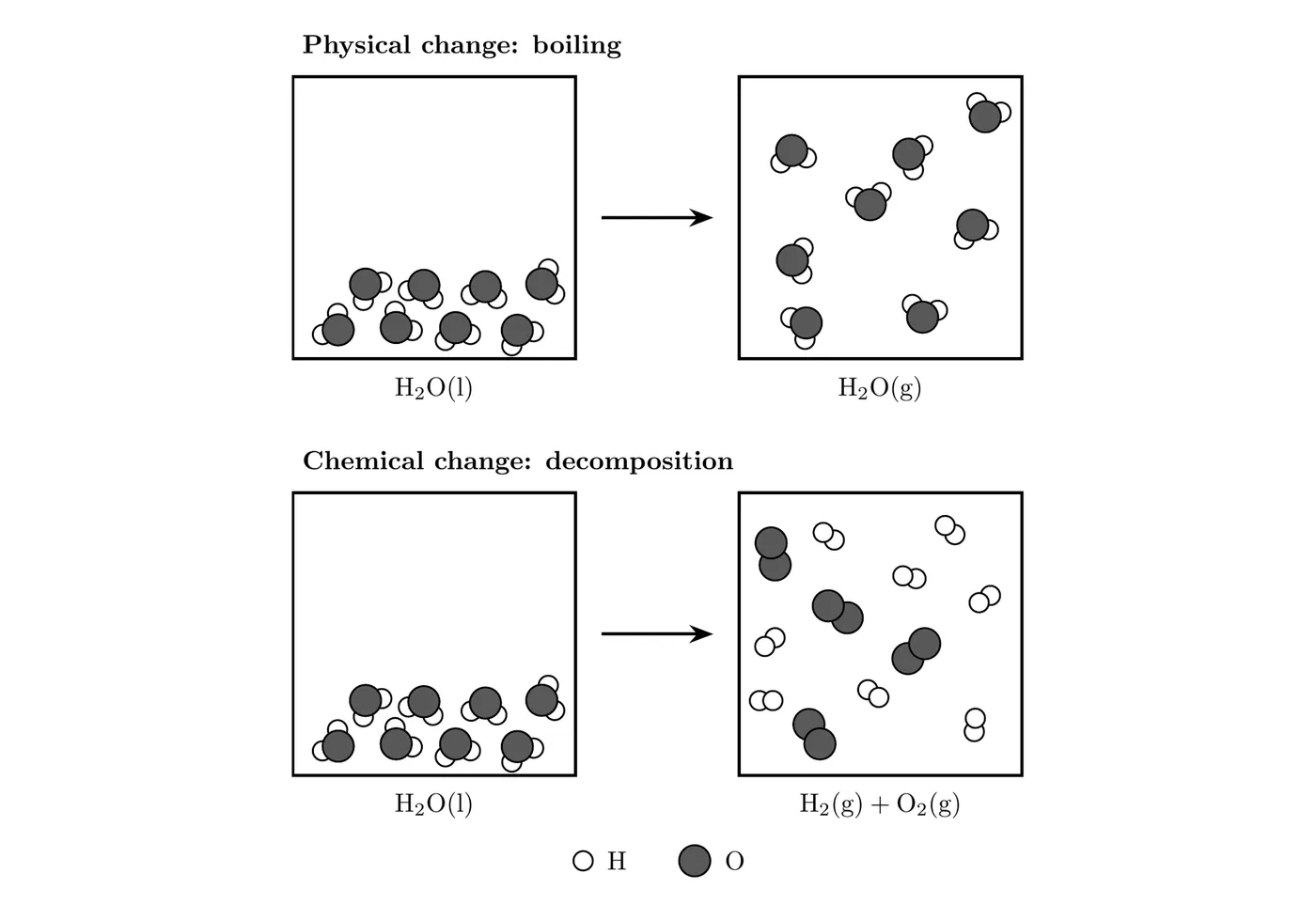
The figure below shows the difference at the particle level, starting from the same sample of liquid water both times. Boiling spreads the molecules apart, but every particle is still an molecule. Decomposition (for example, running an electric current through water) breaks the molecules apart and makes two new substances, and . The atoms are conserved: 8 water molecules hold 16 H atoms and 8 O atoms, and so do the 8 and 4 molecules.
Evidence is a clue, not proof
Each of the four clues can also show up during a physical change. That's why the CED calls them possible evidence.
Observation | A physical change that also does this |
Bubbles | Boiling water (the bubbles are water vapor), or opening a soda (dissolved escaping) |
Heat released | Steam condensing or water freezing |
Light | A light bulb filament glowing (it's still tungsten) |
A solid appears | A saturated solution cooling until crystals of the same solute come back out |
A color change | Dissolving a colored dye in water |
So don't stop at one observation. The real question is always: did a new substance form? The strongest evidence shows that something with new properties now exists, such as a gas that turns limewater cloudy (a test for ), or a leftover solid that dissolves in water when the starting solid didn't.
What the AP exam asks
- Given a set of observations, identify which ones support a chemical change and explain why.
- Predict what you would observe when substances are combined. The CED's suggested skill for this topic is forming a hypothesis or predicting the results of an experiment.
- Explain why a single observation, like bubbles or heat, isn't enough on its own.
Example 1: Sorting observations
Classify each change as physical or chemical, and give the evidence.
- (a) Gently heating solid iodine makes a purple vapor, and purple crystals form again on a cold surface above it.
- Physical. This is sublimation, then deposition. The vapor and the crystals are both : .
- (b) Mixing clear, colorless solutions of lead(II) nitrate and potassium iodide makes a bright yellow solid.
- Chemical. A precipitate forms and a new color appears. The yellow solid is lead(II) iodide, , which wasn't present before.
- (c) Sugar stirred into hot tea disappears.
- Physical. The sugar molecules spread out among the water molecules, forming a mixture. Evaporating the water would leave the sugar behind.
- (d) A strip of magnesium burns with a blinding white light and leaves a white powder.
- Chemical. Heat and light are produced, and the shiny metal becomes a white powder (magnesium oxide) with completely different properties.
- (e) Steam fogs up a cold mirror.
- Physical. Water vapor condenses into liquid water. It's the whole time.
Example 2: Predicting observations (AP-style)
A student drops a small piece of solid calcium carbonate, (the main compound in chalk and marble), into a beaker of hydrochloric acid. The reaction is
(a) Predict two observations that would show a chemical change happened.
Answer: Bubbles of gas form on the solid (that's the ), and the solid gets smaller and eventually disappears as it's used up.
(b) A classmate says the chalk just dissolved, like sugar in water. What evidence could the student collect to show a chemical change instead?
Answer: Dissolving doesn't produce a gas, so the bubbles already point to a new substance. For stronger evidence, evaporate the water at the end. The white solid left behind is calcium chloride, and it dissolves easily in water, while calcium carbonate doesn't dissolve in water. A solid with different properties from the starting solid means a new substance formed.
(c) What control would make the evidence stronger?
Answer: Drop an identical piece of chalk into pure water. No bubbles form and the chalk doesn't noticeably dissolve, so the change in the beaker of acid comes from a reaction with the acid.
Example 3: When heat isn't enough
Dissolving solid sodium hydroxide in water makes the beaker feel hot. A student claims this proves a chemical reaction happened. Evaluate the claim.
Answer: Heat alone doesn't prove it. The ions in the solution, and , are the same ions that made up the solid, and evaporating the water gives back solid :
No new substance formed, so dissolving is usually classified as a physical change. Topic 4.4 explains why dissolving an ionic solid can be argued either way, since ionic bonds do break.
Common mistakes
- Treating any bubbles as proof of a reaction. Boiling makes bubbles too.
- Thinking a phase change makes a new substance. Ice, liquid water, and steam are all .
- Calling dissolving a chemical change just because the solid seems to disappear.
- Listing an observation without connecting it to a new substance. On the AP exam, say what the evidence shows: "a gas formed, so a new substance was produced."
- Calling crystals that come out of a cooling solution a precipitate from a reaction. If it's the same solute coming back out, the change is physical.