

4.6 - Introduction to Titration
Overview
A titration measures how much of a substance is dissolved in a solution by reacting it with a carefully measured volume of another solution whose concentration you already know. It's one of the most common lab techniques in chemistry, and the AP exam uses it in lab setups, data tables, and graphs. This topic is about finding the equivalence point: the moment the two reactants have been mixed in exactly the amounts the balanced equation calls for.
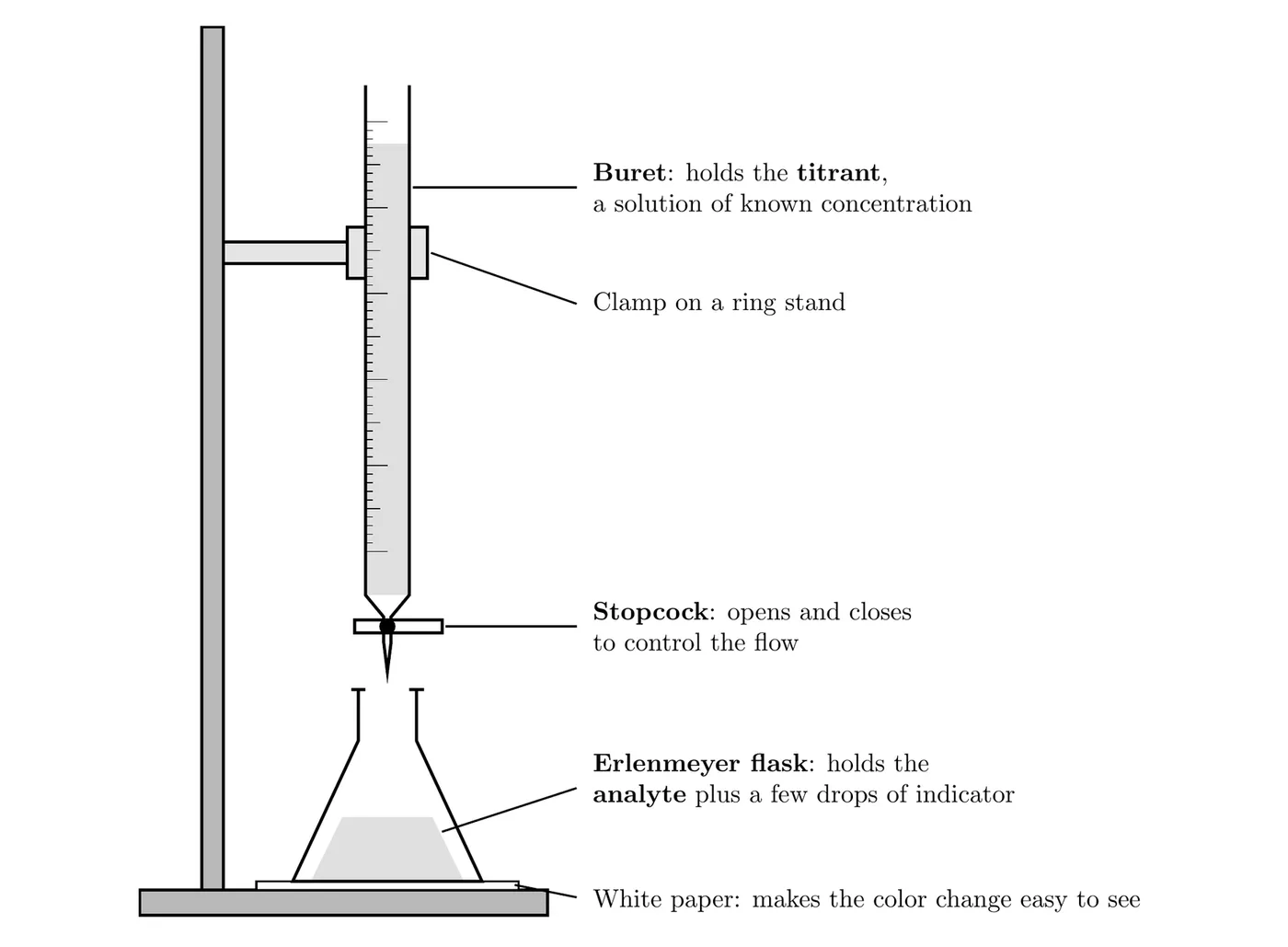
The parts of a titration
- Analyte: the substance you're measuring. Its amount or concentration is the unknown, and it sits in the flask.
- Titrant: the solution of known concentration that you add from a buret. A solution whose concentration is known precisely is called a standard solution.
- Indicator: a few drops of a dye that changes color when the reaction is complete.
The titrant has to react with the analyte specifically and quantitatively. Specifically means it reacts with the analyte and nothing else in the flask. Quantitatively means the reaction goes to completion in the exact mole ratio of the balanced equation. If either one fails, the volume you measure won't tell you the true amount of analyte.
The procedure
- Measure the analyte precisely (with a volumetric pipet, or weigh a solid and dissolve it). Put it in an Erlenmeyer flask with a few drops of indicator.
- Rinse the buret with a little titrant (not just water), fill it, and record the starting volume.
- Add titrant while swirling the flask. Go quickly at first, then drop by drop once the color starts to linger.
- Stop at the first color change that lasts, and record the final volume. The volume of titrant used is the final reading minus the initial reading.
- Repeat until two or three trials agree closely, often within 0.10 mL.
Reading a buret
A buret is marked every 0.1 mL, and you estimate one more digit, so every buret reading has two decimal places (like 12.36 mL). Read the bottom of the curved liquid surface (the meniscus) with your eye level with it. The scale starts at 0.00 mL at the top and the numbers increase going down, because a buret measures how much liquid has left it.
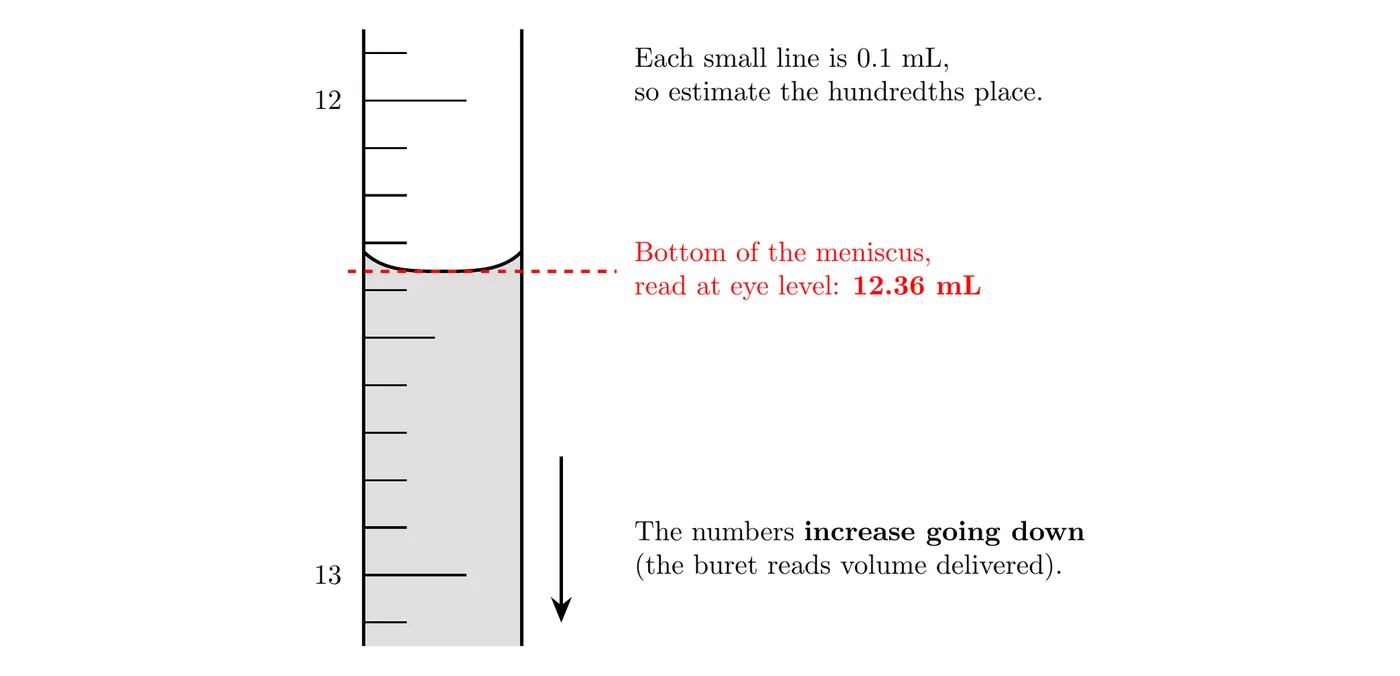
Two decimal places means a delivered volume like 33.77 mL has four significant figures. That precision is why chemists titrate with a buret instead of a graduated cylinder.
Equivalence point and endpoint
The equivalence point is the point where the analyte has been totally consumed by the titrant. At that point, the moles of titrant added and the moles of analyte are in exactly the ratio of their coefficients in the balanced equation:
You can't see molecules, so you need an observable signal that you've arrived. The endpoint is that observable event, usually a color change, that tells you to stop adding titrant. A good indicator is chosen so the endpoint happens at, or extremely close to, the equivalence point.
For acid-base titrations, phenolphthalein is a common indicator. It's colorless in acidic solution and pink in basic solution, so when you titrate an acid with NaOH, the first drop of extra base turns the flask pale pink. Other properties work too. A pH probe shows a sudden jump in pH. In a redox titration with purple permanganate, , the titrant is its own indicator: it loses its color as long as analyte is left, so the first pink color that lasts is the endpoint (Topic 4.9 has an example). Choosing an indicator by its pH range comes in Unit 8.
Example 1: Predicting the equivalence point
A student titrates 20.00 mL of 0.1250 M with 0.1000 M NaOH. What volume of NaOH is needed to reach the equivalence point?
Step 1: Write the balanced equation. Sulfuric acid has two acidic hydrogens, so each molecule needs two hydroxide ions.
Step 2: Find the moles of analyte. Convert mL to L first.
Step 3: Use the mole ratio from the equation.
Step 4: Find the volume of titrant from the molarity, .
Answer: The equivalence point is at 50.00 mL of NaOH, twice what a 1:1 ratio would give.
Graphing a titration
If you track pH with a probe while adding titrant, you can graph the results as a titration curve. Build it the way the AP exam expects:
- Volume of titrant added (mL) on the x-axis (it's what you control) and pH on the y-axis.
- Both axes labeled with the quantity and its units (pH has none).
- A scale that uses most of the grid: pH 0 to 14, and volume from 0 to a bit past the equivalence point.
- A smooth curve through the data points, not a jagged connect-the-dots.
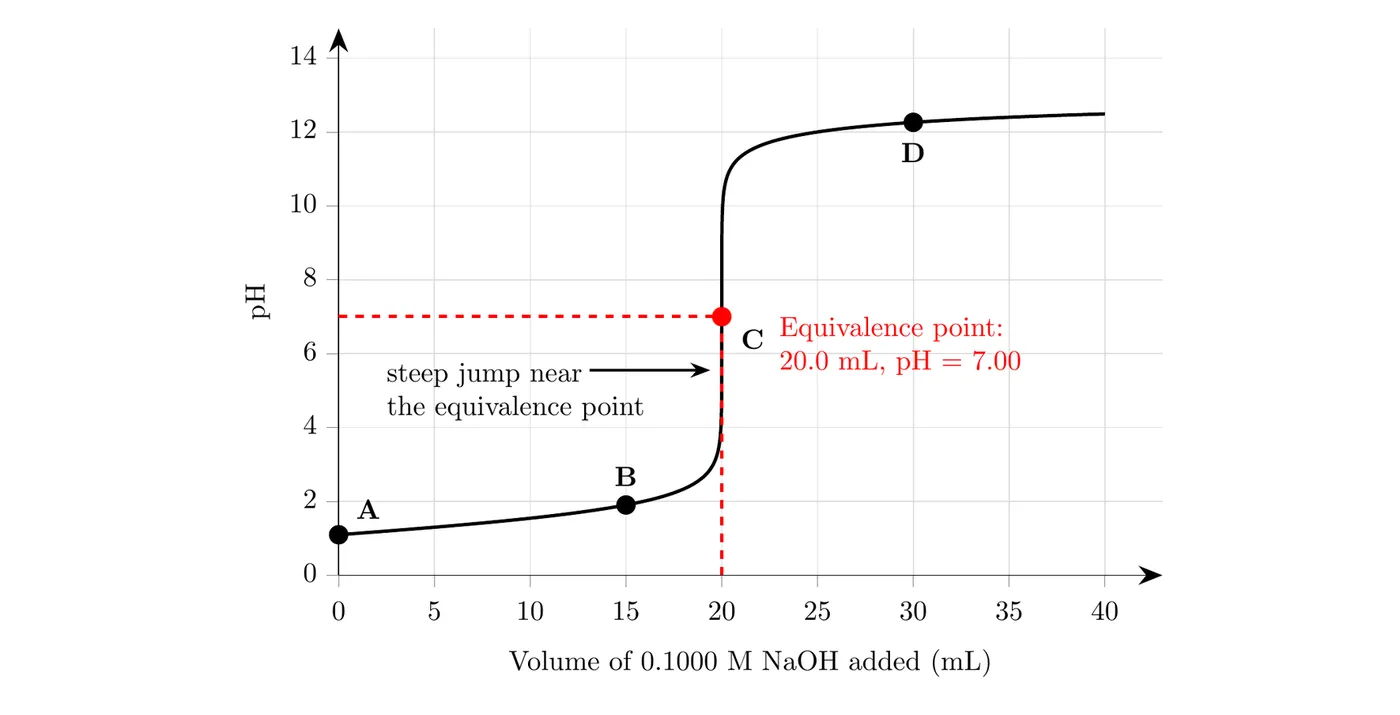
This curve is for 25.00 mL of nitric acid, , titrated with 0.1000 M NaOH. Read it in four stages:
- A (0 mL): only is in the flask. It's a strong acid, so the pH is low (1.10).
- B (15.0 mL): three-quarters of the acid has been neutralized, yet the pH has only risen from 1.10 to 1.90. The that's left still makes the solution strongly acidic.
- C (20.0 mL), the equivalence point: all of the has reacted. The flask holds just , , and water, so the pH is 7.00. Near this point, a single drop of base raises the pH by several units.
- D (30.0 mL): the extra has nothing left to react with, so the pH is high (12.26) and levels off.
To find the equivalence point on any titration curve, look for the middle of the steep, nearly vertical section and read its volume. The pH there is 7 only for a strong acid with a strong base. Weak acids and bases shift it (Unit 8), but the middle of the steep section is always the spot.
What the particles are doing
Here is the same titration at the particle level, with water molecules not shown. and are spectator ions: they never react. So stays at four particles the whole time, while builds up as base is added.
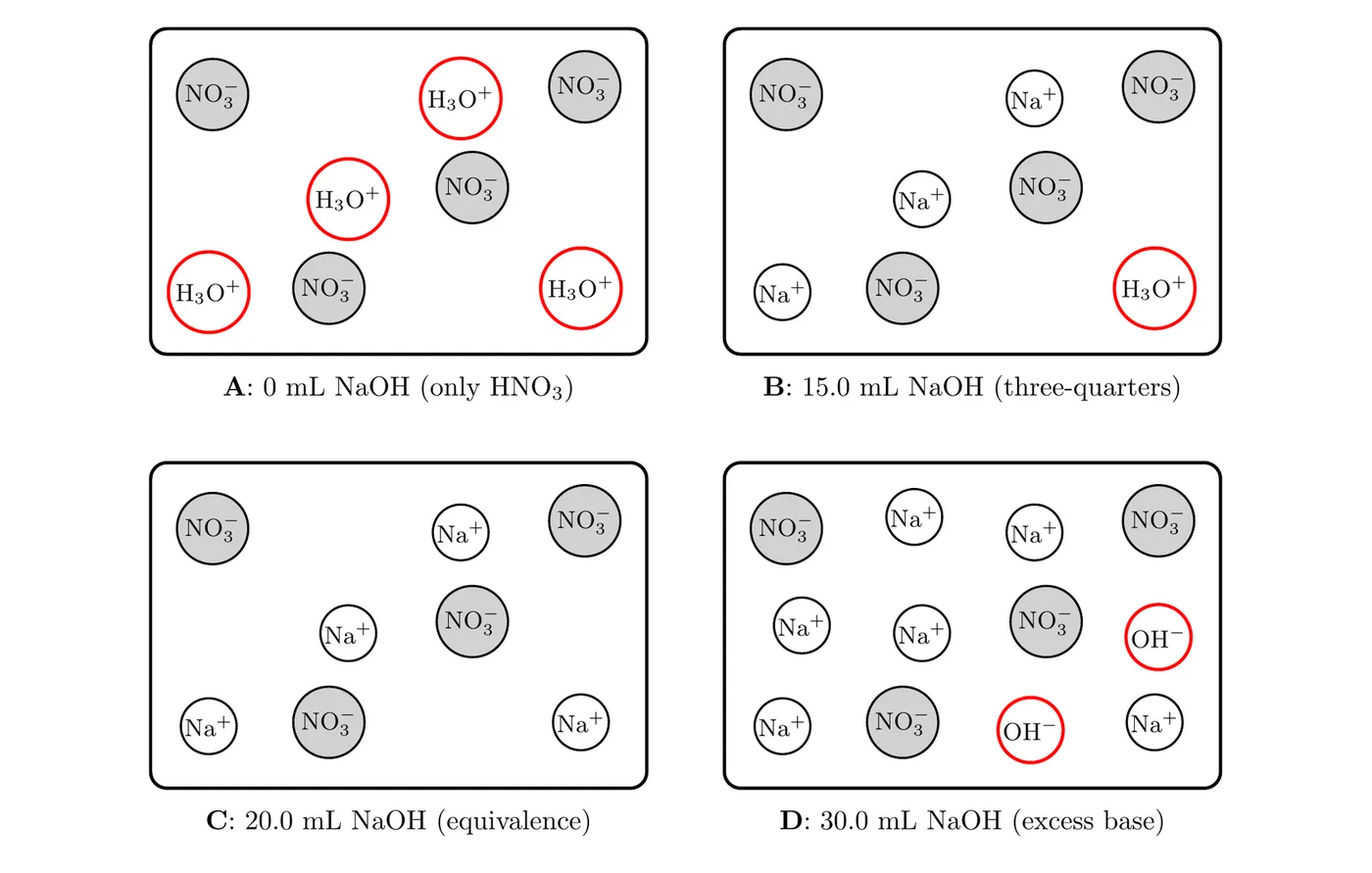
Point | What it shows | ||||
A | 4 | 0 | 0 | 4 | Only acid |
B | 1 | 0 | 3 | 4 | Three-quarters of the acid is used up |
C | 0 | 0 | 4 | 4 | Acid used up, no extra base |
D | 0 | 2 | 6 | 4 | Excess base |
Each that drips in removes one :
So a box never shows many and ions together. To match a box to a point on the curve, check for leftover or , and count the ions that came in with the titrant.
Example 2: Reading the equivalence point from a curve
Use the titration curve above to find the concentration of the nitric acid.
Step 1: Read the equivalence volume. The steep section is centered at 20.0 mL of NaOH. The graph can be read to about 0.1 mL, so this value has three significant figures.
Step 2: Find the moles of NaOH at the equivalence point.
Step 3: and NaOH react 1:1 (one per ), so the flask held mol of .
Step 4: Divide by the volume of the original acid sample.
Answer: 0.0800 M . It agrees with the starting pH on the graph, since .
Example 3: How much acid is in lemon juice? (AP-style)
The AP lab on how much acid is in fruit juice and soft drinks works like this example. A student pipets 5.00 mL of lemon juice into a flask, adds about 20 mL of water and a few drops of phenolphthalein, and titrates with 0.1105 M NaOH. The buret reads 0.85 mL at the start and 34.62 mL at the endpoint. Assume citric acid, (molar mass 192.12 g/mol), is the only acid in the juice. It has three acidic hydrogens:
(a) Calculate the mass of citric acid per liter of lemon juice. (b) The student rinsed the buret with distilled water but forgot to rinse it with the NaOH solution before filling it. Is the calculated amount of citric acid too high, too low, or unchanged?
(a) The volume of titrant is mL, or 0.03377 L.
The lemon juice contains about 47.8 g of citric acid per liter. The answer has three significant figures because the 5.00 mL juice sample has three.
The 20 mL of water added to the flask doesn't change this. It adds no acid, and the equivalence point depends only on moles.
(b) Too high. Water left in the buret dilutes the NaOH, so its real concentration is below 0.1105 M. It takes a larger volume to deliver the moles of base needed, but the student multiplies that larger volume by the labeled 0.1105 M, so the calculated moles of NaOH (and of citric acid) come out too large.
Three more lab errors the AP exam likes to ask about:
- Overshooting the endpoint (dark pink): too high, because extra titrant is counted as if it reacted.
- An air bubble in the buret tip that comes out during the titration: too high, because the bubble's volume is read as liquid delivered.
- Analyte splashing out of the flask: too low, because less titrant is needed.
Common mistakes
- Assuming every titration is 1:1. Write the balanced equation and use its mole ratio. needs two NaOH, and citric acid needs three.
- Mixing up the equivalence point and the endpoint. The equivalence point is the stoichiometric point. The endpoint is the color change you see.
- Using the wrong volume for the analyte. Divide by the volume of the original sample, not the total volume in the flask. Water added to the flask doesn't matter.
- Thinking pH = 7 at every equivalence point. That's only true for a strong acid with a strong base.