

6.3 - Heat Transfer and Thermal Equilibrium
Overview
Put a hot object next to a cold one and they end up at the same temperature. This topic explains why, at the level of particles. Temperature measures how much kinetic energy particles have on average, collisions pass energy from faster particles to slower ones, and the net transfer stops once both objects match. The AP exam expects you to connect what you see (temperatures changing) with what the particles are doing.
Temperature and average kinetic energy
The particles in any sample are always moving. Gas and liquid particles move from place to place, and particles in a solid vibrate in place. Each moving particle has kinetic energy:
The particles in one sample have a wide range of speeds (the Maxwell-Boltzmann distribution from Unit 3), so they don't all have the same kinetic energy. Temperature measures the average kinetic energy of the particles. The particles in a warmer object have a greater average kinetic energy than the particles in a cooler object.
Temperature is not the same thing as total energy. A bathtub of water at 40 °C has a lower temperature than a cup of tea at 80 °C, but the bathtub holds far more thermal energy, because it has so many more particles.
Heat transfer happens through collisions
When two objects are in thermal contact (touching, or mixed together), their particles collide where they meet. In a typical collision between a fast particle from the warmer object and a slow particle from the cooler object, the fast particle slows down and the slow one speeds up. Kinetic energy passes from one to the other.
A single collision can go either way, but on average energy moves from the warmer object to the cooler one. This net flow of energy caused by a temperature difference is called heat transfer, heat exchange, or transfer of energy as heat. The amount of energy transferred is , measured in joules (J).
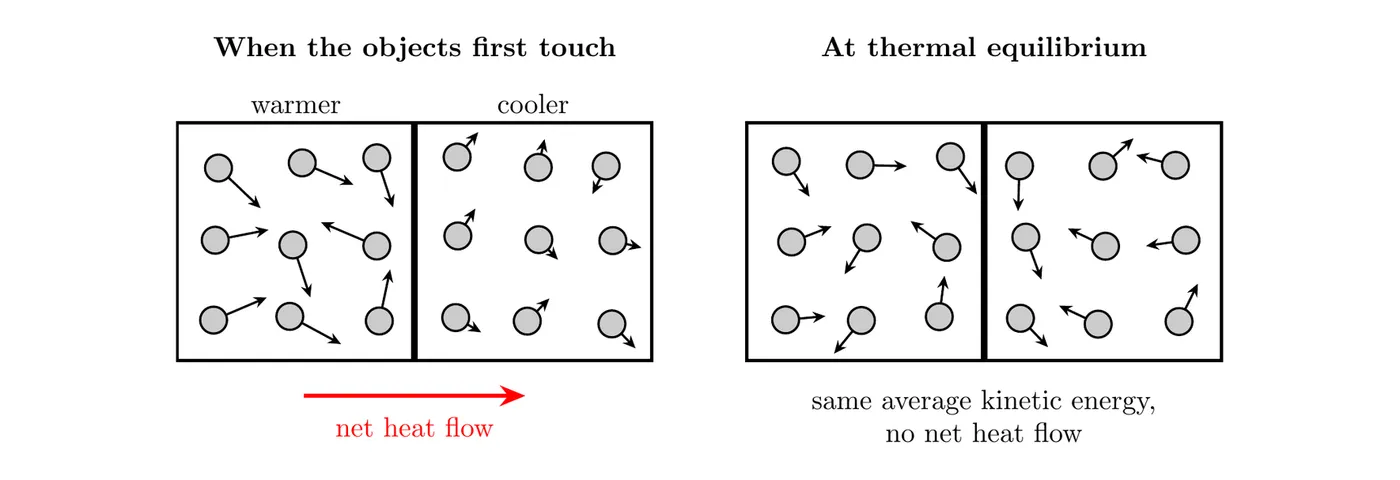
Three things follow from this picture:
- Heat flows from hot to cold, never the other way on its own. The particles of the warmer object have more kinetic energy to give.
- The warmer object cools and the cooler object warms. The average kinetic energies of their particles move toward each other.
- The energy lost by one object equals the energy gained by the other, as long as no energy escapes to anything else (as in an insulated container). This is conservation of energy. Topic 6.4 turns it into an equation: .
Thermal equilibrium
Collisions continue as the temperatures approach each other. Eventually the average kinetic energy of the particles is the same in both objects. From then on, the energy passed one way in collisions is balanced by the energy passed the other way, so there is no net heat transfer and both temperatures stay constant. This state is thermal equilibrium: both objects have the same average kinetic energy, so they have the same temperature.
Particles don't stop moving or colliding at thermal equilibrium. The net flow of energy is zero, which is a different statement.
The graph shows a 50.0 g block of aluminum at 85.0 °C dropped into 100.0 g of water at 22.0 °C in an insulated cup.
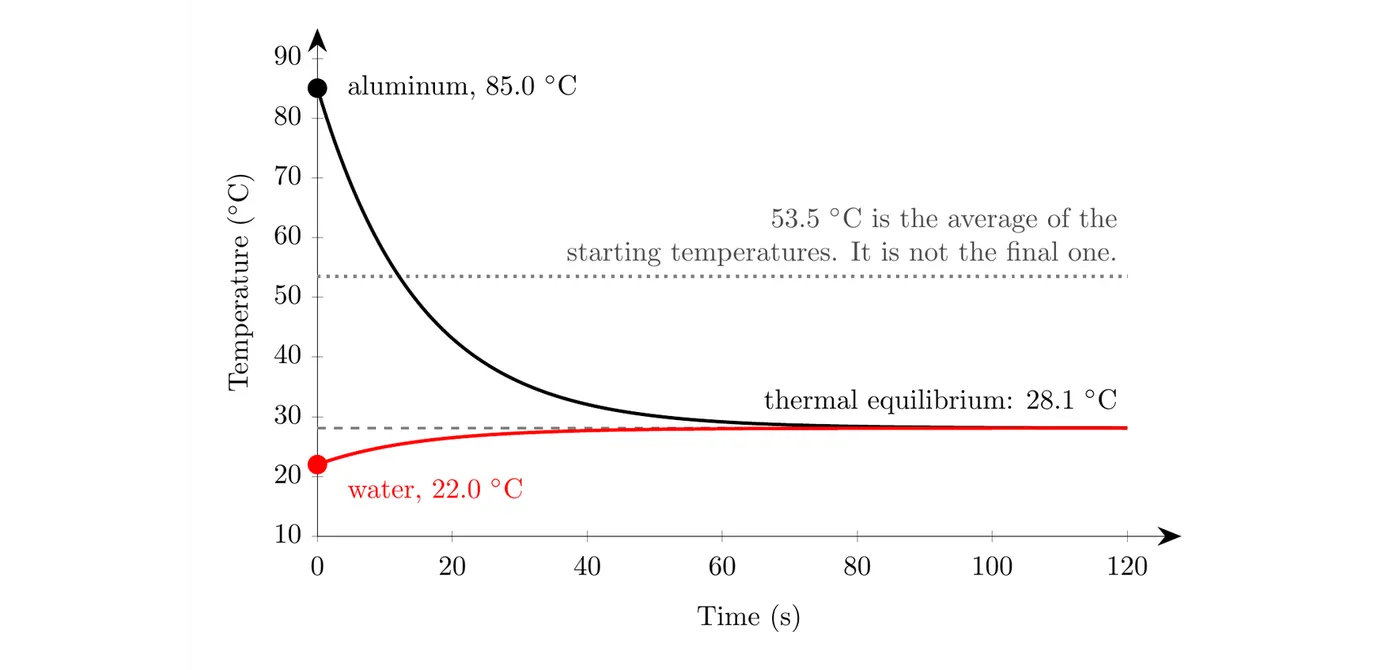
The two curves meet at 28.1 °C and stay there. The final temperature is always between the two starting temperatures, but it usually isn't their average (53.5 °C here). It lands closer to the starting temperature of whichever sample needs more energy to change its temperature. Here that's the water, which has twice the mass of the aluminum and about 4.7 times its specific heat. Topic 6.4 shows how to calculate the 28.1 °C.
Example 1: Which way does heat flow?
A 10.0 g iron nail at 75 °C is dropped into 2.00 L of water at 30 °C. The water has far more total thermal energy than the nail. Which way does heat flow?
Heat flows from the nail to the water. The direction depends only on temperature (average kinetic energy), not on total energy. The iron atoms have the greater average kinetic energy, so on average the collisions at the nail's surface pass energy from iron atoms to water molecules. The nail cools, the water warms very slightly, and the net transfer stops when they reach the same temperature. That temperature is just barely above 30 °C, because there's so much water.
Example 2: Explaining thermal equilibrium (AP-style)
Use the aluminum and water graph above. (a) At time 0, compare the average kinetic energies of the particles in the two samples. (b) Explain, in terms of particles, why the temperature of the water rises during the first 40 seconds. (c) At 100 seconds, are aluminum atoms and water molecules still colliding? Is there any net heat transfer? Justify both answers.
(a) The aluminum is at 85.0 °C and the water is at 22.0 °C. Temperature measures average kinetic energy, so the aluminum atoms have a greater average kinetic energy than the water molecules.
(b) Where the aluminum touches the water, fast-vibrating aluminum atoms collide with slower-moving water molecules. On average, these collisions transfer kinetic energy from the aluminum atoms to the water molecules. The average kinetic energy of the water molecules increases, so the water's temperature rises, while the aluminum's falls.
(c) Yes, the particles are still colliding, because particles never stop moving. But both samples are now at 28.1 °C, so their particles have the same average kinetic energy. The energy transferred in one direction is balanced by the energy transferred in the other, so there is no net heat transfer. The samples are at thermal equilibrium, which is why both curves are flat.
Common mistakes
- Saying cold flows. Only energy flows, and it goes from warmer to cooler.
- Confusing heat and temperature. Temperature measures average kinetic energy (°C or K). Heat is energy being transferred (J).
- Thinking particles stop at equilibrium. They keep moving and colliding. Only the net transfer stops.
- Assuming the final temperature is the average. That only happens when both samples have the same mass and the same specific heat.
- Saying the object with more total energy gives energy away. The direction depends on temperature, not on total thermal energy.
- Describing only temperatures when a question asks about particles. A particle-level explanation needs collisions and average kinetic energy.