Dove's LibraryDove's Library

6.8 - Enthalpy of Formation

Overview

Nobody can list ΔH\Delta H for every possible reaction, but chemists can list one number for each compound: its standard enthalpy of formation, ΔHf∘\Delta H_f^\circ. With a table of these values, you can calculate ΔH∘\Delta H^\circ for almost any reaction in one line, using an equation that's on the AP reference sheet. It's the most accurate of the Unit 6 methods for finding ΔH\Delta H from tables, and AP questions use it often.

What a standard enthalpy of formation is

The standard enthalpy of formation, ΔHf∘\Delta H_f^\circ, of a compound is the enthalpy change when one mole of the compound forms from its elements in their standard states. The reaction it describes is called a formation reaction:
C(s)+O2(g)→CO2(g)ΔHf∘=−393.5 kJ/mol\mathrm{C(s) + O_2(g) \rightarrow CO_2(g)} \qquad \Delta H_f^\circ = -393.5\ \mathrm{kJ/mol}H2(g)+12O2(g)→H2O(l)ΔHf∘=−285.8 kJ/mol\mathrm{H_2(g) + \tfrac{1}{2}O_2(g) \rightarrow H_2O(l)} \qquad \Delta H_f^\circ = -285.8\ \mathrm{kJ/mol}12N2(g)+32H2(g)→NH3(g)ΔHf∘=−46.1 kJ/mol\mathrm{\tfrac{1}{2}N_2(g) + \tfrac{3}{2}H_2(g) \rightarrow NH_3(g)} \qquad \Delta H_f^\circ = -46.1\ \mathrm{kJ/mol}
A formation reaction has to follow three rules:
  • Exactly 1 mol of the compound is made. Fractions on the reactant side are fine, which is why you see 12O2\tfrac{1}{2}\mathrm{O_2}.
  • Only elements are reactants.
  • Each element is in its standard state: its most stable form at 1 atm and 25 °C. For example O2(g)\mathrm{O_2}(g), H2(g)\mathrm{H_2}(g), N2(g)\mathrm{N_2}(g), C(s)\mathrm{C}(s) as graphite, Fe(s)\mathrm{Fe}(s), Br2(l)\mathrm{Br_2}(l), and Hg(l)\mathrm{Hg}(l).
Check yourself:
Equation
Formation reaction?
Why
2H2(g)+O2(g)→2H2O(l)\mathrm{2H_2(g) + O_2(g) \rightarrow 2H_2O(l)}
No
It makes 2 mol of water, not 1
CO(g)+12O2(g)→CO2(g)\mathrm{CO(g) + \tfrac{1}{2}O_2(g) \rightarrow CO_2(g)}
No
CO\mathrm{CO} is a compound, not an element
C(s, diamond)+O2(g)→CO2(g)\mathrm{C(s,\ diamond) + O_2(g) \rightarrow CO_2(g)}
No
Graphite, not diamond, is carbon's standard state
Na(s)+12Cl2(g)→NaCl(s)\mathrm{Na(s) + \tfrac{1}{2}Cl_2(g) \rightarrow NaCl(s)}
Yes
1 mol of product, made from elements in their standard states

What the degree sign means

The ° in ΔHf∘\Delta H_f^\circ means standard conditions: gases at 1 atm, solutions at 1 M, and each substance in its stated phase, usually at 25 °C (298 K). It doesn't mean 0 °C.

Elements in their standard states have a value of zero

Forming O2(g)\mathrm{O_2}(g) from O2(g)\mathrm{O_2}(g) isn't a change at all, so ΔHf∘=0\Delta H_f^\circ = 0. The same is true for every element in its standard state, which is why tables either leave them out or list 0. Only the standard state gets zero: ozone (O3\mathrm{O_3}), bromine gas, and diamond all have nonzero values.

Phase matters

Water has two different values: −285.8-285.8 kJ/mol for H2O(l)\mathrm{H_2O}(l) and −241.8-241.8 kJ/mol for H2O(g)\mathrm{H_2O}(g). The 44.0 kJ/mol difference is the energy needed to vaporize a mole of water at 25 °C. (That's a bit more than the 40.7 kJ/mol in Topic 6.5, which is for water boiling at 100 °C.) Always use the value that matches the phase in the equation.

Using the table

These are the values used on this page (standard tables, rounded to one decimal; other books may differ by a few tenths). On the AP exam, the question always gives you the values you need.
Substance
ΔHf∘\Delta H_f^\circ (kJ/mol)
Substance
ΔHf∘\Delta H_f^\circ (kJ/mol)
CH4(g)\mathrm{CH_4}(g)
−74.8-74.8
H2O(l)\mathrm{H_2O}(l)
−285.8-285.8
C3H8(g)\mathrm{C_3H_8}(g)
−103.8-103.8
H2O(g)\mathrm{H_2O}(g)
−241.8-241.8
C2H5OH(l)\mathrm{C_2H_5OH}(l)
−277.7-277.7
Fe2O3(s)\mathrm{Fe_2O_3}(s)
−824.2-824.2
CO2(g)\mathrm{CO_2}(g)
−393.5-393.5
Al2O3(s)\mathrm{Al_2O_3}(s)
−1675.7-1675.7
O2(g)\mathrm{O_2}(g), Al(s)\mathrm{Al}(s), Fe(s)\mathrm{Fe}(s)
0

Calculating the enthalpy of reaction

This equation is on the AP reference sheet:
ΔHrxn∘=∑ΔHf∘(products)−∑ΔHf∘(reactants)\Delta H^\circ_{\mathrm{rxn}} = \sum \Delta H_f^\circ(\text{products}) - \sum \Delta H_f^\circ(\text{reactants})
  1. Write the balanced equation with phases.
  1. Look up ΔHf∘\Delta H_f^\circ for each substance. Elements in their standard states are 0.
  1. Multiply each value by its coefficient. ΔHf∘\Delta H_f^\circ is per mole of that compound.
  1. Subtract: products minus reactants. Watch the signs, since subtracting a negative number means adding.

Why it works

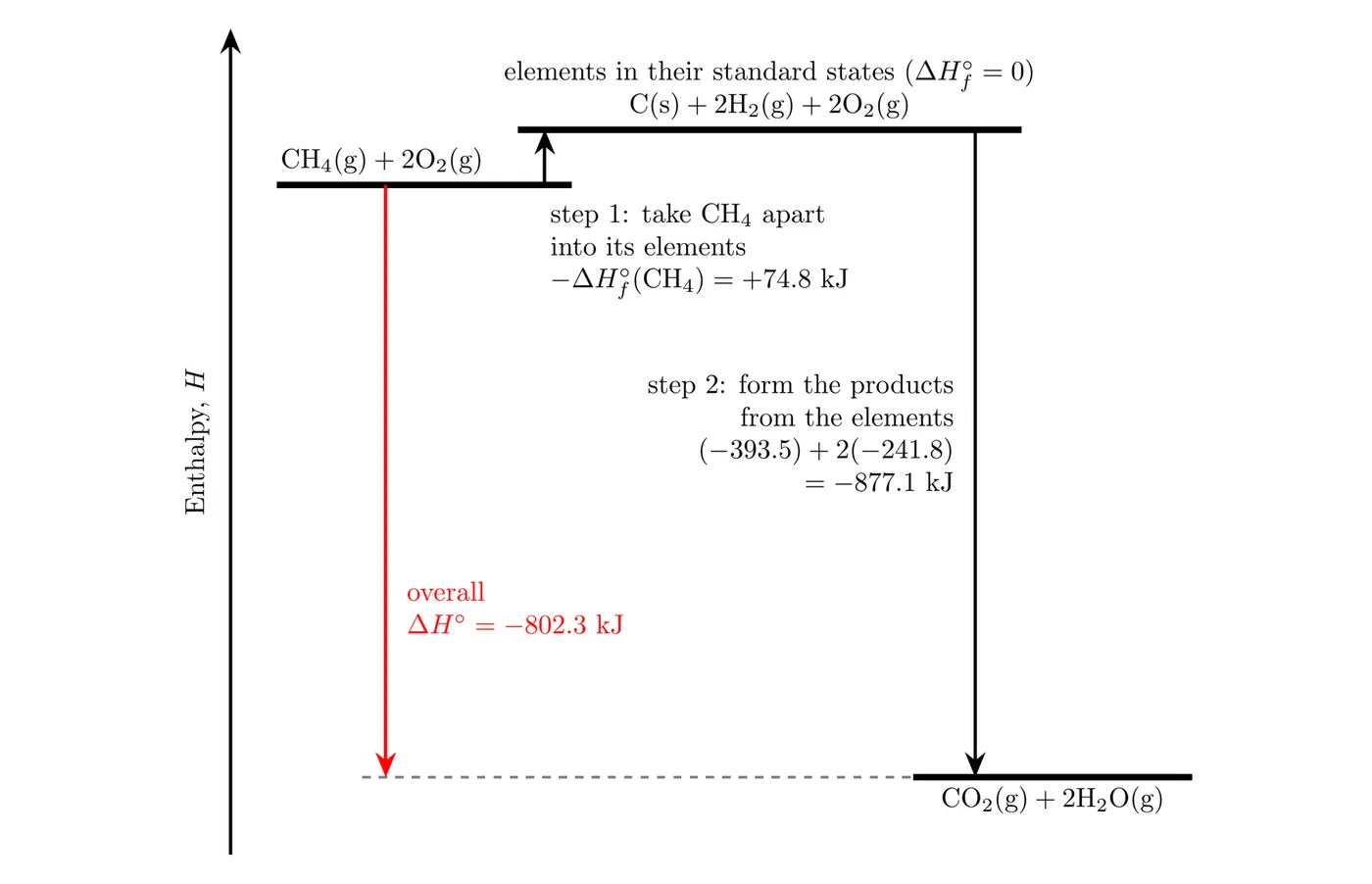
Imagine running the reaction in two steps. First, take the reactants apart into their elements: that's the reverse of their formation reactions, so it has ΔH=−∑ΔHf∘(reactants)\Delta H = -\sum \Delta H_f^\circ(\text{reactants}). Second, build the products from those same elements: ΔH=+∑ΔHf∘(products)\Delta H = +\sum \Delta H_f^\circ(\text{products}). Adding the two steps gives the formula. (Topic 6.9 explains why adding steps is allowed.)
6.8 - Enthalpy of Formation
The line for the elements acts as a shared zero. Every ΔHf∘\Delta H_f^\circ is a height measured from that line, so ΔHrxn∘\Delta H^\circ_{\mathrm{rxn}} is just the height of the products minus the height of the reactants.

Example 1: Burning methane, again

(a) Use the table to calculate ΔH∘\Delta H^\circ for:
CH4(g)+2O2(g)→CO2(g)+2H2O(g)\mathrm{CH_4(g) + 2O_2(g) \rightarrow CO_2(g) + 2H_2O(g)}∑ΔHf∘(products)=(1)(−393.5)+(2)(−241.8)=−393.5−483.6=−877.1 kJ\sum \Delta H_f^\circ(\text{products}) = (1)(-393.5) + (2)(-241.8) = -393.5 - 483.6 = -877.1\ \mathrm{kJ}∑ΔHf∘(reactants)=(1)(−74.8)+(2)(0)=−74.8 kJ\sum \Delta H_f^\circ(\text{reactants}) = (1)(-74.8) + (2)(0) = -74.8\ \mathrm{kJ}ΔH∘=−877.1−(−74.8)=−802.3 kJ/molrxn\Delta H^\circ = -877.1 - (-74.8) = -802.3\ \mathrm{kJ/mol_{rxn}}
Answer: −802.3 kJ/molrxn-802.3\ \mathrm{kJ/mol_{rxn}}. In Topic 6.7, bond enthalpies estimated −808 kJ/molrxn-808\ \mathrm{kJ/mol_{rxn}} for the same reaction. They're close, and the value from enthalpies of formation is the more accurate one.
(b) What is ΔH∘\Delta H^\circ if the water forms as a liquid instead? Replace −241.8-241.8 with −285.8-285.8:
ΔH∘=[(−393.5)+2(−285.8)]−(−74.8)=−965.1+74.8=−890.3 kJ/molrxn\Delta H^\circ = [(-393.5) + 2(-285.8)] - (-74.8) = -965.1 + 74.8 = -890.3\ \mathrm{kJ/mol_{rxn}}
Answer: −890.3 kJ/molrxn-890.3\ \mathrm{kJ/mol_{rxn}}, which is 88.0 kJ more negative. That's the extra heat released when 2 mol of water vapor condenses at 25 °C: 2(44.0)=88.02(44.0) = 88.0 kJ. Liquid water has lower enthalpy than water vapor, so making liquid releases more heat.

Example 2: The thermite reaction

The thermite reaction gets hot enough to melt iron, and it's used to weld railroad rails:
2Al(s)+Fe2O3(s)→Al2O3(s)+2Fe(s)\mathrm{2Al(s) + Fe_2O_3(s) \rightarrow Al_2O_3(s) + 2Fe(s)}
(a) Calculate ΔH∘\Delta H^\circ. Both metals are elements in their standard states, so their values are 0.
ΔH∘=[(−1675.7)+2(0)]−[2(0)+(−824.2)]=−1675.7+824.2=−851.5 kJ/molrxn\Delta H^\circ = [(-1675.7) + 2(0)] - [2(0) + (-824.2)] = -1675.7 + 824.2 = -851.5\ \mathrm{kJ/mol_{rxn}}
(b) How much heat is released when 10.0 g of aluminum reacts? (This is the Topic 6.6 skill.)
nAl=10.0 g26.98 g/mol=0.3706 mol Aln_{\mathrm{Al}} = \frac{10.0\ \mathrm{g}}{26.98\ \mathrm{g/mol}} = 0.3706\ \mathrm{mol\ Al}q=0.3706 mol Al×−851.5 kJ2 mol Al=−158 kJq = 0.3706\ \mathrm{mol\ Al} \times \frac{-851.5\ \mathrm{kJ}}{2\ \mathrm{mol\ Al}} = -158\ \mathrm{kJ}
Answer: 158 kJ of heat is released.

Example 3: Working backward (AP-style)

Ethanol is added to gasoline as a fuel. Its combustion is:
C2H5OH(l)+3O2(g)→2CO2(g)+3H2O(l)ΔH∘=−1366.7 kJ/molrxn\mathrm{C_2H_5OH(l) + 3O_2(g) \rightarrow 2CO_2(g) + 3H_2O(l)} \qquad \Delta H^\circ = -1366.7\ \mathrm{kJ/mol_{rxn}}
(a) Use this value and the table values for CO2(g)\mathrm{CO_2}(g) and H2O(l)\mathrm{H_2O}(l) to calculate ΔHf∘\Delta H_f^\circ of C2H5OH(l)\mathrm{C_2H_5OH}(l). Call the unknown xx and set up the same equation:
−1366.7=[2(−393.5)+3(−285.8)]−[x+3(0)]-1366.7 = [2(-393.5) + 3(-285.8)] - [x + 3(0)]−1366.7=−1644.4−x⇒x=−1644.4+1366.7=−277.7 kJ/mol-1366.7 = -1644.4 - x \quad\Rightarrow\quad x = -1644.4 + 1366.7 = -277.7\ \mathrm{kJ/mol}
Answer: ΔHf∘=−277.7\Delta H_f^\circ = -277.7 kJ/mol, which matches the table.
(b) Check the propane value used in Topic 6.6, ΔH∘=−2219.9 kJ/molrxn\Delta H^\circ = -2219.9\ \mathrm{kJ/mol_{rxn}} for C3H8(g)+5O2(g)→3CO2(g)+4H2O(l)\mathrm{C_3H_8(g) + 5O_2(g) \rightarrow 3CO_2(g) + 4H_2O(l)}:
ΔH∘=[3(−393.5)+4(−285.8)]−[(−103.8)+5(0)]=−1180.5−1143.2+103.8=−2219.9 kJ/molrxn\Delta H^\circ = [3(-393.5) + 4(-285.8)] - [(-103.8) + 5(0)] = -1180.5 - 1143.2 + 103.8 = -2219.9\ \mathrm{kJ/mol_{rxn}}
(c) Which fuel releases more heat per gram? Divide each ΔH∘\Delta H^\circ by the molar mass of the fuel (1 mol of fuel per mole of reaction):
ethanol: 1366.7 kJ46.07 g=29.7 kJ/gpropane: 2219.9 kJ44.09 g=50.3 kJ/g\text{ethanol: } \frac{1366.7\ \mathrm{kJ}}{46.07\ \mathrm{g}} = 29.7\ \mathrm{kJ/g} \qquad \text{propane: } \frac{2219.9\ \mathrm{kJ}}{44.09\ \mathrm{g}} = 50.3\ \mathrm{kJ/g}
Answer: propane releases more heat per gram. One reason: ethanol already has an oxygen atom bonded to carbon, so it's partly oxidized before it burns, and there's less energy left to release.

Bond enthalpies vs. enthalpies of formation

Bond enthalpies (Topic 6.7)
Enthalpies of formation (Topic 6.8)
Formula
ΔH≈∑broken−∑formed\Delta H \approx \sum \text{broken} - \sum \text{formed}
ΔH∘=∑ΔHf∘(products)−∑ΔHf∘(reactants)\Delta H^\circ = \sum \Delta H_f^\circ(\text{products}) - \sum \Delta H_f^\circ(\text{reactants})
Order
Reactants minus products
Products minus reactants
On the reference sheet?
No
Yes
What you need
Lewis diagrams to count bonds
A balanced equation with phases
Accuracy
An estimate (average values, gases only)
Accurate for the stated phases

Common mistakes

  • Forgetting the coefficients. In Example 1, water's value counts twice.
  • Subtracting in the wrong order. It's products minus reactants.
  • Sign errors with negatives. −877.1−(−74.8)=−802.3-877.1 - (-74.8) = -802.3, not −951.9-951.9.
  • Giving elements a nonzero value, or giving zero to a form that isn't the standard state (like O3\mathrm{O_3} or diamond).
  • Using the wrong phase. H2O(l)\mathrm{H_2O}(l) and H2O(g)\mathrm{H_2O}(g) have different values.
  • Writing a formation equation that makes 2 mol. A formation reaction always makes exactly 1 mol of the compound, even if that needs fractions.


AP® is a registered trademark of the College Board, which is not affiliated with Dove's Library and was not involved in the production of, and does not endorse, this website.

Providing free, high-quality AP notes to help students succeed, earn college credit, and reach their educational goals, ensuring everyone has access to the resources they need.

© 2026 Standard Learning Group, Inc., which operates Dove's Library. All rights reserved.