

6.7 - Bond Enthalpies
Overview
A reaction's comes from its bonds. Breaking the reactants' bonds costs energy, and forming the products' bonds releases energy. With a table of average bond enthalpies, you can estimate for a gas-phase reaction just by counting which bonds break and which form. The AP exam asks for this in both multiple-choice and free-response questions, and counting the bonds correctly (from Lewis diagrams) is where most students lose points.
Bonds and potential energy
In Topic 2.2 you saw that two bonded atoms sit at the bottom of a potential energy well. To pull them apart, you have to add energy to climb out of that well. So:
- Breaking a bond always requires energy. It's endothermic, so its enthalpy change is positive.
- Forming a bond always releases energy. It's exothermic, so its enthalpy change is negative. Forming a bond releases exactly as much energy as it takes to break that same bond.
During a reaction, the bonds in the reactants break and the bonds in the products form, and these events change the potential energy of the system. Whether the whole reaction is exothermic or endothermic depends on which of the two is bigger.
A common misconception is that breaking bonds releases energy (you may have heard "energy is stored in ATP's bonds" in biology). It never does. When a reaction releases energy, that energy comes from forming new bonds that are stronger overall than the ones that broke.
Bond enthalpy
The bond enthalpy (or bond energy) is the energy needed to break one mole of a particular bond in gas-phase molecules. It's always a positive number, in kJ/mol.
Table values are averages. A bond in isn't exactly the same strength as a bond in ethanol, because the neighboring atoms change it a little. The table lists an average over many compounds, which is why any you get from bond enthalpies is an estimate.
Bond | Average bond enthalpy (kJ/mol) | Bond | Average bond enthalpy (kJ/mol) |
436 | 463 | ||
413 | 495 | ||
348 | (in ) | 799 | |
614 | 391 | ||
839 | 941 |
The AP exam gives you the bond enthalpies you need, so you don't memorize values. You should know the patterns, though:
- More shared electron pairs, stronger bond. (348) < (614) < (839 kJ/mol). Higher bond order means a shorter, stronger bond. A double bond isn't twice as strong as a single bond (614 is less than ), because the second bond (a pi bond) is weaker than the first (a sigma bond).
- Bigger atoms, longer and weaker bonds. (567) > (431) > (366) > (299 kJ/mol). Going down the group, the halogen atom gets bigger, the bond gets longer, and less energy is needed to break it.
Estimating the enthalpy of reaction from bond enthalpies
Picture the reaction happening in two imaginary steps:
- Break every bond in the reactants, leaving separated gas atoms. This requires energy equal to the sum of the bond enthalpies of the bonds broken.
- Form every bond in the products from those atoms. This releases energy equal to the sum of the bond enthalpies of the bonds formed.
Put together:
- Energy released > energy required: is negative, so the reaction is exothermic.
- Energy required > energy released: is positive, so the reaction is endothermic.
This formula is not on the AP reference sheet, so remember it as "broken minus formed." It looks backward next to the "products minus reactants" formula in Topic 6.8. The reason: bond enthalpies are energies needed to break bonds, and forming the products' bonds releases that energy, so the products' bonds get the minus sign.
Counting bonds
- Start from the balanced equation.
- Draw a Lewis diagram for each molecule so you can see every bond, including double and triple bonds. ( has an double bond, and has a triple bond.)
- Count each type of bond in one molecule, then multiply by the coefficient.
- Count a double bond as one bond with its own table value, not as two bonds.
Example 1: Burning methane
Estimate for this reaction using the table above:
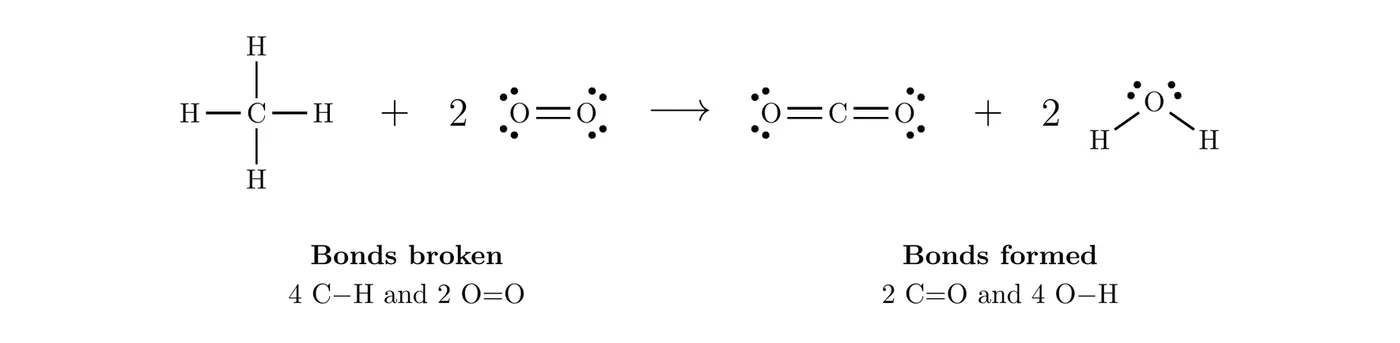
Bonds broken: 4 in , and 2 (one in each , and there are 2 of them).
Bonds formed: 2 in , and 4 (two in each , and there are 2 of them).
Answer: about . The reaction is exothermic because forming the products' bonds releases more energy (3450 kJ) than breaking the reactants' bonds requires (2642 kJ). The diagram shows the two imaginary steps to scale:
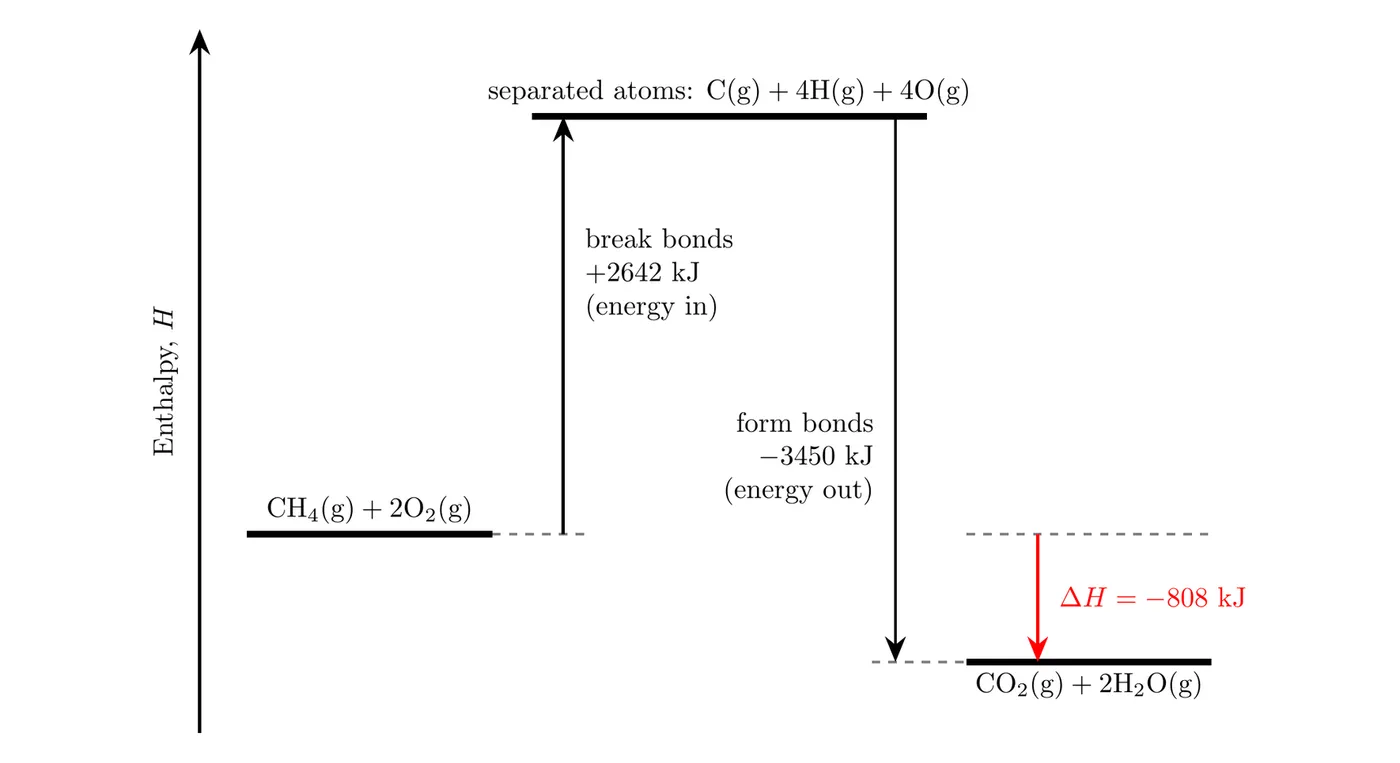
The measured value for this reaction is (Topic 6.8 calculates it from enthalpies of formation). The estimate is within 1%.
Why the estimate isn't exact
- The values are averages. The actual bonds in a specific molecule are a little stronger or weaker than the table says.
- Bond enthalpies are for gases. If a reactant or product is a liquid or solid, the bond method leaves out the intermolecular forces. For example, if the water above formed as a liquid, condensing it would release extra energy that bond counting can't see.
So bond enthalpies are great for estimating and for explaining why a reaction is exothermic or endothermic. When you need an accurate value, use enthalpies of formation (Topic 6.8).
Shortcut: count only the bonds that change
If a bond appears unchanged on both sides, you'd break it and then form it again, so its energy cancels out. You can skip those bonds and count only the ones that actually change. Both ways give the same answer, so use whichever you trust more on test day. Example 3 shows the shortcut.
Example 2: Making ammonia
Estimate for:
Bonds broken: 1 and 3 .
Bonds formed: each has 3 bonds, and the coefficient is 2, so 6 bonds form.
Answer: about , exothermic. The measured value is . The most common error here is counting 3 bonds instead of 6: the coefficient 2 doubles every bond in .
Example 3: Adding hydrogen to ethene (AP-style)
Ethene reacts with hydrogen gas to form ethane:
(a) Identify the bonds that are broken and formed.
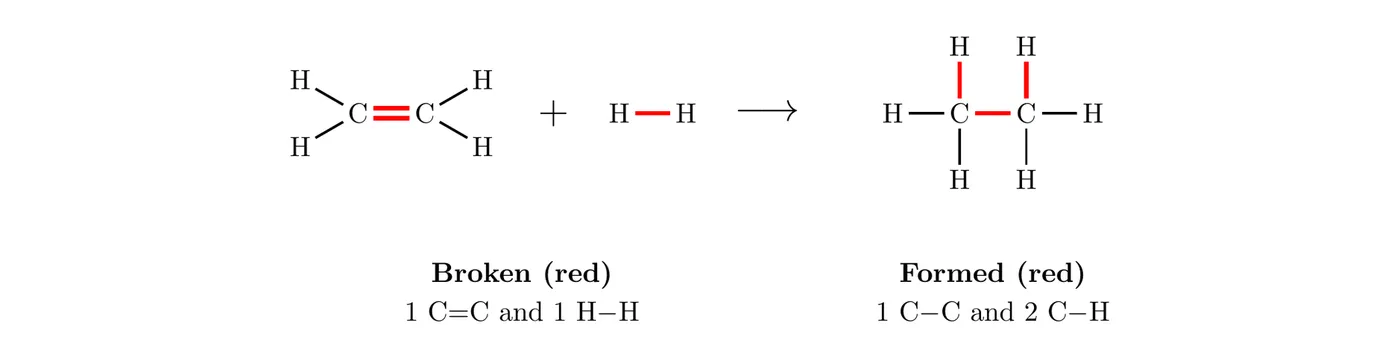
Ethene's four bonds are still there in ethane, so they cancel. The bonds that change (red) are: broken, one and one ; formed, one and two new .
(b) Estimate using the table.
Counting every bond gives the same result: broken kJ, formed kJ, and .
(c) The measured for this reaction is . Use it with the other table values to calculate the bond enthalpy in ethene. Let be the bond enthalpy:
(d) Explain why your answer to (c) doesn't match the table value of 614 kJ/mol. The 614 kJ/mol is an average over many molecules that contain bonds, and the and values are averages too. The bonds in ethene and ethane aren't exactly average, so bond enthalpies give an estimate of , not an exact value.
Common mistakes
- Using formed minus broken. That gives the wrong sign. It's broken minus formed.
- Thinking that breaking bonds releases energy. Breaking bonds always requires energy.
- Forgetting coefficients. Two molecules have 6 bonds, not 3.
- Missing double and triple bonds. Draw the Lewis diagram. is , is , and has two bonds.
- Treating a double bond as two single bonds. Use the double bond's own value.
- Using bond enthalpies when the question gives enthalpies of formation. Use the data the question gives you.