

6.5 - Energy of Phase Changes
Overview
Melting, boiling, freezing, and condensing all move energy into or out of a system, even though the temperature doesn't change while they happen. This topic explains where that energy goes (into or out of the attractions between particles), how to calculate it from moles and molar enthalpies like and , and how to read a heating curve.
Energy and phase changes
Phase changes are about attractions between particles. Pulling particles apart against their intermolecular forces takes energy. Letting them come together into stronger attractions releases energy.
Phase change | Direction | Energy of the system | Classification |
Melting (fusion) | solid to liquid | increases | endothermic |
Vaporization (boiling or evaporation) | liquid to gas | increases | endothermic |
Sublimation | solid to gas | increases | endothermic |
Freezing | liquid to solid | decreases | exothermic |
Condensation | gas to liquid | decreases | exothermic |
Deposition | gas to solid | decreases | exothermic |
This is how sweat cools you: as it evaporates, the water absorbs energy from your skin. Freezing runs the other way. As hydrogen bonds lock water molecules into place in ice, energy is released, and a freezer has to carry that energy away.
Temperature stays constant during a phase change
While a pure substance melts or boils, its temperature stays constant, even though heat is still flowing in. A pot of boiling water at sea level stays at 100 °C until it boils dry, no matter how high the burner is turned. (Turning up the burner just makes the water boil away faster.)
At the particle level, the added energy goes into separating particles, raising their potential energy as attractions are overcome. It doesn't make the particles move faster on average. Average kinetic energy stays the same, so the temperature stays the same. Once the phase change is finished, added energy goes back into kinetic energy and the temperature rises again.
Molar enthalpies of phase change
The energy for a phase change is proportional to how much substance changes phase, so chemists report it per mole:
- Molar enthalpy of fusion, : the energy absorbed to melt 1 mol of solid at its melting point. For water, kJ/mol at 0 °C.
- Molar enthalpy of vaporization, : the energy absorbed to vaporize 1 mol of liquid at its boiling point. For water, kJ/mol at 100 °C.
Here is the number of moles that change phase. If you're given grams, convert to moles first.
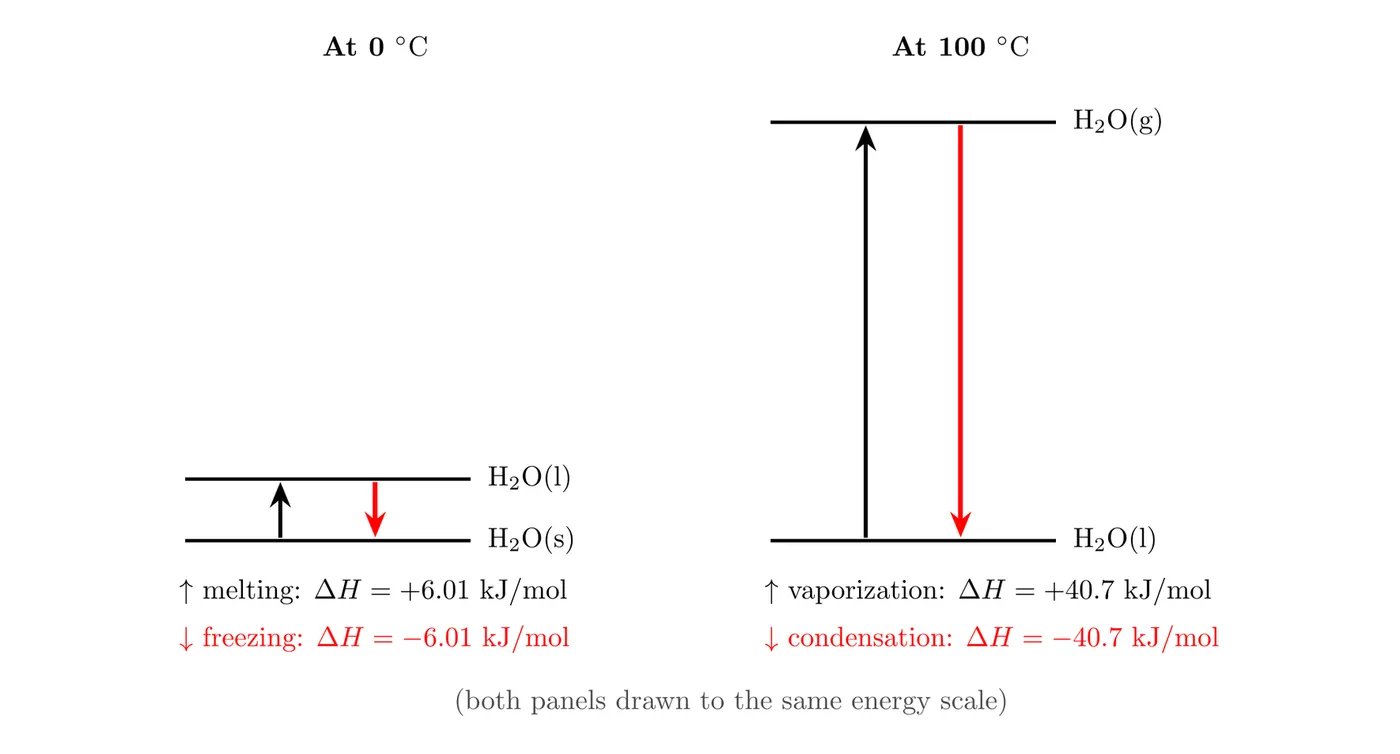
For water, is almost seven times (40.7 vs. 6.01). Melting only loosens the hydrogen bonds enough to let molecules slide past each other. Boiling has to separate the molecules completely, so far more attractions must be overcome.
Opposite processes, opposite signs
The energy absorbed in a phase change equals the energy released in the opposite change. Same size, opposite sign:
So the same 6.01 kJ/mol tells you how much energy it takes to melt ice and how much is released when water freezes. The diagram shows both pairs on one energy scale, which makes the size difference easy to see.
Example 1: Melting ice
How much heat is needed to melt 50.0 g of ice at 0 °C?
The ice absorbs 16.7 kJ, and the temperature stays at 0 °C the whole time. (Keep a guard digit in and round only at the end.)
Example 2: Why steam burns are worse
Compare the heat released to your skin (at 37.0 °C) by (a) 10.0 g of liquid water at 100.0 °C and (b) 10.0 g of steam at 100.0 °C. Assume the steam fully condenses and then cools to 37.0 °C.
(a) Hot water, cooling only:
(b) Steam, condensing and then cooling:
The negative signs mean the water releases the energy (to your skin). The steam releases 25.2 kJ, nearly ten times as much as the hot water, because condensing alone gives off 22.6 kJ. Same temperature, very different energy.
Example 3: A full heating curve (AP-style)
A 36.0 g sample of ice at °C is heated until it is all steam at 120.0 °C. Use J/(g·°C), J/(g·°C), J/(g·°C), kJ/mol, and kJ/mol. (a) Calculate the total heat required. (b) Which step requires the most energy? Explain why at the particle level. (c) Explain why the temperature stays constant during two of the steps.
Moles of water: mol (keep the extra digit).
(a) Split the path into five steps. Heating steps use , and phase changes use . Convert joules to kilojoules before adding.
Step | What happens | Calculation | (kJ) |
1 | ice warms from °C to 0.0 °C | J | 1.50 |
2 | ice melts at 0 °C | 12.0 | |
3 | liquid water warms from 0.0 °C to 100.0 °C | J | 15.0 |
4 | water boils at 100 °C | 81.3 | |
5 | steam warms from 100.0 °C to 120.0 °C | J | 1.45 |
When adding, the answer keeps the fewest decimal places of the numbers being added, which is tenths here.
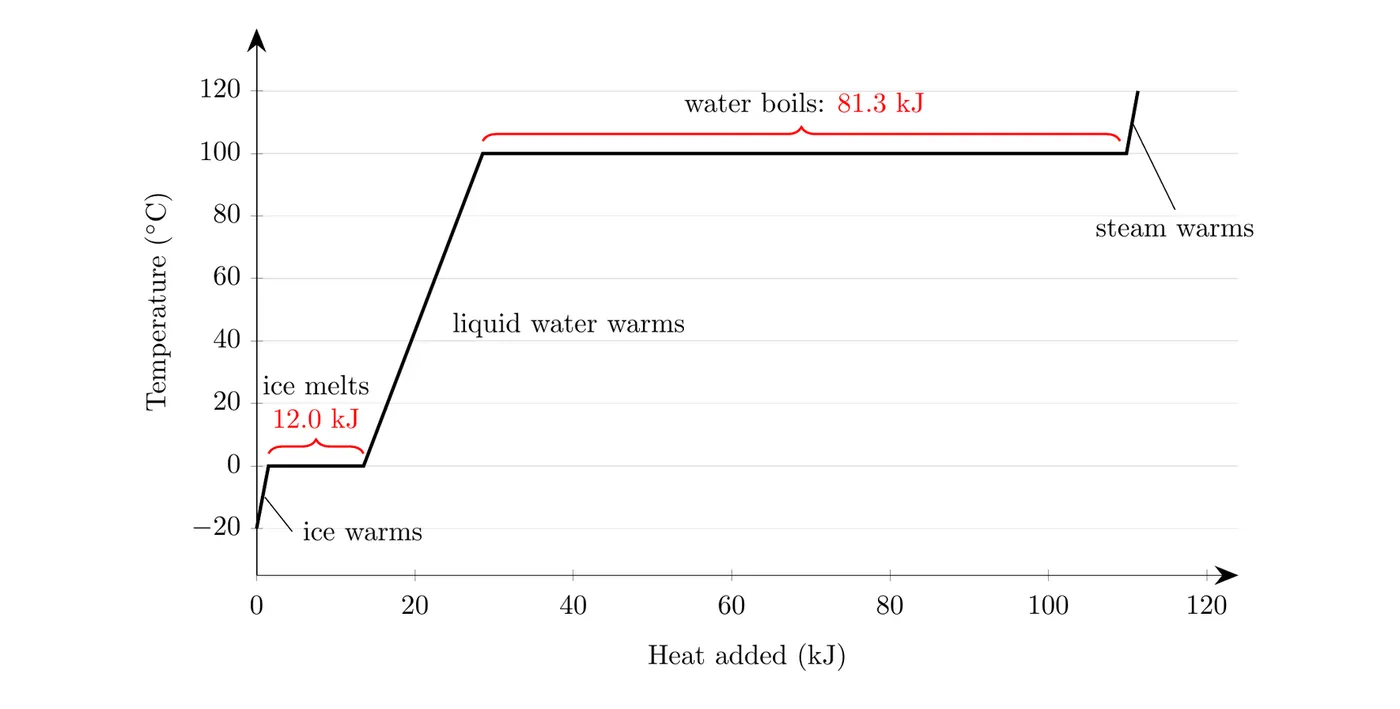
(b) Boiling (step 4) takes 81.3 kJ, about 73% of the total. To vaporize water, the molecules have to be separated completely, which means overcoming essentially all of the hydrogen bonds between them. Melting only loosens the rigid ice structure so the molecules can slide past each other, which overcomes far fewer attractions and takes much less energy (12.0 kJ).
(c) During melting (step 2) and boiling (step 4), the added energy goes into overcoming intermolecular attractions, which raises the potential energy of the particles. The average kinetic energy of the molecules doesn't change, so the temperature doesn't either. In the sloped steps, the added energy increases the average kinetic energy, so the temperature rises.
The slope of each sloped section depends on the specific heat. Liquid water (higher ) warms less per kilojoule than ice or steam, so its section of the curve is less steep.
Common mistakes
- Using during a phase change. On a plateau, , so that equation gives zero. Use .
- Using grams with or in kJ/mol. Convert grams to moles first.
- Mixing J and kJ. gives joules, and gives kilojoules. Convert before adding the steps.
- Getting the sign wrong for freezing or condensing. These release energy, so and are negative: .
- Saying the temperature is constant because no energy is added. Energy is added the whole time. It goes into potential energy (separating particles), not kinetic energy.
- Saying bonds break when water boils. Boiling overcomes the attractions between molecules (hydrogen bonds). The covalent O-H bonds inside each molecule stay intact.