

6.1 - Endothermic and Exothermic Processes
Overview
Every chemical or physical change moves energy around. This topic gives you the words to describe that: which part is the system, which part is the surroundings, and whether a process is endothermic (energy flows into the system) or exothermic (energy flows out). You also learn to back up the label with evidence, usually a temperature change, and with particle-level reasoning. Everything else in Unit 6 builds on this vocabulary.
System and surroundings
To talk about energy flow, first split the world into two parts:
- System: the part you're studying. Usually that's the reacting particles, or the substance that is melting, dissolving, or being heated.
- Surroundings: everything else that can exchange energy with the system. For a reaction in a beaker, that's the water the particles are dissolved in, the beaker, the thermometer, the air, and your hand.
Energy is conserved (the first law of thermodynamics, which comes back in 6.4). Any energy the system loses, the surroundings gain, and the reverse:
Energy moves between the two in two ways. Heat is thermal energy transferred because of a temperature difference. Work is energy transferred when something is pushed through a distance, like a gas expanding against the atmosphere. Almost every AP question in this unit is about heat.
Endothermic and exothermic processes
When a process happens, the energy of the system goes down, goes up, or stays the same.
- Exothermic: the system loses energy. The energy goes to the surroundings, as heat flowing out of the system or as work the system does on the surroundings. The surroundings get warmer.
- Endothermic: the system gains energy. The energy comes from the surroundings, as heat flowing into the system or as work done on the system. The surroundings get cooler.
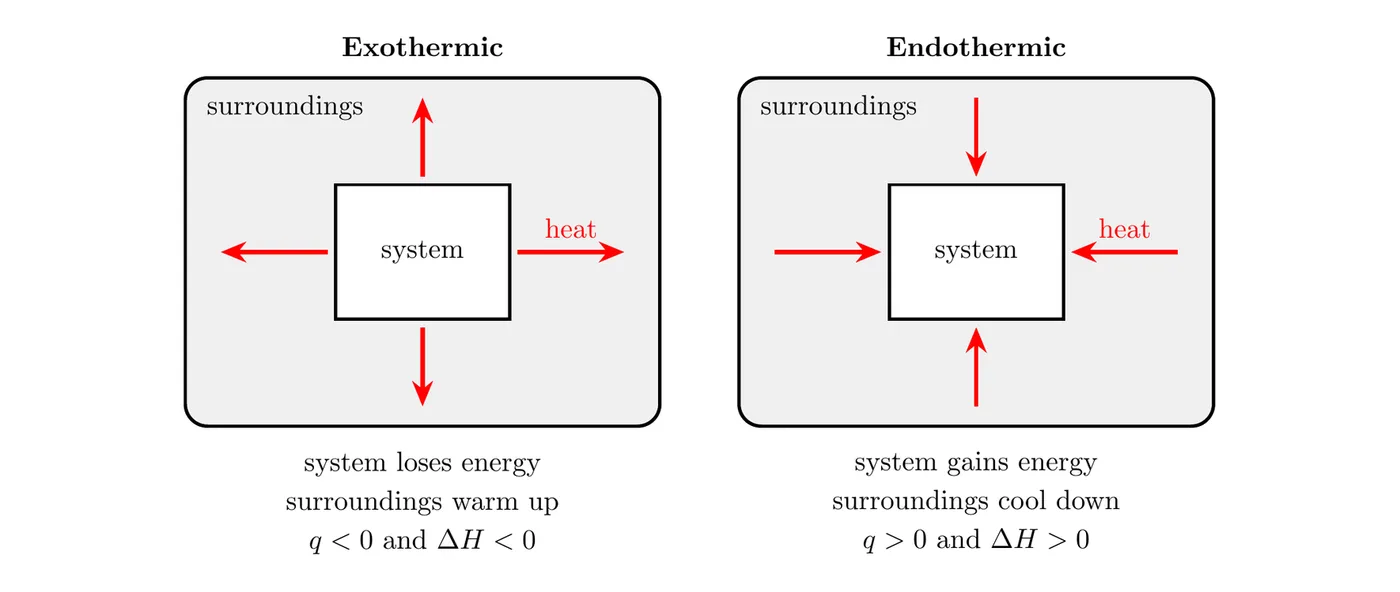
Chemists write the sign from the system's point of view. The heat and the enthalpy change (the heat of a process at constant pressure, covered in 6.6) are negative for exothermic processes and positive for endothermic ones. Positive means the system gains energy, negative means it loses energy. Every number in this unit follows that rule.
Here's the work part in action. When gasoline burns in a car engine, the hot gases push the pistons (work done by the system) and also heat up the engine block (heat). Both are energy leaving the system, so the reaction is exothermic either way.
Temperature changes are the evidence
You can't see energy, but you can measure temperature, and a temperature change tells you energy moved. The key question is whose temperature you measured. When a reaction happens in a solution, the thermometer sits in the water, and the water is part of the surroundings. So:
- Thermometer reading goes up: the surroundings gained energy, so the process released it. Exothermic.
- Thermometer reading goes down: the surroundings lost energy, so the process absorbed it. Endothermic.
This is why an instant cold pack feels cold. The salt dissolving inside is endothermic, so it pulls thermal energy out of the water in the pack and out of your hand. Your hand is part of the surroundings, losing energy, and that's the cold feeling. The energy didn't disappear. It went into the system.
Three kinds of processes
Endothermic and exothermic describe more than chemical reactions. Three kinds of processes can go either direction.
Process | Endothermic (system gains energy) | Exothermic (system loses energy) |
Heating or cooling a substance | water heating in a pot on a stove (the water is the system) | a hot cup of coffee cooling on a desk |
Phase change | melting, vaporization (boiling or evaporating), sublimation | freezing, condensation, deposition |
Chemical reaction | decomposing into and by strong heating; photosynthesis | burning a fuel like methane; neutralizing a strong acid with a strong base |
For phase changes, think about attractions. Melting and boiling pull particles apart against their intermolecular forces, which takes energy (endothermic). Freezing and condensing let particles come together into stronger attractions, which releases energy (exothermic). Topic 6.5 puts numbers on this.
Reactions follow the same idea with bonds: breaking a bond always takes energy, and forming a bond always releases energy. A reaction is exothermic when forming the product bonds releases more energy than it took to break the reactant bonds. Topic 6.7 does the math.
Dissolving can go either way
Forming a solution can be endothermic or exothermic. Which one depends on the strength of the attractions between particles before and after dissolving. Think of it in three steps:
- Separate the solute particles from each other (break the ion-ion attractions in a salt, or the intermolecular forces in a molecular solid). This takes energy.
- Separate some solvent particles to make room (break some hydrogen bonds between water molecules). This takes energy.
- Let the solute and solvent particles attract each other (ion-dipole attractions for a salt in water). This releases energy.
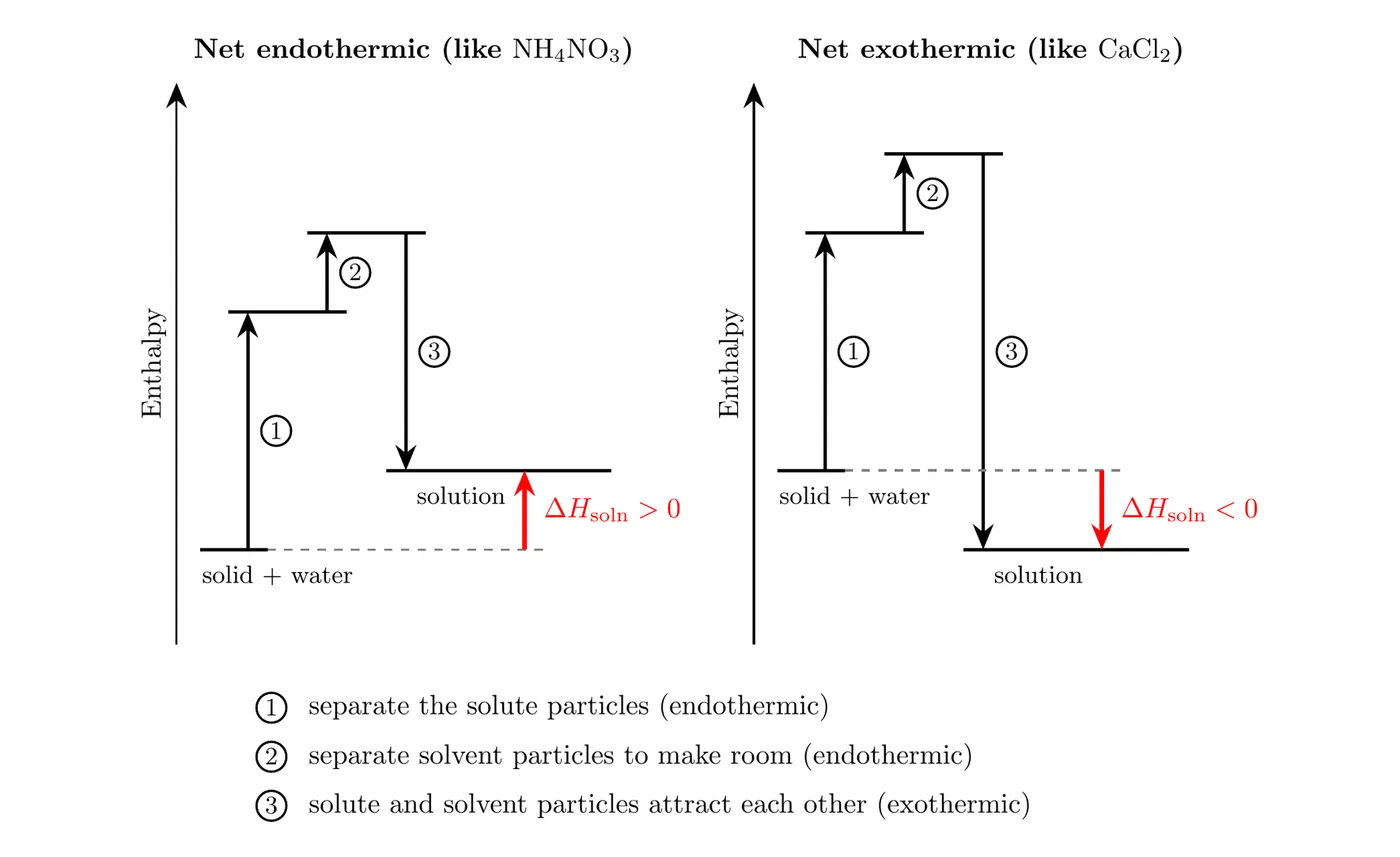
If the new solute-solvent attractions release more energy than steps 1 and 2 cost, dissolving is exothermic and the solution warms up. If they release less, dissolving is endothermic and the solution cools down.
Solute | (kJ/mol, approximate) | What happens to the water |
gets much warmer (used in hot packs) | ||
gets much warmer (it can get dangerously hot) | ||
barely changes (slightly cooler) | ||
gets much colder (used in instant cold packs) |
Notice that dissolves easily even though dissolving it absorbs energy. Whether something dissolves isn't decided by alone. Unit 9 adds entropy to explain that.
Example 1: Reading a temperature change
A student dissolves a solid in water in an insulated cup. The temperature of the water drops from 22.4 °C to 16.8 °C. Is dissolving this solid endothermic or exothermic? Which way does heat flow?
Step 1: Identify the system and the surroundings. The system is the dissolving solid. The water is the surroundings, and it's what the thermometer measures.
Step 2: Read the temperature change.
The surroundings got colder, so they lost energy.
Step 3: Conclude. The energy that left the water went into the system. Heat flowed from the water into the dissolving solid, so dissolving this solid is endothermic ( and for the system).
Example 2: Classifying everyday processes
For each process, name the system and decide whether it's endothermic or exothermic.
Process | System | Classification | Reason |
Sweat evaporating from your skin | the water in the sweat | endothermic | liquid to gas absorbs energy from your skin, so your skin cools |
Dew forming on grass overnight | the water vapor | exothermic | gas to liquid releases energy to the grass and air |
A gas stove burner | the burning methane and oxygen | exothermic | combustion releases energy as heat and light |
A pond freezing over | the water | exothermic | liquid to solid releases energy to the colder air |
An egg cooking in boiling water | the egg | endothermic | the egg gains energy from the hot water |
Photosynthesis in a leaf | the reacting and | endothermic | the products (glucose and oxygen) hold more energy than the reactants; the energy comes from sunlight |
Example 3: Explaining a dissolution at the particle level (AP-style)
When solid ammonium nitrate, , dissolves in water, the temperature of the solution decreases. (a) Is dissolving endothermic or exothermic? (b) Explain the temperature change in terms of the interactions between particles.
(a) The solution got colder, so the water (the surroundings) lost energy to the dissolving process. Dissolving is endothermic.
(b) A full-credit explanation compares the energy cost with the energy payoff:
- Dissolving requires breaking the attractions between and ions in the solid and some hydrogen bonds between water molecules. Breaking attractions requires energy.
- New ion-dipole attractions form between the ions and the polar water molecules. Forming attractions releases energy.
- For , the energy required to break the ion-ion attractions and hydrogen bonds is greater than the energy released when the ion-dipole attractions form. The difference comes from the kinetic energy of the water molecules, so their average kinetic energy decreases and the temperature drops.
An answer that only says "it's endothermic because it got cold" answers part (a) but earns nothing for part (b). The AP exam wants the comparison between the attractions broken and the attractions formed.
Common mistakes
- Mixing up the system and the surroundings. The thermometer usually measures the surroundings. A temperature increase means the process is exothermic.
- Saying bond breaking releases energy. Breaking a bond or an attraction always costs energy. Energy is released only when bonds or attractions form.
- Thinking cold flows. A cold pack doesn't send cold into your hand. Heat flows from your hand into the pack.
- Getting the sign backward. and describe the system. Exothermic means negative, even though the surroundings gain energy.
- Assuming everything that dissolves releases energy. Dissolving can go either way, depending on whether the new solute-solvent attractions release more or less energy than breaking the old attractions cost.