

6.6 - Introduction to Enthalpy of Reaction
Overview
Every chemical reaction either releases energy or absorbs it, and the enthalpy of reaction, , tells you how much. This topic connects to something you can measure: the heat that flows when a known amount of a substance reacts. On the AP exam you'll move between grams, moles, and kilojoules using a balanced equation and its , and you'll explain where the energy comes from at the particle level.
What the enthalpy of reaction tells you
The enthalpy change of a reaction, , is the heat energy a reaction releases or absorbs at constant pressure. Almost every reaction you'll see runs open to the air (a beaker, a foam cup, a flask), so the pressure stays constant and is simply the heat of the reaction.
- Negative : exothermic. The reaction releases heat to its surroundings.
- Positive : endothermic. The reaction absorbs heat from its surroundings.
As in Topic 6.1, the sign is from the point of view of the system (the reacting chemicals). A negative means the system lost energy and the surroundings gained it.
You may hear chemists talk about internal energy too. The technical difference between enthalpy and internal energy isn't tested on the AP exam. At constant pressure, treat as the heat of the reaction.
Thermochemical equations
A thermochemical equation is a balanced equation with its written next to it:
The unit means kilojoules per mole of reaction: the heat for the reaction happening once in mole amounts, exactly as written. Here, 1 mol of reacting with 2 mol of to make 1 mol of and 2 mol of releases 890.3 kJ. So the same equation tells you that 890.3 kJ is released per 1 mol of burned, per 2 mol of used, and per 2 mol of water made. The coefficients are part of the meaning.
The degree sign in means standard conditions (1 atm, 1 M for solutions, usually 25 °C). Topic 6.8 says more about that. Two more things follow from "per mole of reaction as written":
- belongs to the equation as written. Double the equation and doubles. Reverse it and the sign flips. Topic 6.9 uses these rules.
- Phases matter. The above is for liquid water. If the water ends up as a gas, less heat is released (Topic 6.8 shows how much).
Where the energy comes from
Chemical potential energy is stored in the arrangement of atoms and electrons, meaning in bonds and the attractions between particles. During a reaction, bonds in the reactants break and new bonds form in the products (Topic 6.7 counts them). Because the bonds are different, the products have a different chemical potential energy than the reactants.
Energy is conserved, so that difference has to go somewhere. It shows up as a change in the kinetic energy of the particles, which you see as a temperature change:
- Exothermic: the products have lower potential energy than the reactants. The lost potential energy becomes kinetic energy, so the particles move faster and the temperature rises.
- Endothermic: the products have higher potential energy than the reactants. The energy to raise the potential energy comes from the particles' kinetic energy, so they slow down and the temperature drops.
So a temperature change in a reaction mixture is the visible sign that chemical potential energy changed.
Reaching thermal equilibrium with the surroundings
Right after the reaction, the products are at a different temperature than their surroundings. Just like any two objects at different temperatures (Topic 6.3), they exchange thermal energy until they reach thermal equilibrium, the same temperature:
- Exothermic: the warm products transfer thermal energy to the surroundings. The surroundings warm up.
- Endothermic: the cool products take in thermal energy from the surroundings. The surroundings cool down.
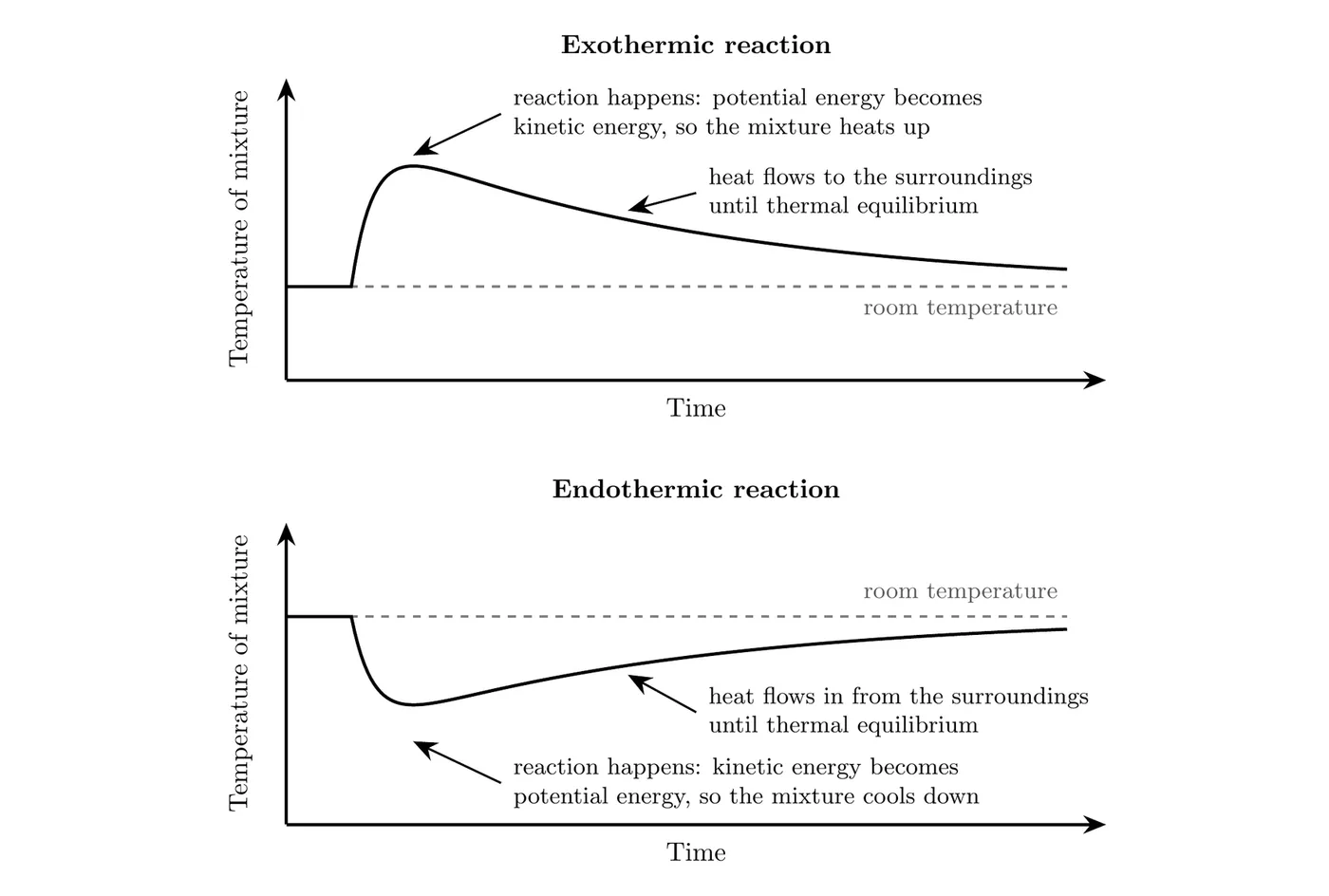
The graphs show a reaction mixture in an open, uninsulated cup. The quick change is the reaction itself, turning potential energy into kinetic energy (or the reverse). The slow return to room temperature is heat flowing between the mixture and the room. counts all the heat that flows by the time everything is back at the starting temperature. That's why, for an exothermic reaction, the heat the surroundings gain equals the energy the reaction released.
Calculating heat from moles
gives the heat per mole of reaction. To find the heat for any amount of a reactant or product, convert to moles, then use the coefficient of that substance as a ratio:
Here is the moles of substance A that react (or form), and is A's coefficient in the balanced equation. Dividing by gives the moles of reaction, , so this is the same as .
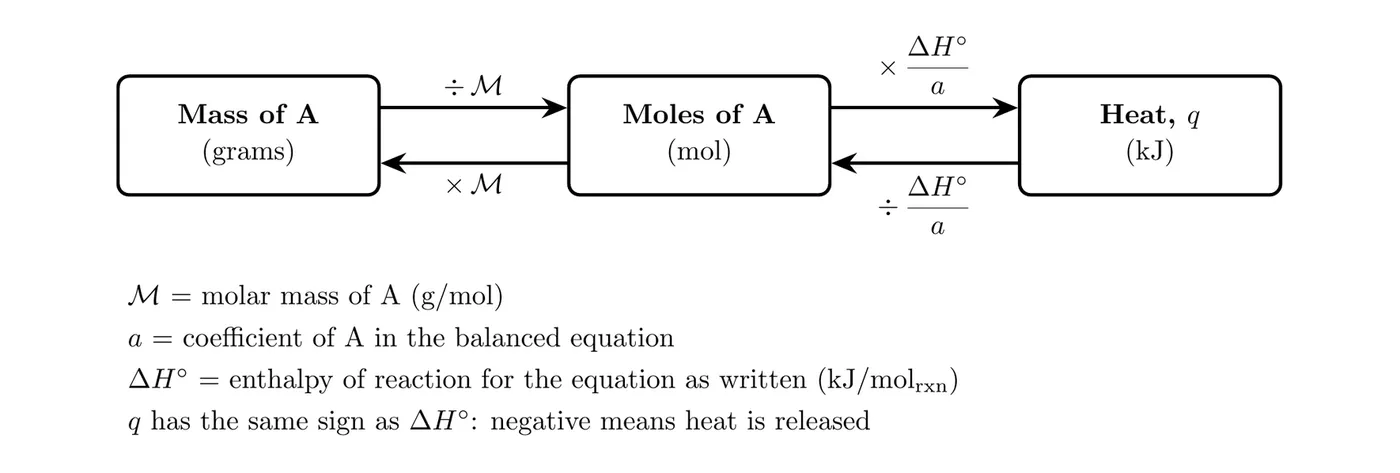
- Sign: for the reaction has the same sign as . The surroundings gain or lose the same amount with the opposite sign: .
- Wording: if a question asks "how much heat is released," answer with a positive number and the word released (554 kJ released), or write kJ. Don't write " kJ released": that double negative says energy was absorbed.
- Limiting reactant: if amounts of two reactants are given, the heat depends on the one that runs out. Use its moles.
Example 1: Heat from burning propane
Propane burns in a gas grill:
How much heat is released when 11.0 g of propane burns completely?
Step 1: Find moles of propane.
(Keep an extra digit until the end.)
Step 2: Use the ratio from the equation. The coefficient of is 1, so each mole of propane goes with 2219.9 kJ.
Answer: burning 11.0 g of propane releases 554 kJ of heat ( kJ, three significant figures from 11.0 g). The surroundings gain 554 kJ.
Example 2: An iron hand warmer
Inside an air-activated hand warmer, iron powder reacts with oxygen from the air. The reaction can be modeled as:
(a) A hand warmer contains 22.0 g of iron. How much heat can it release?
The 1648.4 kJ goes with 4 mol of iron, so divide by the coefficient:
Answer: the iron can release 162 kJ of heat.
(b) What mass of iron must react to release 50.0 kJ? Work the road map backward:
Answer: 6.78 g of iron. Here we used the magnitude of the heat (50.0 kJ released), so the moles come out positive.
Example 3: Finding the enthalpy of reaction from a temperature change (AP-style)
A student adds excess zinc powder to 50.0 mL of 0.200 M in a coffee-cup calorimeter. The reaction is:
The temperature of the solution rises from 21.6 °C to 32.0 °C. Assume the solution has a density of 1.00 g/mL and a specific heat of 4.18 J/(g·°C), and that no heat is lost to the cup or the air.
(a) Calculate the heat absorbed by the solution.
(b) Calculate in . The solution gained 2.17 kJ, so the reaction released it: kJ. Zinc is in excess, so is the limiting reactant:
One mole of reaction uses 1 mol of , so this is 0.0100 mol of reaction:
(c) The student repeats the experiment with 100.0 mL of the same solution and excess zinc. Predict and justify. About 10.4 °C again. Twice as much reacts, so twice as much heat is released, but that heat warms twice as much solution. Since and both and double, doesn't change. ( per mole of reaction doesn't change either.)
(d) Explain, in terms of energy, why the temperature rose. The products, and , have lower chemical potential energy than the reactants. As the reaction happened, that potential energy became kinetic energy of the particles, so the solution's temperature went up.
Common mistakes
- Forgetting to divide by the coefficient. is per mole of reaction as written, not per mole of every substance. In Example 2, 1648.4 kJ goes with 4 mol of iron.
- Mixing up system and surroundings. If the water around a reaction warms up, the surroundings gained heat, so and are negative.
- Double negatives. " kJ released" means energy was absorbed. Write "554 kJ released" or " kJ."
- Using the excess reactant. The heat depends on how much of the limiting reactant reacts.
- Mixing J and kJ. gives joules, but values are in kilojoules. Convert before you divide.
- Using the wrong mass in calorimetry. in is the mass of the solution that changes temperature, not the mass of the reactant.