

6.4 - Heat Capacity and Calorimetry
Overview
This topic puts numbers on heat. You'll use the heat transfer equation, , to find how much energy it takes to change a substance's temperature. Then you'll use calorimetry, measuring temperature changes in an insulated container, to find the heat released or absorbed by a process. Calorimetry is the main lab technique of Unit 6, and it shows up often on AP free-response questions.
Heat capacity
Different substances need different amounts of energy to warm up by the same amount:
Quantity | Symbol | Energy needed to raise... | Units |
Specific heat capacity | 1 gram by 1 °C | J/(g·°C) | |
Molar heat capacity | 1 mole by 1 °C | J/(mol·°C) | |
Heat capacity of an object | the whole object (like a calorimeter) by 1 °C | J/°C |
A change of 1 °C is the same size as a change of 1 K, so J/(g·°C) and J/(g·K) mean the same thing. Molar heat capacity is specific heat times molar mass, . For water:
Substance | Specific heat, (J/(g·°C)) |
liquid water, | 4.18 |
ethanol, | 2.44 |
ice, | 2.09 |
steam, | 2.01 |
aluminum | 0.897 |
iron | 0.449 |
copper | 0.385 |
silver | 0.235 |
gold | 0.129 |
Water's specific heat is unusually high, which is why a pot of water heats so much more slowly than an empty metal pan.
Same energy, different temperature change
Because differs, the same amount of heat doesn't produce the same temperature change in equal masses of different substances. Add 500. J to 25.0 g of each:
The aluminum warms about 4.7 times as much. A lower specific heat means a bigger temperature change for the same energy.
Per gram or per mole?
Specific heat compares equal masses, and molar heat capacity compares equal numbers of particles. They can rank substances differently. Water's specific heat (4.18) is higher than ethanol's (2.44). But ethanol's molar heat capacity, J/(mol·°C), is higher than water's 75.3 J/(mol·°C). So 100 g of water needs more energy than 100 g of ethanol to warm by 10 °C, while 1 mol of ethanol needs more than 1 mol of water. Use whichever matches the amount you're given: grams with , moles with .
The heat transfer equation
- = heat absorbed or released by the substance (J)
- = mass (g)
- = specific heat capacity (J/(g·°C))
- (°C or K)
With moles instead of grams, use .
The sign takes care of itself. Heating a substance makes positive, so is positive: the substance gained energy. Cooling makes and negative: the substance lost energy. In other words, heating a system increases its energy, and cooling a system decreases its energy.
Example 1: Heating water
How much heat is needed to warm 250. g of water from 21.5 °C to 85.0 °C?
Each factor has three significant figures, so the answer does too. is positive because the water gained energy.
Conservation of energy and calorimetry
The first law of thermodynamics says energy is conserved in every chemical and physical process. It moves from place to place but is never created or destroyed. When a hot object and a cold object exchange heat in an insulated container, the heat lost by one equals the heat gained by the other:
Calorimetry uses this idea to measure heat. A process happens inside a calorimeter, an insulated container of water or solution. You can't measure the heat of the process directly, but you can measure the temperature change of the solution around it and calculate the heat the solution gained or lost. Whatever the solution gained, the process lost, and the reverse:
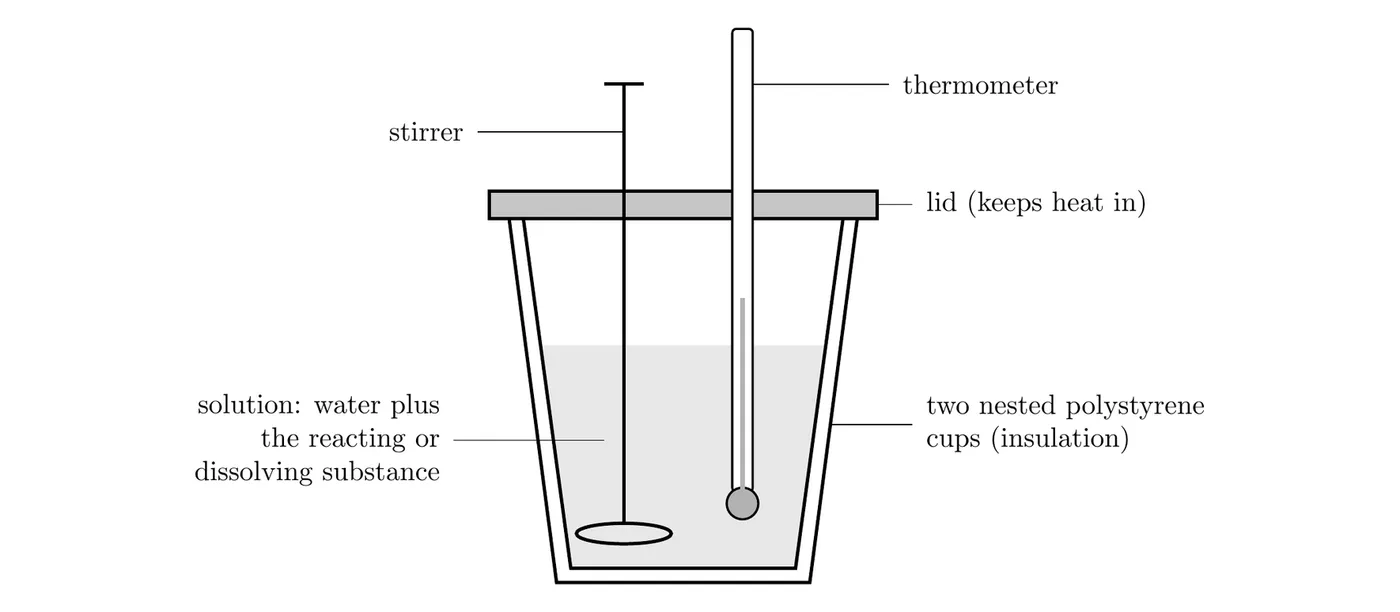
In class, the calorimeter is usually a coffee-cup calorimeter. It isn't sealed, so the pressure stays constant. Each part has a job:
- Nested foam cups and a lid slow heat exchange with the room, so almost all the heat stays in the solution.
- The stirrer keeps the temperature even, so the thermometer reads the whole solution.
- The thermometer or temperature probe measures the starting temperature and the highest (or lowest) temperature reached. Record every digit the instrument gives: tenths of a degree for a typical thermometer, often hundredths for a digital probe.
Unless a problem says otherwise, assume the solution's specific heat equals water's (4.18 J/(g·°C)), its density is 1.00 g/mL, its mass includes everything dissolved in it, and the cup absorbs no heat. If a problem gives the calorimeter's heat capacity , the calorimeter's share counts too: .
Reading the direction of energy flow
In a dissolution experiment, the temperature change of the mixture tells you which way the energy went:
- Temperature increases: the dissolving released thermal energy into the solution. Exothermic, .
- Temperature decreases: the dissolving absorbed thermal energy from the solution. Endothermic, .
Lab connection: in the AP hand warmer lab, you measure the temperature change when several salts dissolve in a coffee-cup calorimeter, calculate the enthalpy of solution of each one, and then decide which salt, and how much of it, would make a hand warmer that heats up enough. The calculation is the same as Example 3 below.
Example 2: Final temperature of a mixture
A 50.0 g block of aluminum ( J/(g·°C)) at 85.0 °C is dropped into 100.0 g of water at 22.0 °C in an insulated cup. What is the final temperature? (This is the graph from Topic 6.3.)
Step 1: Set up conservation of energy. The aluminum loses heat and the water gains it. Both end at the same temperature, .
Step 2: Solve for .
Step 3: Check that it makes sense. 28.1 °C is between 22.0 °C and 85.0 °C, and much closer to the water's starting temperature. That fits: the water's heat capacity ( J/°C) is about nine times the aluminum's ( J/°C), so the water's temperature moves much less.
Example 3: Enthalpy of solution from calorimetry data (AP-style)
A student dissolves 2.50 g of calcium chloride, (molar mass 110.98 g/mol), in 50.0 g of water in a coffee-cup calorimeter. A temperature probe records the data in the graph (made-up data for practice).
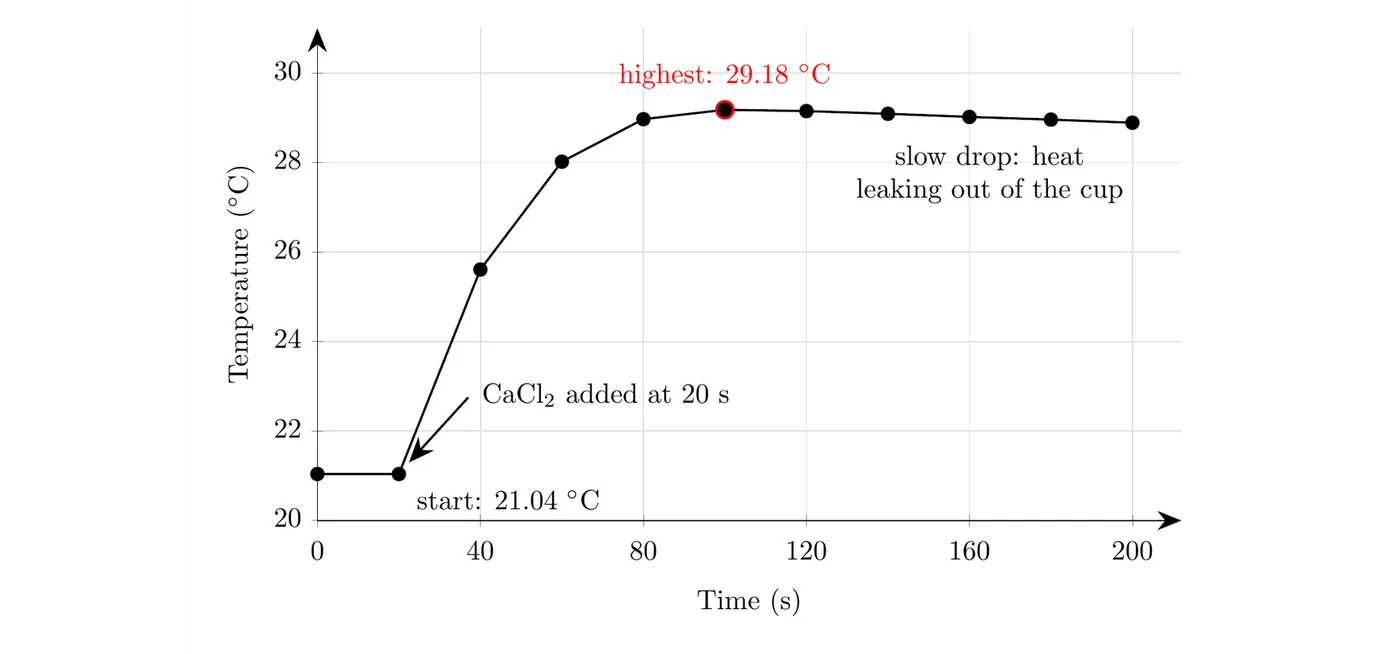
(a) Is dissolving exothermic or endothermic? Justify your answer with the data. (b) Calculate the heat absorbed by the solution. Assume its specific heat is 4.18 J/(g·°C). (c) Calculate of in kJ/mol. (d) The accepted value is about kJ/mol. Give one reason the student's value is smaller in magnitude. (e) If the student repeated the experiment with 5.00 g of in the same 50.0 g of water, how would the temperature change and the calculated compare?
(a) The temperature of the solution rose from 21.04 °C to 29.18 °C. The solution (the surroundings) gained thermal energy, so the dissolving process released it. Dissolving is exothermic.
(b) The mass of the solution includes the salt: g. The temperature change runs from the starting temperature to the highest temperature reached:
Subtraction keeps decimal places, not significant figures: each reading has four significant figures, but has three. A small change like would keep only two, which is one reason calorimetry experiments aim for large temperature changes.
(c) The dissolving released what the solution absorbed, so J kJ. Divide by the moles of :
The sign is negative because the process is exothermic. (The extra digits in the middle step are guard digits; the answer has three significant figures.)
(d) Some of the heat released escaped from the cup (through the lid, the walls, and the probe), or warmed the cup instead of the solution. Either way, the measured is smaller than it should be, so and come out too small. The slow drop in temperature after 100 s is evidence that heat was leaking out.
(e) Twice as much salt releases about twice as much heat, so would be roughly twice as large (a little less than double, since there's slightly more solution to warm). But is energy per mole, so the calculated value would stay about the same, close to kJ/mol.
Three ways a system's energy changes
A chemical system changes its energy in three main ways. Each has its own equation, and many problems chain them together:
Process | How to find | Topic |
Heating or cooling (temperature changes) | or | 6.4 |
Phase transition (temperature stays constant) | or | 6.5 |
Chemical reaction | 6.6 |
Common mistakes
- Using the water's mass instead of the solution's mass. Include the dissolved solid when a problem gives both.
- Dropping the sign in calorimetry. . If the solution warms, the process is exothermic and its is negative.
- Using the last reading instead of the highest one. Use the maximum (or minimum) temperature reached, not a reading taken after heat starts leaking out.
- Mixing units. is per gram and is per mole. gives joules, while values are usually in kilojoules. Convert before combining.
- Using one for both objects. In a heat exchange, each object has its own . They share only the final temperature.
- Forgetting the subtraction rule. often has fewer significant figures than the temperatures it came from.