

6.9 - Hess's Law
Overview
Some reactions are hard to run in a calorimeter: they're too slow, too hot, or they make side products. Hess's law gets around this. If a process can be written as a series of steps with known values, the overall is the sum of the steps. On the AP exam you'll rearrange given equations (reverse them, multiply them, add them) to match a target equation, and combine their values the same way.
Processes as a series of steps
Many chemical and physical processes can be broken down into a series of steps, and each step has its own energy change. The steps don't have to be how the process really happens. They just have to add up to the overall change.
A physical example: sublimation. Ice can turn straight into water vapor. You can also think of that as two steps, melting and then vaporizing:
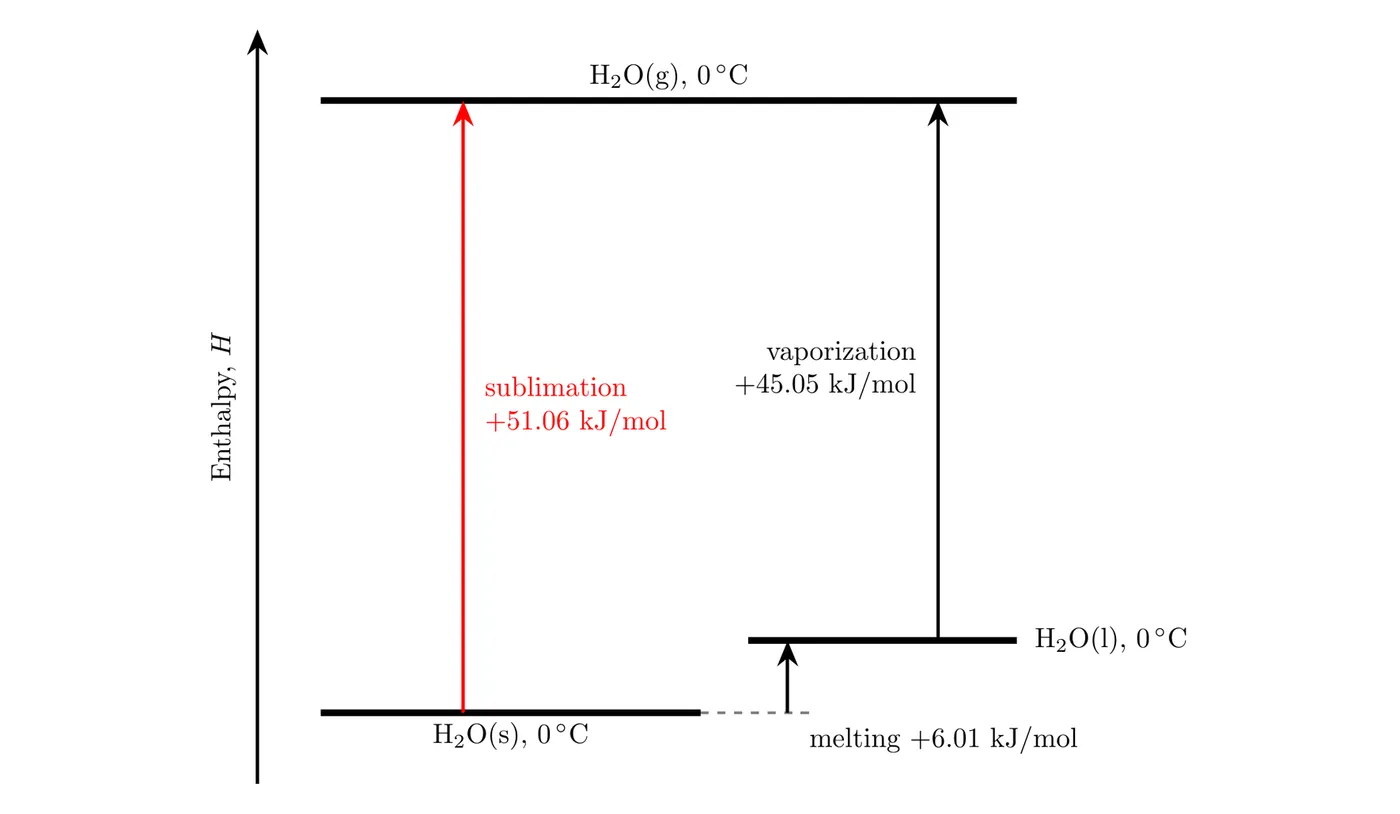
All three values are at 0 °C. Vaporizing takes more energy at 0 °C than at 100 °C (40.7 kJ/mol, the value in Topic 6.5), because colder liquid water has more of its hydrogen bonds intact, so more attractions have to be overcome. (When you add steps, every step has to be at the same conditions.)
A chemical example: carbon can burn straight to carbon dioxide, or you can think of it as burning to carbon monoxide first and then to carbon dioxide. Example 1 uses those steps.
Why the steps add up
Energy is conserved (the first law of thermodynamics). Each step in a sequence transfers some thermal energy to or from the surroundings, and those transfers come from potential energy changes among the species in the steps. Because the sequence starts and ends with the same substances as the one-step process, the net thermal energy transferred over all the steps equals the energy transferred in one step. If it didn't, you could run a reaction forward one way and backward another way and create energy from nothing.
At constant pressure, that means:
That's Hess's law. Think of climbing from the ground floor to the fifth floor of a building: whether you take the elevator straight up or the stairs with a stop on every floor, you gain the same height. (You may hear enthalpy called a state function. That term isn't tested on the AP exam; the idea above is what matters.)
The three rules for combining equations
Here's how changes when you change an equation. Each rule follows from the meaning of as the energy for the equation as written.
- Rule 1: Reverse a reaction, flip the sign of . The size stays the same. Energy that came out going forward has to go back in going backward.
- Rule 2: Multiply a reaction by a number, multiply by the same number. Twice as much stuff reacting means twice as much energy. This works for fractions too.
- Rule 3: Add reactions, add their values. When two or more reactions add up to an overall reaction, the overall is the sum.
Here are the rules applied to the synthesis of ammonia, , :
Change | New equation | New () |
Reverse | ||
Multiply by | ||
Reverse and multiply by 2 |
The middle row is the formation reaction of ammonia, so kJ/mol, the same value used in Topic 6.8.
A strategy for Hess's law problems
- Write the target equation at the top of your work.
- Pick a substance in the target that appears in only one of the given equations. Use that equation so the substance ends up on the same side with the same coefficient as in the target: reverse it, multiply it, or both. Change its the same way.
- Repeat for the other substances in the target.
- Add the adjusted equations and cancel anything that appears on both sides. The result must match the target exactly.
- Add the adjusted values.
Substances that show up in several given equations (often ) usually take care of themselves. Check them last.
Example 1: The enthalpy of forming carbon monoxide
It's hard to measure for directly, because when carbon burns, some of it goes all the way to . Use these two reactions, which are both easy to measure:
Match the target. is a reactant in the target and in (1), so keep (1) as it is. is a product in the target but a reactant in (2) with a coefficient of 2, so reverse (2) and multiply it by :
Add the two equations. appears on both sides and cancels. There's 1 on the left and on the right, which leaves on the left:
Answer: . Since the target is the formation reaction of , this is also of .
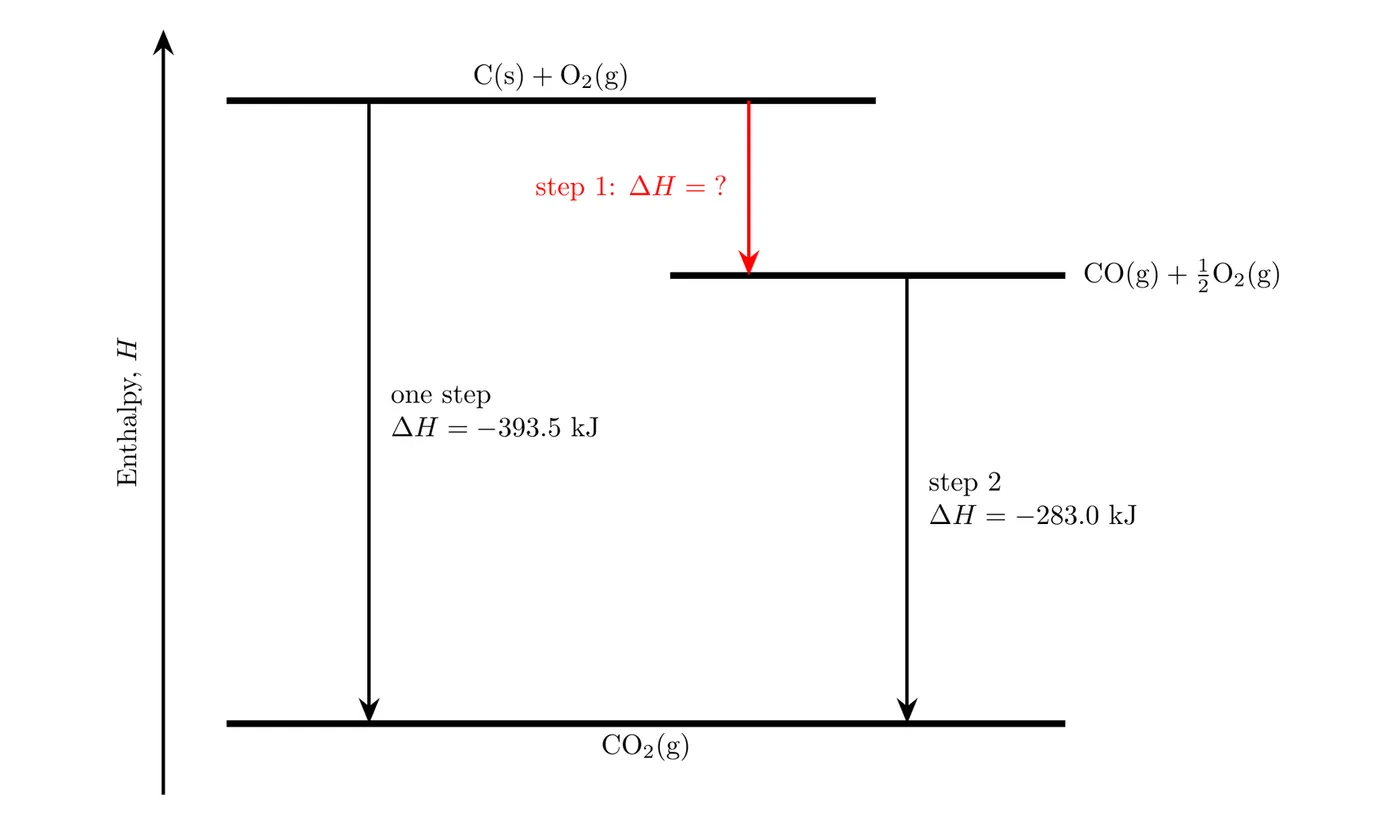
The energy diagram shows the same idea. Going straight from to releases 393.5 kJ. Stopping at first and then going on to has to release the same total, so step 1 is .
Example 2: Acetylene from combustion data
Acetylene () is the fuel in welding torches. Find for using:
- is a product with coefficient 1 in the target, but a reactant with coefficient 2 in (1). Reverse (1) and multiply by : , .
- is a reactant with coefficient 2 in the target. Multiply (2) by 2: , .
- is a reactant with coefficient 1 in the target, same as in (3). Keep (3): .
Add and cancel. and cancel. For oxygen, the left side has and the right side has , so it cancels too. What's left is the target.
Answer: , endothermic. This is of acetylene, one of the few common compounds with a positive enthalpy of formation. Its high enthalpy is part of why acetylene releases so much energy when it burns.
Example 3: Finding the enthalpy of forming MgO in the lab (AP-style)
Burning magnesium is far too hot and bright to do in a coffee-cup calorimeter. Instead, a student measures two reactions with hydrochloric acid in a calorimeter and uses a third, known value:
The target is .
(a) Show how to combine the three reactions to get the target. Keep (1), since is a reactant. Reverse (2), since has to be a product: , . Keep (3), which supplies the as a reactant. When you add them, , , , and all cancel, leaving the target.
(b) Calculate for the target.
Round to the ones place, because and are only known to the ones place.
(c) The accepted value is kJ/mol. Calculate the percent error.
(d) Suppose some heat escaped from the cup during reaction (1). How would that affect the calculated for the target? Justify. Lost heat makes the measured temperature rise too small, so comes out less negative than it should be. is added directly in (b), so the calculated for forming would also be less negative (too high). That fits the student's result, which is a bit less negative than the accepted value. (Heat lost during reaction (2) would push the answer the other way, because reaction (2) gets reversed.)
Four ways to find the enthalpy of reaction
Method | What you need | Topic |
Calorimetry | Mass, specific heat, temperature change, and moles that reacted | 6.4 and 6.6 |
Bond enthalpies | Lewis diagrams and a table of average bond enthalpies (an estimate) | 6.7 |
Enthalpies of formation | A table of values | 6.8 |
Hess's law | Other reactions with known that add up to the target | 6.9 |
Common mistakes
- Reversing an equation but not the sign of .
- Multiplying an equation but not its , or multiplying by the wrong factor.
- Adding the original values instead of the adjusted ones.
- Not checking the sum against the target. If anything is left over that isn't in the target, one of your steps is wrong.
- Canceling different phases. and are different substances here and don't cancel.