

2.3 - Newton’s Third Law
The Statement
Newton’s Third Law: when one object exerts a force on a second object, the second object simultaneously exerts a force back on the first that’s equal in magnitude and opposite in direction.
The classic shorthand is “for every action, there is an equal and opposite reaction.” That captures the essence: forces always come in pairs, equal in strength but opposite in direction.
Read this as “the force of A on B equals the negative of the force of B on A.” The magnitudes are equal, , the directions are opposite (that negative sign), and both forces exist at the same time, you can never have one without the other.
Subscript notation: it’s written as . So is the force the hand exerts on the ball, and is the force the ball exerts back on the hand, and together they form a third law pair: .
Action-Reaction Pairs
Forces described by the Third Law are called action-reaction pairs, or third law pairs. Every third law pair shares these traits: equal magnitude, opposite direction, the same type of force (both gravitational, or both contact, etc.), acting on two different objects (this part gets overlooked a lot), and happening at exactly the same time, with no delay between action and reaction.
Pushing against a wall: if you push a wall with 50 N of force, the wall pushes back on you with 50 N.
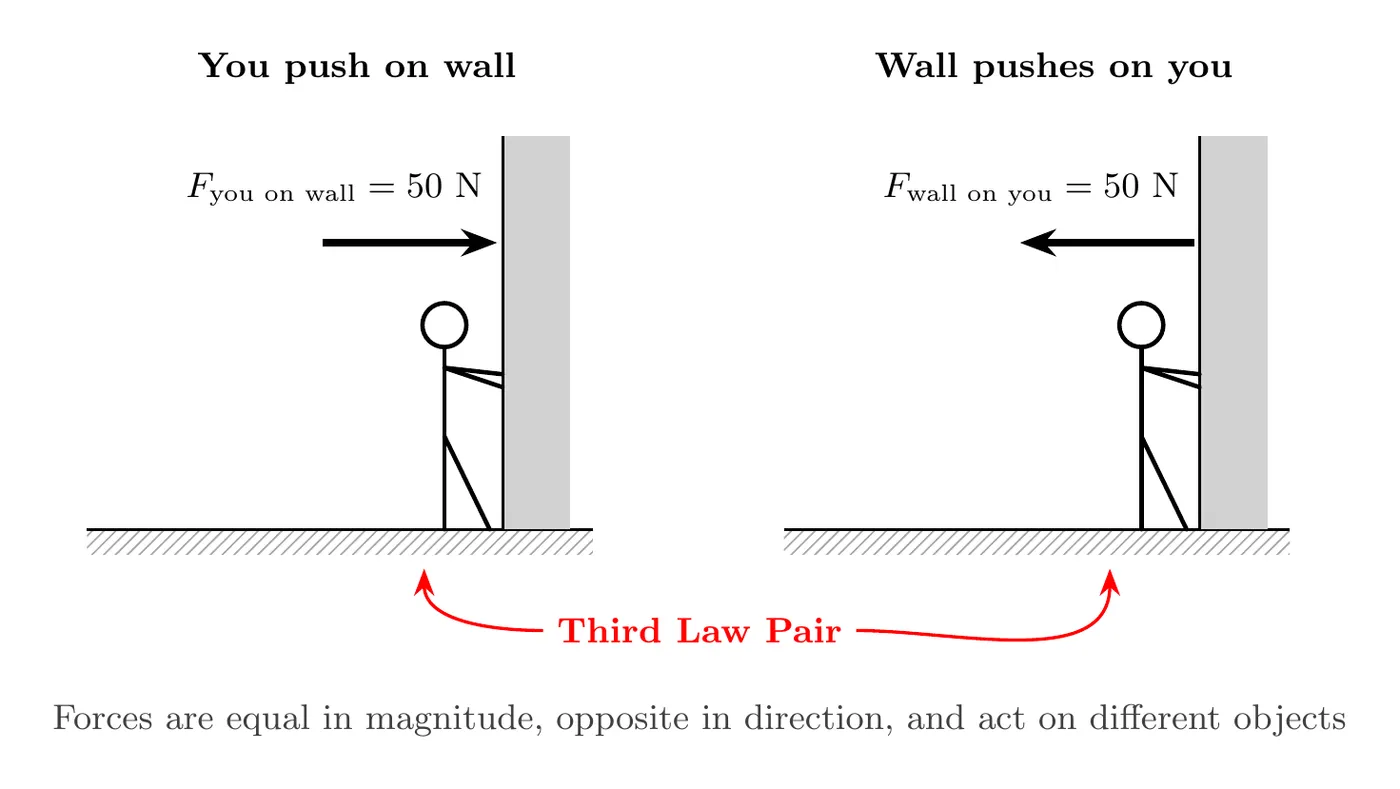
You don’t accelerate through the wall because it pushes back with equal force. The wall itself doesn’t move because it’s anchored to the foundation, is far more massive than you, and friction keeps it in place.
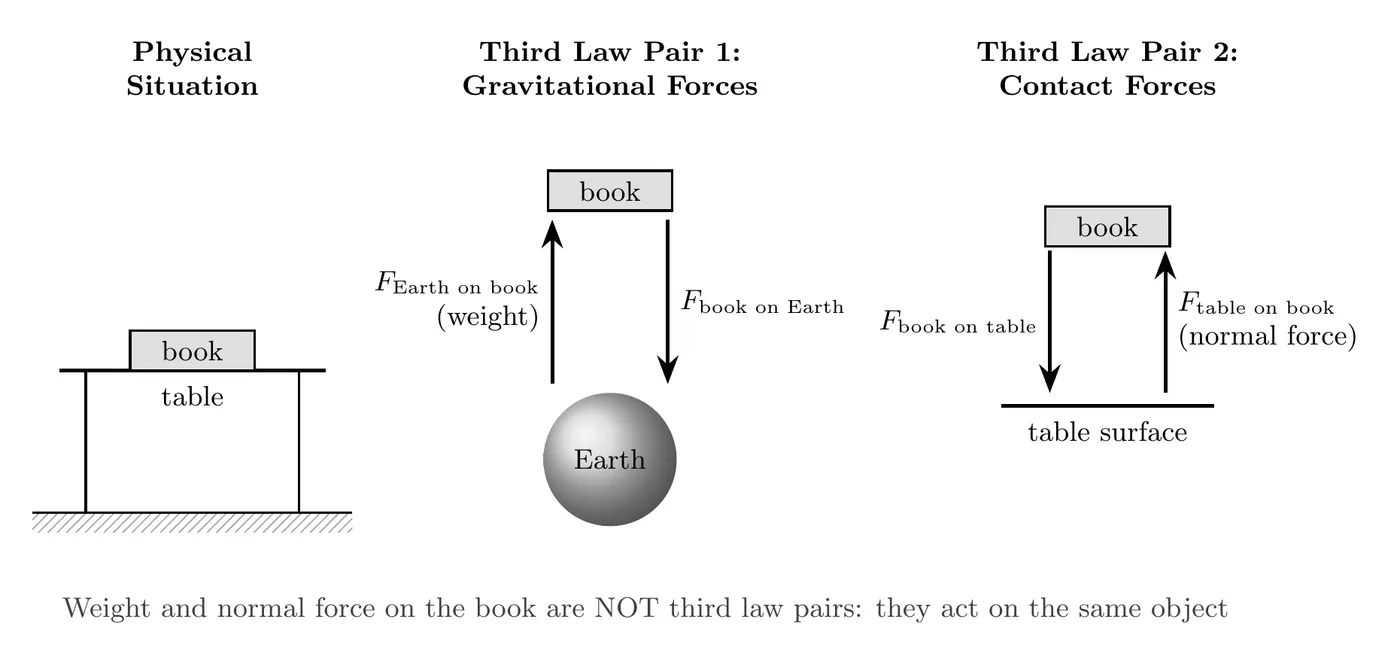
Book resting on a table: there are two separate third law pairs here.
The first is gravitational: Earth pulls the book down, and the book pulls Earth up, .
The second is a contact pair: the book pushes down on the table, and the table pushes up on the book (this upward push is the normal force), .
Here’s an important distinction: the weight of the book (Earth pulling it down) and the normal force (table pushing it up) are not a third law pair, even though they’re equal when the book is at rest. They both act on the same object, the book, so they can’t be a third law pair. They’re equal because of Newton’s First Law (equilibrium), not the Third Law.
Balanced Forces vs. Third Law Pairs
These two ideas get mixed up a lot, but they’re not the same thing.
Balanced forces act on the same object and add up to zero net force (equilibrium). They can be any combination of forces.
Third law pairs act on different objects, always come in pairs, and describe a mutual interaction.
Person standing still example: the forces on the person are weight (700 N down) and normal force (700 N up). These are balanced forces, same object, net zero, but they are not a third law pair.
The actual third law pair involving weight is: Earth pulls the person down with 700 N, and the person pulls Earth up with 700 N. These act on different objects, the person and Earth.
Specific Force Types and Their Pairs
Weight (gravitational force): the force of gravity on an object near Earth’s surface.
where is weight in Newtons, is mass in kg, and .
Weight always points straight down toward Earth’s center, no matter how a surface is angled. Its third law pair: Earth pulls the object down with force , and the object pulls Earth up with the same .
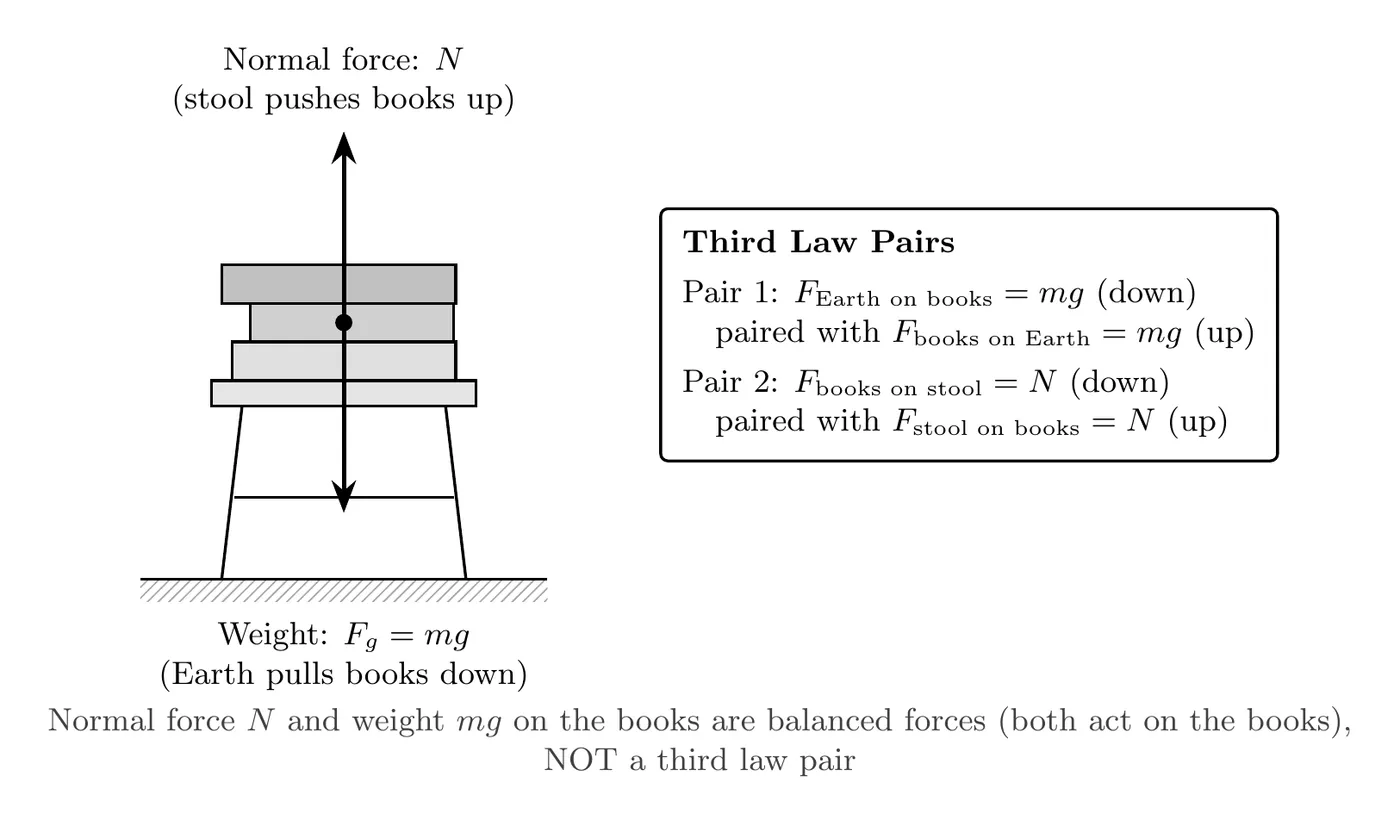
Normal force: the force a surface exerts perpendicular to itself, keeping objects from passing through. It’s always perpendicular to the contact surface, adjusts its magnitude depending on other forces, and doesn’t always equal weight.
For an object at rest on a horizontal surface, weight pulls down with and normal force pushes up with in this specific case. But normal force can change: if you push down on a book on a table, the normal force increases beyond to keep the book from accelerating downward.
Its third law pair: the object pushes down on the surface with force , and the surface pushes up on the object with force .
Tension: the pulling force transmitted through a rope, cable, or string when pulled from opposite ends. Tension always pulls, ropes can’t push, acts along the direction of the rope, stays the same magnitude throughout an ideal massless rope, and often opposes weight when it’s holding something up.
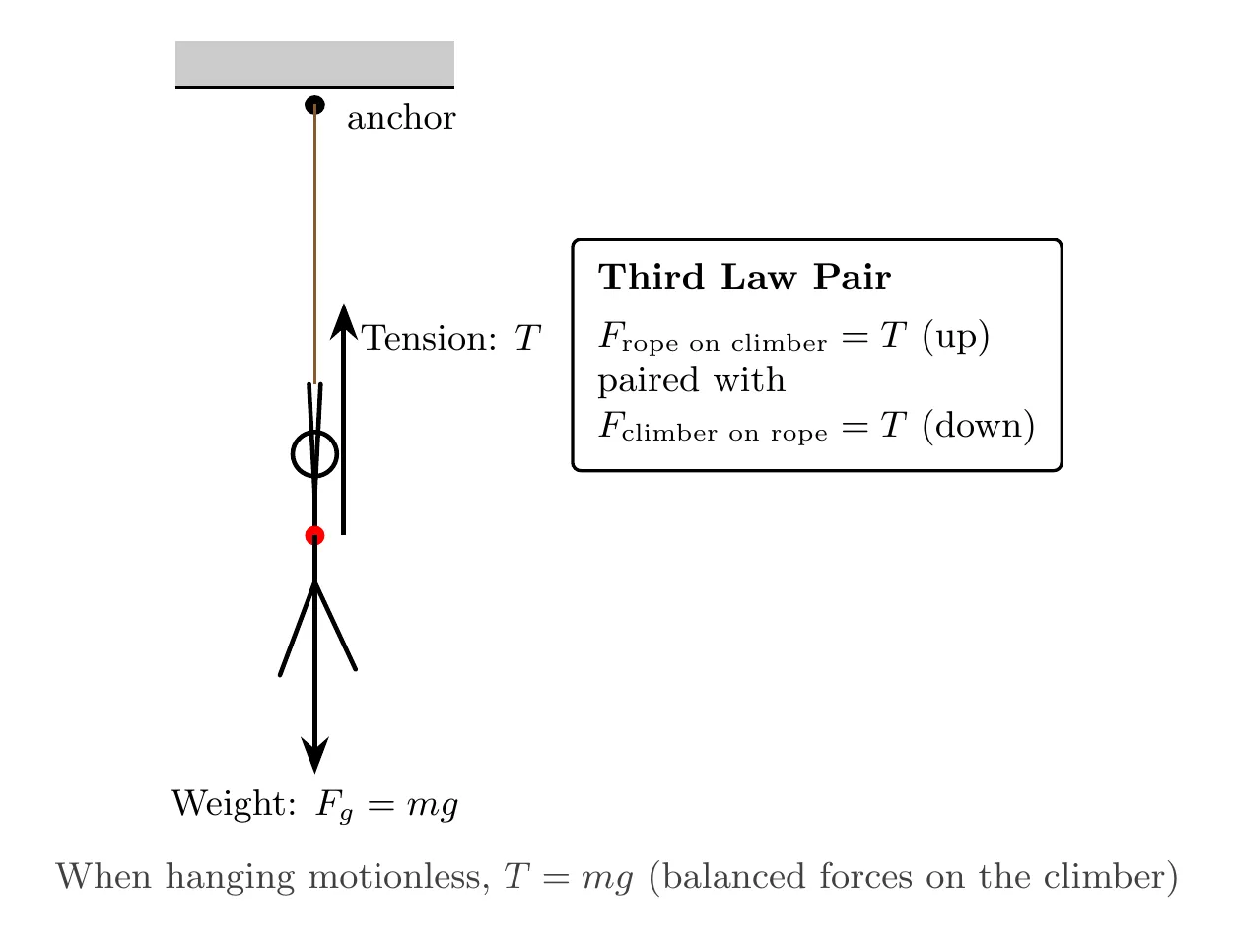
For an object hanging from a rope, weight pulls down with and tension pulls up with , adjusting to the situation. The third law pair: the object pulls down on the rope with force , and the rope pulls up on the object with force .
Example, rock climber on a rope: a 65 kg climber hangs motionless. Weight is N downward. For equilibrium, tension must equal 650 N upward. The third law pair: the rope pulls the climber up with 650 N, and the climber pulls the rope down with 650 N.
Thrust: the force propelling something forward as a result of expelling mass backward. An engine or rocket expels exhaust gas backward, and by the Third Law that expelled gas pushes the engine or rocket forward. This is how rockets, jet engines, and spacecraft work.
For a rocket launching, weight pulls down with and thrust pushes up with . Liftoff needs . The third law pair: the rocket pushes exhaust gases backward, and the exhaust gases push the rocket forward, that push is the thrust.
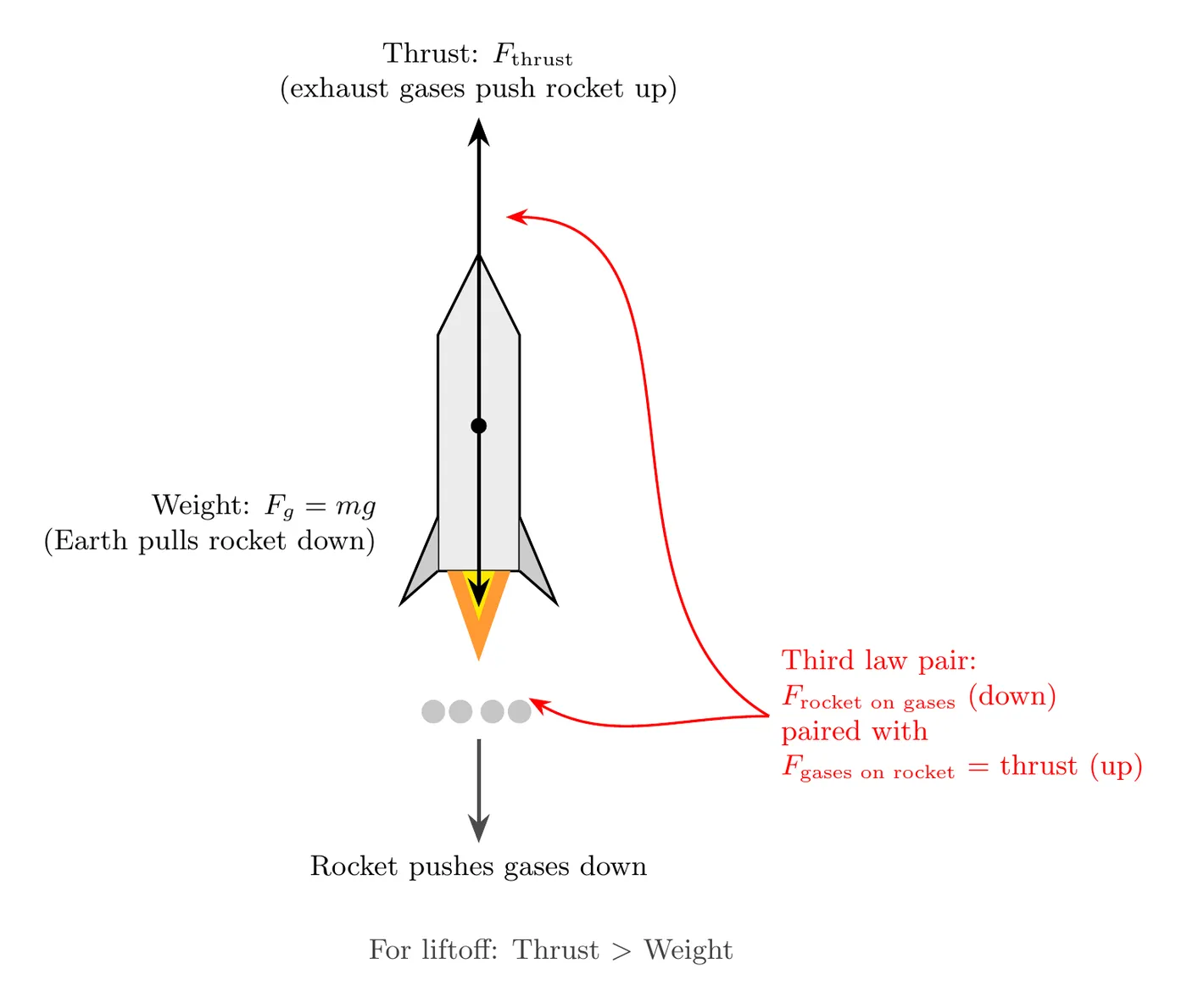
The Saturn V rocket that launched Apollo missions had a liftoff thrust of about 34 million Newtons, well beyond its roughly 29 million Newton weight.
Tension, Strings, and Pulleys
Where tension comes from: a rope is really a long chain of tiny segments. When something pulls on the end of a rope, each segment pulls on the segments next to it, and each pair of neighboring segments is a third law pair. Tension is the overall (macroscopic) result of all those segment-on-segment pulls, set up in response to whatever is pulling on the rope from outside.
Ideal strings: unless a problem says otherwise, AP Physics 1 treats strings, ropes, and cables as ideal:
- Negligible mass: the string itself has no weight to hold up.
- Doesn’t stretch: two objects tied together by the string move together, with the same speed and the same size of acceleration.
- Same tension everywhere: a massless segment can’t have a net force on it (with zero mass, any net force would mean an infinite acceleration), so the pulls on its two ends are equal. That makes the tension the same at every point along the string.
Strings with mass: if a rope or chain has real mass, the tension changes along its length. Picture a heavy chain hanging from a ceiling hook. The link at the very top holds up the whole chain below it, while a link near the bottom only holds up the few links beneath it. So the tension is largest at the top and shrinks toward zero at the bottom. (AP Physics 1 only asks about this qualitatively.)
Ideal pulleys: an ideal pulley has negligible mass and turns on a frictionless axle through its center of mass. Its only job is to change the direction of a string without changing the tension, so for a string over an ideal pulley, the tension is the same on both sides.
A Systematic Way to Find Third Law Pairs
- Identify the interaction: what two objects are actually interacting?
- Name both forces: the force A exerts on B, and the force B exerts on A
- Verify: equal magnitude, opposite direction, same type of force, and acting on different objects. If all four hold, it’s a third law pair.
Practice: hammer hitting a nail. The interaction is contact between hammer and nail. Force 1 is the hammer pushing the nail into the wood, and Force 2 is the nail pushing back on the hammer, slowing it down. Checking the criteria: equal magnitude (yes, both feel the same collision force), opposite direction (yes, hammer pushes one way, nail pushes the other), same type (yes, both contact forces), different objects (yes, one acts on the nail and one on the hammer). So this is a third law pair.
Even though the forces are equal, the two objects respond differently, because each object’s motion depends only on the forces acting on it. The hammer’s push on the nail is strong enough to overcome the wood’s grip, so the nail sinks in. The nail’s equal push back on the hammer points opposite the hammer’s motion, so the hammer slows to a stop.
Why the Third Law Matters
Walking: you push backward on the ground, and the ground pushes forward on you, which is what actually propels you forward.
Swimming: you push water backward, and the water pushes you forward.
Rocket propulsion in space: the rocket expels gas backward, and the gas pushes the rocket forward, this even works in a vacuum.
Why you can’t lift yourself: if you pull up on yourself, you’re also pulling down on yourself equally, so the third law pair cancels out and there’s no net external force.
It also keeps momentum conserved in every interaction, ensures no object experiences a one-sided interaction, and keeps physics self-consistent.
Common Exam Question Types
Identify the pair: a car accelerates forward as its engine turns the wheels, which push backward on the road. What’s the third law pair? The road pushes forward on the wheels, and that’s what actually accelerates the car.
Balanced forces vs. third law pairs: a lamp hangs motionless from the ceiling. The forces on the lamp are weight ( down) and tension ( up), which are balanced (equilibrium), not a third law pair. The actual third law pairs are: Earth pulls the lamp down () and the lamp pulls Earth up (); and the lamp pulls the cord down () and the cord pulls the lamp up ().
Why objects accelerate despite equal forces: if third law pair forces are always equal and opposite, why does anything ever accelerate? Because third law pairs act on different objects. An object’s acceleration only depends on the net force acting on that object alone, and equal and opposite third law forces don’t cancel each other since they’re acting on two different things.
Internal Forces and the Center of Mass
When both objects in an interaction are inside your system, their third law pair is made of internal forces. The two forces are equal and opposite and both act on the system, so they add to zero in the system’s net force. That means internal forces can never change the motion of the system’s center of mass. Only external forces, from objects outside the system, can.
Example: two ice skaters, Ana (48.0 kg) and Ben (72.0 kg), stand at rest on frictionless ice and push off each other. During the push, Ana pushes Ben with 144 N and Ben pushes Ana with 144 N. Each skater accelerates, in opposite directions: and . For the two-skater system, though, the pushes are internal and cancel. Check with the center of mass acceleration formula from 2.1, taking Ben’s direction as positive:
The skaters fly apart, but their center of mass doesn’t accelerate at all, so it stays exactly where it started.
Key Takeaways
- Newton’s Third Law: every action force has an equal and opposite reaction force
- Mathematical form:
- Third law pairs have equal magnitude, opposite direction, the same force type, and act on different objects
- Action and reaction happen simultaneously, no time delay
- Balanced forces (same object, net zero) are not the same as third law pairs (different objects, mutual interaction)
- Weight: , gravity pulling an object toward Earth, always downward
- Normal force: a perpendicular push from a surface, prevents objects passing through, magnitude adjusts
- Tension: pull transmitted through a rope or cable, always pulls, never pushes
- Thrust: forward force from expelling mass backward (rockets, jets)
- Normal force and weight on the same object are not a third law pair, they act on the same object
- Third law pairs act on different objects, so they never cancel each other out
- Subscript notation clearly identifies each pair
- Walking, swimming, and rocket propulsion all rely on the Third Law
- Tension is the overall result of rope segments pulling on each other
- Ideal strings are massless and don’t stretch, so the tension is the same everywhere along them
- An ideal pulley (massless, frictionless axle) changes a string’s direction without changing its tension
- A rope or chain with mass has more tension near the top, where it holds up more of itself
- Internal forces cancel in pairs and can’t change the motion of a system’s center of mass