

2.7 - Kinetic and Static Friction
What is Friction?
Friction is the resistance force that shows up when one surface or object moves, or tries to move, against another surface. It only happens when surfaces are touching and there’s motion or attempted motion between them.
Up until now, we’ve been assuming frictionless surfaces to keep things simple, but real situations almost always involve friction.
Two Types of Friction
Static Friction | Kinetic Friction |
Surfaces are NOT moving relative to each other | Surfaces ARE moving relative to each other |
Prevents motion from starting | Opposes ongoing motion |
Variable force (adjusts as needed) | Constant force (for given conditions) |
Must be overcome to start motion | Acts during motion |
Kinetic Friction
Kinetic friction happens when two touching surfaces are sliding relative to each other.
It’s always opposite the direction of motion. Slide something right, friction points left. Slide it down an incline, friction points up the incline.
More precisely, kinetic friction points opposite to the motion of each surface relative to the other surface. When the other surface is the floor, that’s the same as “opposite the motion.” But drop a suitcase onto a moving conveyor belt: at first the belt slides forward underneath it, so relative to the belt the suitcase slides backward. Kinetic friction on the suitcase points forward, in the direction the belt moves, and speeds the suitcase up until it moves along with the belt.
It’s also independent of contact area. In a classic lab demonstration, students slide a wooden block across a table on different faces, big face down or small face down, and get the same friction force either way. Only the materials involved matter (wood on wood, rubber on concrete, etc.), not how much surface area is touching.
And it depends on normal force, how hard the two surfaces are pressed together.
where is kinetic friction in Newtons, is the coefficient of kinetic friction (dimensionless, usually between 0 and 1), and is the normal force in Newtons.
The coefficient describes how slippery two surfaces are while sliding. Values near 0 mean very slippery (ice on ice, ), while values near 1 mean very rough (rubber on dry pavement, ).
Normal force in different setups: on a horizontal surface, . On an incline, . With extra vertical forces present, you have to account for anything pushing down or pulling up on the object too.
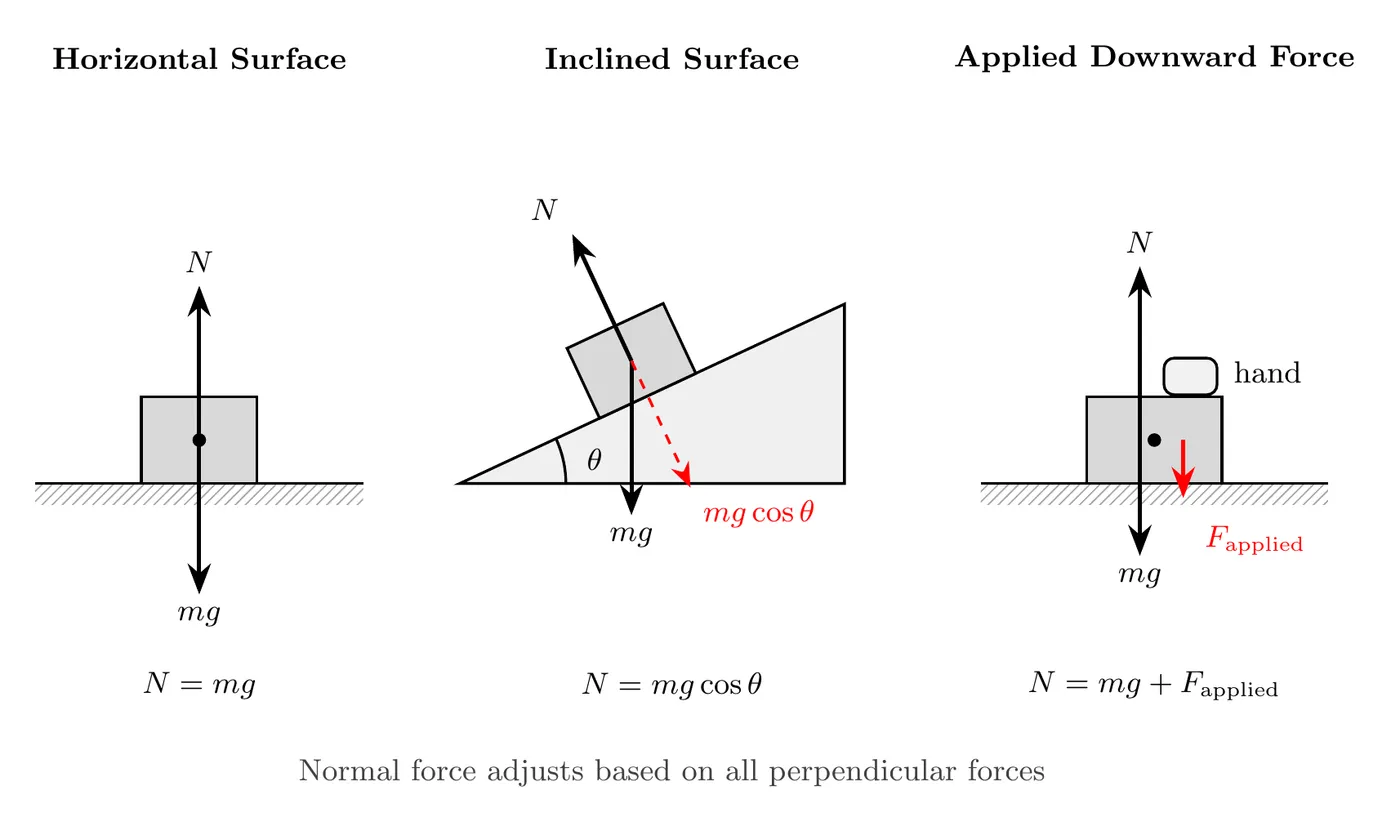
Normal force and friction are two parts of one contact force. When a surface touches an object, it exerts a single contact force on it. The normal force is the part of that force perpendicular to the surface, and it always points away from the surface (a surface can push on an object but never pull it in). Friction is the part parallel to the surface. That’s why ties them together: the harder the two surfaces press together (bigger ), the more friction they can produce.
Static Friction
Static friction happens between two touching surfaces that are not moving relative to each other, and it’s the force preventing motion from starting, the force you have to overcome to get something sliding.
It has an adjustable magnitude, it’s not a fixed value, but increases to match the applied force up to a certain maximum. It opposes the direction of potential motion, whichever way the object would slide if friction weren’t there. And there’s a limit to how much it can provide, once that’s exceeded, motion begins.
where is the (variable) static friction force, is the coefficient of static friction, and is the normal force. This reads as “static friction can be anywhere from zero up to a maximum value of .”
At the threshold of motion: , the minimum force needed to get the object moving.
Pushing a heavy crate example:
Push gently (5 N) and the crate doesn’t move, static friction matches at 5 N, net force is 0.
Push harder (10 N) and it still doesn’t move, static friction increases to match at 10 N, net force is still 0.
Push very hard (25 N) and the crate finally slides: static friction maxes out at, say, 20 N and can’t match the push. Once the crate is sliding, kinetic friction takes over, and it’s even smaller (say 15 N), so the net force is N and the crate accelerates.
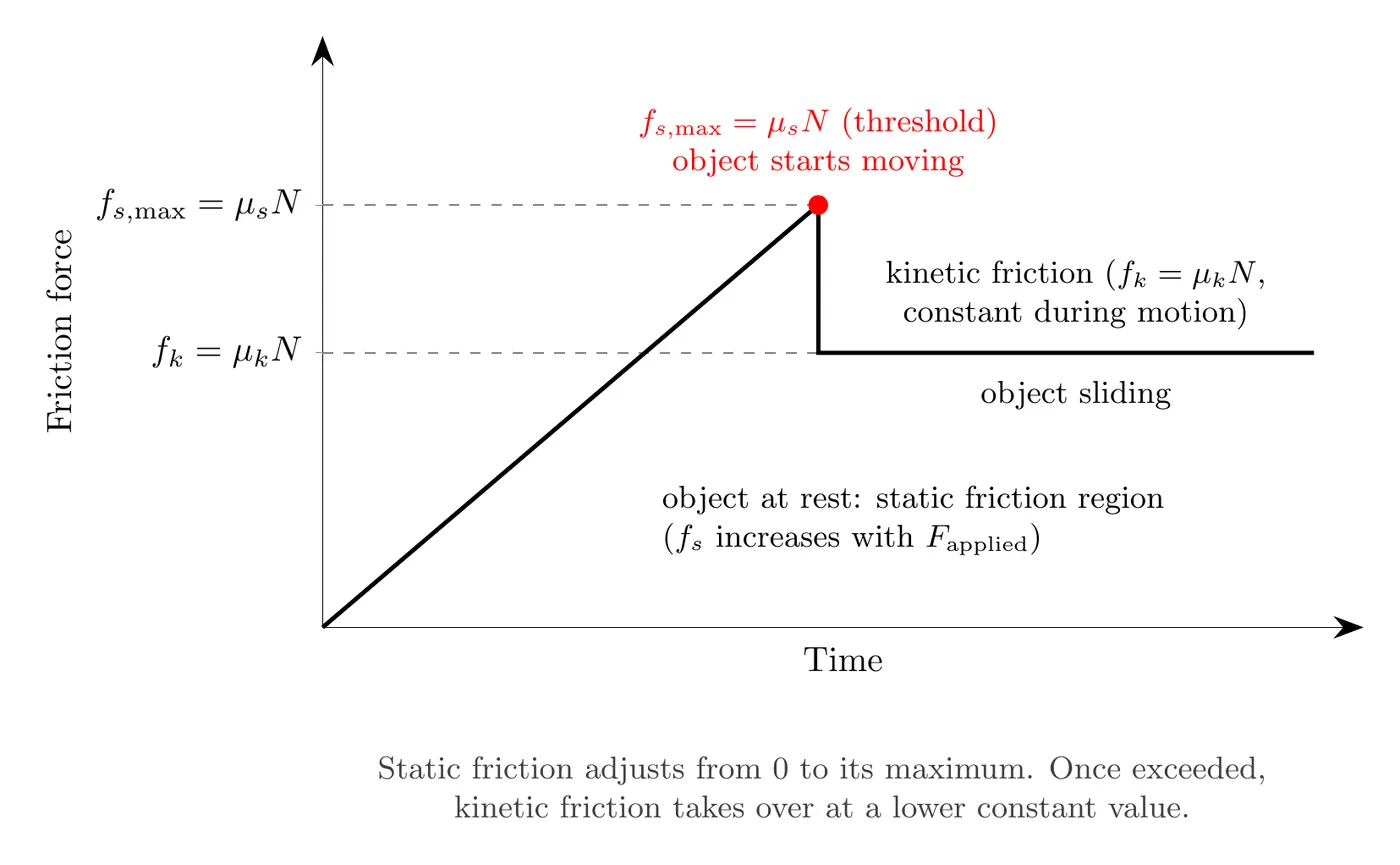
Static vs. Kinetic Friction Coefficients
For the same pair of surfaces, almost always (Teflon on Teflon, in the table below, is the exception). This means it’s usually harder to start motion than to keep it going.
Real-world examples: pushing a stalled car is hard to get rolling but easier to keep rolling. Sliding furniture is hardest right at the start, then easier. Braking a car gives maximum friction when the wheels are rolling (static) and less friction once they lock up and skid (kinetic).
Surface Pair | ||
Rubber on dry concrete | 1.0 | 0.7 |
Rubber on wet concrete | 0.7 | 0.5 |
Wood on wood | 0.5 | 0.3 |
Steel on steel | 0.7 | 0.4 |
Ice on ice | 0.1 | 0.02 |
Teflon on Teflon | 0.04 | 0.04 |
Notice that in every case shown except Teflon, which is an unusual exception.
Solving Friction Problems
These still follow Draw-Sum-Solve, just with friction added to the free body diagram.
Draw: include friction on the FBD, pointed opposite to motion (kinetic) or opposite to potential motion (static). You’ll usually need to figure out the normal force first, through the y-direction.
Sum: often need equations for both x and y directions. The y-direction typically gives you (needed for the friction calculation), and the x-direction includes the friction force itself.
Solve: substitute into your equations, which often ends up as two equations with two unknowns.
Worked Example: Finding Mass with Friction
You push a wooden crate horizontally with 30 N across a floor. The crate accelerates from rest to 15 m/s over a distance of 6.5 meters, with a kinetic friction coefficient of 0.45 between crate and floor. Use . Find the mass of the crate.
Finding acceleration first (kinematics): given , m/s, and m, use the timeless equation:
This is the result of the forces at play (Second Law territory). Now we dig into why this acceleration happened.
Draw: the crate has weight (, down), normal force (, up), applied force ( N, horizontal, in the direction of motion), and kinetic friction (, horizontal, opposing motion).
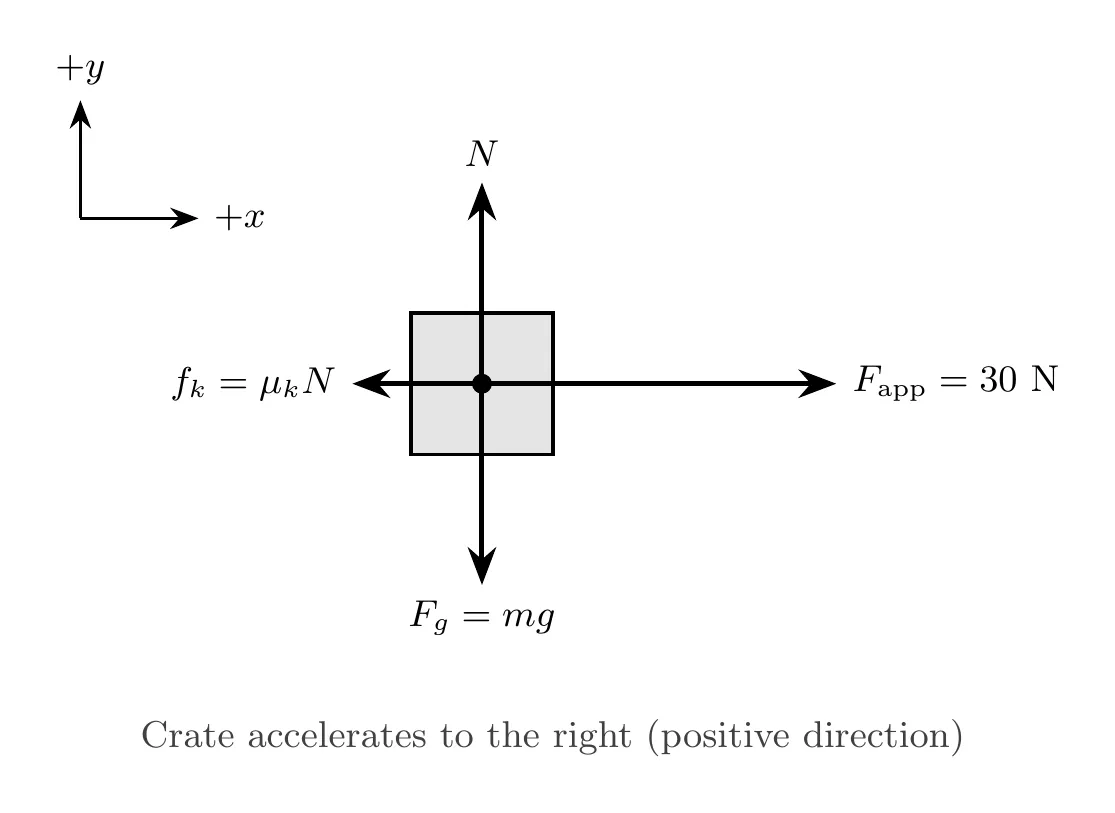
Sum: in the y-direction, there’s no vertical acceleration since the crate stays on the floor:
We need this because friction depends on .
In the x-direction, net force causes acceleration:
Substituting the friction formula, then :
Solve: factor out mass on the right side:
Solving for mass:
The crate comes out to about 1.4 kg, which checks out physically, a fairly light object (roughly 3 pounds) can accelerate quickly with a moderate force even with friction working against it.
A useful side note: in the equation , if you set (imagine the object sliding freely after an initial push):
This is the deceleration of a freely sliding object due only to friction. For example, a hockey puck sliding on ice with decelerates at until it stops.
Application: Skidding Car
When a car locks its brakes and skids, kinetic friction is the only horizontal force at play:
Applying Newton’s Second Law:
The car’s deceleration depends only on the friction coefficient (road condition) and gravitational acceleration. It does not depend on the car’s mass (it cancels out) or its speed (speed affects stopping distance, not the rate of deceleration itself).
Road Condition | Deceleration | |
Dry pavement | 0.7 | |
Wet pavement | 0.5 | |
Ice | 0.1 |
This is exactly why anti-lock brakes help: they keep the wheels from locking up, keeping friction in the higher static regime (), which gives better stopping ability.
Worked Example: Static Friction on a Ramp
A 4.00 kg box sits at rest on a ramp tilted 25.0° above horizontal. The coefficient of static friction between the box and the ramp is 0.600. Use . (a) Find the static friction force on the box. (b) Find the steepest angle the ramp can have before the box starts to slide.
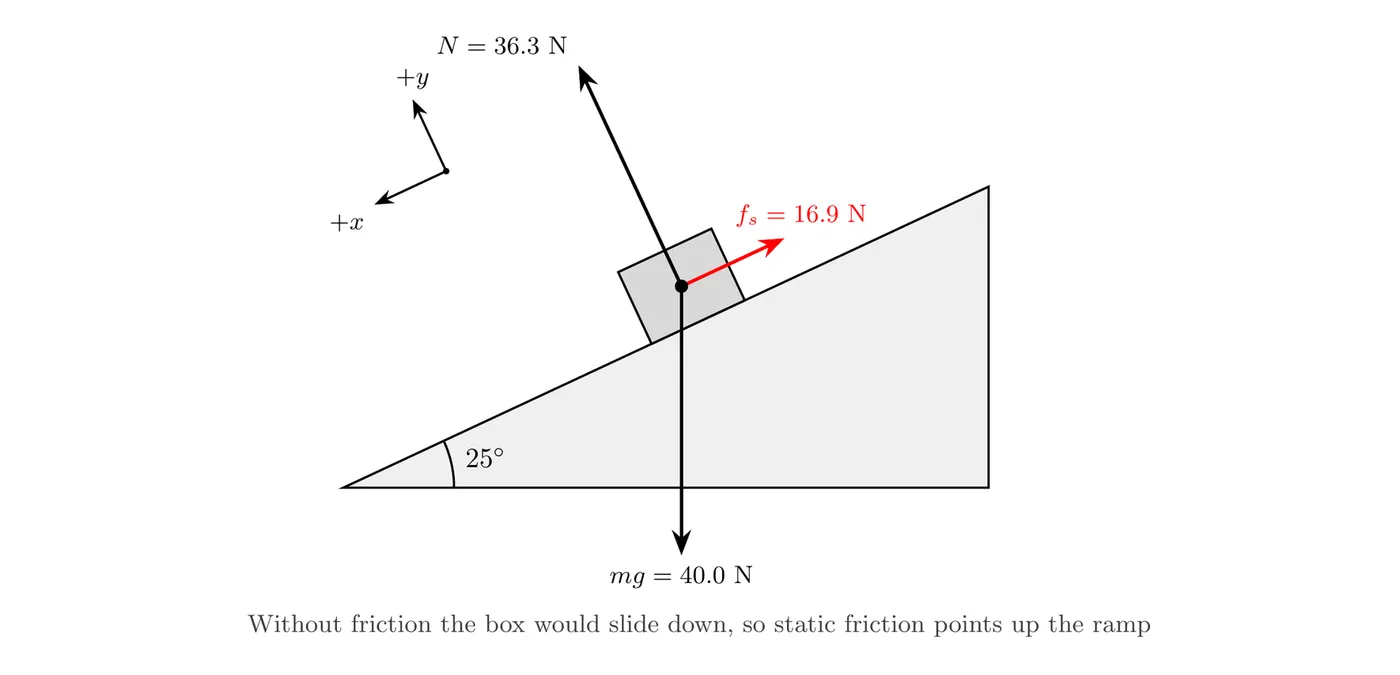
Draw: weight straight down, normal force perpendicular to the ramp, and static friction along the ramp. Without friction the box would slide down, so static friction points up the ramp. Use tilted axes: along the ramp (positive down the slope) and perpendicular to it.
Sum: the box isn’t accelerating, so both directions balance:
Compare to the maximum: N. The box only needs 16.9 N, which is less than the 21.8 N available, so it stays put, and the static friction force is 16.9 N up the ramp. Static friction is not automatically , it only supplies as much as the situation needs. Plugging in here would give the wrong answer.
Steepest angle: right when the box is about to slip, static friction is at its maximum, so . Mass and cancel:
Any steeper than 31.0°, and the box slides, no matter how heavy it is.
Common Problem Scenarios
Will an object start moving? Given an applied force, mass, , and orientation, calculate the maximum static friction and compare it to the applied force. If the applied force exceeds , it moves. If not, it stays put.
Finding acceleration of a sliding object: figure out the normal force from the y-direction, calculate kinetic friction , apply Newton’s Second Law in the x-direction with friction included, then solve for acceleration.
Minimum force needed to start motion: at the threshold, .
Friction on an incline: the weight’s parallel component now factors in. For an object sliding down an incline:
where .
Common Mistakes
Using static friction for a moving object: if the object is already sliding, always use , not .
Forgetting friction’s direction: friction opposes the motion (or attempted motion) of one surface relative to the other. Measured from the ground, that can be the same direction the object moves: static friction from the road pushes a car’s tires forward, and friction from a conveyor belt drags a suitcase forward.
Bringing surface area into it: friction is independent of contact area, a bigger surface doesn’t mean more friction, for the same materials.
Treating static friction as fixed: static friction adjusts anywhere from 0 up to its maximum . Only use the maximum when you’re finding the threshold of motion.
Key Takeaways
- Friction is resistance between surfaces in contact, and only occurs when surfaces slide or attempt to slide
- Kinetic friction: , constant during motion, opposes the direction of motion
- Static friction: , variable, adjusts to prevent motion up to a maximum
- Friction is independent of contact surface area, only material types matter
- Usually , harder to start motion than to keep it going (Teflon on Teflon, with equal values, is an exception)
- Friction depends on normal force, how hard the surfaces press together
- Direction: friction opposes actual motion (kinetic) or potential motion (static)
- Coefficients of friction are dimensionless, typically between 0 and 1
- Problem-solving often needs the y-direction to find , then the x-direction with friction included
- Sliding object deceleration from friction alone:
- A skidding car’s deceleration depends on and , not mass or initial speed
- Static friction behaves like a “smart” force, increasing to match the applied force up to its max
- The switch from static to kinetic friction shows up as a peak in a force vs. time graph
- Still use Draw-Sum-Solve, with friction showing up in the Sum step of the force analysis
- Kinetic friction opposes motion relative to the other surface, which can mean pushing an object forward (a suitcase on a conveyor belt)
- Normal force and friction are the perpendicular and parallel parts of one contact force from a surface, and the normal force always points away from the surface
- Static friction only supplies what’s needed, so use only when the object is about to slip
- On a ramp, an object at rest starts to slip once