

2.6 - Gravitational Force
Newton’s Law of Universal Gravitation
This law describes the gravitational pull between any two objects in the universe: every mass attracts every other mass, and that force is directly proportional to the product of the two masses and inversely proportional to the square of the distance between their centers.
where is the gravitational force in Newtons, is the universal gravitational constant, and are the two masses in kg, and is the distance between their centers of mass in meters. That distance is measured between centers of mass, not the surfaces.
Don’t confuse with :
Symbol | Name | Value | Meaning |
Universal gravitational constant | Same everywhere in the universe | ||
Gravitational field strength on Earth | Varies by location and planet |
is a fundamental constant of nature, while is the local acceleration due to gravity right at Earth’s surface.
Inverse Square Law
Since gravitational force is inversely proportional to , it’s called an inverse square law: . Doubling the distance drops the force to a quarter of its strength, tripling the distance drops it to a ninth, and halving the distance quadruples it.
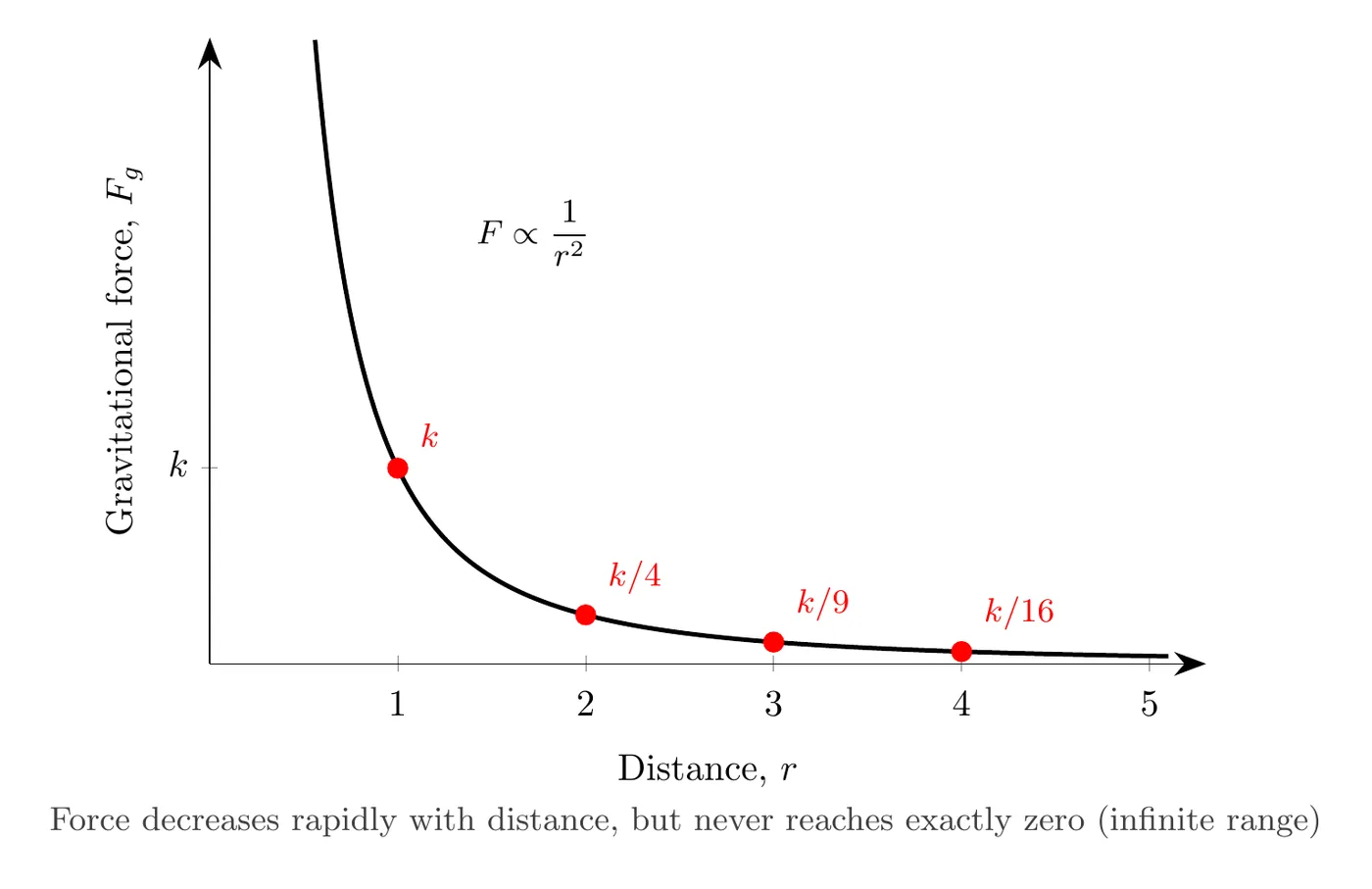
Physically, gravity has infinite range, it never fully disappears, it just becomes negligibly small over large distances.
This equation has a famous counterpart in electricity and magnetism, Coulomb’s Law, , describing the force between charges. The forms are nearly identical, both inverse square laws, even though the underlying phenomena are different, which hints at some deep shared mathematical structure to forces in nature.
Properties of Gravitational Force
Always attractive: unlike electric forces, which can attract or repel, gravity only ever attracts. There’s no such thing as negative mass that would repel, gravity always pulls masses together, and that’s why planets orbit stars and moons orbit planets.
Acts along the line connecting centers of mass: the force vector points straight along the line joining the two centers of mass.
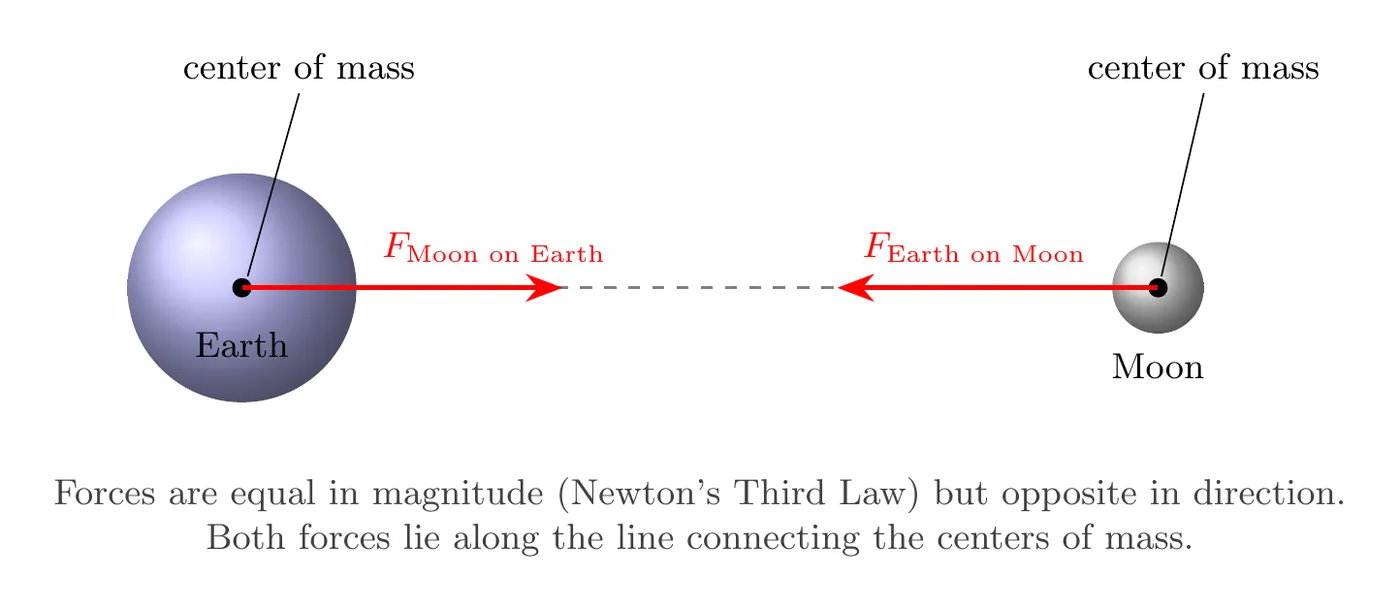
For orbital mechanics, the distance is the orbital radius, which is , where is the planet’s radius (surface to center) and is the altitude above the surface.
Example: a satellite 400 km above Earth’s surface has an orbital radius of m, using Earth’s radius of m.
For small objects near Earth’s surface, like people or cars, the object’s height above the surface can be treated as negligible compared to Earth’s radius (so the distance between centers of mass is just Earth’s radius), and problems will often say you can ignore it.
When can you treat gravity as constant? If the distance between two objects’ centers of mass barely changes during a problem, the gravitational force between them barely changes either, so you can treat it as constant ( with one value of ) the whole time. Near Earth’s surface, that’s almost always true. Hiking to the top of a 1.0 km tall hill only moves you from m to m from Earth’s center, so drops by only about 0.03%:
For a satellite or a trip to the Moon, the distance changes a lot, so gravity can’t be treated as constant and you need .
Force acts on the center of mass: when calculating gravitational effects on a system, treat the force as acting on the system’s center of mass, even if the mass is spread throughout an extended object.
Gravitational Field and Weight
A gravitational field surrounds any mass, and its strength at a given location tells you how much force per unit mass an object would feel there.
On Earth’s surface: (often rounded to for easier math).
Both numbers are official: the AP equation sheet lists (9.8 m/s²) at Earth’s surface, and the course framework says near Earth’s surface. When a problem needs a number, the exam uses 10, and 9.8 or 9.81 isn’t penalized (see 1.3).
The gravitational field strength has the same numerical value as gravitational acceleration, but the units emphasize different things: emphasizes acceleration, a kinematic idea, while emphasizes force per unit mass, a field idea.
The field model: a field describes the effect a noncontact force would have on an object placed at any point in space, even before anything is put there. To find the gravitational field at a point, imagine placing a small test object of mass there, find the gravitational force on it, and divide by . Using universal gravitation for the force, the field a distance from the center of a body of mass is:
The test object’s mass cancels, so the field depends only on the body creating it () and how far you are from its center ().
When does N/kg equal m/s²? Only when gravity is the only force on the object. Then Newton’s Second Law gives , so the acceleration in m/s² has the same number as the field strength in N/kg. A dropped ball (no air resistance) accelerates at 9.8 m/s² because the field is 9.8 N/kg. A book resting on a table sits in the same 9.8 N/kg field but has zero acceleration, because the normal force acts on it too.
Weight vs. gravity: gravity is the fundamental attraction between masses, and weight is the gravitational force acting on one specific object.
where is weight in Newtons, is mass in kg, and is the gravitational field strength in N/kg or m/s².
On a free body diagram, draw weight ( or ), not “gravity.” Weight is the force, gravity is the underlying interaction that produces it.
Deriving Surface Gravity
We can connect the Law of Universal Gravitation to the weight equation. For an object of mass at a planet’s surface:
But weight is also . Setting these equal:
Canceling the object’s mass from both sides:
So the gravitational field strength (and the acceleration due to gravity) at a planet’s surface depends only on that planet’s mass and radius, not on the mass of whatever is falling. This is why every object falls at the same rate ignoring air resistance, it’s how NASA calculates on other planets before sending missions, and it’s why different planets end up with different surface gravities.
Planet | Mass (kg) | Radius (m) | Surface g (m/s²) |
Earth | 9.8 | ||
Moon | 1.6 | ||
Mars | 3.7 |
Worked Example: Gravitational Field at a Satellite’s Height
Find the gravitational field strength m (400 km) above Earth’s surface, about the height of the International Space Station. Then find the gravitational force on a 65.0 kg astronaut there. Use , kg, and m.
Distance from Earth’s center: m
Field strength:
Force on the astronaut: N
That’s about 89% of the surface value of 9.8 N/kg. Gravity at the space station is only a little weaker than on the ground, so astronauts float for a different reason (see apparent weight below).
Common Question Types
Effect of changing mass or distance: for example, what happens if you double the mass of one planet and halve the distance between them? Starting from , doubling and halving gives:
So the force increases by a factor of 8, doubling doubles the force, and halving quadruples it (inverse square), combining to give .
Calculating orbital or surface values: use directly, remembering that is the orbital radius (center to center), not just the altitude.
Apparent weight problems: these involve accelerating reference frames, like elevators, where measured weight differs from actual weight.
Apparent Weight
Apparent weight is the force you actually feel supporting you, which can differ from your real weight if you’re accelerating. It’s measured by things like a bathroom scale, the tension in a rope holding you, or the normal force from a surface.
When you stand on a scale, it measures the normal force pushing up on you. At rest or constant velocity, normal force equals weight. When accelerating, they’re not equal. The sensation of feeling heavier or lighter comes from the normal force changing, not from your actual weight changing.
For an object on a scale in an accelerating elevator, the forces are weight (, always downward) and normal force / scale reading (, upward). Applying Newton’s Second Law with up as positive:
Or with prime notation for apparent weight:
where a positive (accelerating upward) uses and feels heavier, and a negative (accelerating downward) uses and feels lighter.
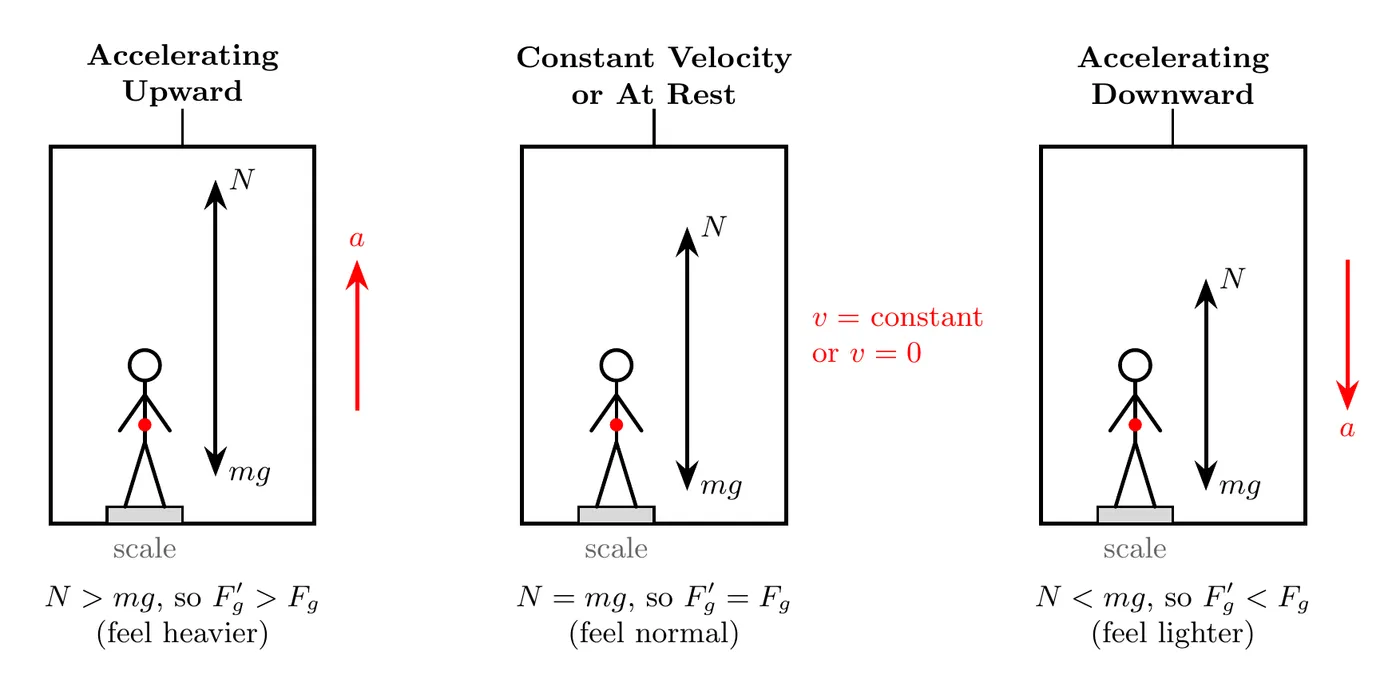
When accelerating upward, extra force is needed to push you upward beyond just supporting your weight, so the scale pushes harder and reads a higher value, you feel heavier. When accelerating downward, gravity is already helping accelerate you down, so the scale pushes less hard, reads lower, and you feel lighter.
In the extreme case of free fall (): . You feel weightless, even though your actual weight hasn’t changed at all, gravity is still there. This is exactly what astronauts experience in orbit.
Apparent weight is also zero when there are no forces at all on a system, like a spacecraft drifting in deep space far from any planet or star. So a system appears weightless in two cases: no forces at all, or gravity as the only force (free fall). Astronauts on the space station are the second case. Gravity up there is still about 8.7 N/kg (see the worked example above), but the station and everyone in it are falling around Earth together, so nothing pushes up on them and the normal force is zero.
Worked Example: Elevator Apparent Weight
A student stands on a bathroom scale in an elevator at rest on the 64th floor, and the scale reads 836 N. Using :
Part A: as the elevator accelerates upward, the scale reads 935 N. Find the acceleration.
Part B: as the elevator approaches the 74th floor and slows down, the scale reads 782 N. Find the acceleration.
Finding mass: using the at-rest reading, kg.
Part A: actual weight is N, apparent weight is N, and mass is kg. Applying Newton’s Second Law with up as positive:
The elevator accelerates upward at about 1.2 m/s². The positive sign confirms it, and the student feels heavier because the scale has to push harder to accelerate them upward.
Part B: actual weight N, apparent weight N, mass kg:
The elevator accelerates downward at about 0.65 m/s² (the negative sign shows downward). Since the elevator is moving upward but nearing its destination, it needs to slow down, which requires downward acceleration. The student feels lighter since less upward force is needed.
Sensation summary: upward acceleration () means apparent weight exceeds actual weight, feeling heavier, common when an elevator starts moving up. Downward acceleration () means apparent weight is less than actual weight, feeling lighter, common when an elevator starts moving down, or slows while moving up. Constant velocity or rest () means apparent weight equals actual weight, feeling normal.
The Equivalence Principle
Imagine waking up inside a closed room with no windows, standing on a scale that reads your normal weight. Are you at rest on Earth, or in a rocket far out in space, speeding up at 9.8 m/s²? There’s no experiment you can do inside the room to tell. In both cases the floor pushes up on you with the same normal force, and anything you drop falls toward the floor at 9.8 m/s² relative to you.
This is the equivalence principle: an observer in a noninertial (accelerating) reference frame can’t tell the difference between an apparent weight caused by the frame’s acceleration and a real gravitational force from a gravitational field. It’s why an elevator accelerating downward feels like being in a weaker gravitational field, and a freely falling one feels like no gravity at all.
Inertial Mass vs. Gravitational Mass
Mass does two different jobs in this unit, and they’re actually two different ideas:
- Inertial mass: how much an object resists changes in its motion when something pushes or pulls on it. It’s the in . More inertial mass means less acceleration for the same net force.
- Gravitational mass: how strongly an object attracts, and is attracted by, other masses. It’s the in and in .
Nothing in Newton’s laws says these two have to be the same number, but every experiment so far (some precise to about one part in ) shows they are equal. That’s why everything falls with the same acceleration when air resistance doesn’t matter: a bowling ball has more gravitational mass, so gravity pulls on it harder, but it also has exactly that much more inertial mass, so it resists by exactly that much more. In , the masses cancel only because they’re equal. Apollo 15 astronaut David Scott showed this on the Moon in 1971 by dropping a hammer and a falcon feather at the same time: with no air, they hit the ground together.
Real-World Applications
Theme park drop towers: briefly feel normal near the top (), feel light or nearly weightless during the drop (), and feel very heavy during braking ().
Astronaut training (“vomit comet”): an airplane flies parabolic arcs to create brief weightlessness. For the whole arc, on the way up and on the way down, the plane follows a free-fall path, so , , and astronauts float inside.
High-speed elevators in skyscrapers: usually keep their acceleration to about 1 to 1.5 m/s² for comfort, which still makes you feel roughly 10 to 15% heavier or lighter, and modern elevators also try to minimize jerk (the rate of change of acceleration).
Key Takeaways
- Newton’s Law of Universal Gravitation: , describing attraction between any two masses
- Universal gravitational constant: , not the same thing as
- Inverse square law: force falls off as , double the distance means a quarter of the force
- Gravitational force is always attractive, never repulsive
- Force acts along the line connecting centers of mass
- Distance is measured center to center, not surface to surface
- Orbital radius:
- Gravitational field strength on Earth:
- Weight equation: , weight is the gravitational force on an object
- Surface gravity formula: , depending only on a planet’s mass and radius
- Apparent weight: , where is the elevator or system’s acceleration
- Accelerating upward () means apparent weight increases, feeling heavier
- Accelerating downward () means apparent weight decreases, feeling lighter
- Free fall () means apparent weight is zero, feeling weightless, even though actual weight is unchanged
- Apparent weight is the normal force or scale reading, not actual weight
- The sensation of weight comes from support forces, not from gravity itself
- Gravitational field: at a distance from the center of a body of mass
- If gravity is the only force on an object, its acceleration (m/s²) equals the field strength (N/kg)
- Treat gravity as constant () when the distance between centers barely changes, like anywhere near Earth’s surface
- A system appears weightless when there are no forces on it, or when gravity is the only force (free fall)
- Equivalence principle: inside an accelerating frame, you can’t tell apparent weight from a real gravitational force
- Inertial mass (resists acceleration) and gravitational mass (feels gravity) have been measured to be equal