

2.5 - Newton’s Second Law
From Balanced to Unbalanced Forces
Newton’s First Law dealt with situations where forces were balanced (net force zero), giving equilibrium and constant velocity. Newton’s Second Law picks up where forces become unbalanced (net force not zero).
First Law | Second Law |
Constant velocity | Changing velocity (acceleration) |
Once the net force stops being zero, the object or system starts to accelerate.
The Statement
Newton’s Second Law: the acceleration of a system’s center of mass is directly proportional to the net force acting on it and inversely proportional to its mass. The acceleration points in the same direction as the net force.
where is the net force (vector sum of everything acting on it), is the mass, and is the resulting acceleration.
Rearranged to solve for acceleration:
This version makes it clear that acceleration is directly proportional to net force (double the force, double the acceleration) and inversely proportional to mass (double the mass, half the acceleration).
On the AP equation sheet, it’s written for a whole system:
Here is the acceleration of the system’s center of mass and is the total mass of everything in the system. Only external forces go in the sum, since internal forces cancel in pairs (2.3).
Direct and Inverse Proportionality
For a constant mass, acceleration grows as net force grows: . For example, applying 10 N to a 2 kg object gives 5 m/s² of acceleration, and applying 20 N to the same object gives 10 m/s².
For a constant net force, acceleration shrinks as mass grows: . For example, 20 N applied to a 2 kg object gives 10 m/s², but 20 N applied to a 4 kg object only gives 5 m/s².
Physically, small mass is easy to accelerate (low inertia), and large mass is hard to accelerate (high inertia), tying right back to inertia from the First Law.
Newton’s Original Framing
Newton himself never wrote . In the Principia (1687), he stated the law in terms of “motion,” what we now call momentum: the change in an object’s motion is proportional to the force applied, and it happens in the direction of that force. Today we usually write it with acceleration on the left, to show that force is the cause:
This framing emphasizes that force causes acceleration, not the other way around, that acceleration depends on both the net force and the mass, and that the acceleration always matches the direction of the net force.
Connection to Center of Mass
Newton’s Second Law technically applies to a system’s center of mass.
Recall from earlier:
The center of mass velocity only changes when a nonzero external net force acts on the system:
Internal forces within a system can’t change the center of mass motion, only external forces can. Think of two ice skaters pushing off each other: the forces between them are internal, equal and opposite (Newton’s Third Law), and they don’t change the center of mass velocity at all. Only something external, like friction with the ice, would affect that.
Common Problem Types
Incline plane problems: objects sliding or being pulled on ramps at various angles, requiring weight to be resolved into components parallel and perpendicular to the surface, with normal force perpendicular to the incline and friction (if present) parallel to it, opposing motion.
Connected object problems: multiple objects connected by ropes or in contact with each other. This includes two blocks pushed together (contact forces between them), Atwood machines (two masses hanging from opposite sides of a pulley), and modified Atwood machines (one mass on a horizontal or inclined surface, one hanging vertically). You can analyze these as one combined system (simpler) or as separate systems (more detailed), and connected parts share the same acceleration if the rope doesn’t stretch.
Multiple force problems: objects with several forces acting at once, like applied force, friction, gravity, and normal force together, solved by adding everything as vectors to find net force, then applying .
Analyzing Incline Planes
Incline problems need careful coordinate choices and force resolution.
The best approach is to rotate your axes so one lines up with the direction of motion. The standard choice is an x-axis parallel to the incline surface (positive pointing down the slope) and a y-axis perpendicular to the surface (positive pointing away from it).
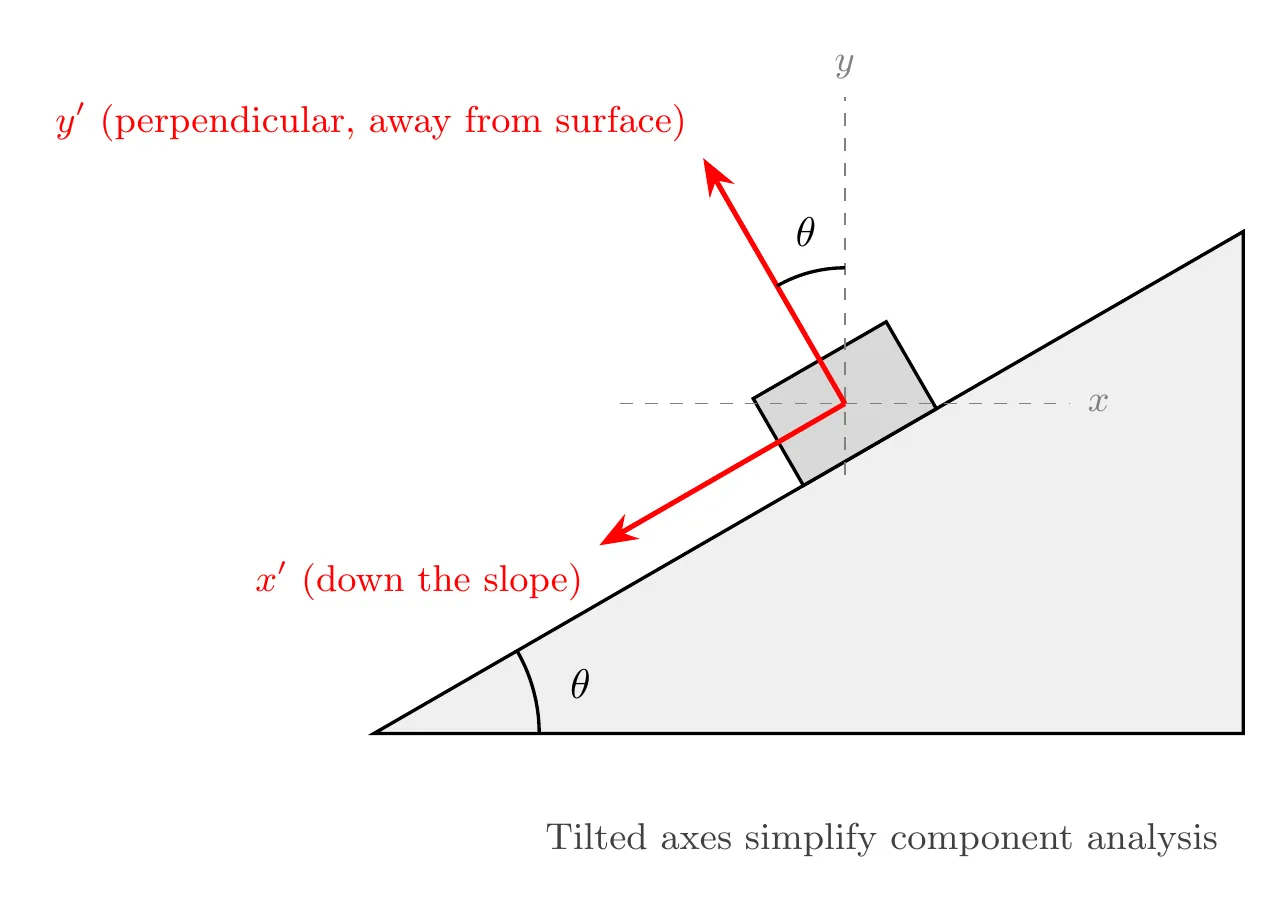
This helps because motion only happens along the x-axis (nothing moves perpendicular to the surface), which simplifies things to (no acceleration perpendicular to the surface) and you only need to solve for motion up or down the slope.
Force components on an incline: weight always points straight down, never perpendicular to the surface, so it needs resolving:
Normal force is always perpendicular to the contact surface:
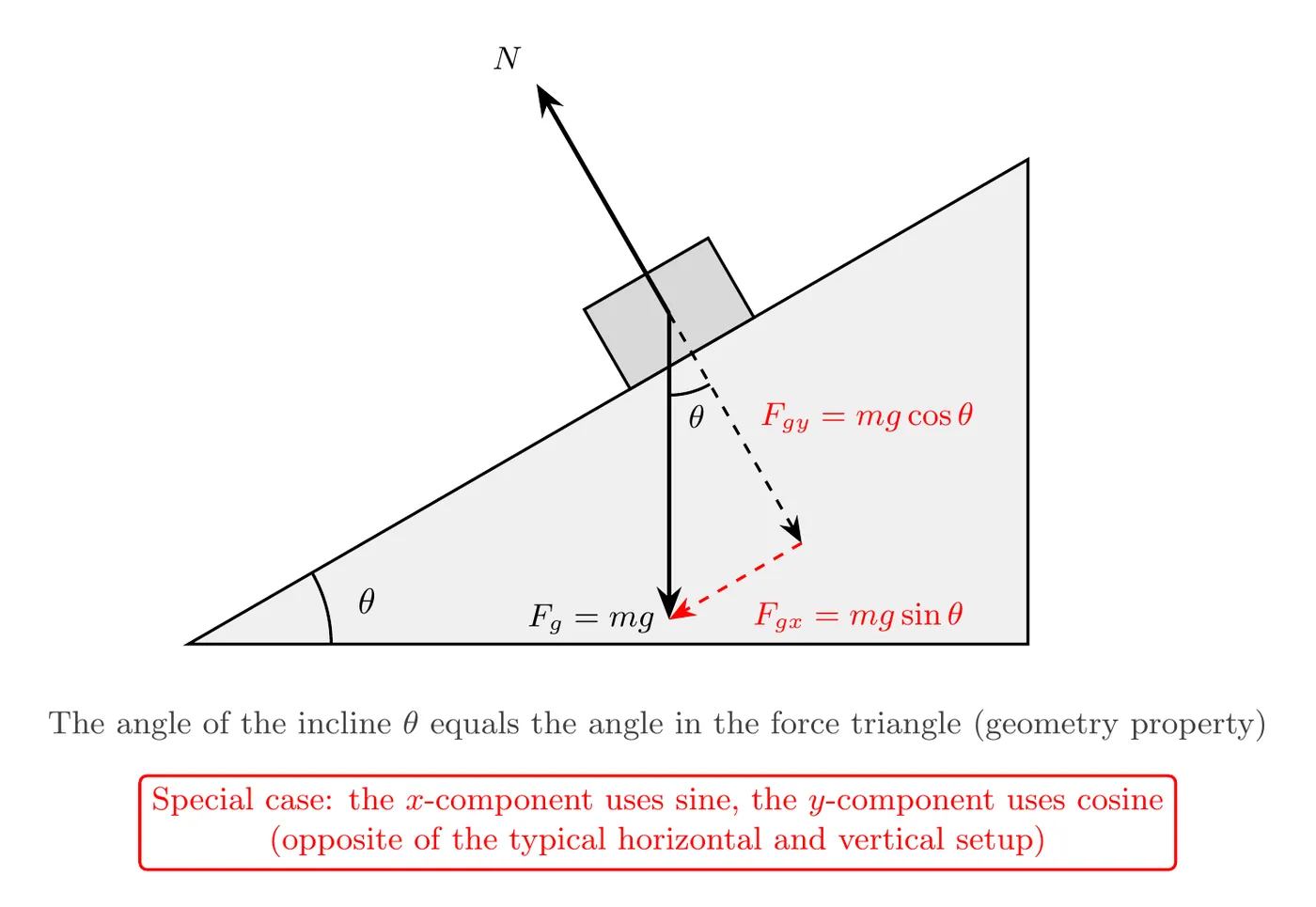
Here’s a key geometric fact: the incline angle equals the angle between the weight vector and its perpendicular component, which is why the parallel piece uses and the perpendicular piece uses . That’s actually the opposite of typical horizontal and vertical problems, where horizontal is and vertical is . On an incline, sine and cosine essentially swap roles compared to standard problems.
Worked Example: Frictionless Incline
A wooden crate with mass sits on a frictionless incline at angle above horizontal. Derive the acceleration down the incline, then describe and justify what happens as increases.
Draw: the forces on the crate are weight (, straight down) and normal force (, perpendicular to the incline, away from the surface). There’s no friction here since the problem says frictionless.
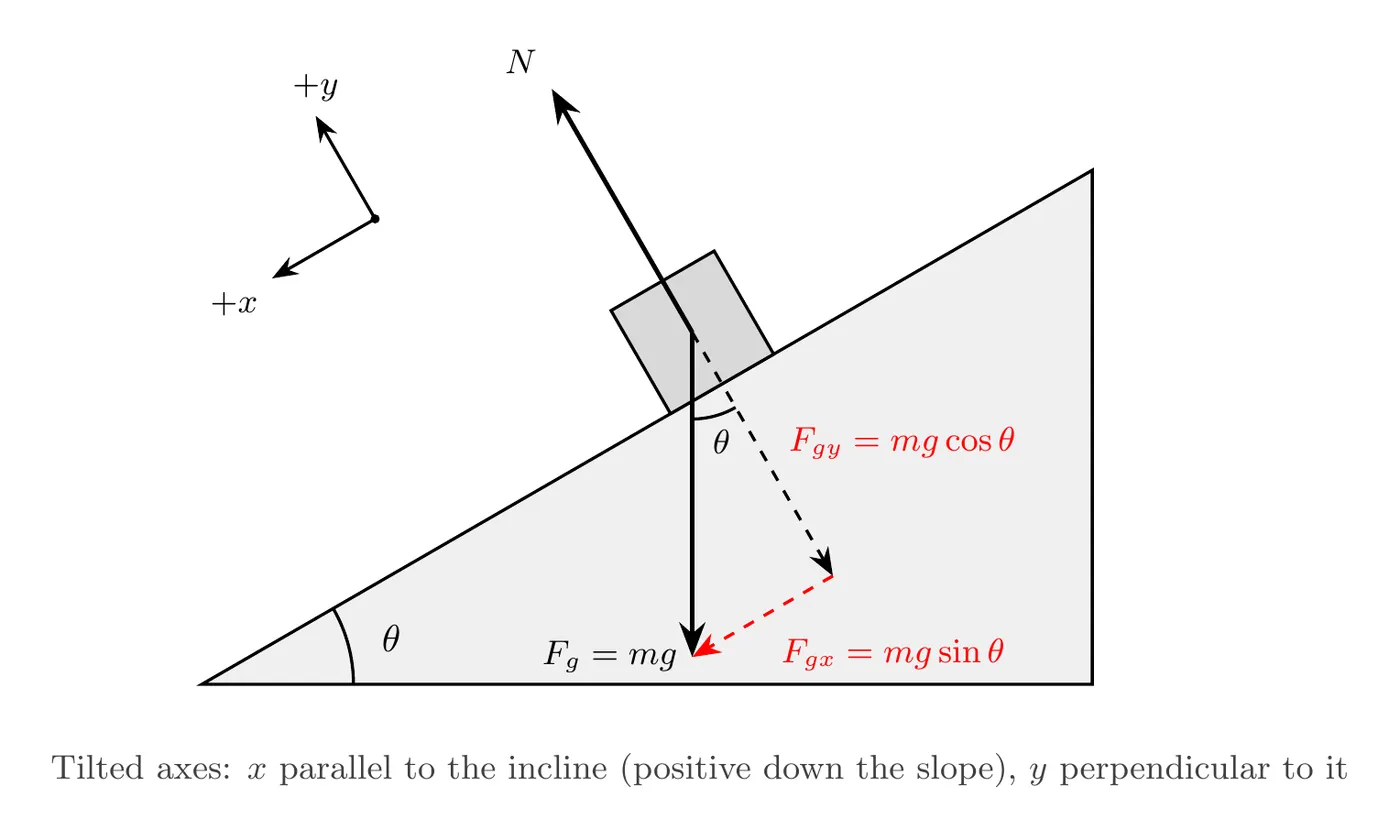
Sum: choosing the x-axis parallel to the incline (down as positive) and y-axis perpendicular to it.
In the x-direction, the only relevant force component is (down the slope):
In the y-direction, there’s no acceleration perpendicular to the surface (the crate doesn’t sink into or lift off the incline):
We don’t actually need the normal force value here, since there’s no friction to calculate.
Solve: starting from , divide both sides by :
Notice this doesn’t depend on mass at all. A heavy crate and a light crate slide down a frictionless incline at the same rate, as long as they’re at the same angle.
What happens as increases from 0° to 90°?
Since , and sine grows from 0 to 1 across that range:
Angle () | Acceleration () | |
0° | 0 | 0 |
30° | 0.5 | 0.5g = 5.0 m/s² |
45° | 0.707 | 0.707g ≈ 7.1 m/s² |
60° | 0.866 | 0.866g ≈ 8.7 m/s² |
90° | 1 | 1g = 10 m/s² |
So acceleration steadily increases as the angle increases.
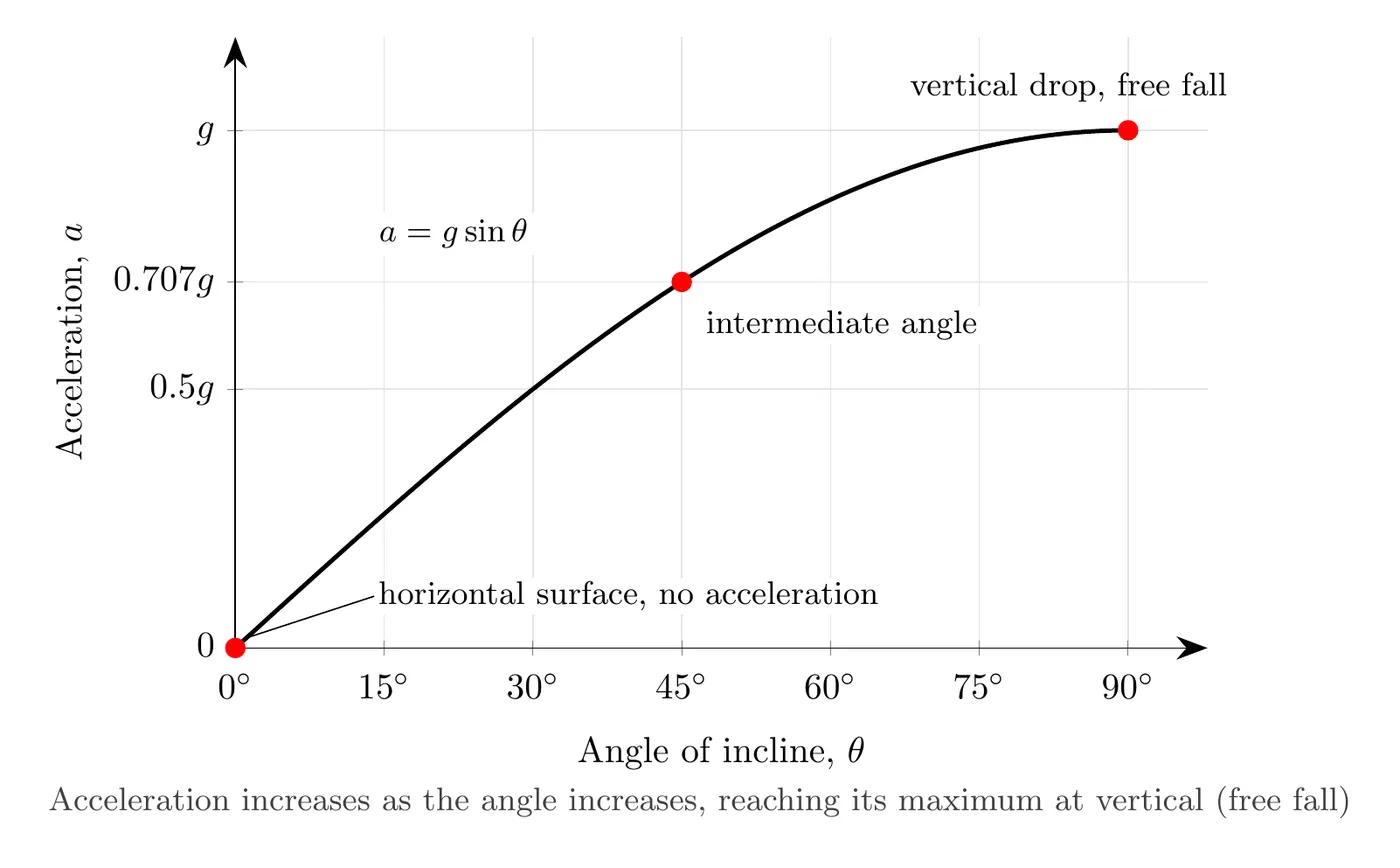
Justification: at (a horizontal surface), the component of gravity parallel to the surface is zero, so there’s no acceleration along it. At (fully vertical), the entire weight acts parallel to the “surface,” which is just free fall with . In between, the parallel component keeps growing continuously, causing greater and greater acceleration.
Mathematically, sine increases monotonically from 0 to 1 as the angle goes from 0° to 90°, and since with constant, as increases, increases, and so increases too. Physically, steeper inclines put more of gravity’s pull along the slope, producing bigger acceleration, and at the extreme of a vertical drop, all of gravity contributes, giving free fall.
Problem-Solving Strategy
- Draw: free body diagram with all forces, choosing a coordinate system aligned with motion when possible
- Sum: apply in each direction. For inclines, this usually means both and , with angled forces resolved into components
- Solve: algebra to find the unknowns, substitute numbers, and check units and reasonableness
Same demarcation as before: everything above the sum equations is physics (identifying forces, drawing diagrams, setting up equations with proper components), and everything below is math (algebra, substitution, calculating results).
Special Cases
Mass independence on frictionless inclines: doesn’t depend on mass at all, which mirrors Galileo’s famous observation that everything falls at the same rate ignoring air resistance. That’s because is proportional to mass, but so is the resistance to accelerating, and the two effects cancel exactly, .
Extreme angles: at , , meaning the object just stays still or moves at constant velocity per the First Law. At , , meaning free fall.
Normal force on an incline: decreases as the angle increases (less surface support needed), hits zero at 90° (no contact during free fall), and equals at 0° (full weight supported by a horizontal surface). Normal force is always adjusting just enough to prevent motion perpendicular to the surface.
Worked Example: Connected Objects (Modified Atwood Machine)
A 3.00 kg block sits on a frictionless table. A light string tied to it runs over an ideal pulley at the table’s edge to a 2.00 kg block hanging below. The blocks are released from rest. Use . Find the acceleration of the blocks and the tension in the string.
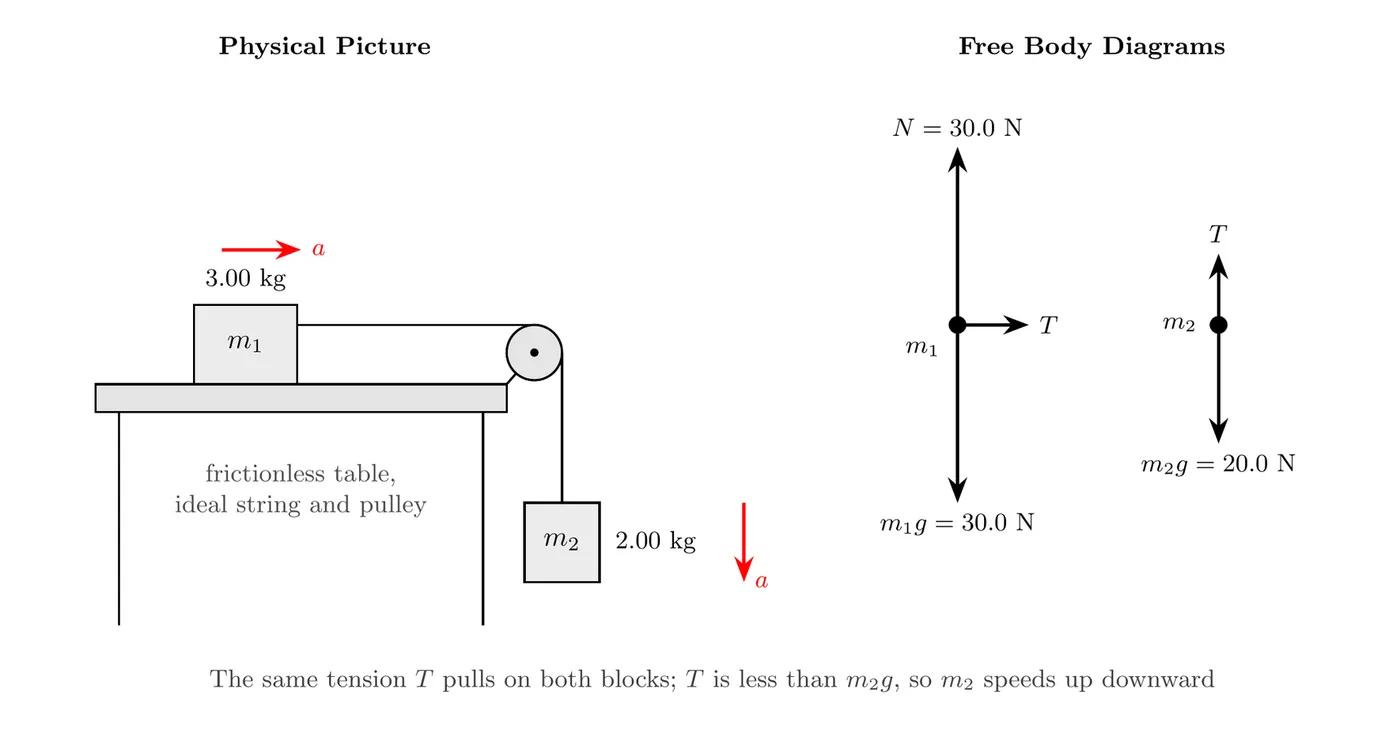
Draw: for the table block (): weight down, normal force up, and tension toward the pulley. For the hanging block (): weight down and tension up. Since the string and pulley are ideal, both blocks feel the same tension , and both move with the same size of acceleration .
Sum (whole system first): treat both blocks and the string as one system, and measure the direction of motion along the string (toward the pulley for , then down for ). Tension is now internal, so it drops out. and cancel each other. The only unbalanced external force is the hanging block’s weight:
Sum (one block) to find the tension: tension is internal to the whole system, so to find it, pick a system where it’s external. The table block by itself has just one horizontal force, the tension:
Check with the hanging block: gives N on the left and N on the right. ✓
Notice the tension (12.0 N) is less than the hanging block’s weight (20.0 N). It has to be: if the tension matched the weight, the hanging block would have zero net force and couldn’t speed up. The string only pulls hard enough to give the 3.00 kg block its acceleration.
Key Takeaways
- Newton’s Second Law: , net force causes acceleration
- Acceleration form: , emphasizing that force causes acceleration
- Acceleration is directly proportional to net force at constant mass
- Acceleration is inversely proportional to mass at constant force
- Unbalanced forces cause acceleration, balanced forces cause equilibrium
- Center of mass velocity only changes with a nonzero net external force
- Common problem types: incline planes, connected objects, Atwood machines, modified Atwood machines
- Incline strategy: rotate axes parallel and perpendicular to the surface
- Component resolution on inclines: (parallel), (perpendicular)
- Sine and cosine flip roles on inclines compared to standard horizontal/vertical setups
- Frictionless incline acceleration: , independent of mass
- As incline angle rises from 0° to 90°, acceleration rises from 0 to g
- Problem-solving: Draw (FBD), Sum (Newton’s Second Law), Solve (algebra)
- Most dynamics problems from here forward involve Newton’s Second Law
- Equation sheet form: , the acceleration of the system’s center of mass, with only external forces in the sum
- Connected objects: treat them as one system to find (the tension is internal and drops out), then use one object to find the tension