

2.4 - Newton’s First Law
Net Force
The net force on a system is the vector sum of every individual force acting on it.
Since forces combine through vector addition, direction really matters: opposite forces subtract, and perpendicular forces need component analysis.
Example: three forces act on an object: 20 N right, 15 N right, and 10 N left. The net force is N to the right.
Newton’s First Law
Newton’s First Law: if the net force on a system is zero, the system’s velocity stays constant.
Constant velocity means no acceleration (), speed doesn’t change, direction doesn’t change, and this could mean the object is at rest () or moving ().
Think of it like a duck on a pond: back in kinematics, we described motion from above the water, just what we could observe. Now we’re diving below the surface to understand why motion behaves the way it does, through forces.
Two Interpretations of the First Law
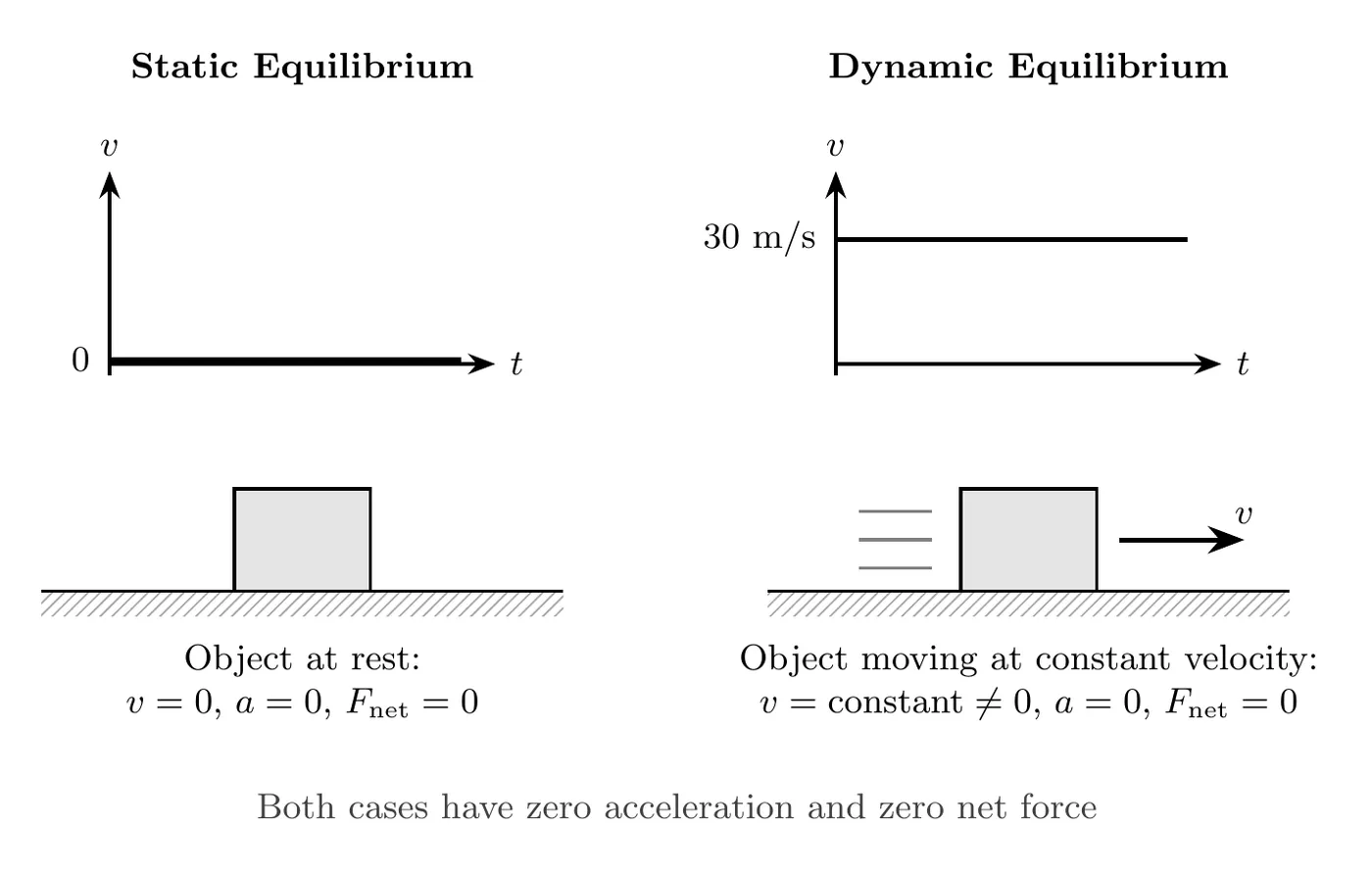
Law of Equilibrium: equilibrium happens when forces are balanced, meaning net force equals zero.
The formal name for this is translational equilibrium: the forces on a system add up to zero, , so the system’s center of mass doesn’t accelerate. (“Translational” means moving from place to place, as opposed to spinning. Rotational equilibrium comes in Unit 5.)
There are two kinds. Static equilibrium means the object is at rest and stays at rest, like a book on a table: , , . Dynamic equilibrium means the object moves at a constant velocity without accelerating, like a car cruising steadily at 65 mph: mph (constant), , .
A common misconception is thinking objects in equilibrium can’t be moving, but that’s not right, they just can’t be accelerating. Dynamic equilibrium is exactly constant-velocity motion.
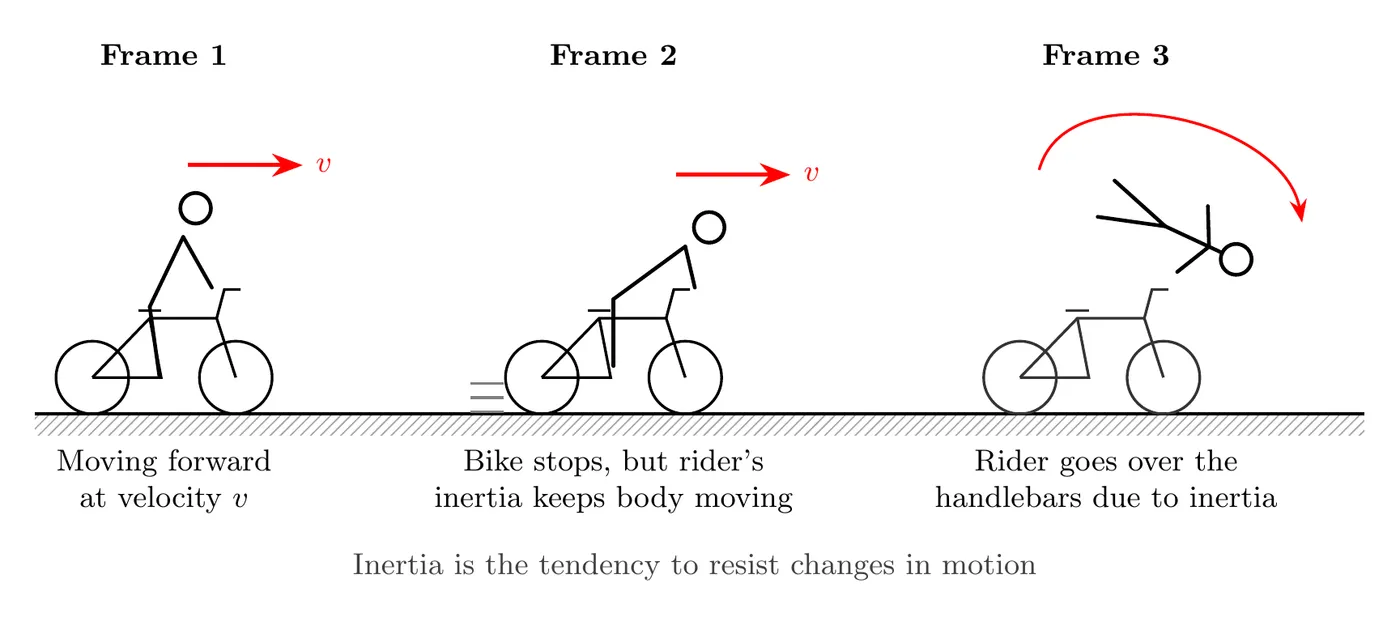
Law of Inertia: inertia is an object’s tendency to resist changes in its motion. Objects at rest tend to stay at rest, objects in motion tend to stay in motion at constant velocity, and it takes an external force to change that.
Bicycle crash example: when you suddenly brake, the bicycle stops (friction acts on the wheels), but your body keeps moving forward because of inertia, and you fly over the handlebars. Your body resists the change in motion and “wants” to keep going at its original velocity.
Inertial Reference Frames
Newton’s First Law doesn’t work for every observer. An inertial reference frame is a frame from which an observer would see Newton’s First Law hold: objects with zero net force really do stay at rest or keep moving at constant velocity. Any frame that isn’t accelerating (at rest, or moving at constant velocity, like the frames in 1.4) is inertial.
A frame that fails the test: you’re on a bus, and a ball sits on the smooth floor. The bus suddenly speeds up, and from your seat the ball rolls toward the back of the bus. Nothing pushed it backward (the horizontal net force on the ball is zero), yet it accelerated relative to you. So the speeding-up bus is a noninertial frame. From the sidewalk, an inertial frame, the story is simple: the ball just kept its velocity while the bus sped up underneath it.
On the AP exam, every frame of reference is assumed to be inertial unless the problem says otherwise, and the ground counts as inertial for everyday problems.
Mass and Inertia
Mass is the physical quantity measuring inertia.
Large mass, high inertia: hard to change its motion. Pushing a stalled car is hard to start moving and just as hard to stop once it’s rolling.
Small mass, low inertia: easy to change its motion. Pushing a shopping cart is easy to start moving and easy to stop.
That’s exactly why massive objects are harder to accelerate, they have more inertia resisting any change in velocity.
Balanced in One Direction, Unbalanced in Another
Newton’s First Law works one direction at a time. Forces can be balanced in one direction and unbalanced in another, and the velocity only changes in the direction of the unbalanced force. In the balanced direction, that part of the velocity stays constant.
Example, a projectile: once a ball leaves your hand (ignoring air resistance), the only force on it is gravity, straight down. Horizontally there’s no force at all, so the horizontal velocity never changes, exactly what Unit 1’s projectile motion said. Vertically the force is unbalanced, so the vertical velocity keeps changing.
Worked example: a 13.0 kg crate is pulled across a level floor by a rope at 37.0° above horizontal. The tension is 55.0 N, and kinetic friction on the crate is 32.0 N. Use . In which direction does the crate’s velocity change?
Split the tension into components: N and N.
Vertical: the crate stays on the floor, so the vertical forces must balance. That tells you the normal force:
Horizontal: N to the right, which is not zero.
So the forces are balanced vertically and unbalanced horizontally. The crate’s vertical velocity stays zero, and its horizontal velocity increases to the right (at about , from 2.5’s ). Notice the normal force (96.9 N) is less than the weight (130 N), because the rope is also lifting up on the crate.
First Law Pairs vs. Third Law Pairs
These get confused a lot since both involve pairs of forces.
Third law pairs act on different objects, are always equal and opposite, and describe a mutual interaction.
First law pairs (equilibrium pairs) act on the same object, are equal and opposite specifically when that object is in equilibrium, and result in zero net force and zero acceleration.
Book on a table example:
The first law pair (the equilibrium forces on the book) is weight (Earth pulling the book down with 20 N) and normal force (the table pushing the book up with 20 N). Both act on the book, giving a net force of zero on the book.
The third law pairs are separate: Earth pulls the book down (20 N) paired with the book pulling Earth up (20 N), and the book pushing the table down (20 N) paired with the table pushing the book up (20 N). Each of these pairs acts on two different objects.
Tension Problems in Equilibrium
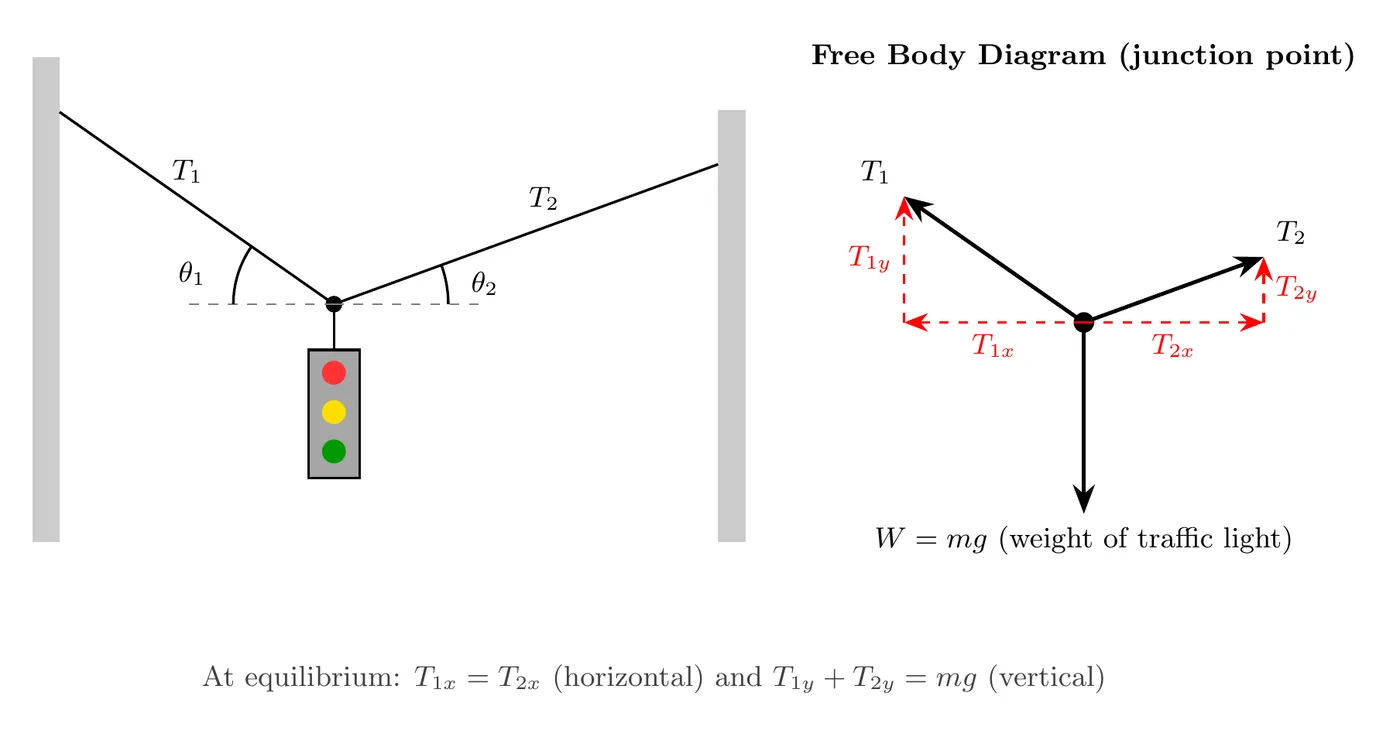
A common application involves objects suspended by cables at angles, which creates tension forces that need resolving.
Tension acts along the cable’s direction, its magnitude adjusts with the angle and other forces, and it needs to be broken into components whenever it’s angled.
At equilibrium, all forces sum to zero, analyzed separately in the x and y directions:
For tension at angle from horizontal:
Draw, Sum, Solve Again
Every Newton’s Law problem follows the same three steps: draw the free body diagram, sum the forces into equilibrium equations by direction, then solve the resulting system of equations with algebra.
Here’s a useful way to think about it: everything above the sum equations is physics, and everything below them is math. The physics tells you which forces exist and how they relate, and the math just solves for the unknowns.
Worked Example: Traffic Light Suspended by Cables
A traffic light of unknown mass hangs from two cables. Cable 1 makes a 35° angle with horizontal and carries 320 N of tension. Cable 2 makes a 20° angle with horizontal. The system is in equilibrium. Use m/s². Find the tension in Cable 2 and the mass of the traffic light.
Draw: the junction point where the cables meet has three forces acting on it: N at 35° above horizontal, at 20° above horizontal, and straight down.
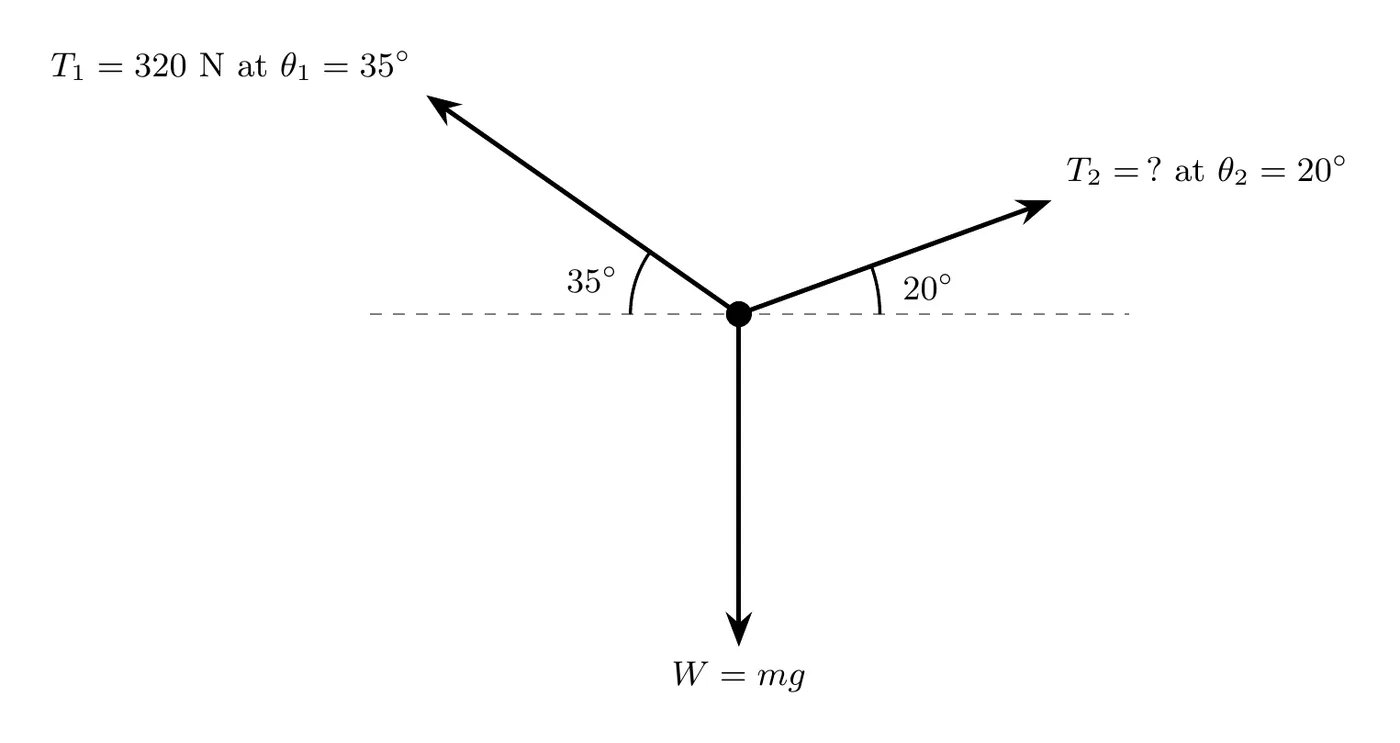
Sum: since the system is in equilibrium, and .
For the x-direction, the horizontal pieces must cancel out. Cable 1 pulls left () and Cable 2 pulls right ():
For the y-direction, the vertical pieces have to support the weight. Cable 1 pulls up (), Cable 2 pulls up (), weight pulls down ():
Solve for :
Cable 2 has a bit less tension (279 N vs. 320 N) since it hangs at a smaller angle. It is closer to horizontal, so it needs less tension to match Cable 1’s horizontal pull (the horizontal parts must cancel).
Solve for mass:
The traffic light comes out to about 28 kg, reasonable for a real traffic signal.
Checking: N, and N. ✓ (small difference just from rounding)
Why x-components cancel: the junction isn’t accelerating sideways, so the horizontal pieces of the tensions must be equal and opposite. That’s true for any setup in equilibrium, symmetric or not (this one isn’t symmetric, since the cables hang at 35° and 20°).
Why y-components don’t cancel: the vertical pieces have to add up to support the weight, so they combine instead of canceling.
Tension problems like this become systems of equations, where solving one equation for a variable lets you substitute it into the other.
Common Equilibrium Scenarios
Object on a horizontal surface: weight (down), normal (up), and equilibrium means .
Object pulled along a surface at constant velocity: weight (down), normal (up), applied force (forward), friction (backward), with equilibrium giving vertically and horizontally.
Object hanging from a single vertical cable: weight (down), tension (up), with equilibrium meaning .
Object suspended by angled cables: weight (down) and multiple tensions at various angles, with the horizontal components of the tensions canceling and the vertical components summing to equal the weight.
Key Takeaways
- Net force is the vector sum of all forces:
- Newton’s First Law: if , then , which could be zero or nonzero
- Law of Equilibrium: balanced forces mean zero acceleration, either static equilibrium (, , ) or dynamic equilibrium (, , )
- Law of Inertia: objects resist changes in motion, and mass measures how much. Large mass means high inertia, small mass means low inertia
- First law pairs act on the same object and create equilibrium when equal and opposite
- Third law pairs act on different objects and are always equal and opposite regardless of equilibrium
- Equilibrium conditions: and , analyzed separately for each direction
- Component resolution: , (angle from horizontal)
- Problem-solving framework: Draw (FBD), Sum (equilibrium equations), Solve (algebra)
- Physics is the drawing and summing, math is the solving
- Tension problems: horizontal components often cancel, vertical components sum to support the weight
- Objects in equilibrium can absolutely be moving, they just can’t be accelerating
- Translational equilibrium: , so the center of mass doesn’t accelerate
- Forces can be balanced in one direction and unbalanced in another, and the velocity only changes in the unbalanced direction
- Inertial reference frame: a frame where Newton’s First Law holds, meaning one that isn’t accelerating