

2.8 - Spring Forces
Ideal Springs
In physics problems, we treat springs as ideal, meaning they’re massless (the spring’s own mass is negligible), they have a linear response (force is directly proportional to displacement), and they lose no energy (springs don’t wear out or lose effectiveness).
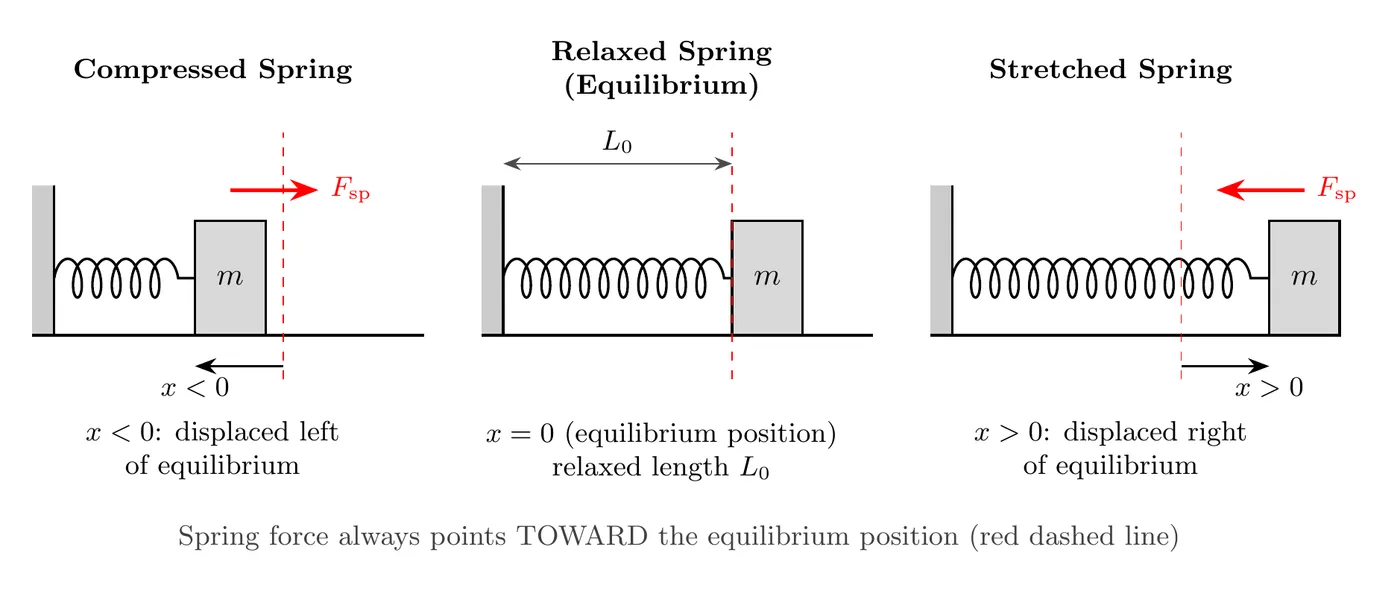
The relaxed length, or equilibrium position, is a spring’s natural length when no external forces act on it, the position it “wants” to return to.
Hooke’s Law
Hooke’s Law describes the relationship between the force a spring exerts and its displacement from equilibrium.
where is the spring force in Newtons, is the spring constant in N/m, is the displacement from the equilibrium position in meters, and the negative sign shows this is a restoring force.
That negative sign is crucial, it’s about direction, not magnitude. A restoring force always points back toward equilibrium: pull the spring right () and the force points left (), push it left () and the force points right (). The spring always “wants” to return to its natural length.
The Spring Constant
The spring constant measures a spring’s stiffness, in units of N/m (Newtons per meter), which is physically the force needed to stretch or compress the spring by one meter.
A high spring constant (a stiff spring) needs a large force for even a small displacement and is hard to stretch or compress, like a garage door spring ( N/m). A low spring constant (a soft spring) needs only a small force for a large displacement and is easy to stretch or compress, like a slinky toy ( N/m).
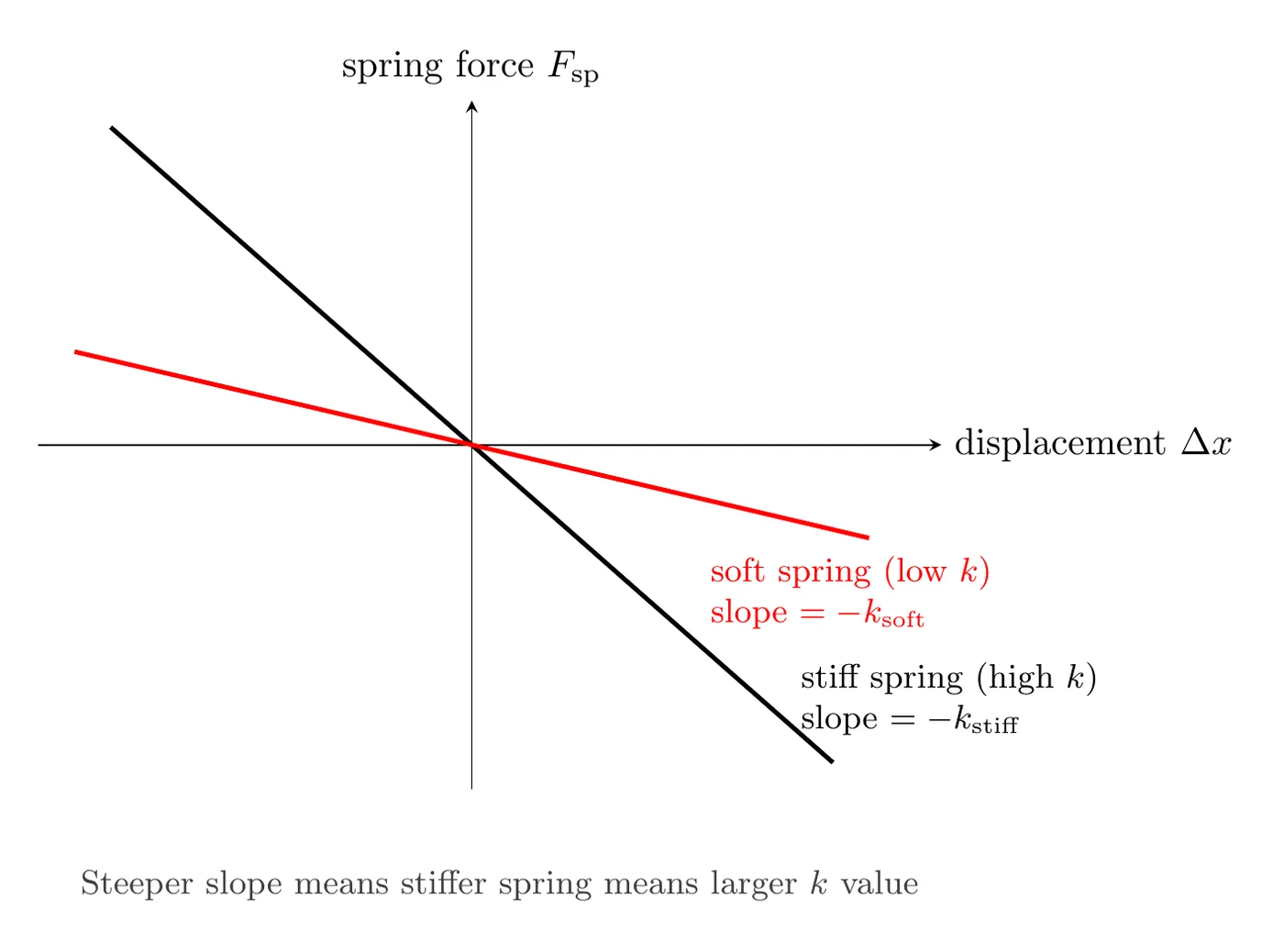
Important: is measured from the equilibrium position, never from the origin or a wall.
Example: if the equilibrium position is at m and the spring is stretched to m:
Don’t use the final position as the displacement itself, always subtract off the equilibrium position first.
Direction of Spring Force
The spring force always points toward equilibrium, whether the spring is compressed or stretched.
A compressed spring sits left of equilibrium (), so its force points right (toward equilibrium), positive in a typical coordinate system with right as positive.
A stretched spring sits right of equilibrium (), so its force points left (toward equilibrium), negative in that same convention.
This automatic direction reversal is exactly why the negative sign shows up in Hooke’s Law.
Horizontal vs. Vertical Spring Systems
Horizontal spring system: the simplest case, with no gravity involved along the direction of motion. The forces on the block are spring force (, horizontal), weight (, downward), and normal force (, upward). Weight and normal force cancel vertically, so only the spring force affects horizontal motion.
Vertical spring system: here gravity acts along the same axis as the spring force, adding complexity. The forces on the block are spring force (, upward when stretched downward) and weight (, downward). At equilibrium, hanging at rest:
The spring stretches until its force balances the weight. If displaced from this new equilibrium, the acceleration still follows the same rule, , but now is measured from the hanging equilibrium position, not the original unstretched length. So despite gravity being present, the acceleration formula stays exactly the same, as long as is measured from equilibrium for that particular orientation.
Careful with the wording here: the spring’s own force always points back toward the spring’s relaxed length (a stretched spring pulls, a compressed spring pushes). For a hanging block, gravity also acts, so it’s the net force (spring force plus weight) that points toward the hanging equilibrium position. For example, lift a hanging block a little above its equilibrium position, but not so high that the spring goes slack. The spring is still stretched, so it still pulls up, just less than before. Now the weight is bigger than the spring force, so the net force points down, back toward equilibrium.
Finding Acceleration of a Spring-Mass System
For a mass on a spring, either orientation:
Draw: for a horizontal system after release, only the spring force acts horizontally, while weight and normal force cancel vertically.
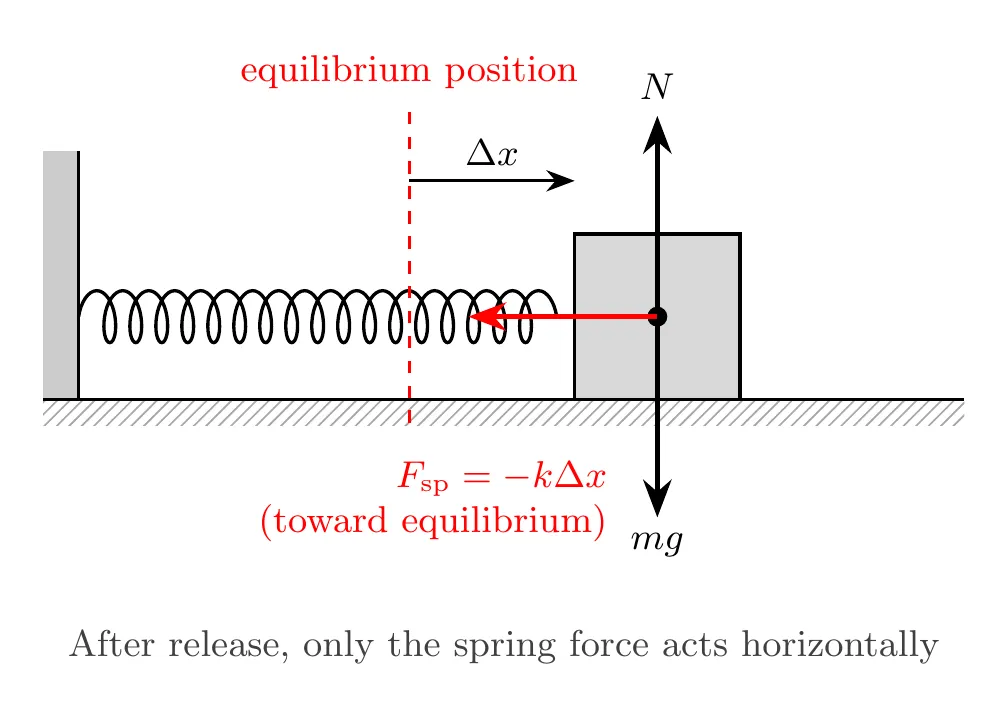
Sum:
Solve: , the acceleration equation for any spring-mass system.
Sign of acceleration: when (stretched right), (accelerates left, toward equilibrium). When (compressed left), (accelerates right, toward equilibrium).
Magnitude depends on: the spring constant (stiffer springs mean larger acceleration), the displacement (farther from equilibrium means larger acceleration), and the mass (more massive objects mean smaller acceleration).
The acceleration is not constant, as the mass approaches equilibrium, shrinks, and so does acceleration. This is what creates oscillatory motion, covered later.
Worked Example: Horizontal Spring System
A spring with N/m is attached to a wall, with a block attached to the spring. The equilibrium (relaxed) position is at m from the wall. The block is pulled to m and held there. Find the spring force at this position, and if the block has mass kg, find the acceleration when released.
Finding spring force: displacement from equilibrium is
Applying Hooke’s Law:
The spring force is 10.4 N in the negative direction, back toward the wall and equilibrium.
Finding acceleration: using :
Or equivalently, directly from the formula:
The block accelerates at 2.08 m/s² toward the wall. Once released, it’ll move left, speed up as the spring contracts, pass through equilibrium, and keep oscillating if there’s no friction.
Common Question Types
Finding spring constant: given a force and the resulting displacement, rearrange Hooke’s Law: . For example, if 50 N stretches a spring by 0.25 m, N/m.
Finding displacement: given the spring constant and force, . For example, a 120 N/m spring under 30 N gives m.
Finding acceleration: given spring constant, displacement, and mass, use .
Vertical spring equilibrium: given a hanging mass and spring constant, find how much the spring stretches. At equilibrium: .
Worked Example: Finding the Spring Constant from Data
A student hangs different masses from a vertical spring. For each one, they wait until the mass hangs at rest and measure how far the spring has stretched from its relaxed length. Use .
Hanging mass (kg) | Spring force, (N) | Stretch, (m) |
0.100 | 1.00 | 0.041 |
0.200 | 2.00 | 0.078 |
0.300 | 3.00 | 0.121 |
0.400 | 4.00 | 0.159 |
0.500 | 5.00 | 0.201 |
Why : each mass hangs at rest, so the spring’s upward pull balances the weight, .
Graph it: put spring force on the vertical axis and stretch on the horizontal axis. Hooke’s law in magnitude form, , has the same shape as , so the points should fall close to a straight line through the origin, with slope .
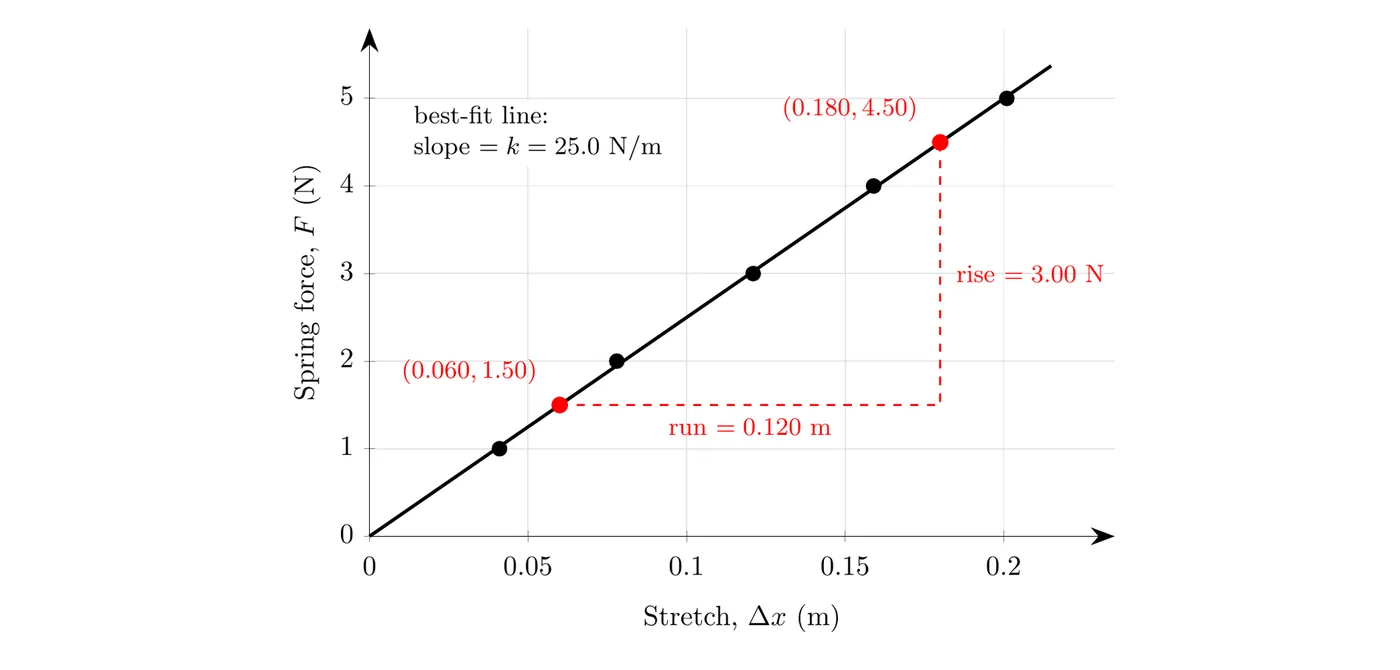
Find the slope from the best-fit line, not from two data points. Pick two points on the line that are far apart and easy to read, like and . They don’t have to be data points:
The best-fit line averages out the small measurement errors in the individual points, which is why AP free-response questions ask for the slope of the line. If the points started curving away from the line at large stretches, that would mean the spring was being stretched past the range where it behaves ideally.
A Quick Look Ahead: Energy
Springs also store elastic potential energy:
When released, this elastic potential energy converts to kinetic energy, creating oscillatory motion, with total mechanical energy conserved if there’s no friction. This gets explored fully in the energy unit.
Real-World Applications
Suspension systems: car springs compress and extend to absorb road bumps, giving a comfortable ride. The spring constant is chosen to balance comfort (soft) against handling (stiff).
Pogo sticks: strong springs (high ) store energy when compressed under a jumper’s weight, then release it to launch them upward.
Trampolines: many springs act together (in parallel) to create a safe, responsive jumping surface.
Shock absorbers: combine springs with damping mechanisms to prevent oscillation after an impact.
Watches and clocks: tiny springs store energy in mechanical timepieces, releasing it gradually to power the movement.
Common Mistakes
Using position instead of displacement: don’t write using raw position from an origin. It’s always where .
Forgetting the negative sign: don’t write as positive. It should be for the restoring force, though if a problem only asks for magnitude, you can drop the sign.
Including spring mass: don’t factor in the spring’s own mass, assume an ideal, massless spring unless told otherwise.
Mixing up and : don’t confuse the spring constant (, in N/m) with gravitational acceleration (, in m/s²), they’re completely different quantities with different units.
Key Takeaways
- Hooke’s Law: , relating spring force to displacement
- Spring constant (N/m) measures stiffness, larger means a stiffer spring
- The negative sign shows a restoring force, always pulling or pushing back toward equilibrium
- Displacement is measured from the equilibrium position, never from an origin
- Spring force direction is always toward equilibrium (compressed pushes out, stretched pulls in)
- Acceleration formula: for any spring-mass system
- Ideal springs are massless with a linear force-displacement relationship
- The equilibrium position is where a spring naturally rests, with no external forces
- Horizontal systems: only the spring force affects motion in the direction of displacement
- Vertical systems: the same acceleration formula applies if measured from the hanging equilibrium
- Stiff springs (high ) need a large force for a small displacement (garage door springs)
- Soft springs (low ) produce a large displacement from a small force (slinky)
- Acceleration is not constant, it decreases as the object nears equilibrium
- Always calculate as current position minus equilibrium position
- Once released, a spring-mass system oscillates back and forth through equilibrium
- A hanging spring’s own force points toward its relaxed length, while the net force on the block (spring plus weight) points toward the hanging equilibrium position
- To find from data, graph spring force vs. stretch and take the slope of the best-fit line