

6.2 - Periodic Waves
What Periodic Waves Are
Periodic waves repeat themselves regularly, and you can describe those repetitions with period and frequency. They run the same pattern over and over at even intervals.
Period
The period () is the time for one complete oscillation of the wave. Its unit is seconds (s).
The period is the time it takes for:
- One complete cycle to pass a fixed point.
- The wave to repeat its pattern.
- A particle in the medium to finish one full oscillation.
Frequency
The frequency () is how often the wave repeats. Its unit is the hertz (Hz), where 1 Hz = 1 cycle per second = 1/s.
Frequency tells you how many complete oscillations happen per unit of time.
Period and Frequency
or, equivalently:
where:
- = period (s)
- = frequency (Hz)
The relationships to remember:
- Higher frequency means a shorter period, since the cycles happen faster.
- Lower frequency means a longer period, since the cycles happen slower.
Amplitude Is Independent
The amplitude of a wave is independent of its period and frequency:
- You can pair high frequency with a small or a large amplitude.
- You can pair low frequency with a small or a large amplitude.
- Amplitude and frequency are separate properties that don’t affect each other.
Amplitude sets the loudness (for sound) or the brightness (for light), while frequency sets the pitch (for sound) or the color (for light). The energy a wave carries depends on both, as the next section shows.
Energy and Frequency
The energy of a wave increases as its frequency increases.
For electromagnetic waves like light, , where is Planck’s constant. Higher-frequency waves carry more energy per photon:
- X-rays (high frequency) carry more energy than radio waves (low frequency).
- This is a separate effect from the energy tied to amplitude.
Mechanical waves. The same idea holds for a wave on a string or a sound wave. Keep the amplitude the same and raise the frequency: each piece of the medium still swings out the same distance, but it makes each round trip in less time, so it moves faster. Faster-moving pieces of the medium have more kinetic energy, so the wave carries more energy. (In a given medium, the power a mechanical wave carries goes as , so doubling the frequency at the same amplitude makes the wave carry energy 4 times as fast.)
Frequency and Sound
The frequency of a sound wave sets its pitch:
- Higher frequency means higher pitch (treble sounds).
- Lower frequency means lower pitch (bass sounds).
The human hearing range is roughly 20 Hz to 20,000 Hz. A few examples:
- Middle C: 262 Hz
- High soprano: 1,000+ Hz
- Bass notes: 100 to 200 Hz
Wavelength
Wavelength () is the distance between successive matching positions on a wave, like peak to peak or trough to trough. Its unit is meters (m).
Wavelength is the spatial length of one complete cycle:
- Peak to peak.
- Trough to trough.
- Any point to the next point in the same phase.
Wave Equations
A sinusoidal wave can be described with equations for displacement from equilibrium.
Displacement as a Function of Time (at a Fixed Position)
where:
- = displacement at time
- = amplitude
- = angular frequency = (rad/s)
- = frequency (Hz)
- = time (s)
This describes how a single point in the medium oscillates over time.
Displacement as a Function of Position (at a Fixed Time)
where:
- = displacement at position
- = amplitude
- = position along the wave’s direction
- = wavelength
This describes the wave’s shape at one instant, like a snapshot.
Reading the two graphs. The two equations go with two different graphs, and the AP exam uses both. A displacement vs. position graph is a snapshot of the whole wave at one instant, so the distance between neighboring peaks is the wavelength. A displacement vs. time graph follows one point in the medium as it moves up and down, so the time between neighboring peaks is the period. On both, the amplitude is measured from the middle line (zero displacement) to a peak.
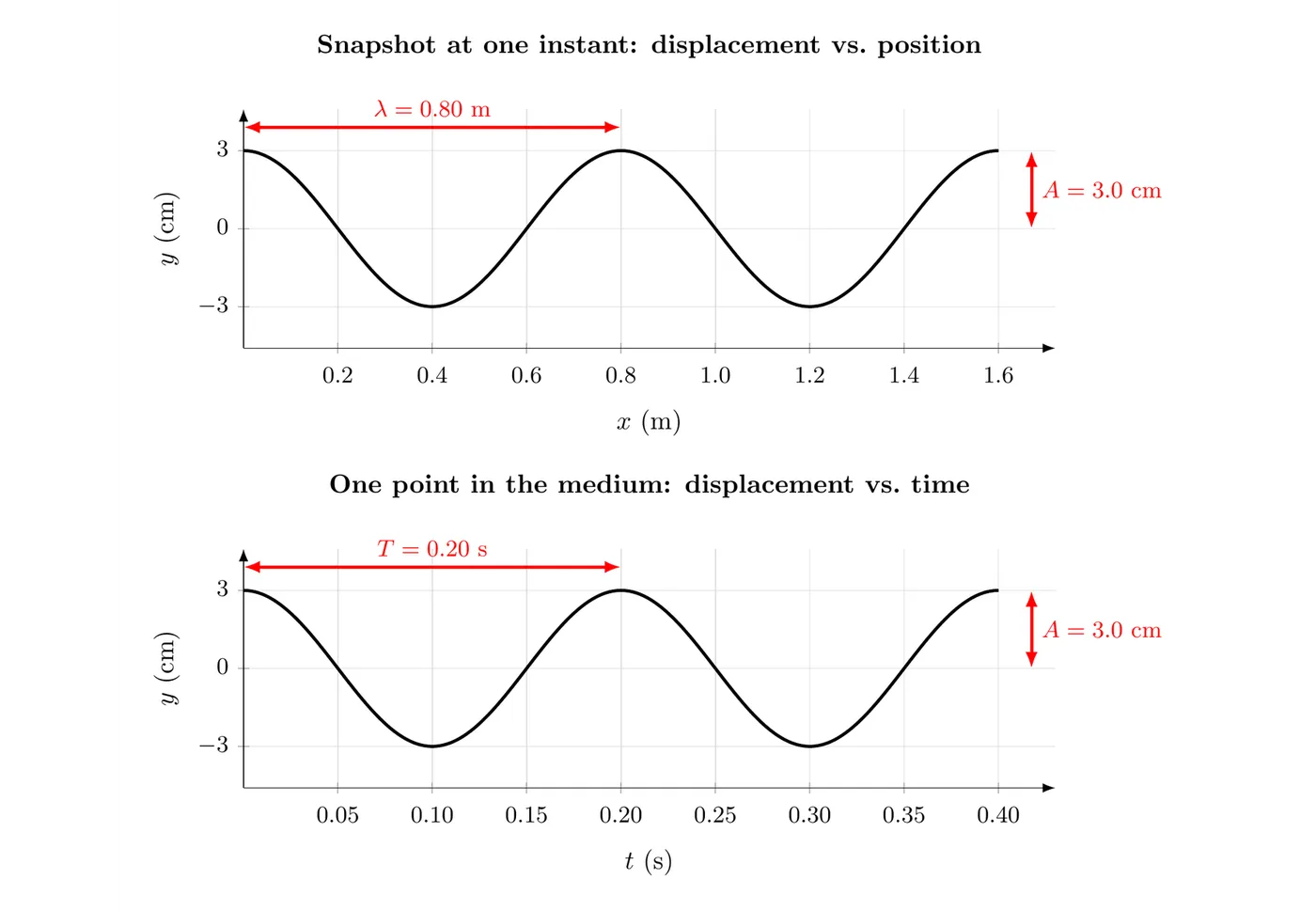
Worked example. The two graphs above describe the same wave on a rope. Find the amplitude, wavelength, period, frequency, and speed, and the displacement at m in the snapshot.
From the snapshot, peak to peak is 0.80 m, so m, and the peaks reach 3.0 cm, so cm. From the time graph, peak to peak is 0.20 s, so s.
(Set your calculator to radians for this.) You can check it on the graph: at m the curve is a bit above 2 cm. Also notice the equation sheet uses for displacement in the time equation, while means position in . Here both graphs use for displacement so the two don’t get mixed up.
Wave Speed Relationship
For a periodic wave, the wavelength is proportional to the wave’s speed and inversely proportional to its frequency.
or, equivalently:
where:
- = wavelength (m)
- = wave speed (m/s)
- = frequency (Hz)
Making sense of it:
- Higher frequency means a shorter wavelength, for a fixed speed.
- Lower frequency means a longer wavelength, for a fixed speed.
- Faster wave speed means a longer wavelength, for a fixed frequency.
This equation links a temporal property (frequency) to a spatial property (wavelength) through the wave speed.
Practice Problems
1. A wave has a frequency of 50 Hz. What is its period?
2. Ocean waves reach a beach every 8.0 seconds. What is their frequency?
3. A sound wave has a frequency of 440 Hz (the musical note A) and travels at 343 m/s in air. What is its wavelength?
4. Green light has a wavelength of 500 nm and travels at m/s. What is its frequency?
5. Two waves travel at the same speed. Wave A has twice the frequency of wave B. How do their wavelengths compare?
6. A wave on a string has an amplitude of 2.0 cm and a frequency of 5.0 Hz. If the frequency is raised to 10 Hz while the amplitude stays the same, does the wave carry more or less energy?
7. Write the equation for a wave with amplitude 0.50 m and frequency 2.0 Hz as a function of time at a fixed position.
8. A radio station broadcasts at 100.0 MHz. What is the wavelength of this radio wave? (Radio waves travel at the speed of light.)
Solutions
1.
Use the period-frequency relationship:
Answer: the period is 0.020 s, or 20 milliseconds.
2.
The period is the time between waves:
s.
Answer: the frequency is 0.125 Hz, which is one wave every 8 seconds.
3.
Use the wave speed equation:
Answer: the wavelength is 0.780 m, or 78.0 cm.
4.
First convert the wavelength to meters:
nm m m.
Answer: the frequency is Hz (600 trillion Hz, in the visible spectrum).
5.
Both waves travel at the same speed, so . Since :
Answer: wave A has half the wavelength of wave B. Higher frequency means shorter wavelength when the speed is constant.
6. The wave carries more energy.
Energy goes up as frequency goes up. Even though the amplitude is unchanged, the higher frequency (10 Hz versus 5.0 Hz) means more oscillations per second, which takes more energy to keep going.
And since amplitude is independent of frequency, doubling the frequency doesn’t touch the amplitude, but it does raise the energy tied to the faster oscillation.
Answer: more energy, because energy increases with frequency.
7. Use the time-dependent wave equation.
Given:
m,
Hz.
where is in meters and is in seconds.
Answer: , or since rad/s.
8. Convert the frequency: MHz Hz Hz.
Use the wave speed equation with m/s:
Answer: the wavelength is 3.00 m.
Common Mistakes
- Confusing period and frequency. Period is time per cycle (seconds), and frequency is cycles per time (Hz = 1/s). They’re reciprocals.
- Forgetting units. Frequency has to be in Hz (not kHz or MHz) when you use with speed in m/s. Convert first.
- Thinking amplitude affects frequency. They’re independent, so changing one doesn’t change the other.
- Confusing wave speed with particle speed. The in is how fast the wave pattern moves, not how fast the particles oscillate.
- Measuring wavelength wrong. Wavelength is between corresponding points in the same phase (peak to peak, not peak to trough, which is half a wavelength).
- Assuming higher amplitude means higher frequency. They’re independent, so any combination of amplitude and frequency is possible.
- Mixing up the energy relationships. Energy grows with both amplitude () and frequency. These are two separate effects.
- Using the wrong equation form. describes oscillation at a point over time, while describes the wave’s shape in space at an instant.
- Forgetting the in the wave equations. The cosine argument is , not . The converts frequency to angular frequency.
- Getting the wavelength-frequency relationship backwards. For a fixed speed, wavelength and frequency are inversely proportional: , not directly proportional.
- Assuming all waves travel at the same speed. Wave speed depends on the medium and the type of wave. Sound in air is about 343 m/s, while light in a vacuum is m/s.
- Confusing pitch and loudness. Pitch comes from frequency, and loudness comes from amplitude.
- Not converting wavelength units. Wavelengths often come in nm, μm, or cm. Convert to meters before using .
- Thinking the period is how long the wave lasts. The period is the time for one cycle, not the total duration of the wave.
- Getting the angular frequency conversion wrong. , not . Angular frequency has units of rad/s.