

6.3 - Boundary Behavior of Waves and Polarization
Waves Meeting Boundaries
A wave that travels from one medium into another can be transmitted or reflected, depending on the properties of the boundary between the two media.
When a wave hits a boundary, some of the energy usually:
- Reflects back into the original medium.
- Transmits into the new medium.
How the energy splits between reflected and transmitted depends on the properties of both media.
Reflection and Transmission at Boundaries
A wave crossing from one medium to another (say, a wave moving between a low-mass and a high-mass string) produces both a reflected and a transmitted wave. Both usually happen at once, with part of the wave bouncing back and part carrying on forward.
When the Reflected Wave Flips
Whether the reflected wave gets flipped depends on how the two media compare.
The reflected wave is inverted when the transmitted wave heads into a medium where the wave speed decreases:
- Going from a lighter to a heavier string (more mass per length, same tension).
- Hitting a fixed end, like a string tied to a wall. This is the extreme case: the wave can’t move into the wall at all.
- Example: a wave on a light string hits a heavy string, so the reflected pulse flips upside down.
The reflected wave is not inverted when the transmitted wave heads into a medium where the wave speed increases:
- Going from a heavier to a lighter string (less mass per length, same tension).
- Reaching a free end, like a string tied to a ring that slides up and down a pole without friction. This is the extreme case.
- Example: a wave on a heavy string hits a light string, so the reflected pulse keeps its orientation.
The short version:
- Slower medium ahead means an inverted reflection.
- Faster medium ahead means an upright reflection.
The transmitted wave is never inverted. It always keeps the same orientation as the incident wave. Only the reflected wave can flip.
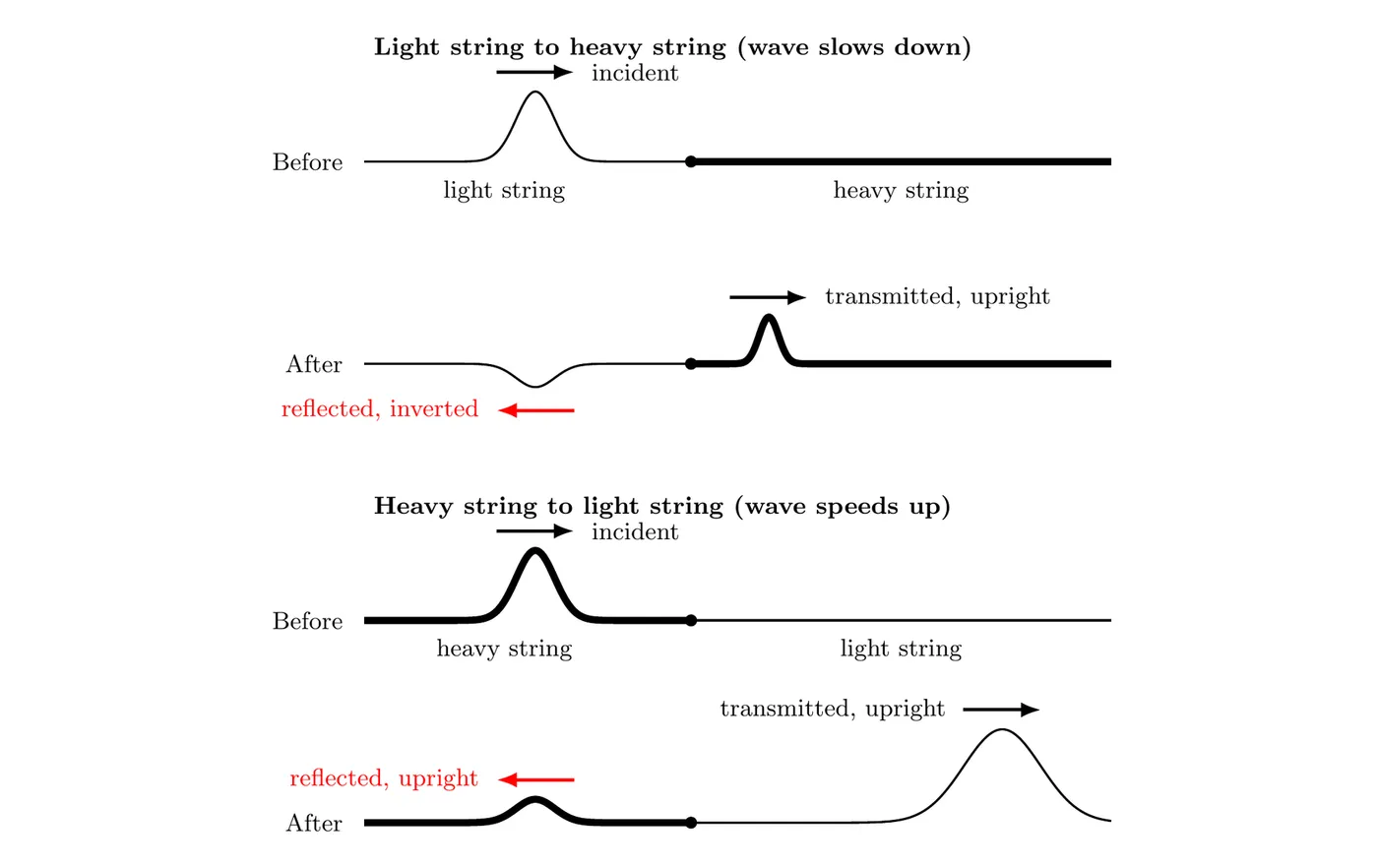
In the picture, the heavy string has 4 times the mass per length of the light string and the same tension, so waves on it move at half the speed. Going into the heavy string, the reflected pulse is inverted and the transmitted pulse is upright, smaller, and narrower (it moves slower, so it gets squeezed). Going into the light string, the reflected pulse stays upright and the transmitted pulse is wider because it moves faster.
Why is that transmitted pulse taller than the incident one? The string is one piece, so right at the knot both sides always have the same height. On the incoming side, that height is the incident pulse plus the reflected pulse, since the two overlap there and add. Going into the light string, the reflected pulse is upright and adds on, so the transmitted pulse has to come out taller than the incident pulse. Going into the heavy string, the reflected pulse is inverted and takes away, so the transmitted pulse comes out shorter. The taller pulse doesn’t carry extra energy. It carries less than the incident pulse, because part of the energy went into the reflected pulse and the light string has less mass to move.
Worked example. A light string ( kg/m) is knotted to a heavy string ( kg/m), and both are under 40.0 N of tension. A 25.0 Hz wave travels along the light string toward the knot. Find the wave speed and wavelength on each string, and say whether the reflected wave is inverted.
The frequency is 25.0 Hz on both strings because the source sets it. The wave slows down going into the heavy string, so its wavelength gets shorter and the reflected wave is inverted.
Frequency at Boundaries
The frequency of a wave doesn’t change when it moves from one medium to another:
- Frequency is set by the source.
- The period stays the same across the boundary.
- What does change is the wavelength and the speed, which are linked by .
For example, sound going from air into water keeps the same frequency, but its wavelength changes because its speed changes.
Polarization
Transverse waves that reflect off a surface, refract through a medium, or pass through certain openings can become polarized.
What Polarization Is
Transverse waves can be polarized, meaning they oscillate in a single plane.
- An unpolarized wave oscillates in all directions perpendicular to its propagation.
- A polarized wave is restricted to oscillating in one specific plane.
Picture unpolarized light vibrating in every transverse direction, while polarized light vibrates in only one.
Transverse vs. Longitudinal
Transverse waves can be polarized because their oscillations are perpendicular to the direction of propagation, so you can pick out one particular perpendicular direction.
Longitudinal waves cannot be polarized because their oscillations run parallel to the direction of propagation. There’s only the one direction (forward and backward), so there’s no transverse plane to choose.
Examples:
- Light (transverse) can be polarized, which is how polarized sunglasses work.
- Sound (longitudinal) cannot be polarized.
Intensity
Intensity measures the power transferred per unit area.
where:
- = intensity (W/m²)
- = power (W)
- = area (m²)
The intensity of a wave is the average power per unit area over one period. It describes how much energy flows through a given area per unit of time.
Polarization Cuts Intensity
Polarizing a wave can reduce its intensity.
When unpolarized light passes through a polarizer:
- Only the component oscillating in the polarizer’s direction gets through.
- The other components are blocked.
- The result is reduced intensity, typically about 50% for perfectly unpolarized light passing through the first polarizer.
Why half? In unpolarized light, the electric field points in every direction perpendicular to the beam, in equal amounts. A polarizer passes only the part lined up with its axis, and averaged over all those directions that’s half the intensity. The light that comes out is polarized along the polarizer’s axis.
Worked example. Unpolarized sunlight with an intensity of 800 W/m² hits an ideal polarizing filter. The light that gets through lands on a small solar cell with an area of 25 cm². How much power reaches the cell?
Without the filter the cell would get 2.0 W. The filter cut the intensity in half, and since the area didn’t change, the power was cut in half too.
Two polarizers. When light that’s already polarized goes through a second polarizer, the more the second polarizer’s axis is turned away from the light’s polarization, the less light gets through. At 90°, none does. (The exact formula, Malus’s law, , goes beyond AP Physics 2.)
Practice Problems
1. A wave pulse travels along a light string and hits a heavy string. Describe what happens to:
- (a) the transmitted pulse
- (b) the reflected pulse
2. A sound wave travels from air into water. The speed of sound is 343 m/s in air and 1480 m/s in water. If the frequency in air is 500 Hz:
- (a) What is the wavelength in air?
- (b) What is the frequency in water?
- (c) What is the wavelength in water?
3. Explain why polarized sunglasses can cut glare off water, but you can’t use “polarized earplugs” to block sound from certain directions.
4. A wave on a heavy rope reaches a light rope. Will the reflected wave be inverted or upright? Explain.
5. A laser beam with intensity 100 W/m² and a diameter of 2.0 mm delivers what total power?
6. Unpolarized light passes through a vertical polarizing filter. Roughly what fraction of the intensity gets through?
7. Say whether each wave can or can’t be polarized:
- (a) Light waves
- (b) Sound waves in air
- (c) Waves on a string
- (d) Seismic P-waves (longitudinal)
Solutions
1.
- Transmitted pulse: it passes into the heavy string with:
- Reduced speed, since the heavy string slows the wave down.
- Reduced amplitude, since some energy reflected.
- The same frequency as the original.
- A shorter wavelength, because of the slower speed ().
- Reflected pulse: it bounces back into the light string:
- Inverted, flipped upside down, because the wave speed decreases in the heavy string.
- Smaller in amplitude than the original, since some energy transmitted.
- The same speed as the original, since it’s still in the same medium.
- The same frequency and wavelength as the original.
Answer: the transmitted pulse continues with reduced speed and amplitude, and the reflected pulse is inverted.
2.
- Use in air:
Answer: the wavelength in air is 0.686 m.
- Frequency doesn’t change at boundaries:
Answer: the frequency in water is still 500 Hz.
- Use in water:
Answer: the wavelength in water is 2.96 m, about 4.3 times longer than in air.
3. Light is a transverse wave (electromagnetic), so its electric and magnetic fields oscillate perpendicular to the direction of propagation. Light bouncing off water tends to become partly polarized in the horizontal direction. Polarized sunglasses have a vertical polarizing axis, so they block that horizontal glare and cut the intensity of the reflected light.
Sound is a longitudinal wave, so the air molecules oscillate back and forth parallel to the direction of propagation. There’s no transverse direction to pick out or block. Since sound can’t be polarized, you can’t build a filter to block sound based on polarization direction. The idea just doesn’t apply to longitudinal waves.
Answer: light (transverse) can be polarized, so polarizers can selectively block certain orientations. Sound (longitudinal) can’t be polarized, so selective directional filtering by polarization is impossible.
4. The wave goes from a heavy rope (slower wave speed) to a light rope (faster wave speed).
Since the transmitted wave enters a medium where the speed increases, the reflected wave is not inverted and keeps its original upright orientation.
Answer: the reflected wave is upright (not inverted) because the wave speed increases in the lighter rope.
5. First find the beam’s area.
Radius: m.
Area:
Use the intensity definition:
Answer: the total power is W, or 0.314 mW.
6. When unpolarized light passes through a polarizer, the transmitted intensity is about half the incident intensity.
Unpolarized light has equal components in every transverse direction. The polarizer only lets through the component lined up with its axis, and on average that’s about 50% of the total intensity.
Answer: about 50%, or half, of the intensity gets through.
7.
- Can be polarized. Light waves are transverse, with oscillating electric and magnetic fields perpendicular to propagation.
- Cannot be polarized. Sound waves in air are longitudinal, with air molecules oscillating parallel to the direction of propagation.
- Can be polarized. Waves on a string are transverse, since the string moves perpendicular to the wave direction.
- Cannot be polarized. Seismic P-waves are longitudinal compression waves.
The general rule: transverse waves can be polarized, and longitudinal waves cannot.
Common Mistakes
- Confusing which reflection inverts. Reflection inverts when the wave heads into a slower medium (like a heavier string), not a faster one. Slower ahead means flip.
- Thinking frequency changes at boundaries. Frequency is set by the source and doesn’t change when crossing a boundary. Speed and wavelength change, but stays put.
- Assuming all energy reflects or all transmits. Usually both reflection and transmission happen at a boundary, with the energy split between them.
- Confusing wave speed change with particle speed. “Wave speed decreases” means the propagation speed of the disturbance, not how fast the particles move.
- Thinking longitudinal waves can be polarized. Only transverse waves can. Longitudinal waves like sound can’t, because there’s no transverse direction to select.
- Confusing intensity with amplitude. Intensity is power per unit area, and it relates to amplitude squared (). They’re related but not the same.
- Forgetting intensity units. Intensity is in W/m² (power per area), not just watts.
- Assuming polarization increases intensity. Polarization generally reduces intensity, since it blocks the components that aren’t aligned with the polarizer’s axis.
- Thinking every boundary inverts. Inversion depends on whether the speed decreases or increases in the new medium. Not all boundaries flip the wave.
- Confusing transmission and refraction. Both involve a wave entering a new medium, but refraction specifically means the bending or change of direction, while transmission is the more general passing of wave energy into the new medium.
- Calculating area wrong. For a circular beam, use , not . Square the radius, not the diameter.
- Assuming perpendicular polarizers block all light. That’s approximately right (Malus’s law gives ), but real-world imperfections mean it’s not exactly zero.
- Thinking polarization only applies to light. Any transverse wave can be polarized: light, radio waves, waves on strings, and more.
- Confusing polarization with interference. Polarization is about restricting the oscillation direction. Interference is about waves combining constructively or destructively.
- Not recognizing fixed vs. free end reflection. A fixed end (can’t move) always inverts the reflection, while a free end (can move) never does. This is the extreme case of the speed-change rule.