

6.5 - The Doppler Effect
What the Doppler Effect Is
The Doppler effect describes how the rest frequency of a wave source, the observed frequency, and the relative velocity between the source and observer are all connected.
When there’s relative motion between a wave source and an observer, the observed frequency differs from the frequency the source is actually putting out.
- Rest frequency (or source frequency): the frequency of the wave measured in the source’s own reference frame.
- Observed frequency: the frequency the observer actually detects.
Relative Velocity and the Frequency Shift
A greater relative velocity produces a greater measured difference between the observed and rest frequencies. The faster the source and observer move relative to each other, the bigger the frequency shift:
- Small relative velocity means a small frequency change.
- Large relative velocity means a large frequency change.
- Zero relative velocity means no frequency change.
Cases of the Doppler Effect
Source and Observer at the Same Velocity
If the source moves at the same velocity as the observer, the observed frequency equals the rest frequency. With no relative motion, there’s no Doppler shift.
Source Moving Toward the Observer
If the source moves toward the observer, the observed frequency is greater than the rest frequency.
Why it happens:
- The source puts out wave crests at regular intervals.
- As the source moves toward the observer, each new crest starts from a spot closer to the observer.
- This bunches up the wavelengths and makes them shorter.
- A shorter wavelength means a higher frequency, since and the wave speed in the medium is constant.
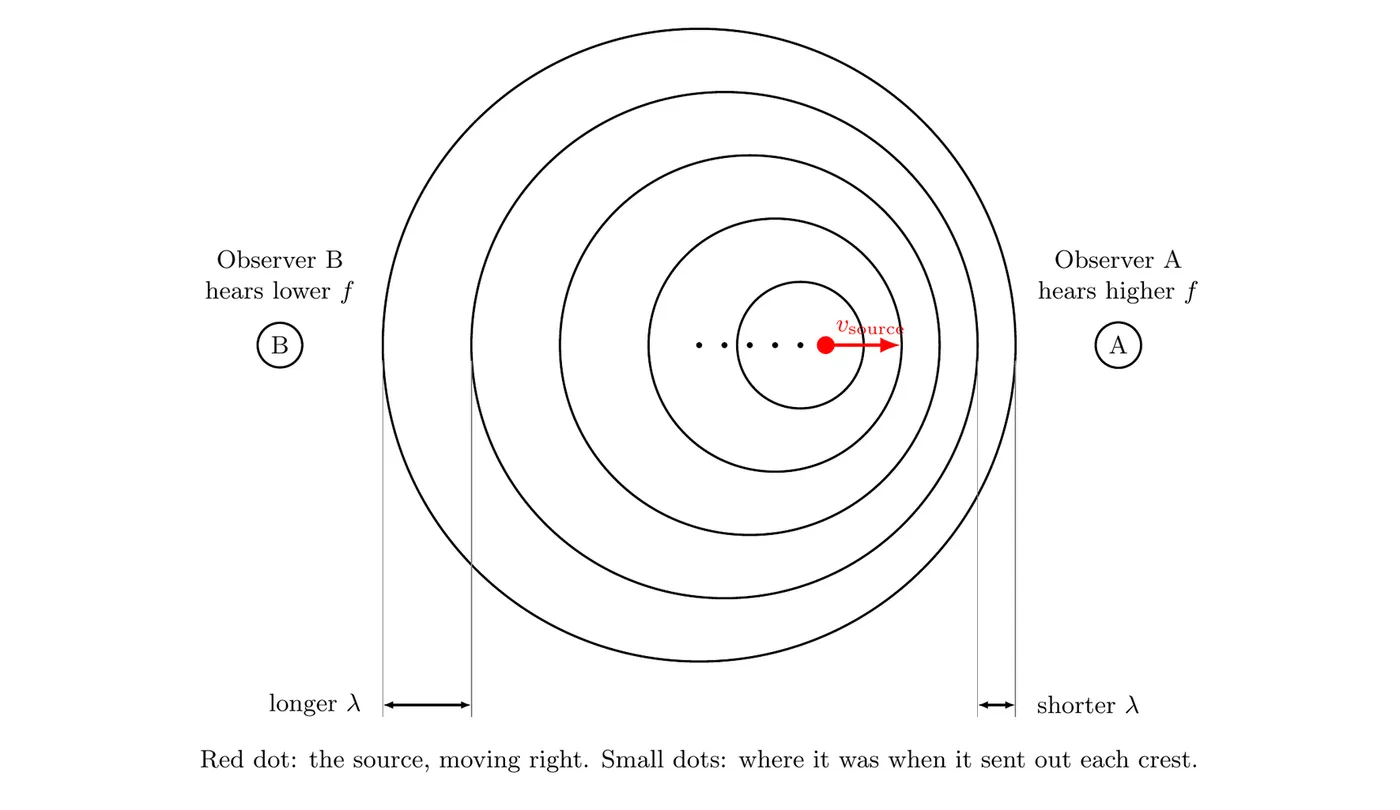
Each circle in the picture is a crest. Each one spreads out at the same wave speed from the spot where the source was when it sent that crest out (the small dots). Since the source keeps moving right, the crests bunch up in front of it and spread out behind it. Observer A, in front, gets crests that are closer together (a shorter wavelength), so more of them arrive each second and A hears a higher frequency. Observer B, behind, gets crests that are farther apart and hears a lower frequency. The source itself puts out the same rest frequency the whole time.
Examples:
- An approaching ambulance siren sounds higher-pitched.
- A star moving toward Earth shows blue-shifted light, shifted toward shorter wavelengths and higher frequencies.
Source Moving Away from the Observer
If the source moves away from the observer, the observed frequency is less than the rest frequency.
Why it happens:
- As the source moves away, each new crest starts from a spot farther from the observer.
- This stretches out the wavelengths and makes them longer.
- A longer wavelength means a lower frequency, since and the wave speed is constant.
Examples:
- A receding ambulance siren sounds lower-pitched.
- A star moving away from Earth shows red-shifted light, shifted toward longer wavelengths and lower frequencies.
- A galaxy receding as the universe expands shows a redshift.
Observer Motion
The Doppler effect also shows up when the observer moves relative to a stationary source:
- Observer moving toward the source: the observed frequency increases, similar to a source approaching.
- Observer moving away from the source: the observed frequency decreases, similar to a source receding.
The general principle is that what matters is the relative motion between the source and the observer.
Applications
Sound
- Emergency vehicle sirens (the pitch changes as the vehicle passes).
- Medical ultrasound (measuring blood flow velocity).
Light (Electromagnetic Waves)
- Astronomy: figuring out whether stars and galaxies are moving toward or away from Earth.
- Cosmology: measuring the expansion of the universe through the redshift of distant galaxies.
- Speed detection: police radar guns, lidar, and weather radar (which measures wind speeds inside storms).
Practice Problems
1. A car horn has a frequency of 400 Hz. As the car drives toward you, will you hear a frequency higher than, lower than, or equal to 400 Hz?
2. An ambulance with a 1000 Hz siren passes you on the street. Describe how the pitch you hear changes as it approaches, passes, and moves away.
3. Two spaceships move toward each other. Ship A emits a radio signal at 5.0 GHz. Will Ship B detect a frequency higher than, lower than, or equal to 5.0 GHz?
4. A stationary observer measures the frequency of a train whistle as the train passes. When would the measured frequency equal the whistle’s actual frequency?
5. Astronomers see that light from a distant galaxy is shifted toward longer wavelengths (redshifted). What does that tell you about the galaxy’s motion relative to Earth?
6. A police radar gun measures the frequency of radio waves reflected off a moving car. If the reflected waves have a higher frequency than the transmitted waves, is the car moving toward or away from the radar gun?
7. Compare the Doppler effect for sound versus light. Does it apply to both?
8. If the speed of a sound source approaching you doubles, how does the Doppler shift change?
Solutions
1. The car (the source) is moving toward you (the observer).
By the Doppler effect, when the source moves toward the observer, the observed frequency is greater than the rest frequency.
Answer: you’ll hear a frequency higher than 400 Hz, so a higher pitch.
2. Approaching: while the ambulance comes toward you, the source is moving toward you, so the observed frequency is higher than 1000 Hz. You hear a higher-pitched siren.
At the moment it passes: for that instant there’s no motion directly toward or away from you, since the velocity is perpendicular to your line of sight. The frequency briefly comes close to the actual 1000 Hz.
Moving away: after it passes, the ambulance moves away, so the observed frequency is lower than 1000 Hz. You hear a lower-pitched siren.
Answer: the pitch starts high (above 1000 Hz), drops as it passes, and becomes low (below 1000 Hz) as it moves away. That’s the classic “eee-ooo” of a passing siren.
3. The ships are moving toward each other.
From Ship B’s point of view, Ship A (the source) is moving toward it. When the source moves toward the observer, the observed frequency is greater than the rest frequency.
Answer: Ship B will detect a frequency higher than 5.0 GHz.
4. The measured frequency equals the actual frequency when there’s no relative motion between the observer and the train along the line connecting them.
That happens at the instant the train passes directly in front of the observer, when the velocity is perpendicular to the line between them, or if the train and observer happen to move at the same velocity in the same direction.
Answer: at the instant of closest approach (as it passes), the measured frequency equals the actual frequency, because the component of velocity along the line of sight is zero.
5. Light shifted toward longer wavelengths means the frequency has decreased, since means a bigger gives a smaller .
By the Doppler effect, a drop in observed frequency happens when the source moves away from the observer.
Answer: the galaxy is moving away from Earth. This redshift is evidence for the expansion of the universe.
6. There are two Doppler shifts involved here:
1. The car receives the radar signal with a Doppler shift.
2. The car reflects the signal back, now acting as a moving source.
If the reflected waves come back at a higher frequency than what was transmitted, both Doppler shifts must have raised the frequency, which happens when the source and observer are approaching each other.
Answer: the car is moving toward the radar gun.
7. Yes, the Doppler effect applies to both sound and light, and to all waves.
Similarities:
- Both show a frequency shift due to relative motion.
- A source approaching means a higher frequency.
- A source receding means a lower frequency.
Differences:
- Sound needs a medium, so its Doppler effect depends on whether the source or the observer is moving relative to that medium.
- Light doesn’t need a medium, so only the relative velocity between the source and observer matters, which fits with relativity.
- For light at very high speeds (a significant fraction of ), relativistic effects start to matter.
Answer: the Doppler effect applies to all waves, including sound and light. The underlying idea is the same, though the math differs a bit.
8. By the principle that a greater relative velocity gives a greater frequency shift, if the speed doubles, the Doppler shift increases.
The gap between the observed and rest frequencies gets bigger. The frequency shift is larger when the source moves faster.
Answer: the Doppler shift increases. The observed frequency will be even higher than before, further from the rest frequency.
Common Mistakes
- Confusing higher pitch with louder sound. The Doppler effect changes frequency and pitch, not amplitude and loudness. A receding ambulance sounds lower-pitched, not necessarily quieter, though it may also get quieter with distance.
- Thinking the Doppler effect only applies to sound. It applies to all waves: sound, light, water waves, and more.
- Forgetting the effect is symmetric. It doesn’t matter whether the source moves toward a stationary observer or the observer moves toward a stationary source. Both give a Doppler shift, though the exact equations differ slightly for sound.
- Assuming the wavelength stays constant. When the source moves, the crests bunch up in front of it and spread out behind it, so the wavelength in the medium really does change (the wave speed in the medium stays the same, so gives the new frequency). When only the observer moves through the air, the wavelength in the air doesn’t change; the observer just runs into crests more or less often.
- Confusing “toward” and “away.” Toward means a higher frequency (blueshift for light), and away means a lower frequency (redshift for light).
- Thinking the frequency change is instantaneous. The shift is continuous and depends on the component of velocity along the line of sight at each moment.
- Forgetting that relative velocity is what matters. A source moving at 50 m/s toward a stationary observer gives about the same effect as a stationary source with an observer moving at 50 m/s toward it (approximately, for sound at low speeds).
- Assuming the Doppler effect only happens while passing. It happens whenever there’s relative motion. It’s most dramatic when the motion is straight toward or away, but it exists for any motion with a component along the line of sight.
- Confusing redshift and blueshift. Redshift is a shift toward longer wavelengths, a lower frequency, moving away. Blueshift is a shift toward shorter wavelengths, a higher frequency, moving toward.
- Thinking the wave speed changes. The speed of the wave in its medium doesn’t change because of the source’s motion. What changes is the observed wavelength and frequency.
- Ignoring the direction of motion. Only the component of velocity along the line connecting the source and observer matters. Perpendicular motion causes no Doppler shift.
- Assuming you need equations. For AP Physics 2, only a qualitative understanding is required. Focus on the concepts, not the calculations.
- Forgetting the change is continuous. As an object passes, the Doppler shift changes smoothly from positive (approaching) through zero (passing) to negative (receding).
- Thinking amplitude affects the Doppler shift. The Doppler effect depends on velocity, not on amplitude or intensity.
- Confusing the Doppler effect with other frequency changes. The Doppler effect is specifically about relative motion. Frequency doesn’t change when a wave travels through a different medium, though the wavelength and speed do.