

6.7 - Diffraction
What Diffraction Is
Diffraction is the spreading of a wave around the edges of an obstacle or through an opening.
When waves run into barriers or openings, they don’t just keep going in straight lines. They bend and spread into regions that would be “shadowed” according to geometric optics. This is a distinctly wave behavior, and it’s evidence of the wave nature of light.
When Diffraction Is Most Noticeable
Diffraction is strongest when the size of the opening is comparable to the wavelength of the wave:
- Opening size roughly equal to the wavelength means strong diffraction, with significant spreading.
- Opening size much bigger than the wavelength means weak diffraction, close to straight-line travel.
- Opening size much smaller than the wavelength means most of the wave is reflected or blocked, and the little that gets through spreads out in all directions.
For example:
- Sound (wavelength around 1 m) diffracts a lot around doorways (around 1 m wide).
- Light (wavelength around 500 nm) needs very narrow slits before diffraction shows up.
The rule of thumb: diffraction is strongest when the opening width .
Diffraction and Interference Patterns
Diffraction of multiple wavefronts through a single opening leads to observable interference patterns. Different parts of the wavefront passing through the opening act like coherent sources. Those sources interfere with each other, producing a characteristic pattern of bright and dark regions.
Single-Slit Diffraction Setup
Diffraction is often demonstrated with monochromatic light of wavelength hitting a narrow opening of width that sits a distance from a screen.
The setup:
- A monochromatic light source (a single wavelength, like a laser).
- A single narrow slit of width .
- A screen a distance from the slit.
- The pattern observed on the screen.
What the Pattern Looks Like
Constructive and destructive interference of the many wavefronts coming from the opening produces bright and dark bands on the screen:
- A central bright fringe, the widest and most intense.
- Alternating dark and bright fringes on both sides.
- Intensity that fades with distance from the center.
- Dark fringes narrower than the bright fringes.
Path Length Difference
The amount of interference between two wavefronts depends on their path length difference (), which is the difference in the distance traveled by waves from different parts of the opening to the same point on the screen:
- A path difference of a whole-number multiple of gives constructive interference (bright).
- A path difference of an odd multiple of gives destructive interference (dark).
The Path Length Difference Equation
You can write the path length difference in terms of the opening width and the angle between the wavefront’s direction of propagation and the normal to the opening:
where:
- = path length difference
- = slit width
- = angle from the central axis to the point on the screen
Condition for Dark Fringes (Minima)
For destructive interference (dark fringes) in single-slit diffraction:
where (integers, but not zero).
Note that does not give a minimum. It gives the central maximum.
Why whole wavelengths give darkness here. This looks backwards compared with two sources, where a path difference of means bright. The difference is that is the path difference between the two edges of the slit, and the slit is full of wavelets in between.
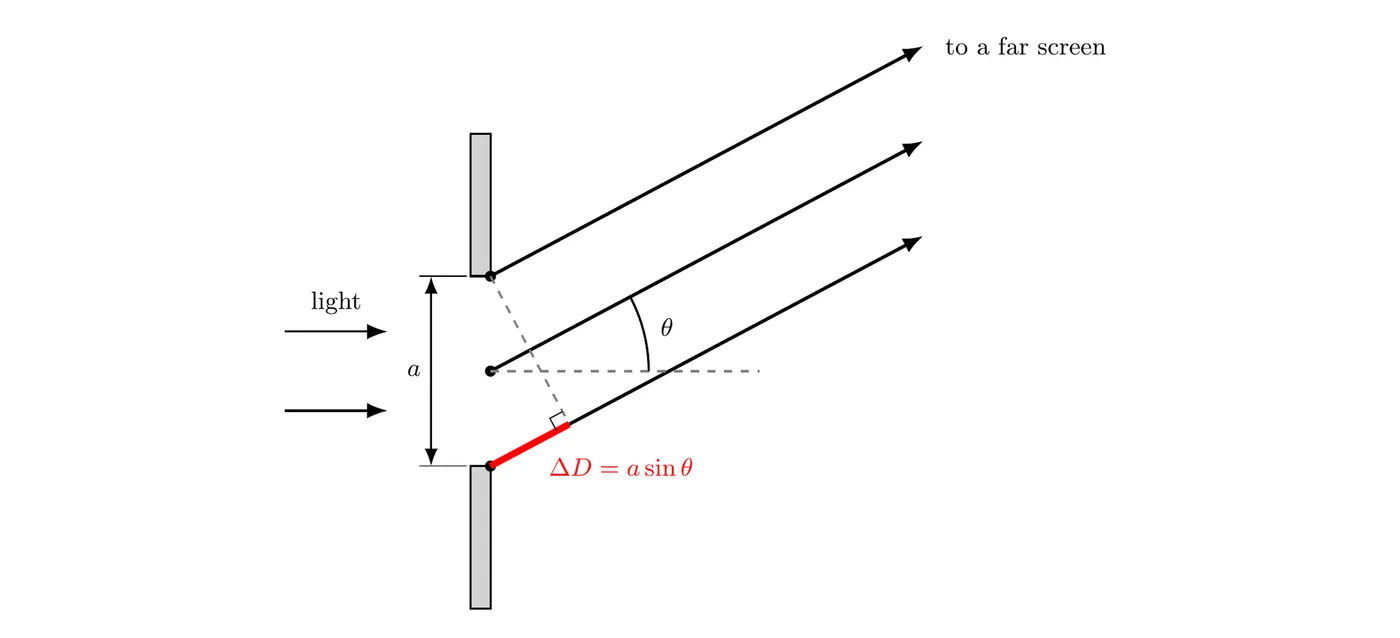
Split the slit into a top half and a bottom half. When the edge-to-edge path difference is , a wavelet from the top edge and one from the middle of the slit differ by , so they cancel. The same goes for every pair of points half a slit apart, so the whole top half cancels the whole bottom half and the screen is dark at that angle. At , split the slit into four quarters and the same pairing works again, and so on for every whole number .
Small Angle Approximation
For small angles where , you can use the small angle approximation to connect , , and to , the distance from the middle of the central bright fringe to the -th dark fringe on the screen.
or, rearranged:
where:
- = distance from the center to the -th dark fringe
- = order of the minimum (1, 2, 3, …)
- = wavelength
- = distance from the slit to the screen
- = slit width
The small angle approximation is (in radians), with .
The Shape of the Opening Matters
The diffraction pattern a wave makes going through an opening depends on the shape of the opening:
- A rectangular slit gives the pattern described above, with alternating bright and dark bands.
- A circular aperture gives concentric rings (the Airy pattern).
- Other shapes give their own characteristic patterns.
The symmetry of the opening sets the symmetry of the diffraction pattern.
Visual Representations
Drawing single-slit diffraction patterns is a useful way to work out the physical properties of the slit and the waves involved. From a diffraction pattern you can figure out:
- The wavelength, if you know the slit width.
- The slit width, if you know the wavelength.
- The relative intensity distribution.
- The angular positions of the minima and maxima.
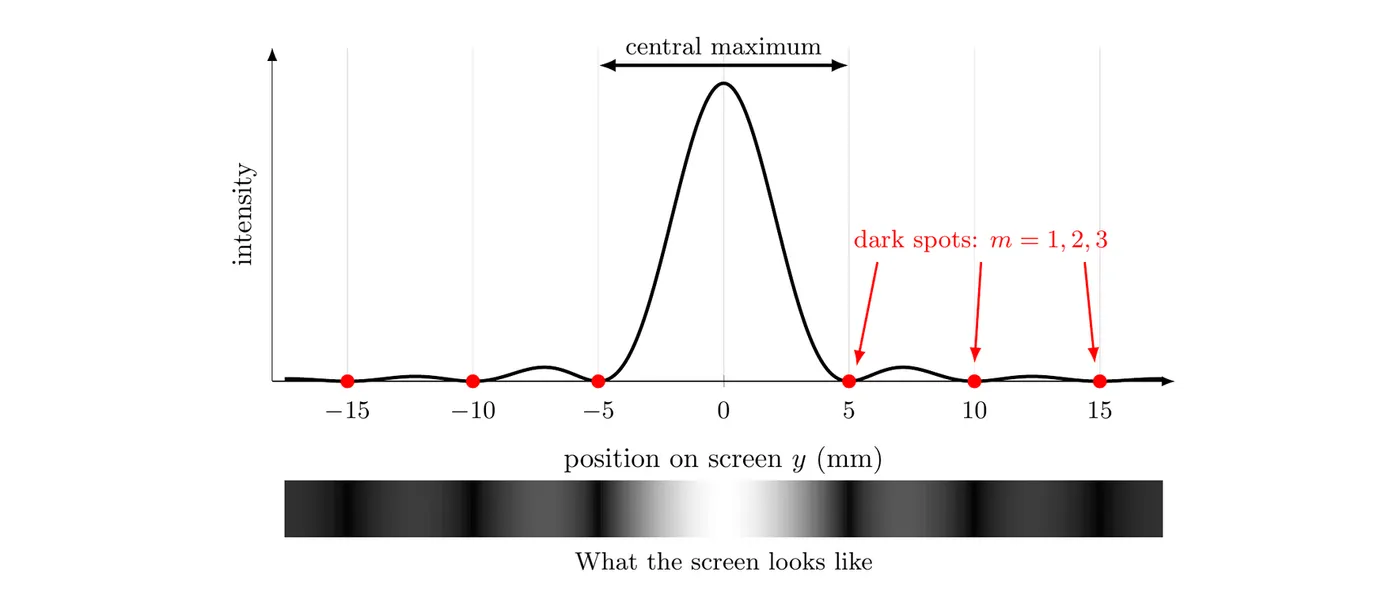
Worked example. A red laser ( nm) shines through a single slit onto a screen 2.00 m away and makes the pattern above. Find the slit width.
Read the graph: the first dark spot () is mm from the center, so the central bright band is 10 mm wide. Use the equation sheet’s :
Check with : the second dark spot is at 10 mm, which gives the same 0.26 mm. The small angle approximation is fine here, since rad, about 0.14°, far below 10°. Notice the side bright bands are much dimmer than the center and only half as wide. That’s how you tell a single-slit pattern from a double-slit one.
Practice Problems
1. Light with a wavelength of 600 nm passes through a single slit of width 0.10 mm onto a screen 2.0 m away. Find the distance from the center to the first dark fringe.
2. Explain why you can hear someone talking in another room even when the door is only partly open, but you can’t see them without a direct line of sight.
3. A single-slit diffraction pattern has its first minimum at an angle of 30° from the central maximum. If the slit width is 2.0 μm, what is the wavelength of the light?
4. How does the width of the central bright fringe change if:
- (a) the slit width is doubled?
- (b) the wavelength is doubled?
5. In a single-slit diffraction experiment, the distance between the first and third dark fringes on one side of the central maximum is 4.0 mm. What is the distance between the first and second dark fringes?
6. Why is diffraction easier to see with sound waves than with light waves in everyday situations?
7. A slit of width 0.050 mm is lit with red light (λ = 650 nm) and blue light (λ = 450 nm) at the same time. Which color makes a wider diffraction pattern?
Solutions
1. Use the small angle approximation formula with (the first dark fringe).
Given:
- nm m m
- mm m
- m
-
Answer: the first dark fringe is 1.2 cm from the center.
2. This comes down to the relationship between wavelength and diffraction.
Sound waves have wavelengths on the order of centimeters to meters for audible frequencies. A partly open door has an opening of a similar size, tens of centimeters. Since the opening is comparable to the wavelength, sound diffracts a lot. It bends around the edges and spreads throughout the room, so you can hear the person even without a direct line of sight.
Light waves have wavelengths on the order of hundreds of nanometers, which is much smaller. The door opening is much larger than the wavelength of light, so light barely diffracts. It travels essentially in straight lines, and you need a direct line of sight to see the person.
Answer: sound wavelengths (cm to m) are comparable to a door opening, so sound diffracts and spreads a lot. Light wavelengths (about 500 nm) are much smaller than the opening, so light barely diffracts and travels in straight lines.
3.
Use the condition for dark fringes at the first minimum ():
Answer: the wavelength is 1000 nm, or 1.0 μm (infrared light).
4. From , the width of the central bright fringe is roughly (from the first minimum on one side to the first minimum on the other).
- If the slit width doubles (): Doubling halves , so the central bright fringe gets narrower (half as wide).
Answer: the central bright fringe width is halved, so the pattern gets narrower.
- If the wavelength doubles (): Doubling doubles , so the central bright fringe gets wider (twice as wide).
Answer: the central bright fringe width doubles, so the pattern gets wider.
5. The dark fringes are at , where
The distance from the first to the third dark fringe:
So:
The distance from the first to the second dark fringe:
Answer: the distance between the first and second dark fringes is 2.0 mm.
6. Diffraction is strongest when the opening size is comparable to the wavelength.
Sound waves in the audible range have wavelengths from about 2 cm (high pitch) to 17 m (low pitch). These are comparable to or larger than everyday objects like doors, windows, and furniture, so sound readily diffracts around obstacles.
Light waves have wavelengths around 400 to 700 nm, which is much smaller than everyday objects, by a factor of millions. For light to diffract noticeably, you’d need openings on the order of micrometers, which don’t come up in everyday life.
Answer: sound wavelengths (cm to m) match everyday object sizes, so diffraction is easy to see. Light wavelengths (about 500 nm) are much smaller, so you need special narrow slits to see diffraction.
7.
From , the width of the diffraction pattern is proportional to the wavelength:
Red light has a longer wavelength (650 nm) than blue light (450 nm). Since , red light makes a wider diffraction pattern, with larger spacing between fringes.
Answer: red light makes a wider diffraction pattern because it has a longer wavelength. The ratio of widths is 650:450, or about 1.4:1.
Common Mistakes
- Confusing diffraction with refraction. Diffraction is bending and spreading around obstacles. Refraction is bending due to a speed change when entering a new medium.
- Thinking only the edges diffract. The entire wavefront passing through the opening contributes. Every point in the opening acts as a source.
- Using for dark fringes. In single-slit diffraction, gives the central maximum (bright), not a minimum. Dark fringes start at
- Confusing single-slit and double-slit patterns. A single slit has a wide central maximum with weaker side maxima. A double slit has equally spaced fringes modulated by the single-slit envelope.
- Using the wrong angle approximation. The small angle approximation () is only good for . For larger angles, use the exact equation.
- Forgetting to convert units. Convert wavelengths to meters (nm to m) and slit widths to meters (mm to m, μm to m) before calculating.
- Thinking a wider slit means a wider pattern. It’s the opposite. A wider slit (bigger ) makes a narrower pattern, since .
- Assuming bright fringes occur at . The condition gives the dark fringes (minima), not the bright ones. Bright fringes fall between the minima.
- Confusing path difference and phase difference. The path difference (in meters) relates to the phase difference by .
- Not recognizing when diffraction is negligible. When is much bigger than , diffraction is minimal, and geometric optics (straight-line rays) is good enough.
- Using the wrong formula for a circular aperture. The single rectangular slit formula doesn’t apply to circular openings. Circular apertures give Airy patterns with different math.
- Thinking the central maximum is the same width as the others. The central maximum is twice as wide as the secondary maxima in single-slit diffraction.
- Forgetting the in the small angle formula. It’s , not . Don’t drop the .
- Mixing up what widens and narrows the pattern. Increasing or makes the pattern wider. Increasing makes it narrower.
- Ignoring the physical setup requirements. The screen has to be far enough that is much bigger than for the formulas to hold (Fraunhofer diffraction).
- Assuming diffraction only applies to light. Diffraction happens for all waves (sound, water, radio, and more) whenever they hit obstacles or openings.