

6.8 - Double-Slit Interference and Diffraction Gratings
Double-Slit Pattern
When monochromatic light of wavelength hits two slits a distance apart, the pattern you get comes from a mix of wave diffraction and wave interference.
Setup:
- A monochromatic light source.
- Two narrow parallel slits separated by distance .
- A screen sitting a distance from the slits.
- The pattern shows up on the screen.
Interference from Two Slits
If you only think about wave interference and ignore the diffraction coming from each slit’s width, a double slit gives you a pattern of evenly spaced maxima.
Bright and Dark Fringes
The constructive and destructive interference of the wavefronts coming out of each slit produces bright and dark bands on the screen.
- Bright fringes (maxima): constructive interference, where the waves show up in phase.
- Dark fringes (minima): destructive interference, where the waves show up out of phase.
Path Length Difference
How much interference you get between two wavefronts depends on their path length difference ().
The path length difference is just the difference in how far the light traveled from each slit to reach a given point on the screen.
- Path difference is an integer multiple of , which gives constructive interference (bright).
- Path difference is an odd multiple of , which gives destructive interference (dark).
Path Length Difference Equation
You can write the path length difference in terms of the slit separation and the angle between the direction the wavefront travels and the normal to the opening:
where:
- = path length difference
- = distance between the slits (slit separation)
- = angle from the central axis to the point on the screen
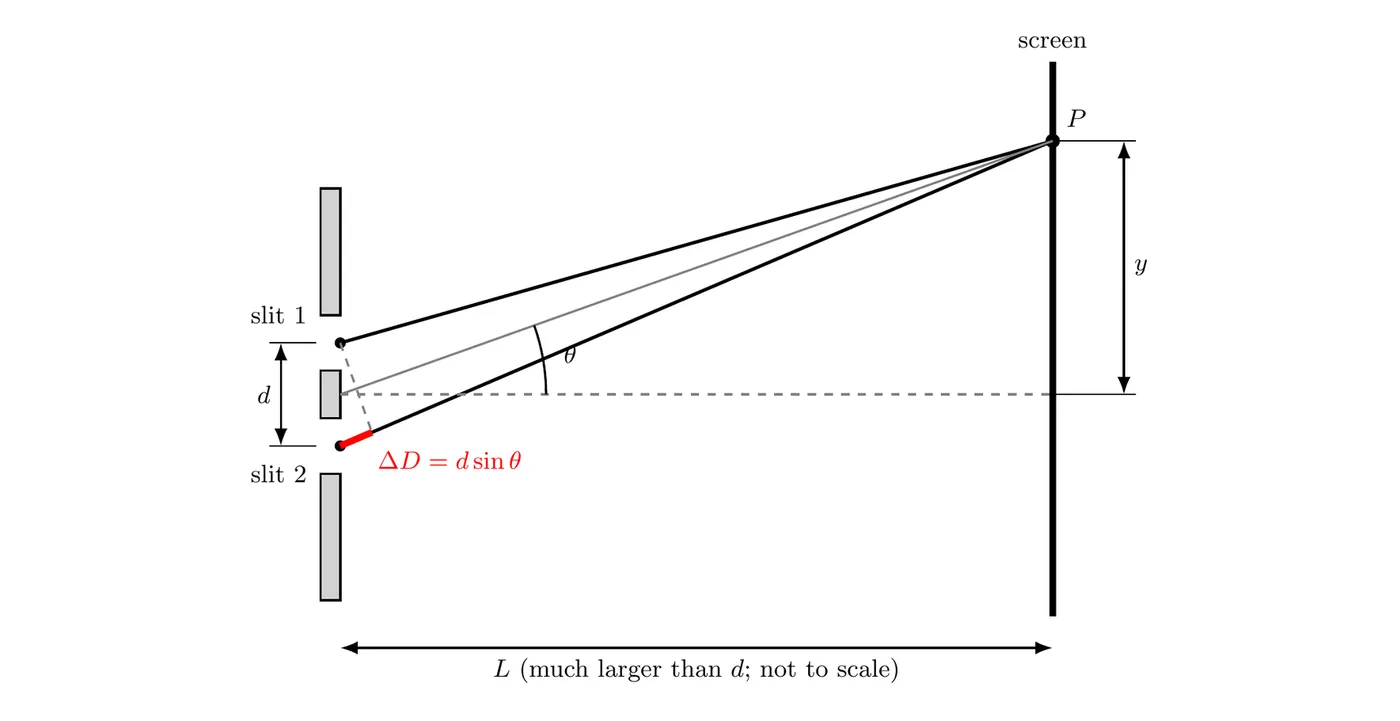
Where comes from. The screen is so far away compared with that the two rays to point are almost parallel. Draw a line from slit 1 that meets the ray from slit 2 at a right angle (dashed in the picture). Past that line, both rays have the same distance left to go. The only extra distance is the short red piece at slit 2, the side of a small right triangle with hypotenuse and angle , so .
Condition for Bright Fringes (Maxima)
For constructive interference (bright fringes):
where (integers).
- : the central maximum (zeroth order).
- : the first-order maxima.
- : the second-order maxima.
- And so on.
Note: unlike single-slit diffraction (where for the minima), here is allowed and gives you the central bright fringe.
Dark fringes come halfway between the bright ones, where the path difference is an odd number of half wavelengths: . The waves from the two slits arrive crest to trough and cancel.
Small Angle Approximation
For small angles where , you can use the small angle approximation to connect , , and to , the distance from the middle of the central bright fringe out to the -th order bright fringe on the screen.
or, rearranged:
where:
- = distance from the center to the -th bright fringe
- = order of the maximum (0, 1, 2, 3, …)
- = wavelength
- = distance from the slits to the screen
- = slit separation
Fringe spacing (the distance between neighboring bright fringes):
Combined Interference and Diffraction
Once you account for both wave interference and wave diffraction, a double slit produces an interference pattern of maxima and minima sitting inside the envelope created by single-slit diffraction.
The full pattern:
- Double-slit interference creates lots of closely spaced, equally bright fringes.
- Single-slit diffraction creates an envelope that dials the brightness of the interference pattern up and down.
- The result is closely spaced fringes whose brightness varies (brightest at the center, dimmer as you go out).
The single-slit diffraction pattern acts like an “envelope” that limits how visible the double-slit fringes are.
Young’s Double-Slit Experiment
The interference patterns light makes when it goes through a double slit tell us that light has wave properties. This came out of Young’s double-slit experiment (1801).
Why it mattered historically:
- It gave strong evidence for the wave nature of light.
- It went against the particle theory of light that was popular at the time.
- It’s one of the most important experiments in all of physics.
How we see it now: light shows both wave and particle properties (wave-particle duality).
Visual Representations
Pictures of double-slit diffraction patterns come in handy for figuring out the physical properties of the slits and the waves involved.
From a double-slit pattern, you can pin down:
- The wavelength (if you know ).
- The slit separation (if you know ).
- The order of the fringes.
- What happens when you change parameters.
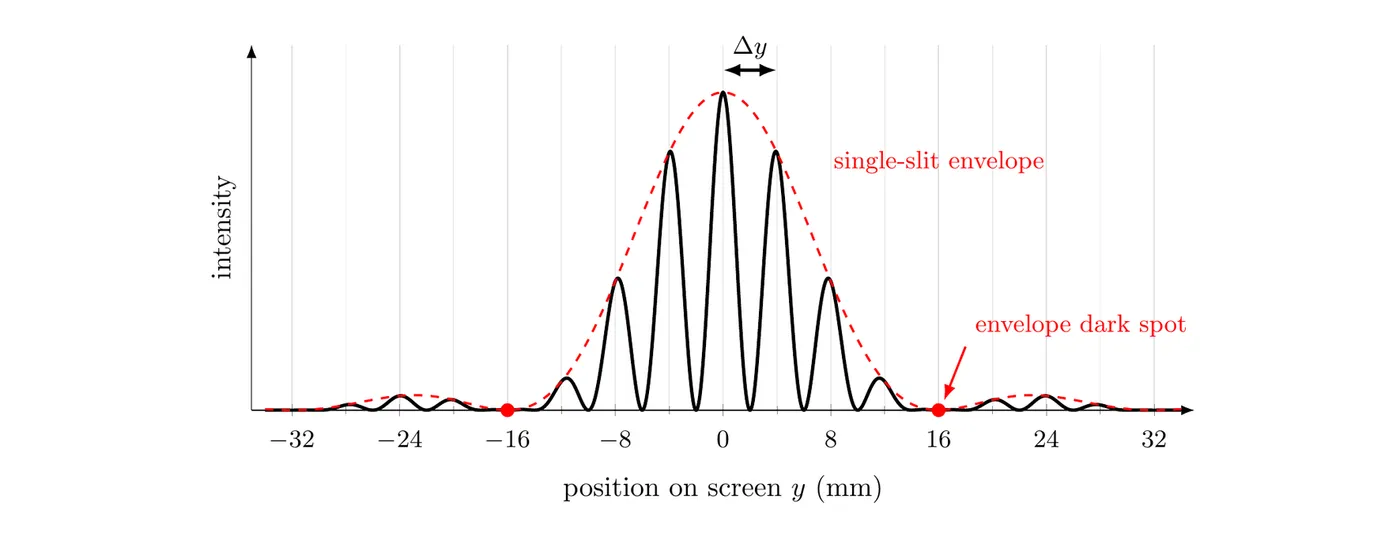
Worked example. Light with nm passes through a double slit onto a screen 2.00 m away and makes the pattern above. Find the slit separation and the width of each slit.
Slit separation, from the fringe spacing. Neighboring bright fringes are mm apart. Use with :
Slit width, from the envelope. The envelope first goes dark at 16 mm. That’s a single-slit minimum, so use with :
The bright fringe that should sit at 16 mm (the interference maximum) is missing, because neither slit sends any light to that spot. That happens here because . Narrower slits would spread the envelope out and show more fringes inside it; slits farther apart would pack the fringes closer together.
Diffraction Gratings
A diffraction grating is a set of evenly spaced parallel slits or openings that makes an interference pattern out of many diffraction patterns layered on top of each other.
What sets it apart:
- It has lots of slits (hundreds to thousands per millimeter).
- It produces very sharp, bright maxima at specific angles.
- It uses the same equation as the double slit: .
- It gives better resolution and more intensity than a double slit.
Grating spacing is often given as the number of lines per unit length. If there are lines per meter, then .
White Light and Diffraction Gratings
When white light hits a diffraction grating:
- The center maximum () stays white.
- The higher-order maxima spread the white light into a rainbow.
- The longest-wavelength light (red) lands farthest from the central maximum.
- The shortest-wavelength light (violet) lands closest to the central maximum (just after the white center).
Why this happens:
From , for a given order :
- Bigger means bigger means a bigger angle.
- Red light (λ ≈ 700 nm) diffracts more than violet (λ ≈ 400 nm).
At : every wavelength has , so all the colors pile on top of each other and give white.
At : different wavelengths diffract at different angles, so the spectrum splits apart.
Order of the colors from the center outward: violet, blue, green, yellow, orange, red.
Practice Problems
1. In a double-slit experiment, 550 nm light goes through slits separated by 0.20 mm. The screen is 1.5 m away. Find the distance from the center to the third bright fringe.
2. A double-slit pattern has bright fringes 2.5 mm apart on a screen 2.0 m from the slits. If the slit separation is 0.50 mm, what wavelength was used?
3. Explain why the central maximum is white with white light, but the other maxima show colors.
4. A diffraction grating has 500 lines per millimeter. What’s the angle of the first-order maximum for red light (λ = 650 nm)?
5. In a double-slit experiment, how does the fringe spacing change if:
- (a) You double the slit separation?
- (b) You double the wavelength?
- (c) You double the screen distance?
6. A diffraction grating produces a second-order maximum at 30° for a certain wavelength. At what angle is the first-order maximum?
7. Why does a grating with many slits produce sharper, brighter maxima than a double slit?
8. White light hits a grating. In the first-order spectrum, which color lands at a bigger angle from the center, red or blue?
Solutions
1. Use the small angle approximation with (the third bright fringe):
Given:
- nm m m
- mm m
- m
-
Answer: the third bright fringe is 1.24 cm (or 12.4 mm) from the center.
2. The fringe spacing is:
Rearrange for the wavelength:
Answer: the wavelength is 625 nm (orange-red light).
3. Start from the bright-fringe condition: .
At the central maximum
():
This works for every wavelength at once. All the colors (red through violet) arrive at in phase no matter their wavelength. When all the colors overlap, they combine into white light.
At the higher-order maxima
():
Now different wavelengths satisfy this at different angles. Red light (longer λ) shows up at bigger angles than blue (shorter λ). The colors split into a spectrum because they no longer land on top of each other, since each wavelength has its own angle for constructive interference.
Answer: at every wavelength interferes constructively at the same spot (the center), so you get white. For different wavelengths interfere constructively at different angles, so the colors fan out into a spectrum.
4. First find the grating spacing:
Use the grating equation with :
Answer: the first-order maximum is at 19.0° from the center.
5. From , the fringe spacing is .
- Slit separation doubled ():
Doubling halves the spacing, so the fringes get closer together.
Answer: the fringe spacing is cut in half (fringes closer).
- Wavelength doubled ():
Doubling doubles the spacing, so the fringes spread farther apart.
Answer: the fringe spacing doubles (fringes farther apart).
- Screen distance doubled ():
Doubling doubles the spacing, so the fringes spread farther apart.
Answer: the fringe spacing doubles (fringes farther apart).
6. Use the grating equation for both orders.
Second-order maximum
():
First-order maximum
():
Answer: the first-order maximum is at 14.5°.
7. With many slits, the pattern comes from the superposition of waves from all the slits at once.
Sharpness: for a maximum to form, all waves have to arrive in phase. Even a small nudge off the exact angle throws waves from different slits out of phase, which quickly cancels things out. With more slits, even tiny angle changes cause a lot of cancellation, so the peaks come out very narrow and sharp.
Brightness: when constructive interference does happen, all slits pitch in coherently. The amplitude scales with , and the intensity (brightness) scales with . More slits means dramatically more intensity at the maxima.
Side by side:
- 2 slits: broad peaks, intensity .
- 1000 slits: very sharp peaks, intensity (250,000 times brighter).
Answer: many slits make sharper peaks because small angle changes trigger destructive interference among all those waves, and the peaks are brighter because every slit contributes coherently, which makes the intensity scale with .
8.
From , for the first order ():
Red light has a longer wavelength ( nm) than blue light ( nm).
Since , and :
so:
Answer: red light lands at a bigger angle from the center. In the spectrum, red is farthest out and violet/blue is closest in (just after the white central maximum).
Common Mistakes
- Confusing the single-slit and double-slit formulas. Single-slit uses the slit width for its minima. Double-slit uses the slit separation for its maxima.
- Wrong variable in the equations. Double-slit uses (the distance between the slits), not (an individual slit’s width).
- Mixing up the maxima and minima conditions. For a double slit, gives you maxima (bright fringes), not minima.
- Forgetting that m = 0 is allowed. For double-slit maxima, . The central maximum sits at .
- Not converting the grating spec. If you’re given “lines per mm,” turn it into a spacing: .
- Thinking more slits makes wider fringes. More slits (a grating) makes narrower, sharper maxima, not wider ones.
- Confusing fringe spacing with fringe width. Fringe spacing is the distance between the centers of neighboring fringes. Fringe width is how wide each bright region is.
- Getting the proportionality backwards. . A bigger makes the fringes closer, not farther. A bigger or makes them farther apart.
- Assuming the central maximum is always brightest. In pure double-slit interference, every maximum has equal intensity. The single-slit diffraction envelope is what modulates it and makes the central region the brightest.
- Getting the white-light dispersion direction wrong. Red (longer λ) lands farther from center than blue (shorter λ) in the higher orders.
- Not seeing why the central max is white. At , for every wavelength, so all the colors overlap and you get white.
- Confusing interference with diffraction. Interference is the superposition of waves from different slits. Diffraction is the spreading from each individual slit. Both are happening together in a double slit.
- Using the wrong angle range for the approximation. The small angle approximation is only good for . For bigger angles, use the exact formula with .
- Forgetting units. Wavelength in meters (convert from nm), distances in meters (convert from mm), angles in degrees (check your calculator mode).
- Thinking the grating equation is different. It’s the same equation as the double slit (), just with way more slits and a different .
- Not checking the maximum possible order. Since , the highest order is (rounded down to a whole number).
- Confusing path difference with phase difference. The path difference connects to the phase difference through .