

6.1 - Properties of Wave Pulses and Waves
Waves and Energy Transfer
Waves move energy from one place to another without moving matter along with it. The medium can wiggle in place, but it doesn’t travel with the wave. Only the disturbance and its energy travel.
Wave pulse. A wave pulse is a single, one-off disturbance that carries energy from one spot to another. It’s isolated, not repeating. Flicking one end of a rope sends a single pulse down it.
Wave. A wave is a continuous, repeating disturbance with a well-defined wavelength and frequency. It’s a steady pattern of regular oscillations. Sound waves, light waves, and water waves are examples.
Types of Waves by Medium
Mechanical waves. These need a medium to travel through. No matter, no wave, so they can’t cross a vacuum. Sound, water waves, seismic waves, and waves on strings are all mechanical.
Electromagnetic waves. These don’t need a medium and can cross a vacuum. They’re self-sustaining oscillations of electric and magnetic fields. Light, radio waves, X-rays, and microwaves are all electromagnetic.
Wave Speed
How fast a wave moves depends on the type of wave and the properties of the medium.
Electromagnetic waves in vacuum. All electromagnetic waves travel at the same speed in vacuum, a universal constant:
This is the speed of light in vacuum, and it’s the same for every kind of electromagnetic radiation no matter the frequency or wavelength.
Waves on a string. The speed of a wave on a string depends on the tension () and the mass per length:
where:
- = wave speed on the string (m/s)
- = tension in the string (N)
- = linear mass density, mass per unit length (kg/m)
More tension means a faster wave, and more mass per length means a slower one.
Worked example. A guitar string is 0.650 m long, has a mass of 2.60 g, and is pulled to a tension of 64.0 N. How fast do waves travel along it?
First find the mass per length, with the mass in kilograms (the AP equation sheet writes this as ):
A longer piece of the same string has more mass but also more length, so and the wave speed stay the same. Only the tension and the mass per length matter.
Sound waves. In a given medium, sound gets faster as the medium warms up. Warmer air means faster sound. The medium itself matters too: sound moves faster in water than in air, and faster still in steel than in water.
Transverse Waves
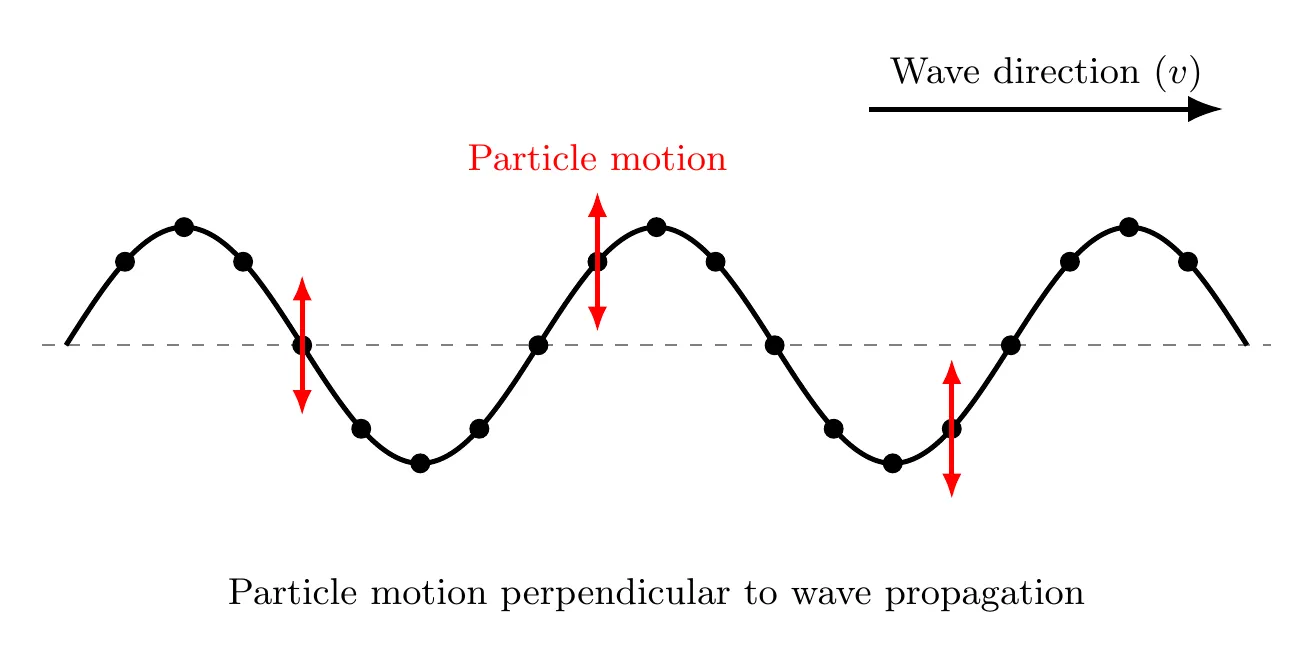
In a transverse wave, the disturbance is perpendicular to the direction the wave travels. The medium wiggles at right angles to the wave’s path. Waves on a string (the string moves up and down while the wave goes sideways), electromagnetic waves (the fields oscillate perpendicular to the travel direction), and water surface waves (roughly) are all transverse.
Longitudinal Waves
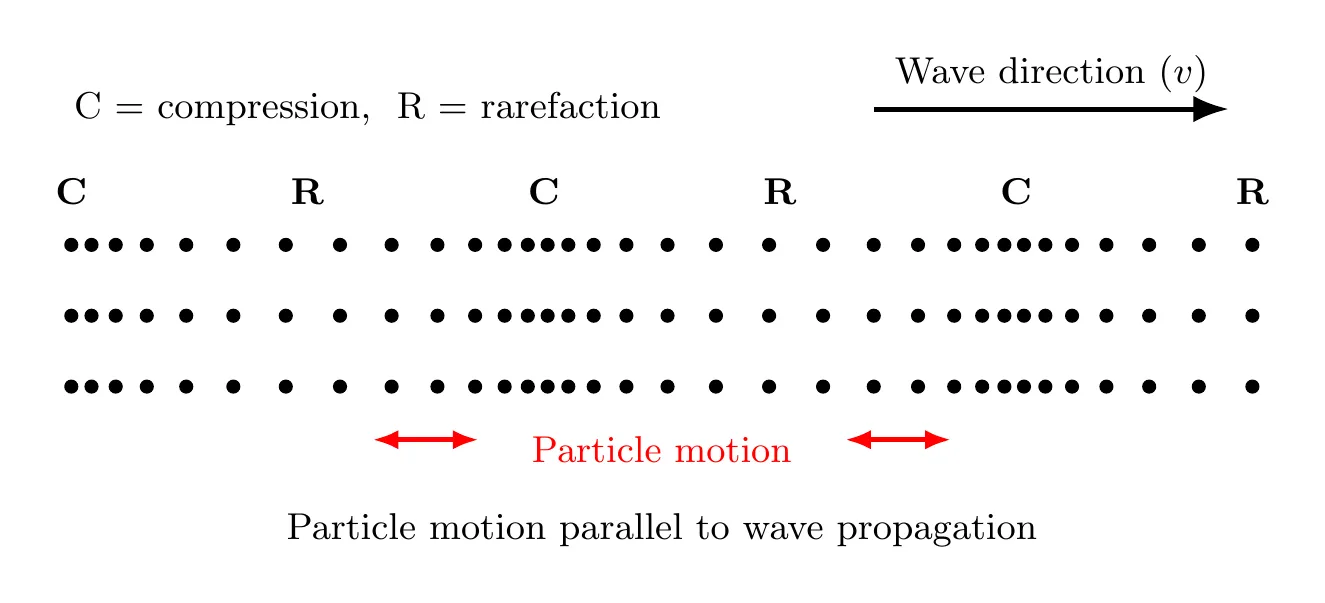
In a longitudinal wave, the disturbance is parallel to the direction the wave travels. The medium wiggles back and forth along the same line the wave moves.
Sound waves. Sound is a mechanical longitudinal wave. Air molecules (or the particles of whatever medium) push back and forth in the same direction the sound travels.
Compressions and rarefactions. The high-pressure and low-pressure regions of a sound wave are called compressions and rarefactions. A compression is where particles bunch together (high pressure, high density), and a rarefaction is where they spread apart (low pressure, low density). They alternate as the wave moves along.
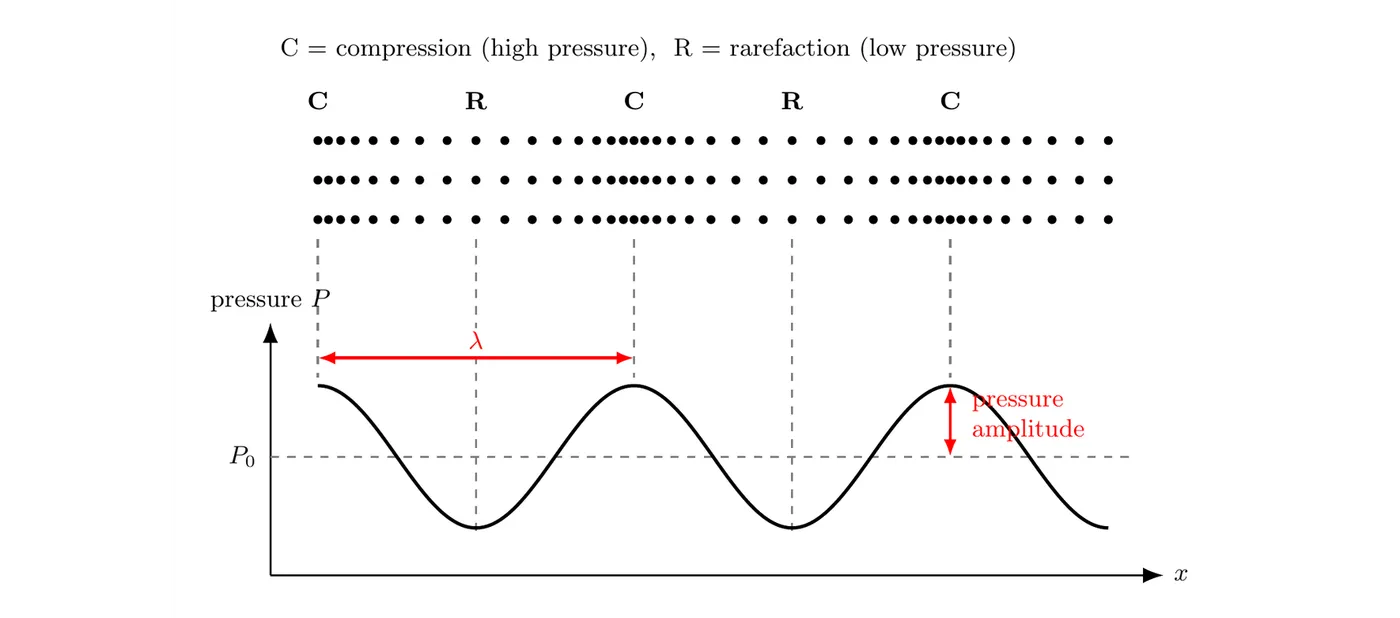
The dots are air molecules at one instant. Where they crowd together (C), the pressure is above normal air pressure . Where they spread apart (R), it is below. The graph underneath plots the pressure at each spot: compressions line up with the pressure peaks and rarefactions with the dips. The distance from one compression to the next is one wavelength.
Amplitude
Amplitude is the maximum displacement of a wave from its resting position. It’s basically the size or strength of the disturbance.
Amplitude of pressure waves. For a longitudinal pressure wave, the amplitude is the biggest jump above or drop below the equilibrium pressure. For sound, that’s the pressure amplitude, measured in pascals.
Example. A microphone shows the air pressure swinging from 0.30 Pa above normal air pressure to 0.30 Pa below it. The pressure amplitude is 0.30 Pa, not 0.60 Pa, because amplitude is measured from equilibrium to a peak, not from a peak to a dip. Compared with air pressure itself (about Pa), that’s a change of less than 0.001%, even for a fairly loud sound.
Amplitude and loudness. Louder sound means bigger amplitude. Loudness also depends on frequency, but amplitude is the main driver. It’s measured in decibels (dB) on a logarithmic scale.
Amplitude and energy. More amplitude means more energy. Specifically, energy is proportional to the square of the amplitude: . So doubling the amplitude quadruples the energy, and this holds for all kinds of waves.
Practice Problems
1. Explain why astronauts in space can’t hear sounds outside their spacecraft but can still see sunlight.
2. A string has 80 N of tension and a linear mass density of 0.020 kg/m. What’s the wave speed on it?
3. If you quadruple the tension in a string while keeping the mass per length the same, how does the wave speed change?
4. Classify each as transverse or longitudinal:
- (a) Sound waves in air
- (b) Light waves
- (c) Waves on a rope
- (d) Seismic P-waves (compression waves in Earth)
5. One sound wave has twice the amplitude of another with the same frequency. How much more energy does it carry?
6. On a hot day (30°C) versus a cold day (0°C), does sound travel faster or slower? Explain.
7. Draw a diagram showing how particle motion relates to wave propagation for both transverse and longitudinal waves.
Solutions
1. Sound is a mechanical wave, so it needs a medium (air, water, a solid) to travel through. Space is a vacuum with no molecules to carry the disturbance, so sound can’t travel there and astronauts can’t hear anything outside. Light is an electromagnetic wave and doesn’t need a medium, so it crosses the vacuum of space just fine, which is why we can see the sun and stars.
2.
The wave speed is about 63 m/s.
3. Start with . Quadruple the tension to :
The speed doubles. Since , quadrupling the tension doubles the speed.
4. (a) Longitudinal: air molecules move back and forth along the sound’s travel direction.
(b) Transverse: the electric and magnetic fields oscillate perpendicular to the light’s travel direction.
(c) Transverse: the rope moves up and down (or side to side) perpendicular to the wave’s path.
(d) Longitudinal: P-waves compress and expand the rock parallel to the wave’s direction.
5. Energy goes with the square of amplitude, . If the amplitude doubles ():
The louder wave carries 4 times as much energy.
6. Sound travels faster on the hot day. Sound speed rises with temperature, because warmer molecules have more kinetic energy and move faster on average, which lets the disturbance spread more quickly. In air, roughly: at 0°C, m/s, and at 30°C, m/s. So warmer air means faster sound.
7.
Transverse wave:
Longitudinal wave:
Common Mistakes
- Thinking waves carry matter. Waves carry energy, not matter. The medium wiggles in place; it doesn’t flow along with the wave.
- Confusing wave speed with particle speed. Wave speed is how fast the disturbance moves. Particle speed is how fast individual bits of the medium wiggle. Different things.
- Assuming all waves need a medium. Only mechanical waves do. Electromagnetic waves cross vacuum.
- Thinking higher frequency means higher speed. In a given medium, speed usually doesn’t depend on frequency. Different frequencies travel at the same speed on a string or through air (non-dispersive media).
- Dropping the square root in the string speed. It’s , not .
- Confusing mass per length with total mass. The formula uses linear mass density (kg/m), not the total mass.
- Thinking amplitude changes wave speed. In most media it doesn’t. Bigger amplitude means more energy but the same speed.
- Swapping compressions and rarefactions. Compressions are high pressure (particles close), rarefactions are low pressure (particles spread out).
- Thinking loudness is only amplitude. Amplitude is the main factor, but loudness also depends on frequency and how sensitive your ear is.
- Mixing up transverse and longitudinal. Transverse: disturbance perpendicular to travel. Longitudinal: disturbance parallel to travel.
- Thinking space is just quiet. In space sound doesn’t just get faint, it can’t exist at all without a medium.
- Unit slips. Speed in m/s, tension in N, linear density in kg/m.
- Forgetting temperature effects. Sound speed rises with temperature, so don’t treat it as constant.
- Thinking electromagnetic waves have different vacuum speeds. Every electromagnetic wave (radio, visible, X-ray, and so on) travels at m/s in vacuum, whatever its frequency.