

6.6 - Wave Interference and Standing Waves
Wave Interference
Wave interference is the interaction of two or more wave pulses or waves. When waves meet, they interact in a specific, predictable way.
How Waves Overlap
When two or more wave pulses or waves meet, they travel through each other and overlap, rather than bouncing off each other.
Unlike particles, which collide and bounce, waves:
- Pass through one another.
- Combine while they overlap.
- Continue on unchanged after passing through.
This is a distinctly wave behavior, and it’s one of the things that sets waves apart from particles.
The Superposition Principle
When two or more wave pulses or waves overlap, you find the resulting displacement by adding the individual displacements. This is called superposition.
At any point in space and time, the net displacement is the algebraic sum of the displacements from each wave. The key is to add displacements point by point, keeping track of both magnitude and direction (the sign).
Types of Interference
Wave interference can be constructive or destructive.
Constructive Interference
When the displacements of the overlapping waves point in the same direction, you get constructive interference:
- Both waves push up, so you get a larger upward displacement.
- Both push down, so you get a larger downward displacement.
- The amplitudes add: .
- The result is a bigger amplitude.
For example, two wave crests meeting make a larger crest.
Destructive Interference
When the displacements of the overlapping waves point in opposite directions, you get destructive interference:
- One wave goes up while the other goes down, so they partly or fully cancel.
- The amplitudes subtract: .
- The result is a smaller amplitude, which can be zero if the amplitudes are equal.
For example, a crest meeting a trough makes a reduced or zero displacement.
Amplitude Variations
Two or more traveling wave pulses or waves can interact to produce amplitude variations in the resulting wave. As the waves move, the regions of constructive and destructive interference shift around, creating changing amplitude patterns.
Visual Representations
Drawing the waves and adding their displacements graphically is a useful way to predict interference patterns and figure out the result of two interacting waves.
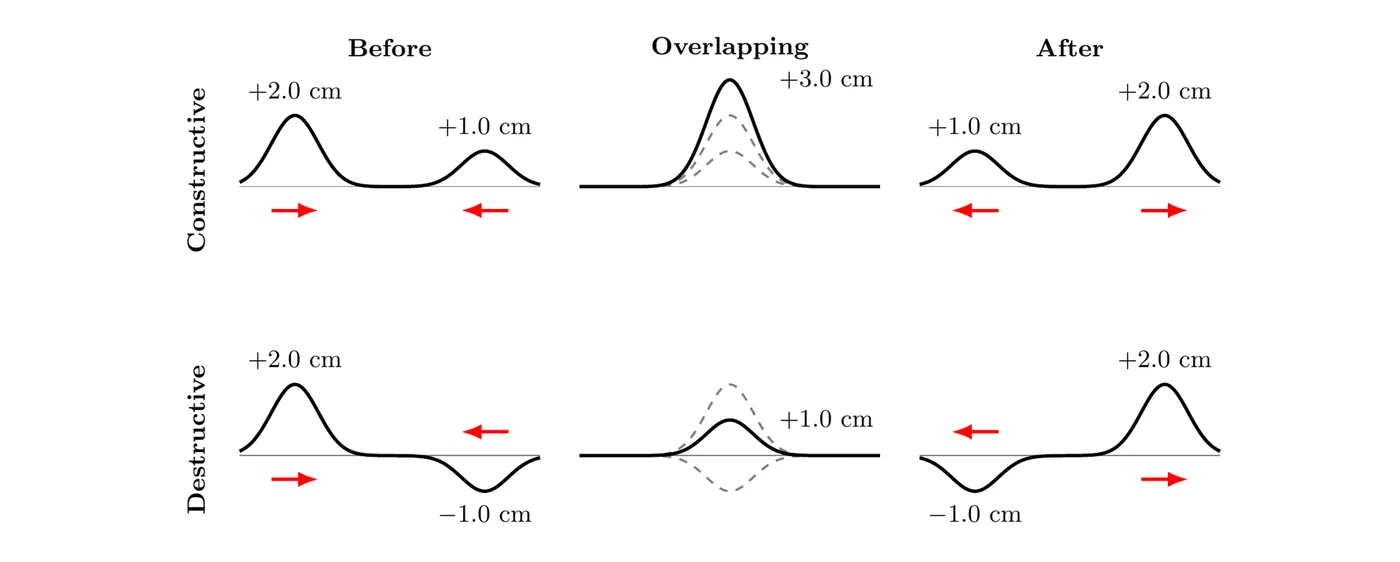
To find the shape at any instant, go point by point along the string and add the two displacements, keeping the signs. In the middle column, the dashed gray curves are the two pulses on their own and the thick curve is their sum.
Worked example. In the top row, a cm pulse moves right and a cm pulse moves left. When their peaks line up, the displacement there is cm (constructive). In the bottom row the second pulse is inverted ( cm), so at full overlap the displacement is cm (destructive). Either way, once they pass through each other, each pulse keeps going with its original shape and size.
Beats
Beats come from adding two waves of slightly different frequency.
How Beats Work
Waves with different frequencies are sometimes in phase and sometimes out of phase at points along the waves, which causes periodic amplitude changes in the combined wave:
- When the waves are in phase, you get constructive interference and a loud sound.
- When the waves are out of phase, you get destructive interference and a quiet sound.
- This alternates over and over, creating a “beating” pattern.
Beat Frequency
The beat frequency is the difference between the two waves’ frequencies.
where:
- = beat frequency (Hz)
- = frequency of the first wave (Hz)
- = frequency of the second wave (Hz)
Physically, this is the number of times per second the amplitude reaches a maximum (loud) and a minimum (quiet).
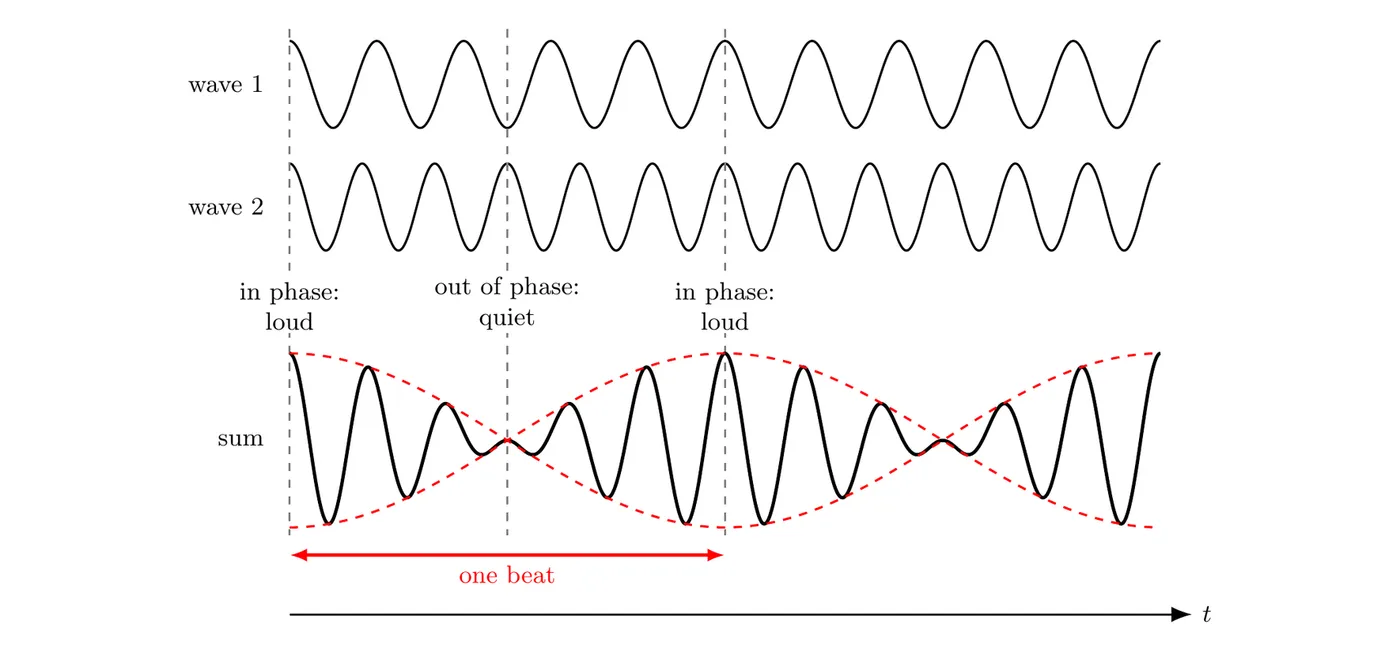
In the picture, wave 2 has a slightly higher frequency, so it slowly pulls ahead of wave 1. Where their peaks line up, they add up (loud). Half a beat later, a peak of one lines up with a trough of the other and they nearly cancel (quiet). One beat is the time from one loud moment to the next, and the number of beats each second is .
Tuning Forks
Tuning forks are a common way to demonstrate beat frequencies. When you strike two tuning forks with slightly different frequencies at once, you hear periodic changes in loudness, which are the beats. This is used for:
- Tuning musical instruments, since when the beat frequency drops to zero, the instruments are in tune.
- Detecting small frequency differences.
Worked example. A guitarist plays a string along with a 440 Hz tuning fork and hears 3 beats per second. What are the two possible frequencies of the string? She tightens the string a little and the beats slow down to 1 per second. Which one was it?
Tightening a string raises its wave speed (). The length and the wavelength stay the same, so the frequency goes up. Going up brought the string closer to 440 Hz (fewer beats), so it must have started below 440 Hz, at 437 Hz, and is now at 439 Hz. One more small turn puts it in tune, with no beats.
Standing Waves
Standing waves can form from interference between two waves that are confined to a region and traveling in opposite directions.
Standing waves look “stationary.” They don’t travel, they oscillate in place. A common way to get one is a wave interfering with its own reflection, which sets up a standing wave pattern.
Nodes and Antinodes
Standing waves have nodes and antinodes.
- A node is a point where the amplitude is always zero. The medium never moves there.
- An antinode is a point where the amplitude is always at its maximum. The medium oscillates with its biggest displacement there.
Nodes and antinodes alternate along the standing wave.
Boundary Conditions
The wavelengths a standing wave can have are set by the size and boundary conditions of the region it’s confined to. Only certain wavelengths, and therefore certain frequencies, can form standing waves in a given setup.
Common regions where standing waves form:
- Pipes with open or closed ends (sound waves).
- Strings with fixed or loose ends (transverse waves).
The boundary conditions are:
- A fixed end (on a string) or a closed end (on a pipe) must be a node.
- A free end (on a string) or an open end (on a pipe) must be an antinode.
Harmonics
The standing wave with the longest possible wavelength is the fundamental, also called the first harmonic:
- The second harmonic has the second-longest wavelength.
- The third harmonic has the third-longest wavelength.
- And so on.
Harmonic Patterns
For systems with a node at both ends (a string fixed at both ends):
- All harmonics are possible: 1st, 2nd, 3rd, 4th, and so on.
- The pattern fits half-wavelengths into the length .
For systems with a node at one end and an antinode at the other (a pipe closed at one end, open at the other):
- Only odd harmonics can form: 1st, 3rd, 5th, 7th, and so on.
- The even harmonics (2nd, 4th, 6th…) aren’t possible because of the boundary conditions.
Wavelength-Length Relationships
String fixed at both ends (or pipe open at both ends):
- 1st harmonic: , so
- 2nd harmonic: , so
- 3rd harmonic: , so
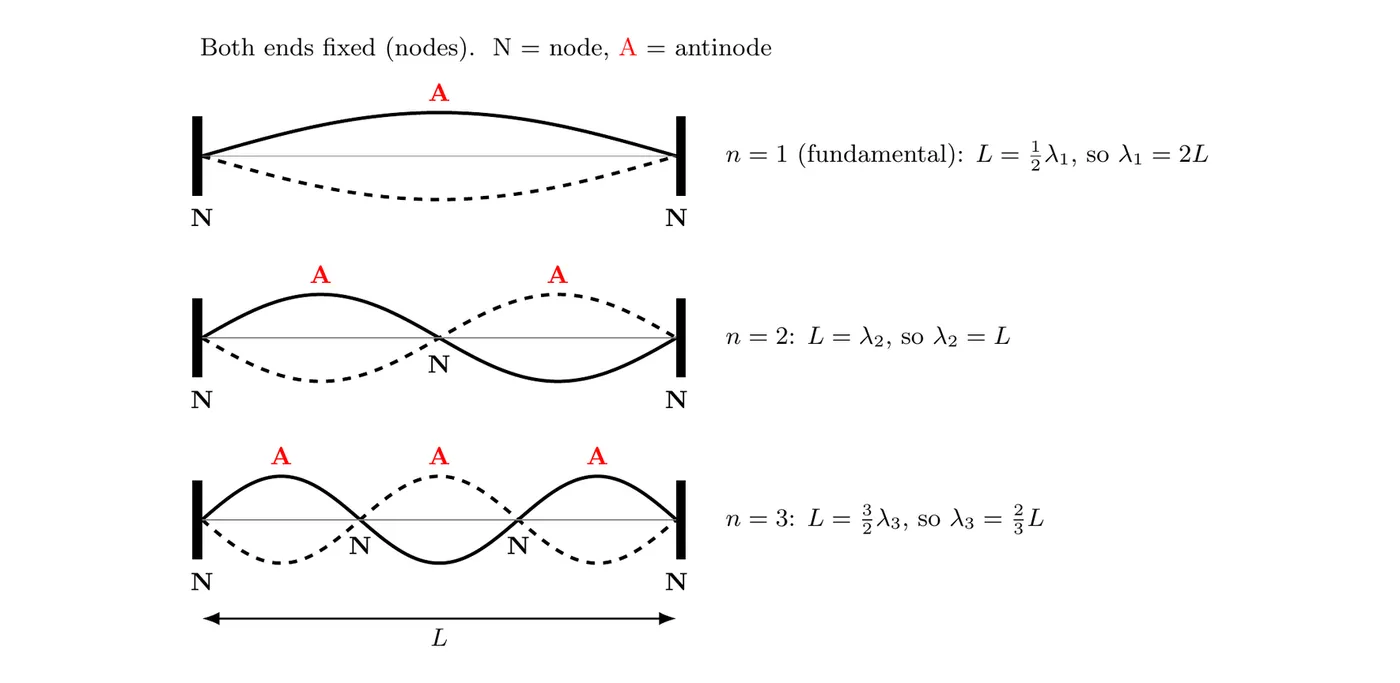
Each picture shows the string at its two farthest positions (solid and dashed). Count the loops: each loop is half a wavelength. The harmonic number for a string fixed at both ends equals the number of loops, which is also the number of antinodes.
Pipe closed at one end, open at the other:
- 1st harmonic: , so
- 3rd harmonic: , so
- 5th harmonic: , so
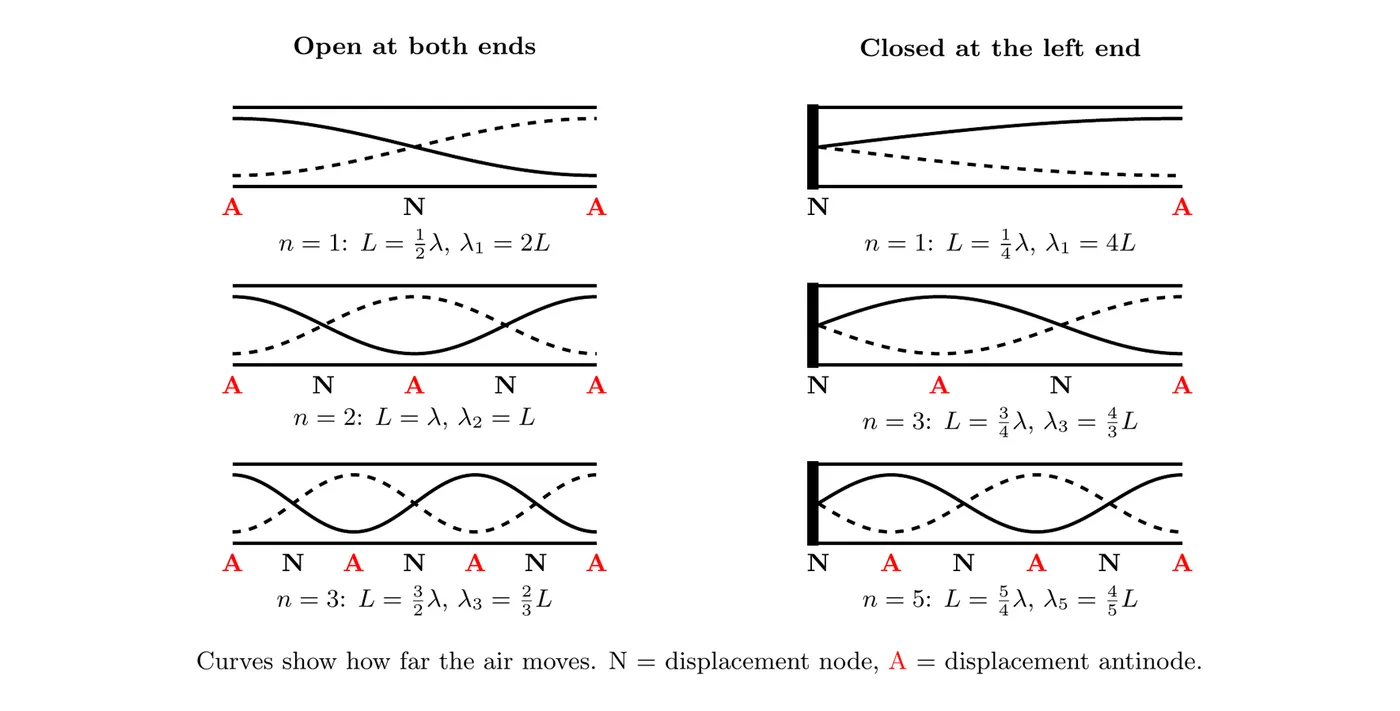
For sound in a pipe, the curves show how far the air molecules swing back and forth. At a closed end, the air runs into a wall and can’t move, so it’s a displacement node. At an open end, the air moves in and out freely, so it’s a displacement antinode. A pipe open at both ends matches a string fixed at both ends (both ends the same), so it has every harmonic. A pipe closed at one end fits only odd numbers of quarter wavelengths, so it has only odd harmonics. A string with one fixed end and one loose end (free to slide) works like the closed pipe: node at one end, antinode at the other, odd harmonics only.
Harmonic Frequencies
Once you have the wavelength, use (the equation sheet’s ). The wave speed is set by the medium (the string’s tension and mass per length, or the speed of sound in the air), so it’s the same for every harmonic. That makes every harmonic a whole-number multiple of the fundamental.
Both ends the same (string fixed at both ends, or pipe open at both ends):
Ends different (pipe closed at one end, or string with one loose end):
These two aren’t on the equation sheet. You can always rebuild them from a quick sketch: count how many half or quarter wavelengths fit in , solve for , then use .
Setup | Ends | Harmonics allowed | Longest wavelength |
String fixed at both ends | node, node | all (1, 2, 3, ...) | |
Pipe open at both ends | antinode, antinode | all (1, 2, 3, ...) | |
Pipe closed at one end | node, antinode | odd only (1, 3, 5, ...) | |
String with one loose end | node, antinode | odd only (1, 3, 5, ...) |
Visual Representations
Drawing standing wave patterns is a useful way to see the relationships between the length of the region, the wavelength, the frequency, the wave speed, and the harmonic. A sketch helps you identify:
- The number of nodes and antinodes.
- The wavelength.
- The harmonic number.
- How it relates to the length of the system.
Worked example. Two pipes are each 0.600 m long. Pipe A is open at both ends, and pipe B is closed at one end. The speed of sound is 343 m/s. Find the two lowest frequencies each pipe can play.
Pipe A (open, open): sketch it with antinodes at both ends. The fundamental is half a wavelength, so m, and the second harmonic is one full wavelength, so m.
Pipe B (closed, open): node at the closed end, antinode at the open end. Only odd harmonics exist, so the two lowest are and : m and m.
Closing one end cuts the fundamental in half (286 Hz to 143 Hz) and removes the even harmonics. Pipe B’s harmonics are odd multiples of its fundamental: .
Practice Problems
1. Two wave pulses with amplitudes 3 cm and 5 cm travel in opposite directions and meet. If both are upward pulses, what’s the maximum displacement when they overlap?
2. Two sound waves with frequencies 440 Hz and 445 Hz interfere. What beat frequency will you hear?
3. A guitar string fixed at both ends vibrates in its fundamental mode with a wavelength of 1.2 m. What is the length of the string?
4. Explain why you hear alternating loud and quiet sounds when two slightly different tuning forks are struck at the same time.
5. A standing wave on a 2.0 m string fixed at both ends has 3 antinodes. What harmonic is this, and what’s the wavelength?
6. A pipe is closed at one end and open at the other. Can it support a second harmonic standing wave? Explain.
7. Two identical wave pulses travel toward each other and meet, but one is inverted relative to the other. Describe what happens at the moment of maximum overlap.
8. A string is 0.60 m long and fixed at both ends. If the wave speed is 240 m/s, what is the frequency of the third harmonic?
Solutions
1.
Both pulses displace in the same direction (both upward), so this is constructive interference. The displacements add:
Answer: the maximum displacement is 8 cm upward.
2.
Use the beat frequency formula:
Answer: the beat frequency is 5 Hz. You’d hear the sound get louder and quieter 5 times per second.
3.
For a string fixed at both ends, the fundamental mode (1st harmonic) has:
Answer: the length of the string is 0.60 m, or 60 cm.
4. The two tuning forks put out sound waves at slightly different frequencies, and at any point in space those waves interfere.
When the waves are in phase (crests lining up with crests), you get constructive interference and a loud sound. When they’re out of phase (crests lining up with troughs), you get destructive interference and a quiet sound, or silence if the amplitudes match.
Because the frequencies differ, the waves keep drifting from in phase to out of phase and back. That creates a periodic change in loudness, which are the beats. The rate of that change is the beat frequency, equal to the difference in frequencies.
Answer: the waves alternate between constructive interference (loud) and destructive interference (quiet) because of their frequency difference, which creates periodic beats.
5. For a string fixed at both ends with 3 antinodes:
Counting nodes and antinodes:
- 3 antinodes means nodes at both ends plus 2 internal nodes, so 4 nodes total.
- The pattern is N-A-N-A-N-A-N (N = node, A = antinode).
- This is 3 half-wavelengths fitting into the length .
So this is the 3rd harmonic. The wavelength:
Answer: it’s the 3rd harmonic, with a wavelength of 1.33 m.
6. No, a pipe closed at one end and open at the other cannot support a second harmonic.
For this setup:
- The closed end has to be a node (a pressure antinode).
- The open end has to be an antinode (a pressure node).
That boundary condition only allows odd harmonics (1st, 3rd, 5th, and so on). The pattern has to fit an odd number of quarter-wavelengths into the pipe.
The second harmonic would need an even number of quarter-wavelengths, which would put either two nodes or two antinodes at the ends and break the boundary conditions.
Answer: no, only odd harmonics (1st, 3rd, 5th…) work for a pipe closed at one end. The second harmonic can’t exist in this setup.
7. At maximum overlap, the two pulses sit right on top of each other. Since one pulse is upward and the other is identical but inverted (downward), they create displacements in opposite directions.
This is destructive interference. If the amplitudes are equal, the displacements cancel completely:
Answer: the two pulses cancel each other out completely at maximum overlap, leaving zero displacement (a flat string). After passing through, each pulse continues on unchanged.
8.
For the third harmonic on a string fixed at both ends:
Use the wave speed equation:
Answer: the frequency of the third harmonic is 600 Hz.
Common Mistakes
- Thinking waves bounce off each other. Waves pass through each other during interference. They don’t collide like particles.
- Forgetting signs in superposition. When you add displacements, up is positive and down is negative. A +3 and a −5 give −2, not 8.
- Confusing constructive with loud. Constructive interference makes a bigger amplitude, but “loud” only applies to sound. Constructive interference can also happen with light (brighter) or water waves (higher).
- Getting the beat frequency formula wrong. The beat frequency is the difference, not the sum: . The absolute value keeps it positive.
- Counting harmonics wrong. The harmonic number equals the number of antinodes (for a string fixed at both ends) or the number of half-wavelengths in the length.
- Forgetting the odd-harmonics-only rule. A pipe or string with one closed or fixed end and one open or free end supports only odd harmonics.
- Mixing up nodes and antinodes. Nodes have zero displacement (no motion), while antinodes have maximum displacement (maximum motion).
- Getting the wavelength-length relationship wrong. For both ends fixed, . For one end closed, with odd.
- Thinking standing waves travel. Standing waves oscillate in place. They don’t propagate, and the pattern stays put.
- Confusing an interference pattern with a standing wave. Interference is the general phenomenon, while a standing wave is a specific result of interference between oppositely traveling waves in a confined region.
- Getting the boundary conditions wrong. Fixed and closed ends must be nodes. Free and open ends must be antinodes.
- Forgetting that waves continue after interfering. After overlapping, the waves come out unchanged and keep traveling as if nothing happened.
- Assuming beats only happen with sound. Beats can happen with any type of wave when two similar frequencies interfere, including light and water waves.
- Not using the absolute value in the beat frequency. The formula uses an absolute value because frequency is always positive: , not just .
- Thinking every point on a standing wave moves in phase. Points between two nodes move in phase with each other, but points on opposite sides of a node move 180° out of phase.
- Confusing harmonic number with number of nodes. For a string fixed at both ends, the harmonic number equals the number of antinodes, which is the number of nodes minus 1.