

6.4 - Electromagnetic Waves
The Structure of EM Waves
Electromagnetic waves are made of oscillating electric and magnetic fields that are mutually perpendicular. The electric field () and the magnetic field () oscillate at right angles to each other as the wave travels.
They’re Transverse
Electromagnetic waves are transverse because the electric and magnetic field oscillations are perpendicular to the direction of propagation:
- The electric field oscillates in one transverse direction.
- The magnetic field oscillates in another transverse direction, perpendicular to the electric field.
- Both are perpendicular to the direction the wave travels.
- This makes a self-sustaining wave that can move through a vacuum.
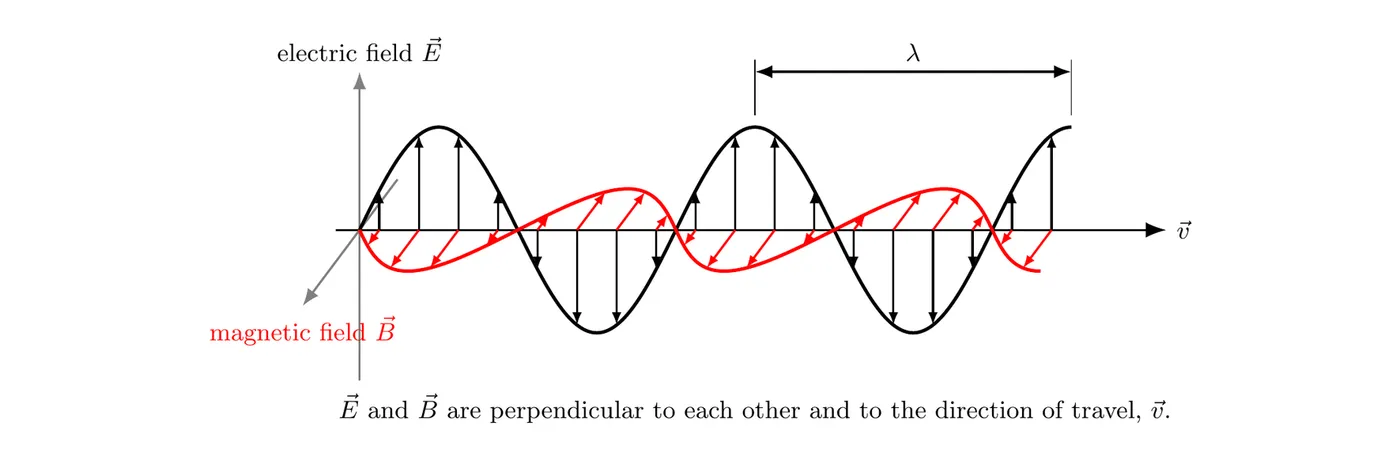
In the picture, the wave moves to the right. The electric field (black) points up and down, the magnetic field (red) points into and out of the page, and the two rise and fall together. All three directions are perpendicular to each other, which is what makes the wave transverse. The wavelength is the distance between neighboring peaks of either field.
Plane Waves
Electromagnetic waves are often assumed to be plane waves, which have planar wavefronts. A plane wave has flat wavefronts (surfaces of constant phase) perpendicular to the direction of propagation. It’s an idealization that’s handy for analysis. Real waves from a localized source are spherical, but from far away they look approximately like plane waves.
They Don’t Need a Medium
Electromagnetic waves don’t need a medium to travel through.
Unlike mechanical waves (sound, water waves, waves on strings), EM waves can travel through:
- A vacuum (empty space).
- Air.
- Glass, water, and other transparent materials.
This is why we can see light from the sun and the stars. It reaches us through the vacuum of space.
The Electromagnetic Spectrum
The categories of electromagnetic waves are defined by their wavelengths. All EM waves travel at the speed of light ( m/s) in a vacuum, but they differ in wavelength and frequency.
In order of decreasing wavelength (which is increasing frequency and energy):
1. Radio waves: kilometers to meters
2. Microwaves: meters to millimeters
3. Infrared (IR): millimeters to about 700 nm
4. Visible light: about 700 nm to about 400 nm
5. Ultraviolet (UV): about 400 nm to about 10 nm
6. X-rays: about 10 nm to about 0.01 nm
7. Gamma rays: below 0.01 nm (picometers)
So the wavelength range runs from kilometers (radio) down to picometers (gamma rays).
A mnemonic for the order: “Rabbits Mate In Very Unusual eXpensive Gardens.”
The Visible Light Spectrum
Visible electromagnetic waves break down further into colors.
In order of decreasing wavelength (increasing frequency):
1. Red: the longest visible wavelength (about 700 nm)
2. Orange: about 620 nm
3. Yellow: about 580 nm
4. Green: about 550 nm
5. Blue: about 470 nm
6. Violet: the shortest visible wavelength (about 400 nm)
A mnemonic for the colors: “Roy G. Biv” (Red, Orange, Yellow, Green, Blue, Indigo, Violet).
A Note on the Word “Light”
Visible electromagnetic waves are also just called light. Sometimes, though, electromagnetic waves of all wavelengths get lumped together as “light” or “electromagnetic radiation,” so context decides the meaning:
- “Light” often means visible light (400 to 700 nm).
- “Light” can also mean any electromagnetic radiation, from radio to gamma.
Key Relationships
Since all EM waves travel at speed in a vacuum:
where:
- m/s, constant for all EM waves in a vacuum
- = frequency (Hz)
- = wavelength (m)
What follows from this:
- Longer wavelength means lower frequency (radio waves).
- Shorter wavelength means higher frequency (gamma rays).
- Higher frequency means higher energy ().
Practice Problems
1. A radio station broadcasts at 95.5 MHz. What is the wavelength of this radio wave?
2. Green light has a wavelength of 550 nm. What is its frequency?
3. Put these in order of increasing frequency: infrared, visible light, X-rays, radio waves, ultraviolet.
4. Which has more energy per photon, red light or blue light? Explain.
5. Explain why astronauts on the moon can see Earth and the stars but can’t hear sounds from the outside of their spacecraft.
6. An electromagnetic wave has a wavelength of 1.0 cm. What region of the spectrum is it in?
7. If the wavelength of light increases, what happens to its frequency and energy?
8. Why are electromagnetic waves classified as transverse?
Solutions
1. Convert the frequency: MHz Hz Hz.
Use :
Answer: the wavelength is 3.14 m, in the radio range.
2. Convert the wavelength: nm m m.
Use :
Answer: the frequency is Hz (545 trillion Hz).
3. Frequency is inversely related to wavelength. From longest wavelength to shortest, the order is:
Radio waves → infrared → visible light → ultraviolet → X-rays.
So in order of increasing frequency: radio waves, infrared, visible light, ultraviolet, X-rays.
4. Blue light has more energy per photon.
Blue light has a shorter wavelength than red light, which means a higher frequency (from , a shorter means a bigger ).
The energy per photon is , where is Planck’s constant, so a higher frequency means higher energy.
In order of energy across the visible spectrum: red < orange < yellow < green < blue < violet.
Answer: blue light has more energy per photon than red light because it has a higher frequency.
5. Light is an electromagnetic wave, and it doesn’t need a medium to travel, so it can move through the vacuum of space. That’s why astronauts can see Earth, the stars, and the sun. The light reaches them through space.
Sound is a mechanical wave (a longitudinal pressure wave) that does need a medium. In the vacuum of space around the moon, there’s no air or other medium to carry sound, so astronauts can’t hear anything from outside their spacecraft or suits.
Answer: light (electromagnetic) travels through a vacuum, so they can see. Sound (mechanical) needs a medium, so it can’t travel through the vacuum of space.
6. A wavelength of 1.0 cm m m sits in the centimeter-to-millimeter range.
Checking the spectrum:
- Radio waves: km to m.
- Microwaves: m to mm, which includes the cm range.
- Infrared: mm to about 700 nm.
Answer: this wave is in the microwave region.
7. Using with constant, if the wavelength increases ( up):
- The frequency decreases ( down), because makes them inversely related.
- The energy decreases, because makes energy proportional to frequency.
The chain: higher wavelength → lower frequency → lower energy. That’s like moving from blue light toward red light.
Answer: the frequency decreases and the energy decreases.
8. Electromagnetic waves are transverse because their oscillations (of the electric and magnetic fields) are perpendicular to the direction the wave travels.
The electric field oscillates in one direction perpendicular to propagation, the magnetic field oscillates in another perpendicular direction (also perpendicular to the electric field), and the wave propagates in a third direction perpendicular to both. Oscillation perpendicular to propagation is exactly what defines a transverse wave.
Answer: the electric and magnetic field oscillations are perpendicular to the direction of propagation, which is the definition of a transverse wave.
Common Mistakes
- Thinking EM waves need a medium. They don’t. They can travel through a vacuum, unlike sound or water waves.
- Getting the wavelength-frequency order backwards. Longer wavelength means lower frequency, not higher. They’re inversely related through .
- Thinking all “light” is visible. Context matters. “Light” can mean visible light specifically (400 to 700 nm) or all electromagnetic radiation in general.
- Forgetting that energy rises with frequency. Higher frequency means higher energy. Gamma rays are the most energetic and radio waves the least.
- Mixing up the visible spectrum order. ROY G. BIV runs from the longest wavelength (red) to the shortest (violet). Red has the lowest frequency and energy, and violet the highest.
- Assuming different EM waves travel at different speeds in a vacuum. All EM waves travel at exactly m/s in a vacuum, no matter the wavelength.
- Confusing speed in a vacuum with speed in a material. All EM waves travel at in a vacuum, but they travel at different speeds in materials. Light slows down in glass, for instance, which causes refraction.
- Using the wrong wavelength units. Be careful: visible light is often in nm, radio waves in m or km, and X-rays in nm or pm. Convert to meters for calculations.
- Thinking EM waves are longitudinal. They’re transverse, with the electric and magnetic fields oscillating perpendicular to the direction of propagation.
- Not realizing the E and B fields are perpendicular to each other. In an EM wave, the electric and magnetic fields are perpendicular to each other and both perpendicular to the direction of propagation.
- Overthinking the boundary values. You need to know the order of the spectrum, but not the exact wavelength cutoffs between categories.
- Assuming visible light is most of the spectrum. Visible light is actually a tiny slice, roughly 400 to 700 nm, out of a range that runs from kilometers to picometers, many orders of magnitude.
- Confusing color names with wavelength. Within visible light, red is the longest wavelength (lowest energy) and violet is the shortest (highest energy in the visible range).
- Thinking microwaves and radio waves are fundamentally different. They’re both electromagnetic waves, just at different wavelengths. The categories are somewhat arbitrary slices of a continuous spectrum.
- Not using scientific notation. EM wavelengths span huge ranges, so use scientific notation: radio (about 10³ m), visible (about 10⁻⁷ m), gamma (about 10⁻¹² m).