

6.9 - Thin-Film Interference
Light at Boundaries
When light crosses from one medium into another, some of it gets transmitted, some gets reflected, and some gets absorbed.
At any boundary between two media:
- Reflection: some light bounces back into the original medium.
- Transmission: some light passes into the new medium (and may refract).
- Absorption: some energy gets soaked up by the material and turned into heat.
How much goes each way depends on the materials, the angle of incidence, and the wavelength.
Phase Change Upon Reflection
The phase change of a reflected ray depends on the relative indices of refraction of the materials the ray runs into.
Reflecting off a Higher Index
You get a phase change of 180 degrees (the same as radians, or half a wavelength) when a ray reflects off a medium with a higher index of refraction than the one it’s traveling in.
Example: light in air () reflecting off glass () gets a 180° phase shift.
Analogy: it’s like a wave pulse on a light string bouncing off a heavy string, where the pulse flips over.
Reflecting off a Lower Index
You get no phase change when a ray reflects off a medium with a lower index of refraction than the one it’s traveling in.
Example: light in glass () reflecting off air () gets no phase shift.
Analogy: it’s like a wave pulse on a heavy string bouncing off a light string, where the pulse keeps its orientation.
Phase Change Upon Refraction
The phase of a wave doesn’t change when it gets refracted on its way from one medium into another.
- Reflection can cause a phase change (depending on the indices).
- Refraction never causes a phase change.
- The wavelength and speed do change during refraction, but the phase stays continuous across the boundary.
Thin-Film Interference
Thin-film interference happens when light interacts with a medium whose thickness is close to the light’s wavelength.
Typical thin films are a few hundred nanometers thick, which is right in the range of visible light wavelengths (400 to 700 nm).
How It Works
The light reflected off the top surface interferes with the light that goes into the film, reflects off the bottom surface, and comes back out, and the two combine into a single wave that’s their sum.
Step by step:
1. Light hits the top surface of the film.
2. Some of it reflects off the top surface (Ray 1).
3. Some enters the film, travels through it, reflects off the bottom surface, and exits (Ray 2).
4. Rays 1 and 2 interfere, either constructively or destructively.
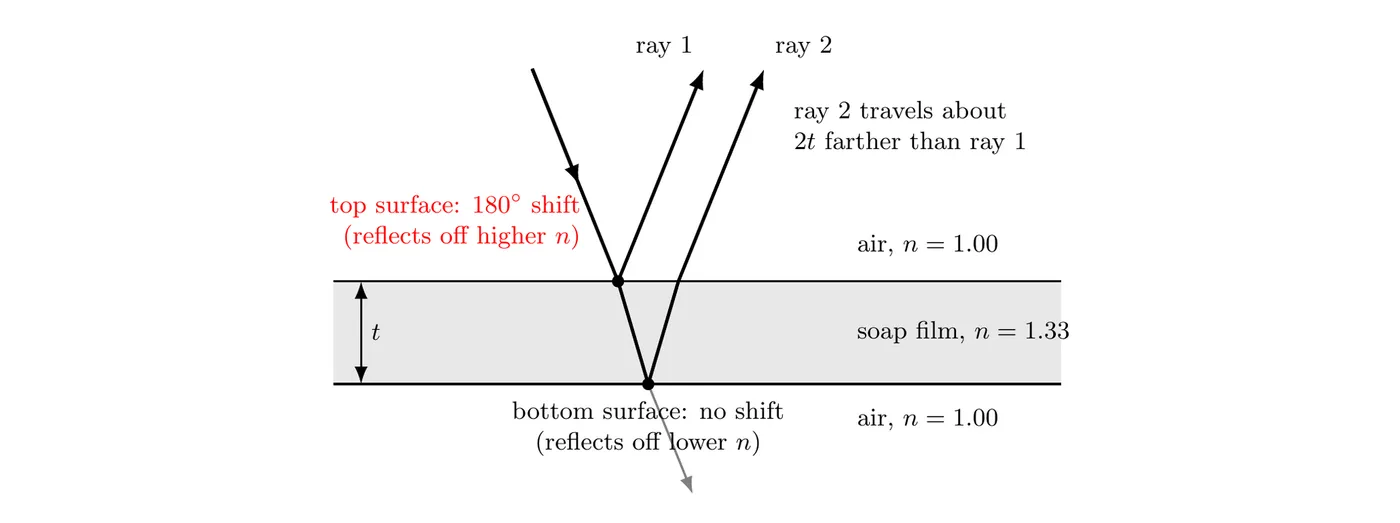
The picture shows a soap film in air. The angle is exaggerated so you can see both rays; in AP problems the light hits the film straight on, so ray 2 travels an extra (down through the film and back up). Ray 1 flips (180°) when it reflects off the film, because the film has a higher index than air. Ray 2 reflects off the air below the film, which has a lower index, so it doesn’t flip. That’s one phase shift in total.
Interference Conditions
How much constructive or destructive interference you get between the two reflected waves depends on:
- The thickness of the film ().
- The wavelength of the light ().
- Any phase shifts from reflection.
- The angle the incident light hits the film at.
For AP Physics 2: quantitative work is limited to normal incidence (light hitting perpendicular to the surface).
Path Difference
Light going through the film covers an extra distance:
(down through the film and back up).
The wavelength inside the film is:
Optical Path Length
where is the refractive index of the film and is its thickness.
Constructive and Destructive Interference
Deal with the phase shifts first.
Count how many 180° phase shifts (0, 1, or 2) come from the reflections at the top and bottom surfaces:
- 0 or 2 phase shifts: the waves start out in phase.
- 1 phase shift: the waves start out 180° out of phase.
Case 1: No Phase Shift or Two Phase Shifts (Waves Start In Phase)
Constructive interference (bright):
Destructive interference (dark):
Case 2: One Phase Shift (Waves Start 180° Out of Phase)
Constructive interference (bright):
Destructive interference (dark):
Note: one phase shift flips the conditions for constructive and destructive interference.
In these conditions, is the wavelength of the light in air (or vacuum). The in already takes care of the shorter wavelength inside the film: the extra trip of holds film wavelengths.
Real-World Examples
Soap Bubbles and Oil Films
The spectrum of colors you see in oil films and soap bubbles comes from differences in the film’s thickness.
- Different thicknesses cause constructive interference for different wavelengths.
- As the thickness changes across the film, different colors show up in different spots.
- White light has all the colors, and the interference picks out which ones get boosted or knocked out.
- Thin regions might cancel one color while thick regions cancel another.
What you notice: swirling rainbow patterns on soap bubbles or on oil sitting on water.
Antireflection Coatings
Antireflection coatings get rid of reflected light by using the relationships between the indices of refraction, the phase shifts, and wave interference to set up destructive interference between the light reflecting off the two surfaces of the coating.
The point: cut down glare and let more light through lenses (cameras, eyeglasses, and the like).
Quarter-Wave Coating
The simplest antireflection coating has:
- A thickness equal to a quarter of the wavelength of the light inside the coating.
- An index of refraction that’s higher than air but lower than the surface it’s coating.
- The assumption that the incident light hits perpendicular to the surface.
Layout: air () then coating () then glass (), where .
Thickness condition:
Why it works:
1. Light reflecting off the air-coating boundary gets a 180° phase shift (going to a higher ).
2. Light travels through the coating ( down, back up, for total optical path).
3. Light reflecting off the coating-glass boundary gets another 180° phase shift (going to a higher ).
4. Adding it up: path difference plus 180° plus 180° equals plus 360°, which comes out to out of phase.
5. The upshot: destructive interference, so no reflected light.
Practice Problems
1. Light traveling through air reflects off a glass surface (). Does the reflected light get a phase change?
2. A soap film () in air looks bright at normal incidence for a certain wavelength. The film is 225 nm thick. What’s the longest wavelength that interferes constructively?
3. An oil film () floating on water () is 400 nm thick. At normal incidence, which visible wavelength(s) (400 to 700 nm) get strongly reflected?
4. Explain why soap bubbles show different colors in different spots.
5. An antireflection coating for glass () is designed for 550 nm light. If the coating’s index of refraction is 1.25, what’s the minimum thickness it needs?
6. Light in glass () reflects off the glass-air boundary. Is there a phase change on reflection?
7. Why does an antireflection coating need an index of refraction between that of air and glass?
Solutions
1. Light goes from air () to glass ().
Since the reflecting medium (glass) has a higher index than the incident medium (air):
Answer: yes, the reflected light gets a 180° phase change.
2. For a soap film in air:
- Top surface: air to soap ( goes up), so a 180° phase shift on reflection.
- Bottom surface: soap to air ( goes down), so no phase shift on reflection.
- Total: one phase shift.
With one phase shift, constructive interference happens when:
Solve for the wavelength:
For the longest wavelength, use :
Answer: the longest wavelength is 1197 nm, which is in the infrared, not visible.
For visible light, try :
That one sits right at the violet edge of what we can see.
3. For oil on water:
- Top surface: air to oil ( goes up, ), so a 180° phase shift.
- Bottom surface: oil to water ( goes down, ), so no phase shift.
- Total: one phase shift.
With one phase shift, you get constructive interference (bright reflection) when:
Try a few values of :
- : nm (infrared, not visible).
- : nm (infrared, just barely not visible).
- : nm (blue, visible).
- : nm (UV, not visible).
Answer: blue light around 464 nm gets strongly reflected.
4. Soap films vary in thickness across their surface because of:
- Gravity pulling the soap down.
- Surface tension.
- Air currents.
- Evaporation.
At each thickness , the condition is satisfied by a different wavelength.
Thinner regions boost shorter wavelengths (blue, violet). Thicker regions boost longer wavelengths (red, orange). The in-between thicknesses boost green and yellow.
As you scan across the bubble, the thickness changes from spot to spot, so different colors interfere constructively at different positions, which is what gives you those rainbow swirls.
Answer: the varying thickness across the film makes different wavelengths (colors) interfere constructively at different spots, which creates the spread of colors.
5. For a quarter-wave coating at normal incidence:
Answer: the minimum thickness is 110 nm.
Check: with , both reflections get 180° phase shifts. The quarter-wave thickness tacks on another of path difference (going down and up), which works out to total and gives destructive interference, since the two 180° shifts cancel each other out.
6. Light goes from glass () to air ().
Since the reflecting medium (air) has a lower index than the incident medium (glass):
Answer: no, there’s no phase change when light in glass reflects off air.
7. For an antireflection coating stacked air then coating then glass, you want both boundaries to give 180° phase shifts:
- Air-coating boundary: you need .
- Coating-glass boundary: you need .
Together that means: .
If , the second reflection wouldn’t get a phase shift and the coating wouldn’t work the way it’s supposed to.
If (which is basically impossible, since air at about 1 is nearly the minimum), the first reflection wouldn’t get a phase shift.
With both phase shifts in play, the quarter-wave thickness supplies the extra of path difference you need for destructive interference.
Answer: the coating’s index has to sit between air and glass so both reflections get 180° phase shifts, which combined with the quarter-wave path difference sets up destructive interference.
Common Mistakes
- Forgetting the phase shifts. Always check each reflection. Low to high gives a 180° shift. High to low gives no shift.
- Miscounting the phase shifts. Count the reflections at both surfaces separately. The total can be 0, 1, or 2 phase shifts.
- Using the wrong wavelength. Use for path calculations, or work with the optical path length .
- Flipping constructive and destructive. One phase shift swaps the conditions. Check your situation carefully.
- Dropping the factor of 2. The light goes down and back up through the film, so the path difference is , not .
- Wrong coating thickness. A quarter-wave coating is in the coating material, not in air: .
- Assuming every thin film is sitting in air. Check what’s on both sides. Oil on water behaves differently than oil in air.
- Not using the optical path length. The effective path difference is (which accounts for light moving slower in the medium), not just .
- Thinking refraction causes a phase change. Only reflection can give you a 180° phase shift. Refraction doesn’t change the phase.
- Mixing up which surface gets the phase shift. Check each surface on its own, comparing the on the incident side to the on the reflecting side.
- Forgetting the minimum thickness. For you get the smallest thickness that satisfies the condition. Higher gives thicker films.
- Comparing the wrong indices. A phase shift happens when you reflect off a higher index, not when you travel into a higher index.
- Assuming a coating cancels reflection at every wavelength. Antireflection coatings are tuned for specific wavelengths. At other wavelengths the cancellation is only partial, so some light still reflects.
- Ignoring multiple reflections. This analysis only looks at the first-order reflections (the two rays). Higher-order reflections exist, but they’re much weaker.
- Units. Convert nm to m for calculations. Indices of refraction have no units.
- Thinking bubbles are always colorful. A very thin film (getting close to zero thickness) reflects no light, since both rays cancel. A very thick film (many wavelengths) shows no clear colors, since many orders interfere at once. The colors show up at the in-between thicknesses.