

2.6 - Market Equilibrium and Consumer and Producer Surplus
This defines market equilibrium and how prices adjust to clear the market, tells apart consumer surplus (benefit to buyers) from producer surplus (benefit to sellers), covers economic surplus and allocative efficiency, and explains deadweight loss.
Market equilibrium
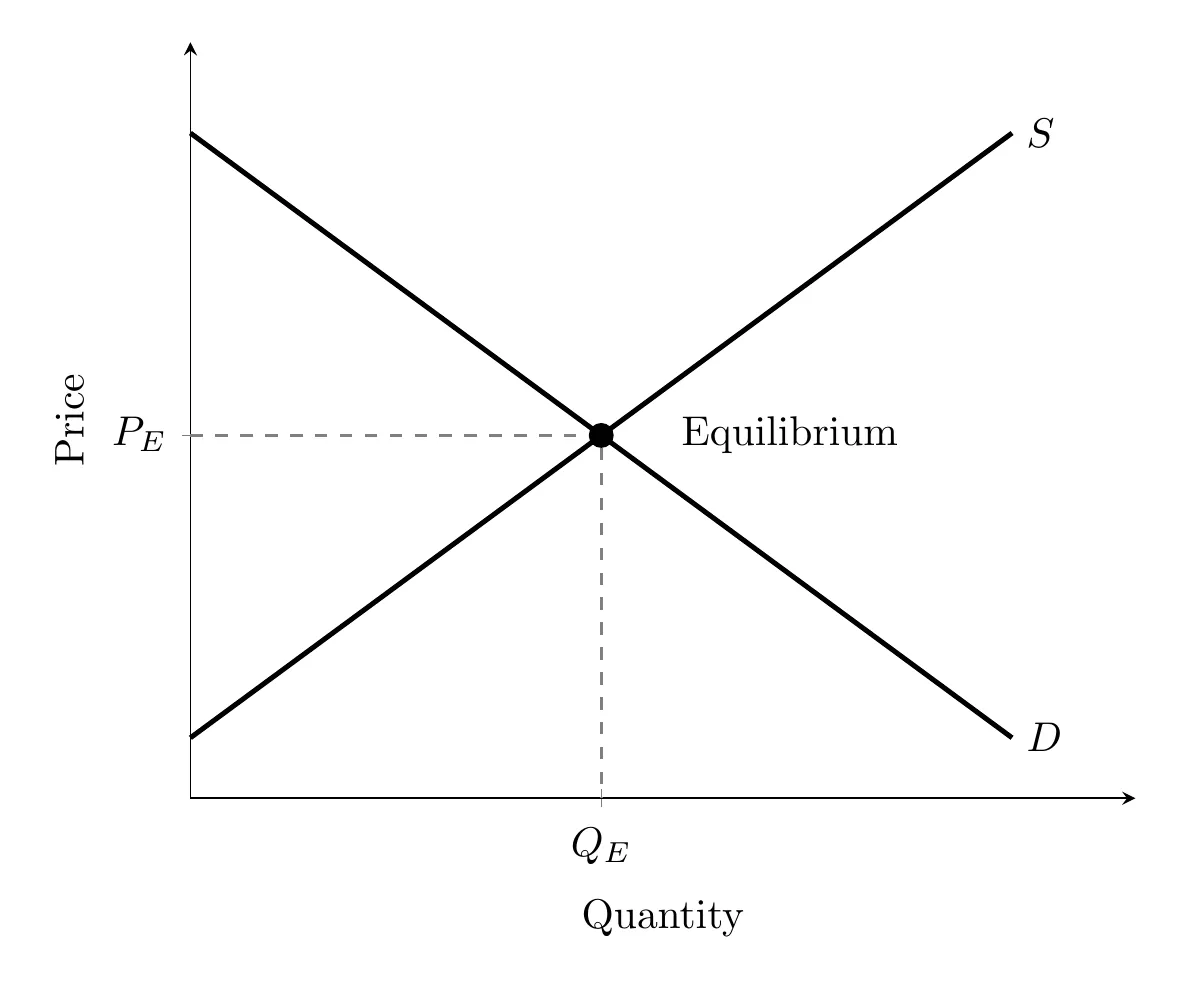
Equilibrium happens where the quantity consumers want to buy exactly equals the quantity producers want to sell, which is right where the supply and demand curves cross. Equilibrium price () is on the y-axis, equilibrium quantity () is on the x-axis.
If price sits above equilibrium, you get a surplus and prices fall naturally. If it sits below, you get a shortage and prices rise.
Prices as signals
At equilibrium the market clears: there’s no shortage and no surplus. The equilibrium price also carries information that guides where resources go. If more people start wanting avocados, the price rises. That tells farmers to plant more avocado trees (pulling land, labor, and capital toward avocados) and tells buyers to use them more carefully. A falling price sends the opposite signal and moves resources toward things people value more.
That’s why the supply and demand model is so useful. It shows which factors set prices and quantities, why the same good can cost different amounts in different markets (a house in San Francisco vs. one in rural Ohio), and why prices change over time.
Consumer surplus
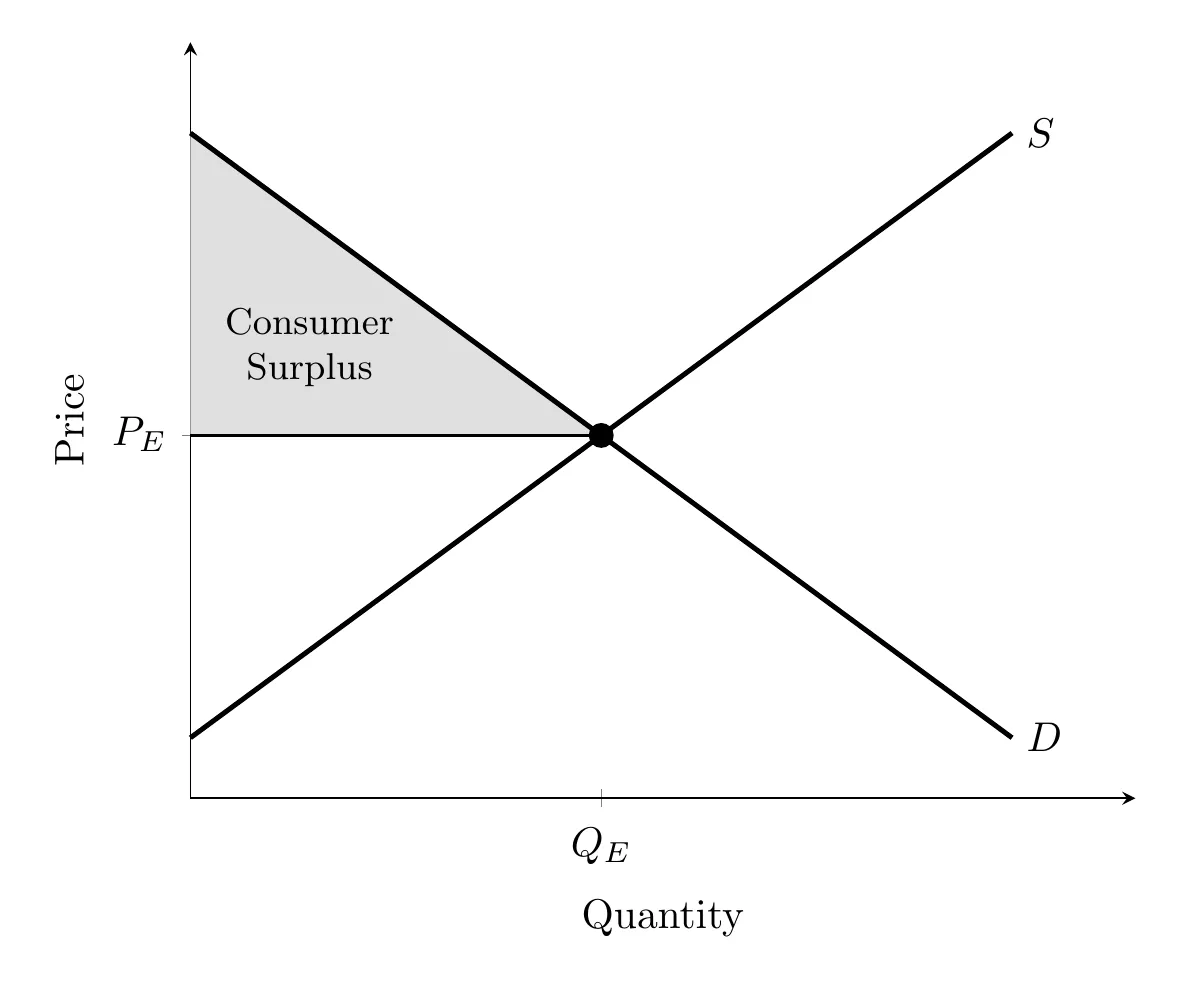
This is the gap between what a consumer is willing to pay and what they actually pay. The demand curve represents marginal utility, the benefit consumers get from each unit, and a rational consumer keeps buying as long as marginal benefit is at least equal to price.
Example: if someone values headphones at $300 but only pays $200, that’s $100 in consumer surplus. Graphically, it’s the triangular area below the demand curve and above market price.
Producer surplus
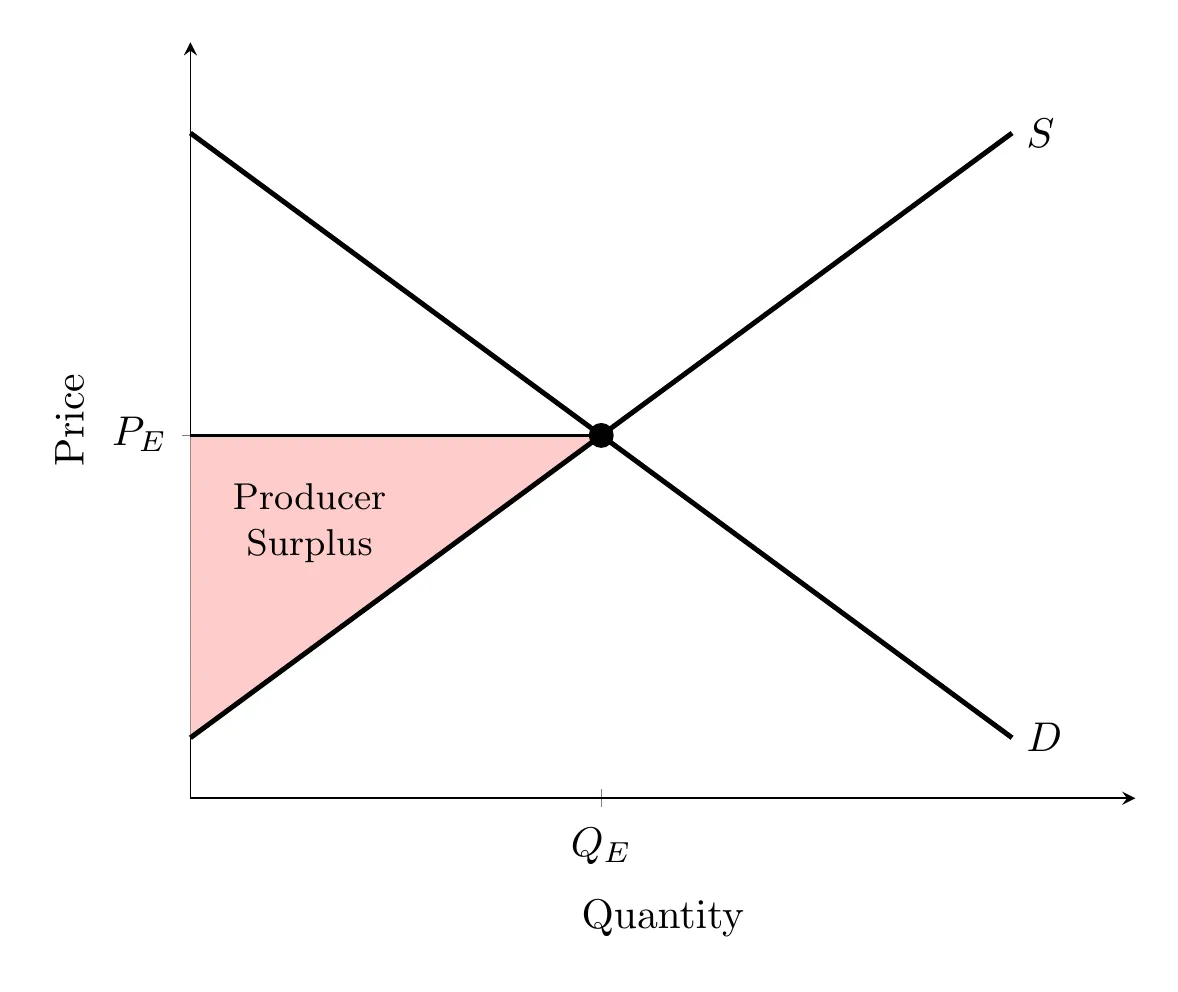
This is the gap between market price and marginal cost of production. The supply curve represents marginal cost for each unit. If a manufacturer makes a skateboard for $50 and sells it for $80, that’s $30 in producer surplus. Graphically, it’s the triangle above the supply curve and below market price.
Economic surplus and allocative efficiency
Economic (total) surplus is consumer surplus plus producer surplus, representing the total benefit to everyone involved. Allocative efficiency happens where marginal benefit equals marginal cost (), and economic surplus is maximized right at equilibrium.
This is why economists say perfectly competitive markets are efficient. As long as there are no market failures (like pollution or public goods, covered in Unit 6), the market produces exactly where , so total surplus is as large as it can be. Every unit worth more to buyers than it costs to make gets made, and no unit that costs more than it’s worth does.
Deadweight loss
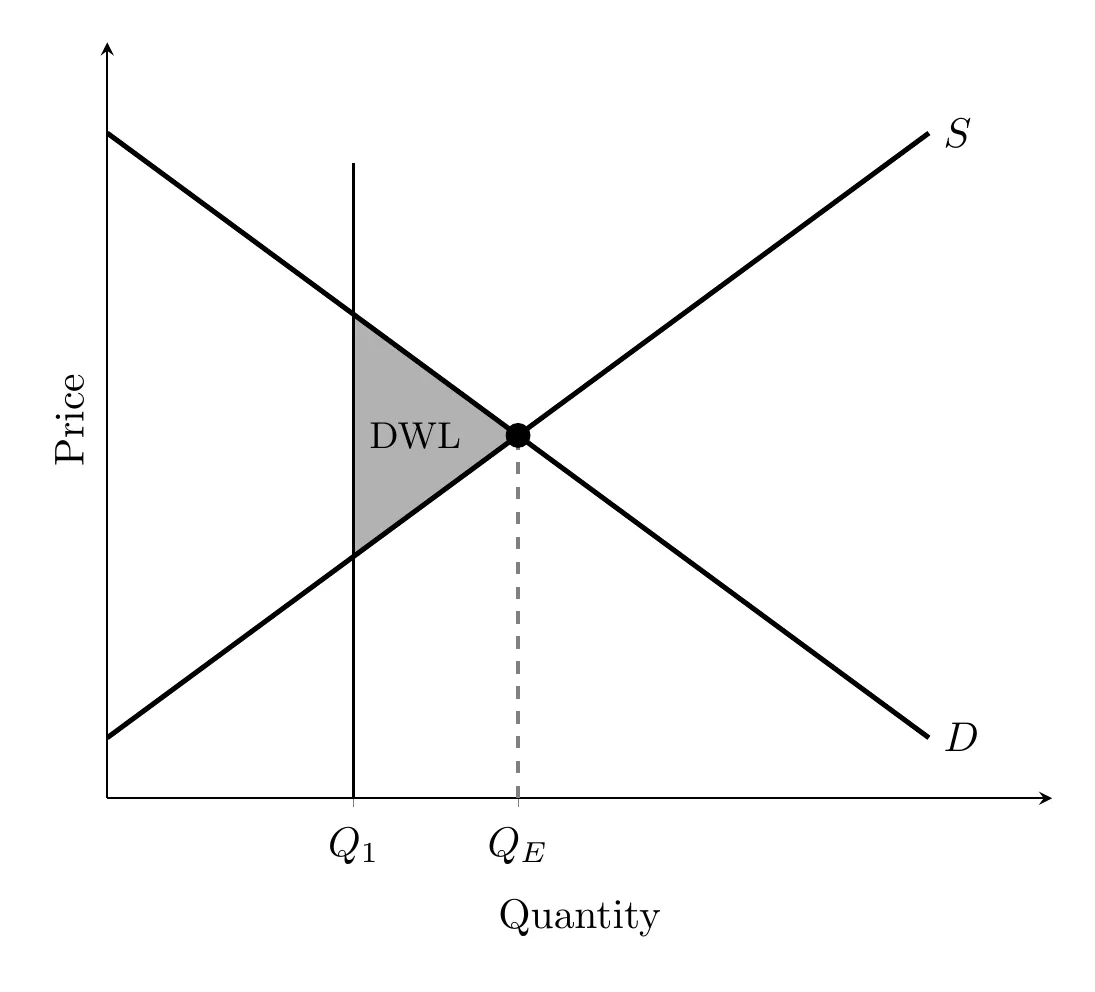
This is the surplus lost when the market isn’t producing at the allocatively efficient quantity:
- Price above equilibrium: fewer units get bought, losing potential surplus.
- Price below equilibrium: producers won’t supply enough, creating shortage and lost surplus.
- Overproduction: extra units cost more (marginal cost) than they’re worth to consumers (marginal benefit).
The deadweight loss triangle forms between the marginal cost of the actual quantity, the marginal benefit of that quantity, and the equilibrium point.
Calculating surplus and loss
Use the triangle area formula:
Base is the quantity exchanged, and height is the vertical distance between price and the relevant curve.
Example: in the market below, the demand curve starts at $12 on the price axis, the supply curve starts at $3, and they cross at a price of $6 and a quantity of 6.
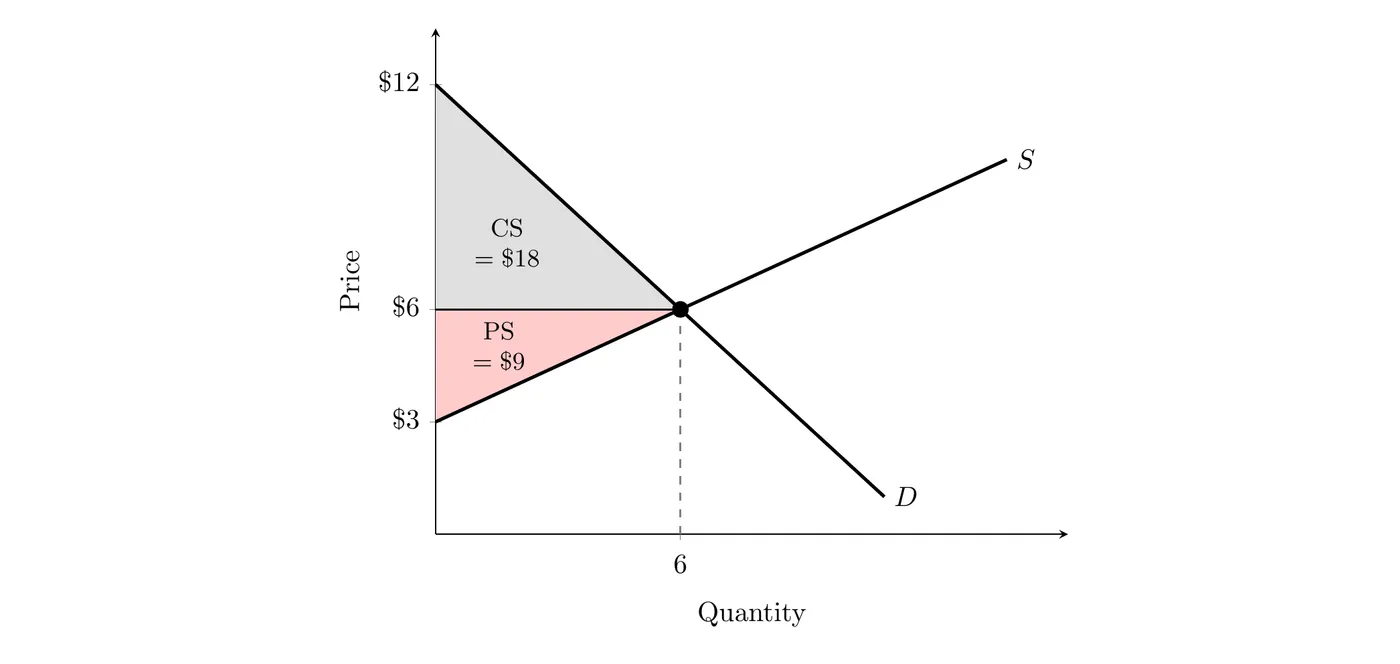
- Consumer surplus: base 6, height $12 - $6 = $6, so , or $18.
- Producer surplus: base 6, height $6 - $3 = $3, so , or $9.
- Total surplus: $18 + $9 = $27, the most this market can create.
Takeaway
Economic surplus is the “social profit” a healthy market generates, the shared happiness and gain between buyers and sellers. At equilibrium, it’s like a perfectly tuned engine where every beneficial trade happens, maximizing the surplus triangles. When prices get forced too high or too low, the engine stalls and deadweight loss appears, a benefit that could’ve existed but got lost to inefficiency.