

2.8 - The Effects of Government Intervention in Markets
This covers government controls, price floors, ceilings, taxes, subsidies, and quantity controls, and how they impact competitive markets. We also look at binding vs. non-binding constraints and tax incidence based on relative elasticity.
Quantity controls (quotas)
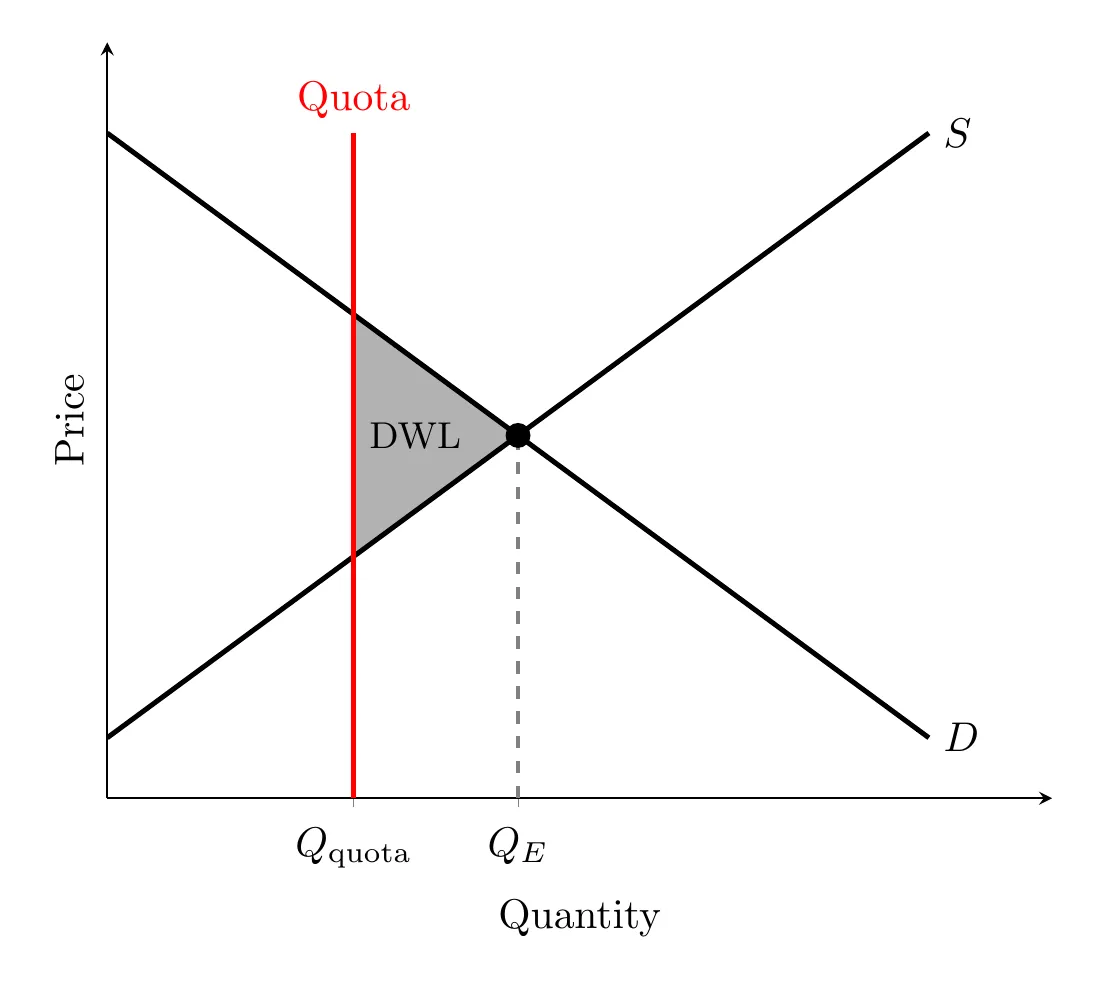
A quota is a legal limit on how much of a good can be produced or sold. Like a price control, it only matters (it’s binding) when it’s set below the equilibrium quantity.
- Underproduction: setting the limit below natural equilibrium causes a deadweight loss triangle.
- Buyers compete for the limited units, so the price rises to what buyers will pay for the quota amount (read it off the demand curve at the quota). Consumer surplus falls, and the units between the quota and equilibrium, which were worth more to buyers than they cost to make, never get made.
- Overproduction: if the government instead requires firms to make more than the equilibrium quantity (a production mandate, not a quota), that also creates deadweight loss, since consumers value those extra units less than what it costs to make them. A quota set above equilibrium does nothing, since firms weren’t going to make that much anyway.
Example: a city limiting the number of street food vendor permits creates a quota below the market’s natural size.
Price floors
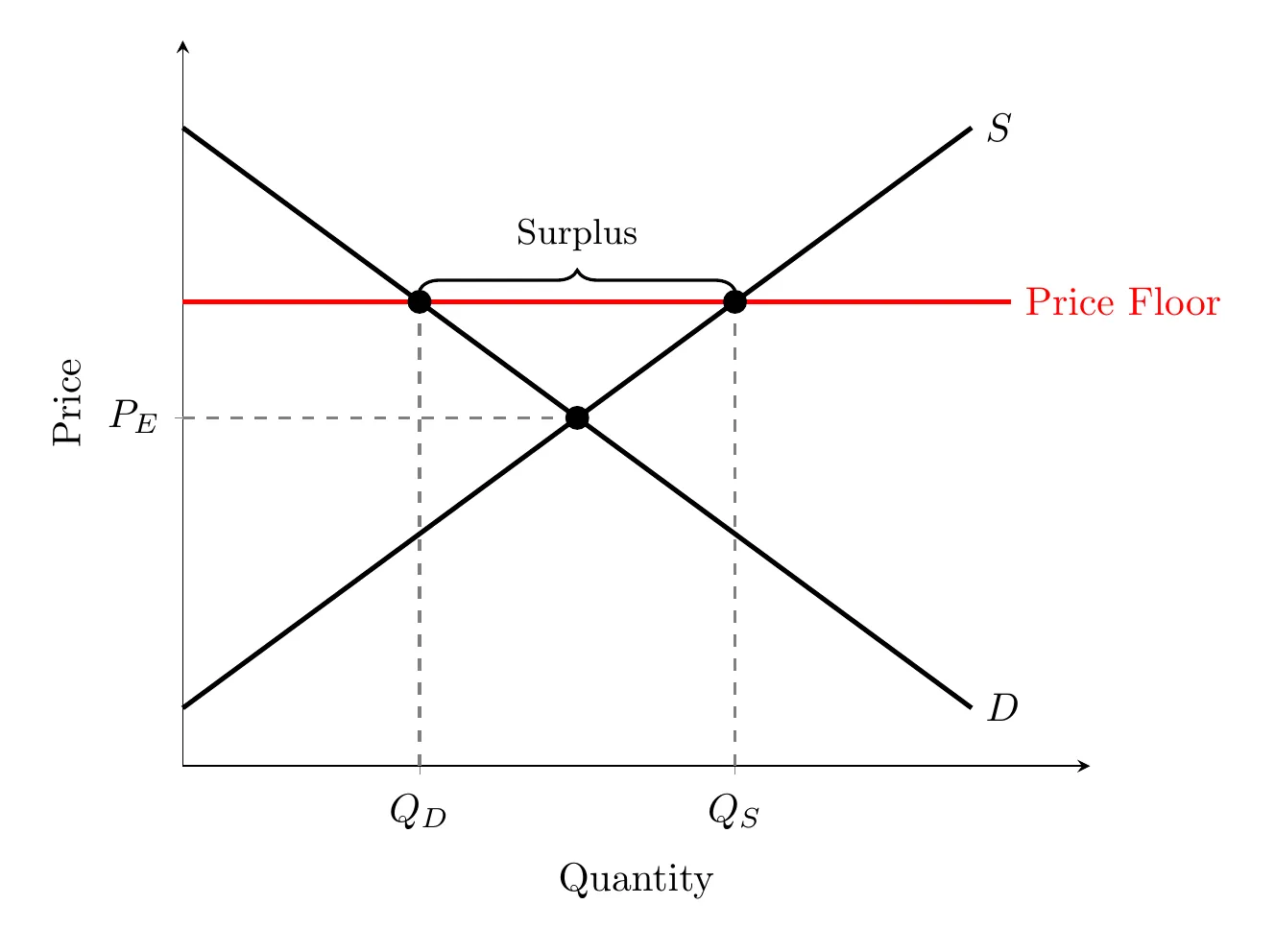
A legal minimum price. To actually matter, it has to sit above equilibrium, at which point quantity supplied exceeds quantity demanded, creating a surplus.
Producer surplus can rise for those who manage to sell, but overall consumer surplus falls and deadweight loss appears from lower sales volume. A floor set below equilibrium doesn’t do anything since the market settles at the higher equilibrium price anyway.
Example: a minimum price for milk set above what consumers will pay leads to a surplus of milk piling up in storage.
Price ceilings
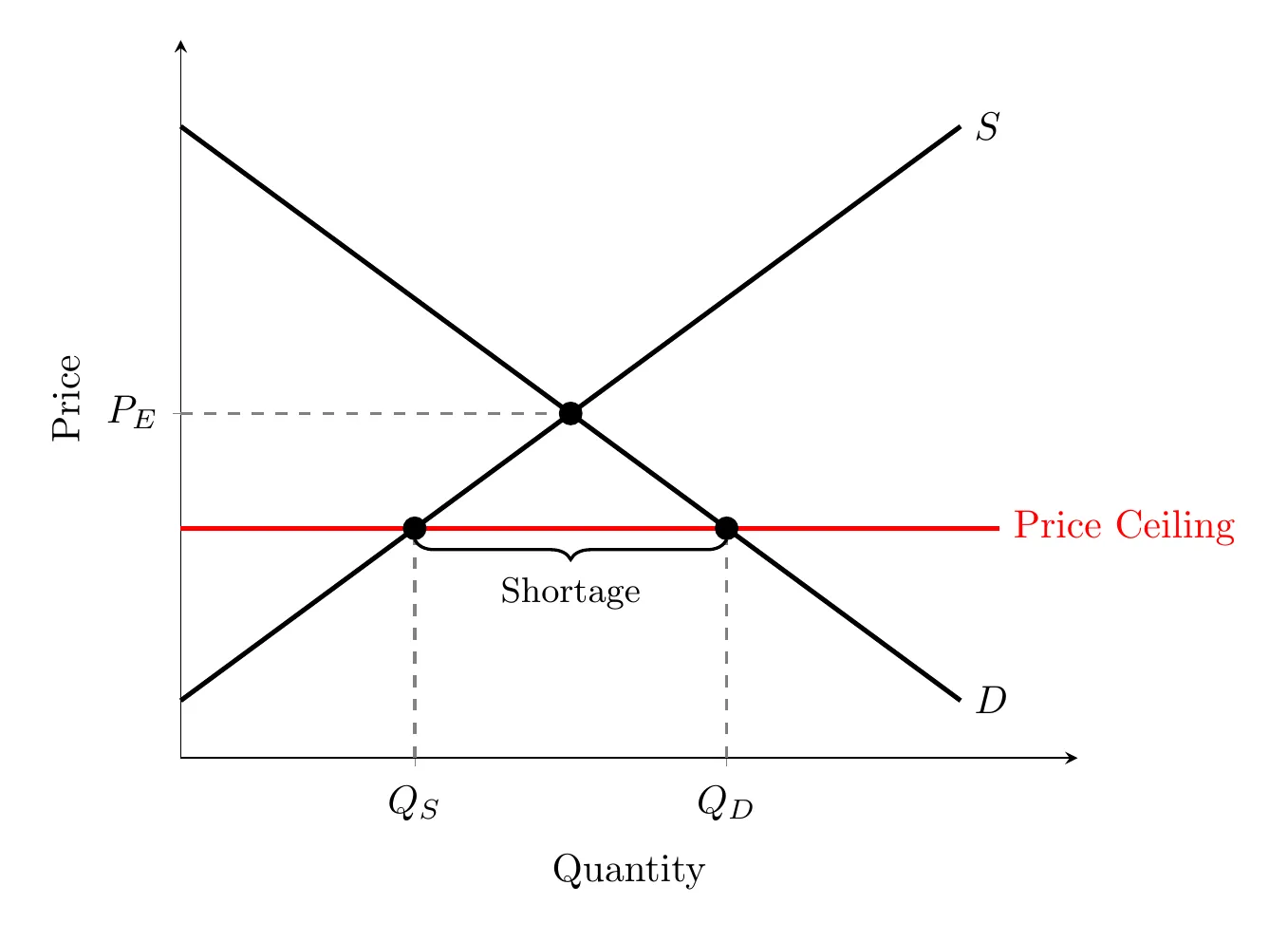
A legal maximum price. To matter, it has to sit below equilibrium, where quantity demanded outpaces quantity supplied, creating a shortage. Since producers won’t supply more than that amount, the market underproduces and deadweight loss results. A ceiling above equilibrium doesn’t do anything.
Example: capping concert ticket prices below market value leaves plenty of fans wanting tickets that simply don’t exist.
Subsidies and taxes
- Subsidies: a per-unit payment to producers, shifting supply right (or down by the subsidy amount). This raises quantity and lowers price for buyers, but creates deadweight loss from overproduction.
- Subsidies cost the government money: the subsidy per unit times the new quantity. That cost is bigger than what buyers and sellers gain combined, and the difference is the deadweight loss.
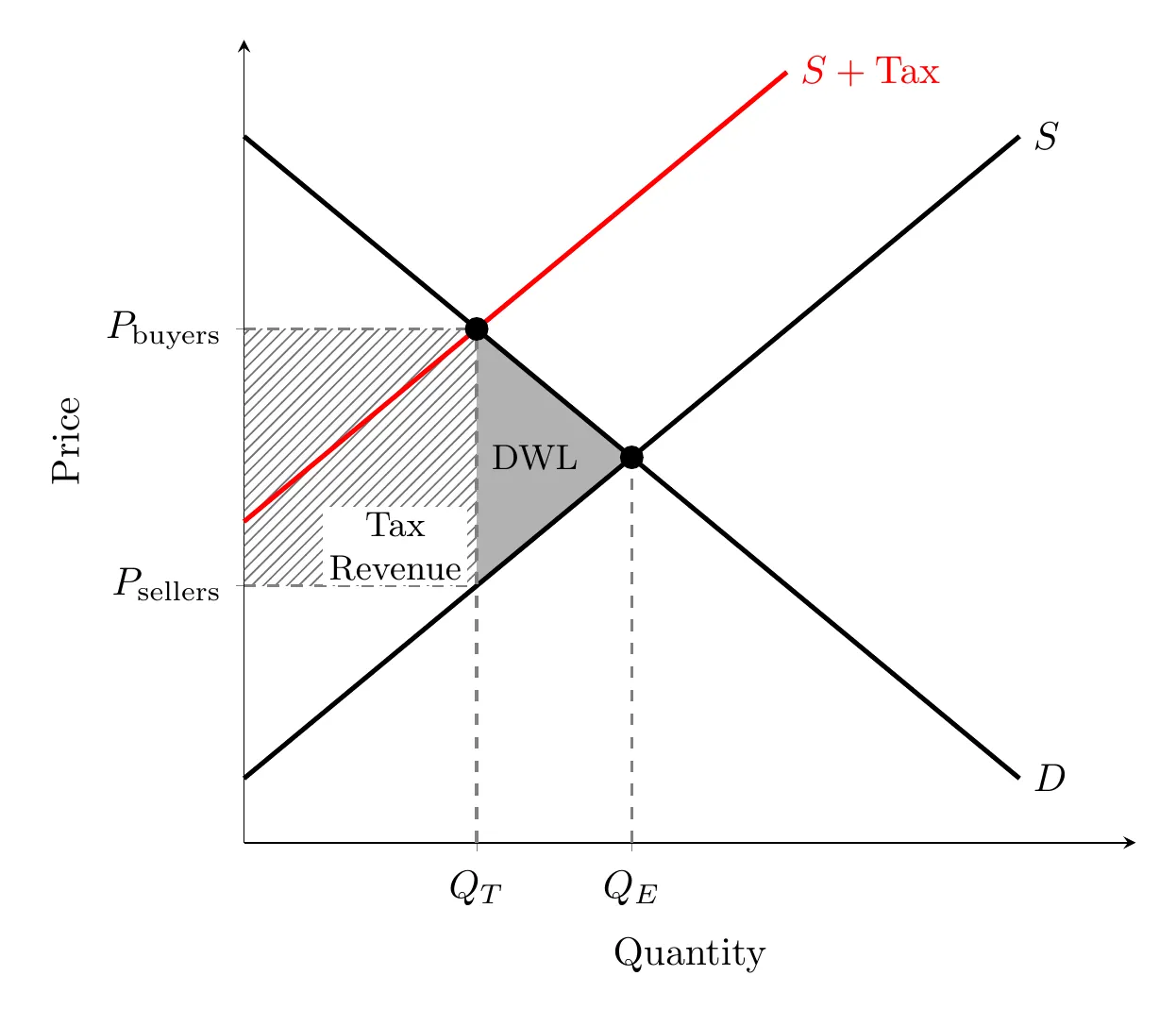
- Taxes: a per-unit charge on production, shifting supply left (or up by the tax amount). Government collects revenue equal to the tax per unit times quantity sold. Taxes cause underproduction and deadweight loss.
Tax incidence and elasticity
Whoever is less price-sensitive (less elastic) ends up carrying more of the tax burden.
- Perfectly inelastic: that group bears 100% of the burden since their behavior doesn’t change regardless of price.
- Perfectly elastic: that group pays none of it, the whole burden shifts to the other side.
Example: if patients need a life-saving medication no matter the cost (perfectly inelastic), they end up paying the entire tax on it.
It also doesn’t matter who the law says pays. A tax charged to sellers shifts supply up by the tax, a tax charged to buyers shifts demand down by the tax, and either way buyers and sellers split the burden the same way, based on elasticity.
Worked example: a $3 tax
Take the market from the 2.6 surplus example (equilibrium at $6 and 6 units, consumer surplus $18, producer surplus $9). A $3 per-unit tax on sellers shifts supply up by $3.
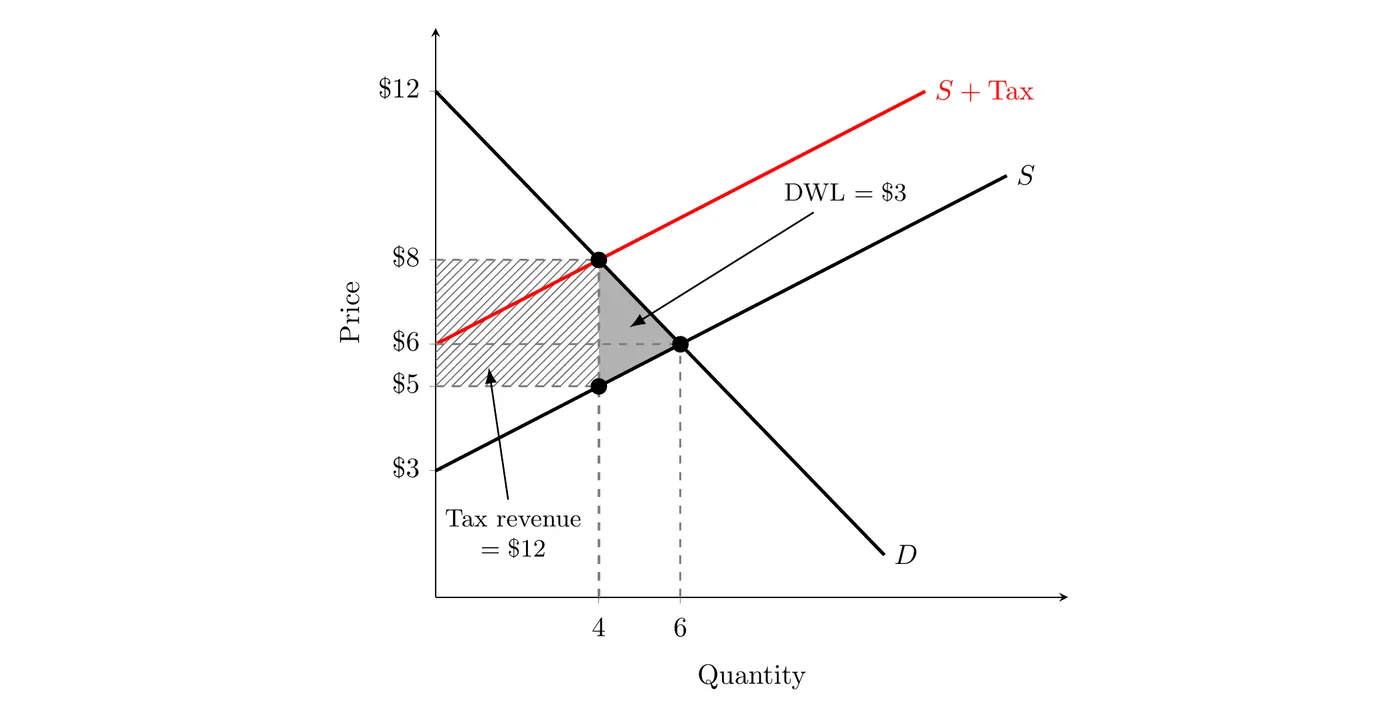
- New quantity: 4 units. Buyers now pay $8, and sellers keep $8 - $3 = $5.
- Tax revenue: $3 × 4 = $12 (the striped rectangle).
- Incidence: buyers pay $2 more than before ($6 to $8) and sellers get $1 less ($6 to $5). Buyers carry $2 of the $3 tax because demand is less elastic than supply here (at the starting equilibrium, the demand curve is the steeper one).
- Deadweight loss: , so $3. Those 2 units were worth more to buyers than they cost to make, but the tax stops them from being traded.
- Surplus: consumer surplus falls from $18 to $8 and producer surplus falls from $9 to $4. That $15 drop is the $12 the government collects plus the $3 deadweight loss.
Worked example: a $3 subsidy
Same market, but now the government pays sellers $3 for every unit, which shifts supply down by $3.
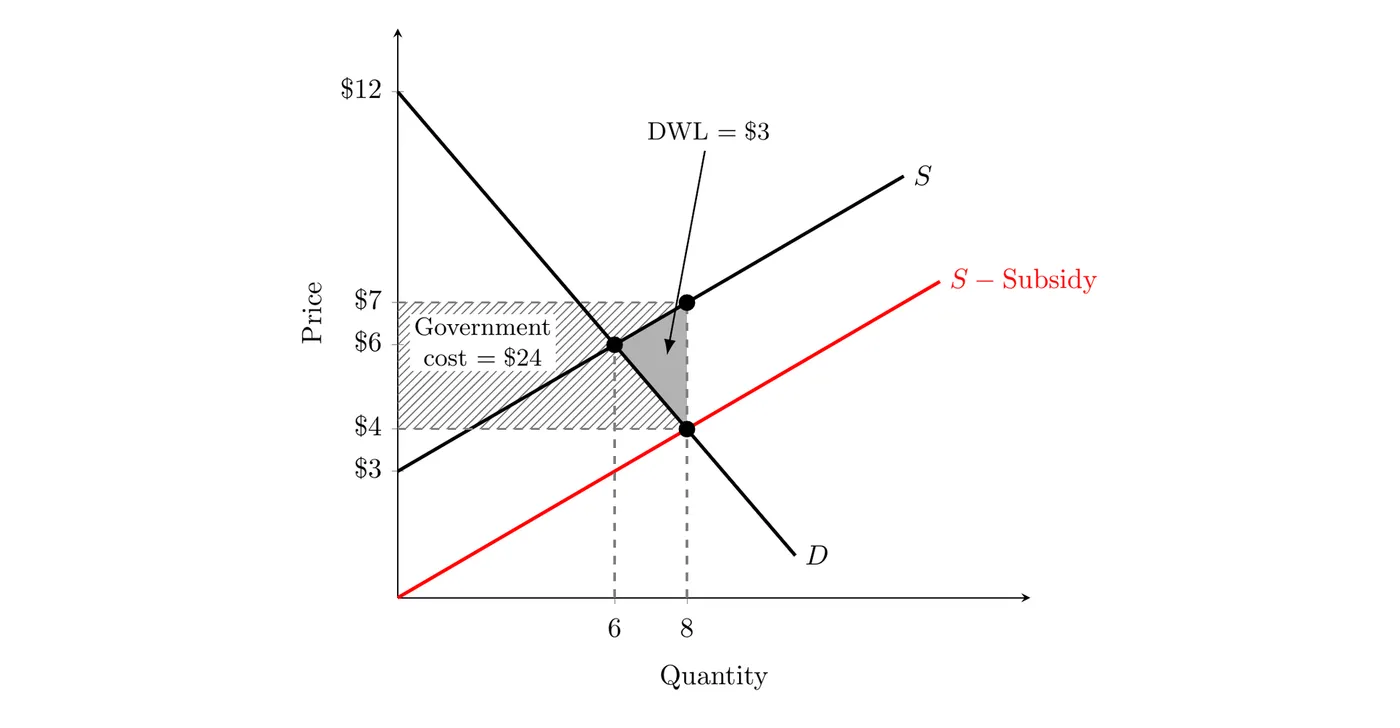
- New quantity: 8 units. Buyers pay $4, and sellers receive $4 + $3 = $7.
- Cost to the government: $3 × 8 = $24 (the striped rectangle).
- Surplus: consumer surplus rises from $18 to $32 and producer surplus rises from $9 to $16, a total gain of $21. That’s $3 less than the subsidy costs.
- Deadweight loss: , so $3, from the 2 extra units that cost more to make than they’re worth to buyers.
Why intervention lowers efficiency
If a competitive market is already making the efficient quantity (where ), a tax, subsidy, price control, or quantity control can never make it more efficient. If the policy changes the quantity traded, allocative efficiency gets worse, either by cutting output below the efficient quantity (taxes, binding price floors and ceilings, quotas), so units worth more than they cost don’t get made, or by pushing output above it (subsidies), so units that cost more than they’re worth do get made. The deadweight loss is the surplus buyers and sellers lose that nobody else gets, not even the government.
Takeaway
Government controls are usually well-intentioned, protecting workers with price floors or helping renters with price ceilings, but they act like a wedge in the market’s natural mechanics. Forcing prices away from equilibrium inevitably creates surpluses or shortages and prevents allocative efficiency. And a tax’s real burden isn’t decided by who technically hands the money over, it’s decided by elasticity: whoever has the least flexibility ends up carrying the heaviest load.