

2.7 - Market Disequilibrium and Changes in Equilibrium
Here we define market equilibrium and how prices adjust to match quantity supplied with quantity demanded, tell apart surplus from shortage, look at how shifts in demand and supply change equilibrium, and cover double shifts where one variable becomes indeterminate.
Market equilibrium
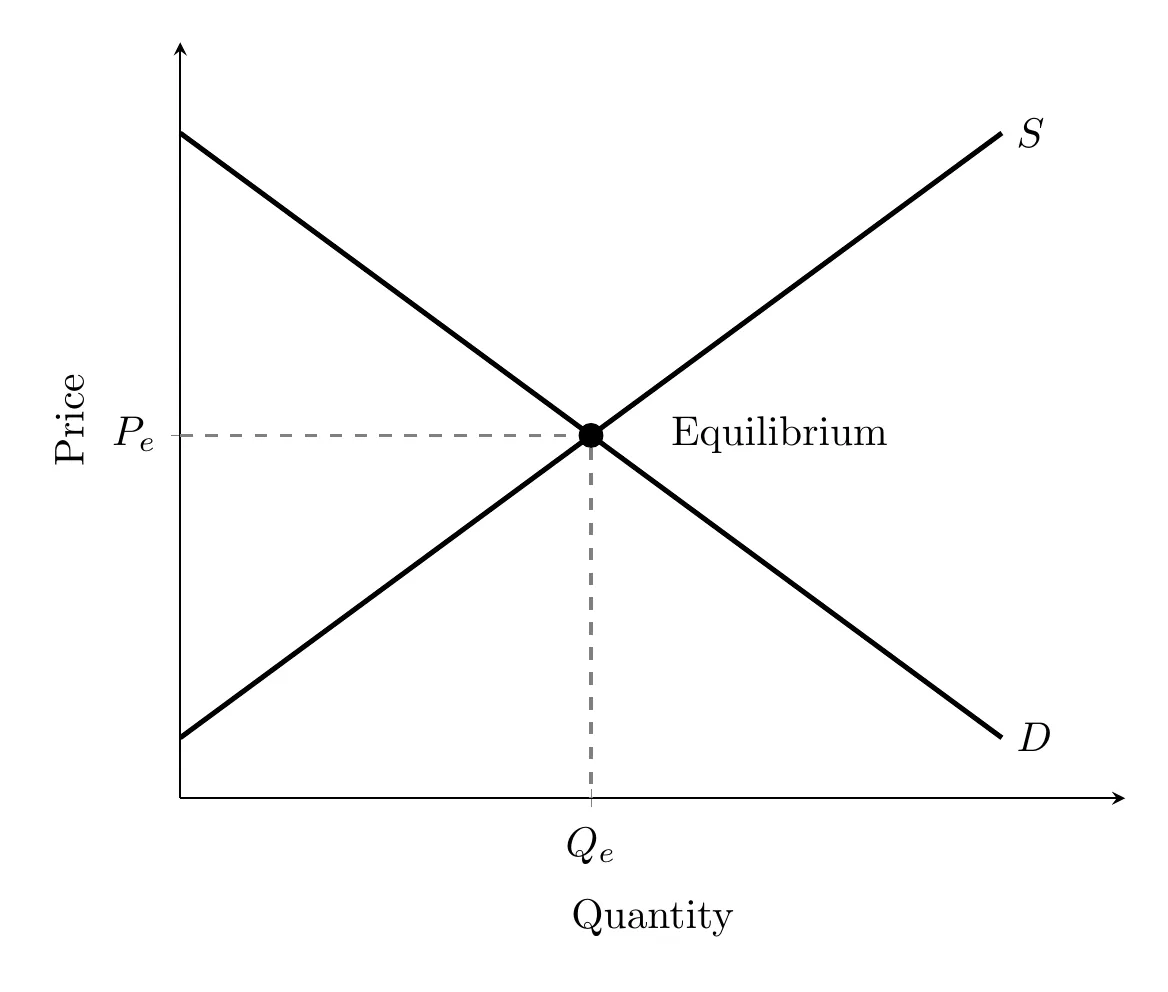
A market brings buyers and sellers together, and equilibrium is where their plans line up perfectly. Price sits on the Y-axis, quantity on the X-axis, and equilibrium is where the downward-sloping demand curve crosses the upward-sloping supply curve. At that point, quantity supplied equals quantity demanded, no leftover stock, no unfulfilled buyers.
Surpluses and shortages
- Surplus (price above equilibrium): producers want to sell a lot but buyers want very little. A smartphone priced too high sits on shelves unsold. Sellers respond by cutting prices until equilibrium returns.
- Shortage (price below equilibrium): buyers want more than what’s available. A cheap, popular game console sells out instantly. Prices rise in response, which brings in more production and cools off some buyers until the market clears.
Example, using the market from the 2.6 surplus example (equilibrium at $6 and 6 units):
Price | Quantity demanded | Quantity supplied | Result |
$8 | 4 | 10 | Surplus of 6 |
$6 | 6 | 6 | Equilibrium |
$4 | 8 | 2 | Shortage of 6 |
At $8, sellers are stuck with 6 unsold units, so they cut prices. At $4, buyers want 6 more units than sellers offer, so buyers bid the price up. Either way, the price gets pushed back to $6.
Single shifts
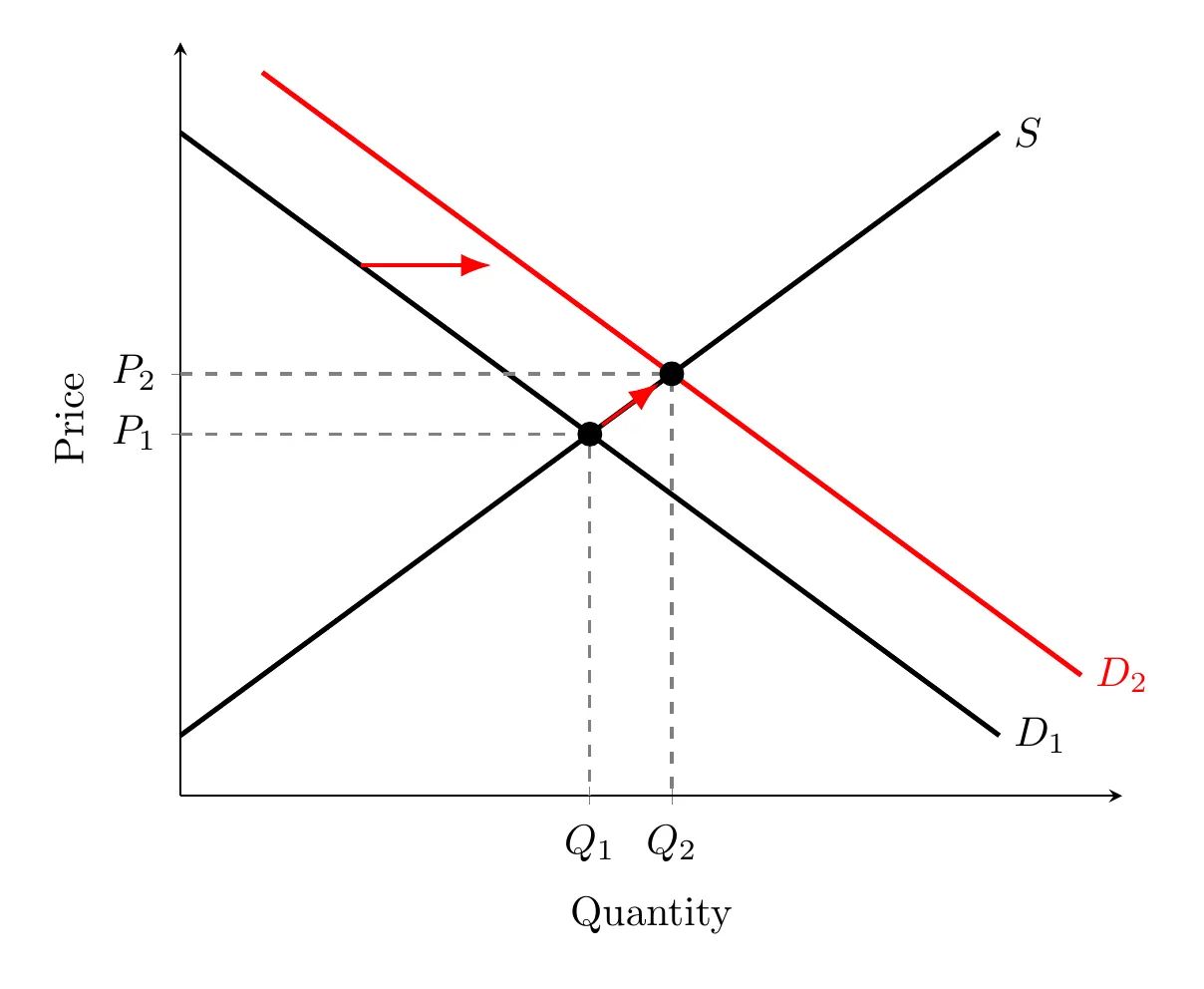
Demand shifts: an increase (say, a product goes viral) shifts demand right, raising both price and quantity. A decrease (market shrinks) shifts demand left, lowering both.
Supply shifts: an increase (new production tech) shifts supply right, lowering price but raising quantity. A decrease (pricier raw materials) shifts supply left, raising price but lowering quantity.
Shifts change surplus too
Anything that shifts demand or supply also changes consumer surplus, producer surplus, and total surplus in that market, since the triangles get redrawn from the new equilibrium. Example: in the 2.6 market, say demand increases so buyers will pay $3 more for every unit (the demand curve now starts at $15 instead of $12). The new equilibrium is $7 and 8 units.
- Consumer surplus: , up from $18 to $32.
- Producer surplus: , up from $9 to $16.
- Total surplus: $32 + $16 = $48, up from $27.
Elasticity decides how big the changes are
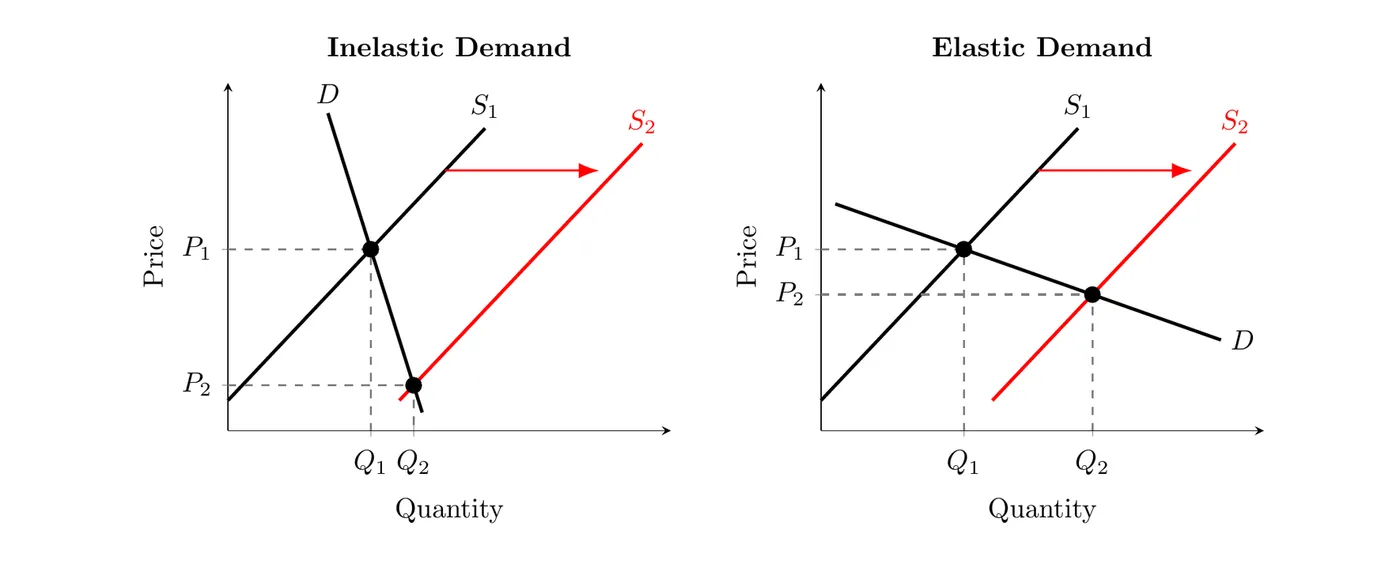
How much price and quantity move after a shift depends on the price elasticities of demand and supply.
- Supply shifts: if supply increases and demand is inelastic, price falls a lot and quantity barely rises, since buyers don’t want much more even at a lower price. If demand is elastic, price falls only a little and quantity rises a lot.
- Demand shifts: if demand increases and supply is inelastic, price rises a lot and quantity barely changes, since sellers can’t make much more quickly. If supply is elastic, quantity rises a lot and price barely moves.
Double shifts and indeterminacy
When both curves shift at once, either price or quantity becomes indeterminate unless you know the exact size of each shift.
- Same direction: if both demand and supply increase, quantity definitely rises, but price is indeterminate since one shift pushes it up while the other pulls it down.
- Opposite direction: if demand rises while supply falls, price definitely rises since both forces push it up, but quantity becomes indeterminate.
Shift scenario | Price | Quantity |
Demand up, Supply up | Indeterminate | Increase |
Demand down, Supply down | Indeterminate | Decrease |
Demand up, Supply down | Increase | Indeterminate |
Demand down, Supply up | Decrease | Indeterminate |
Takeaway
Market equilibrium acts like an invisible handshake between buyers and sellers, with prices as the balancing mechanism. When things get out of sync, surpluses and shortages act as signals that force self-correction, either by cutting prices to clear unsold goods or raising them to manage scarcity. Single shifts create predictable outcomes, but double shifts introduce a layer of uncertainty where one variable can’t be pinned down without more information.