

4.11 - The Inverse and Determinant of a Matrix
Overview
In Topic 4.10 you learned how to multiply matrices. This topic adds three tools that make matrices useful. The identity matrix acts like the number 1. The inverse of a matrix acts like a reciprocal, so it lets you undo a matrix multiplication. The determinant is a single number that tells you whether an inverse exists, and it also has a picture behind it: it measures the area of a parallelogram built from two vectors.
The identity matrix
The identity matrix, written , is a square matrix with 1s on the main diagonal (from the top left to the bottom right) and 0s everywhere else. Here are the and identity matrices:
Multiplying a square matrix by the identity matrix of the same size gives back the original matrix, no matter which side is on:
You can see why by multiplying it out. Each entry of the product is a dot product, and the 0s in wipe out everything except the one entry you started with:
That's why plays the role of 1. For numbers, . For matrices, . Matrix multiplication usually depends on order ( and are often different), but the identity matrix gives the same answer on either side.
The inverse of a matrix
For a nonzero number, the reciprocal undoes multiplication: . The matrix version is the inverse. The inverse of a square matrix is written , and it's the matrix that multiplies with to give the identity matrix of the same size:
A few things to know about inverses:
- Only square matrices have inverses. A matrix doesn't have one.
- Not every square matrix has an inverse, just like the number 0 has no reciprocal. The determinant (below) tells you which ones do.
- There's no matrix division. You never write or divide by a matrix. You multiply by instead.
- To check an inverse, multiply. If times your answer gives , your answer is right.
Inverses are how you undo a matrix multiplication. If and you know and , multiply both sides on the left by :
Because order matters, has to go on the left of both sides. You'll use exactly this move in Topic 4.13 to undo a transformation and in Topic 4.14 to go backward in time.
The determinant
Every square matrix has a number attached to it called its determinant. For a matrix, it's the product of the main diagonal minus the product of the other diagonal:
The determinant is written , and some books use vertical bars, . It can be positive, negative, or zero. For example:
You can find determinants with or without technology. On a TI-84, press 2nd and then to open the MATRIX menu, go to EDIT, and enter the matrix as
[A]. Back on the home screen, MATRIX, then MATH, then det( gives det([A]).Finding the inverse of a matrix
When the inverse of a matrix exists, this formula gives it:
In words:
- Find . If it's 0, stop: there's no inverse.
- Swap the two entries on the main diagonal ( and ).
- Change the signs of the other two entries ( and ), but leave them where they are.
- Multiply every entry by .
Why it works. Multiply by the swapped-and-negated matrix and see what comes out:
That's times the identity matrix. Dividing every entry by turns it into exactly , which is what an inverse has to produce.
With technology, type
[A] on the home screen and press the key. MATH, then Frac, shows the entries as fractions.Example 1: Finding an inverse
Find the inverse of and check your answer.
Step 1: Find the determinant.
It isn't 0, so the inverse exists.
Step 2: Swap the diagonal entries and change the signs of the other two.
Step 3: Multiply every entry by .
Step 4: Check by multiplying.
Answer: , and confirms it.
When does an inverse exist?
A square matrix has an inverse if and only if . A matrix with an inverse is called invertible. A matrix with determinant 0 has no inverse (it's sometimes called singular).
The formula shows part of the reason: when , the formula builds an inverse, and when it would divide by zero. But it's more than a formula problem. When the determinant is 0, no matrix at all can work as an inverse. Take this matrix:
The first row of is exactly twice the second row. Each row of a product comes from dotting that row of with the columns of , so the first row of is always twice the second row of , whatever is. In , the first row is and the second is , and the first isn't twice the second. So can never equal , and has no inverse.
Example 2: When there's no inverse
For what values of does have no inverse?
has no inverse exactly when its determinant is 0.
Answer: has no inverse when or . For every other value of , is invertible. (At , is the matrix from above.)
The determinant as area
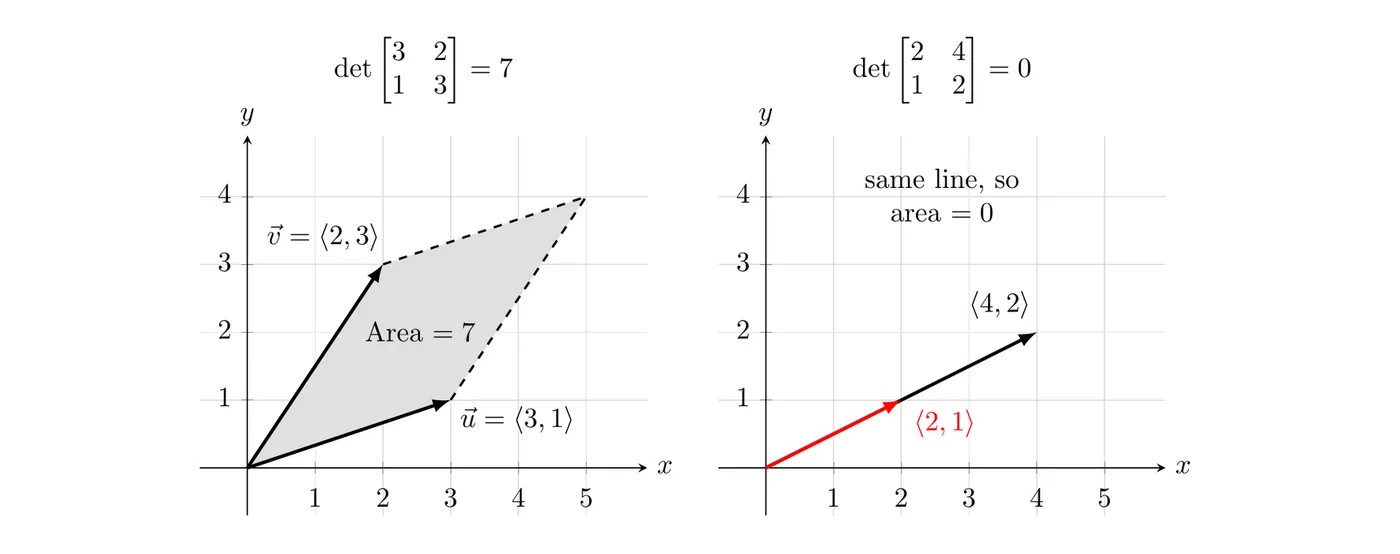
Put two vectors from into a matrix, either as its columns or as its rows. The absolute value of the determinant is the area of the parallelogram spanned by the vectors: the parallelogram that has the two vectors as adjacent sides, starting from the same point.
For example, and as columns give
so the parallelogram they span has area 7. Using them as rows instead gives , the same area.
Why it works. Draw a box around the parallelogram. The box is 5 by 4, so its area is 20. The parts of the box outside the parallelogram are two triangles with area 1.5, two rectangles with area 2, and two triangles with area 3, for a total of 13. That leaves for the parallelogram, which matches the determinant.
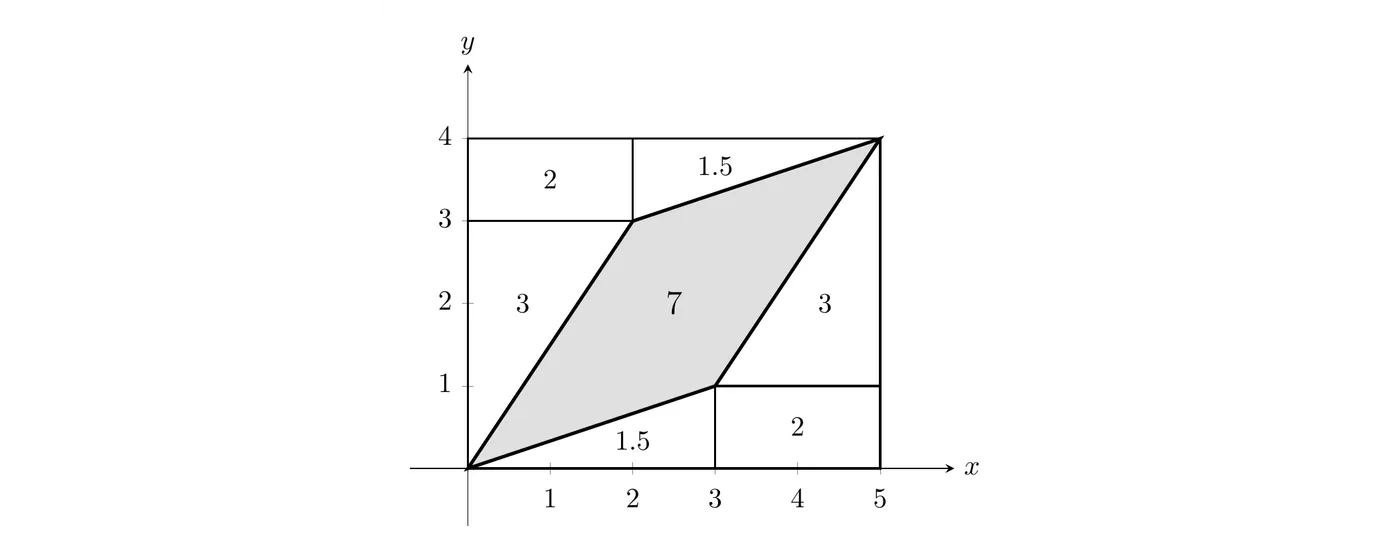
The same subtraction works with letters. For columns and , the box is by , and the pieces outside add up to :
The determinant can come out negative (that just depends on which vector you list first), so take the absolute value to get the area.
A determinant of 0 means parallel vectors
If the determinant is 0, the two vectors are parallel: they lie along the same line, and one is a scalar multiple of the other. The parallelogram gets flattened into a segment with zero area. In the right-hand graph above, , and
That's the matrix from earlier, which had no inverse. The two ideas fit together: a matrix is invertible exactly when its columns are not parallel.
Example 3: Area and parallel vectors
(a) Find the area of the parallelogram spanned by and . (b) Are and parallel?
(a) Put the vectors in as columns and find the determinant.
The area is the absolute value: square units.
(b) Do the same with the second pair.
The determinant is 0, so the vectors are parallel. You can confirm it directly: .
Example 4: Putting it together
Let .
- (a) Find the value of for which has no inverse.
- (b) Let . Find and verify that .
- (c) Let . Find the area of the parallelogram spanned by the columns of .
- (d) For the value of from part (a), what is true about the columns of ?
(a) . Set it equal to 0:
has no inverse when .
(b) With , . Swap, change signs, and divide by 7:
Verify:
(c) The area is square units.
(d) At , the columns are and . The second is times the first, so the columns are parallel and span a parallelogram with area 0. That's the geometric reason has no inverse there.
Common mistakes
- Mixing up the determinant formula. It's : main diagonal first, then subtract the other diagonal. Not , and not .
- Moving the wrong entries. In the inverse formula, and trade places, while and stay put and only change sign.
- Forgetting to divide by the determinant, or multiplying by it instead.
- Inverting a matrix with determinant 0. Check the determinant first. If it's 0, the answer is "no inverse."
- Reporting a negative area. The area of the parallelogram is .
- Dividing by a matrix. There's no . Multiply by on the correct side: gives , not .
- Skipping the check. Multiplying by your inverse takes a minute and catches almost every sign error.