

4.2 - Parametric Functions Modeling Planar Motion
Overview
Parametric functions are built for describing motion. If a particle moves around the plane, tracks its horizontal position and tracks its vertical position at time . This topic is about reading position information from a parametric function: where the particle is, how far left, right, up, or down it gets, and where its path crosses the axes.
Position of a particle
A parametric function can model a particle moving in the plane:
- is the particle's horizontal position at time .
- is the particle's vertical position at time .
- The graph of is the path of the particle, and the point is its position at time .
The path alone doesn't show timing. Two particles can follow the same path at different speeds or in opposite directions, which is why you label points with their -values and add arrows.
Be precise about what a question asks for: a position (a point), one coordinate ( or alone), or a time (a value of ). Mixing these up is the easiest way to lose credit on a correct idea.
Horizontal and vertical extrema
Because and are separate functions of , you can find the extreme positions one direction at a time:
To find the particle's... | Look for the... |
Farthest right position | maximum of |
Farthest left position | minimum of |
Highest position | maximum of |
Lowest position | minimum of |
Find the extreme value of that one coordinate function and the where it happens. Then plug that into both functions to get the point.
- Check the endpoints. On a restricted domain , the farthest point in some direction can be where the motion starts or stops.
- Use the vertex for quadratics. If , its max or min is at . For other functions, graph or by itself on a calculator (in function mode, with as the input) and find the max or min.
Intercepts: Where the path crosses the axes
This is the part students mix up most, so slow down here.
- -intercepts: the path crosses the -axis where . So solve . The real zeros of give the -intercepts.
- -intercepts: the path crosses the -axis where . So solve . The real zeros of give the -intercepts.
After you find each , throw out any value outside the domain, then plug the rest into the other function to get the full point.
Example 1: Extrema and intercepts
A particle moves in the plane so that its position at time is , where
Find (a) the leftmost and rightmost points of the path, (b) the highest and lowest points, and (c) all intercepts.
Step 1: Make a table and sketch the path.
Point | |||
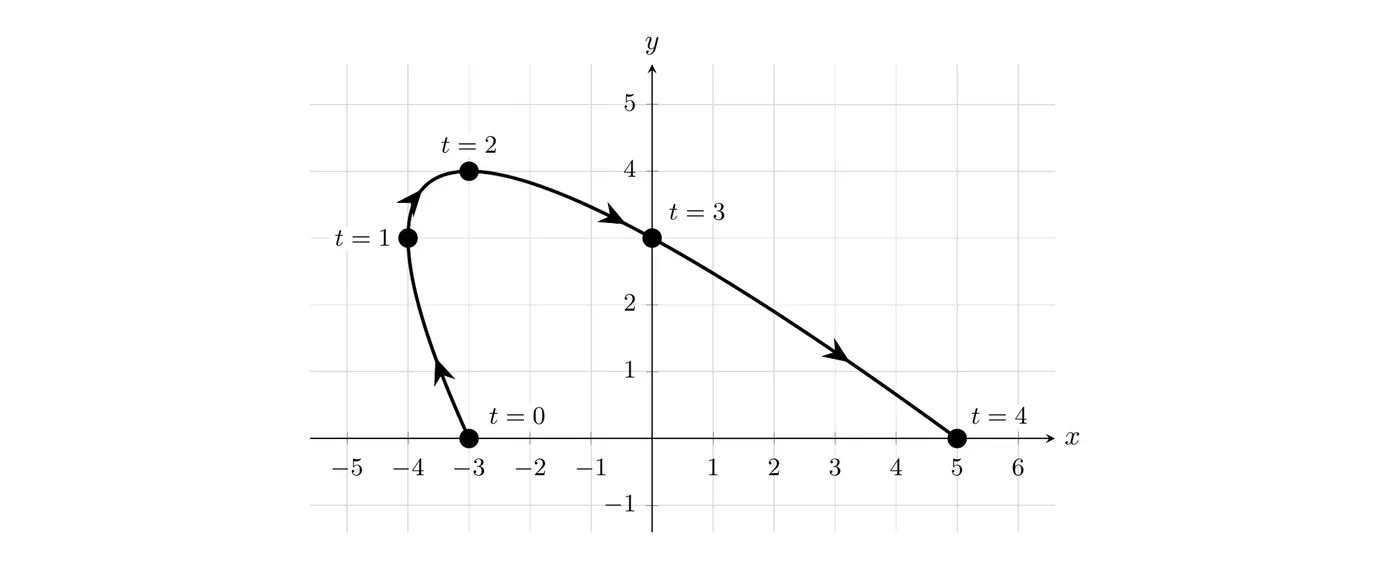
(a) Left and right. Complete the square: . This is an upward parabola in with its vertex at , so the minimum of is . The maximum on is at the endpoint farther from the vertex: , compared with .
Answer: The leftmost point is , at . The rightmost point is , at .
(b) High and low. is a downward parabola in with its vertex at , so the maximum is . The minimum on is at the endpoints: and .
Answer: The highest point is , at . The lowest points are at and at , both at height .
(c) Intercepts. For -intercepts, solve :
Only is in the domain, and . For -intercepts, solve :
Then and .
Answer: The path has one -intercept, at , and two -intercepts, at and at .
Example 2: A thrown ball
A ball is thrown from a balcony. Its position seconds later is
where is the horizontal distance from the balcony in feet and is the height above the ground in feet. The model holds from until the ball hits the ground.
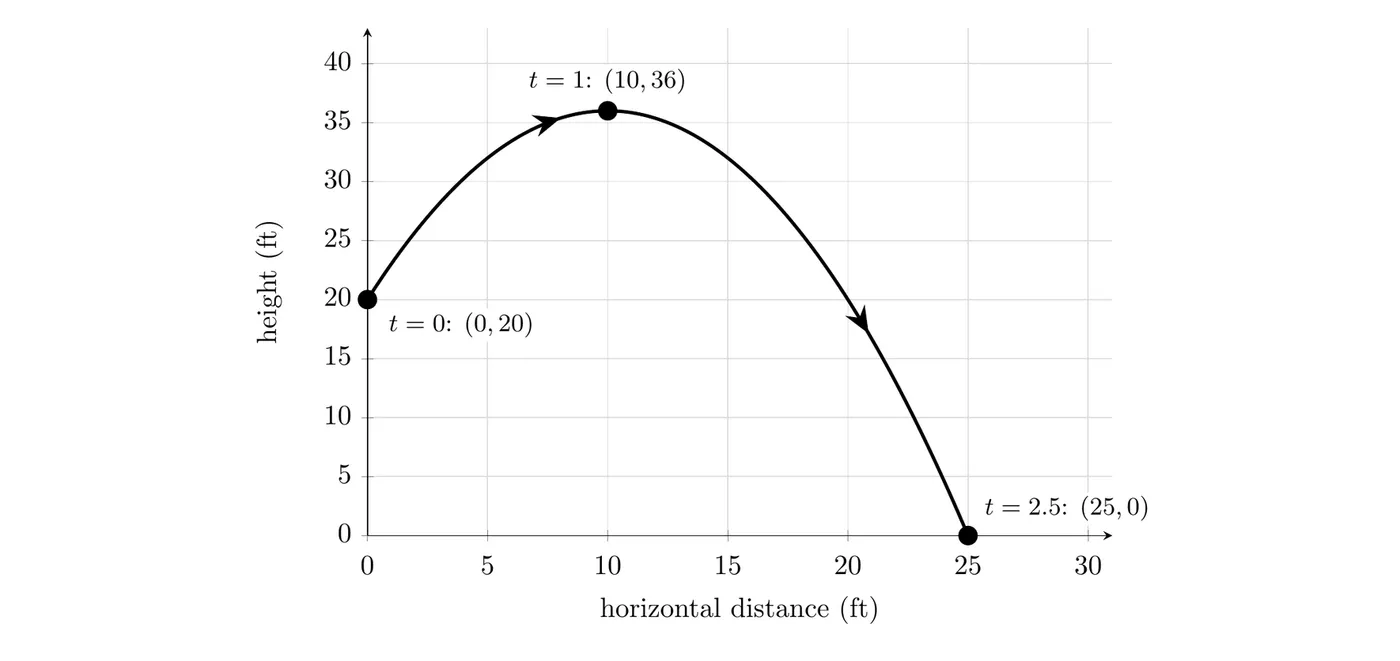
(a) Find the ball's maximum height and where the ball is at that moment. (b) When and where does the ball hit the ground? (c) Find the -intercept of the path and explain what it means.
(a) Height is , a downward parabola in . Its vertex is at
Answer: The maximum height is 36 feet, 1 second after the throw, when the ball is 10 feet horizontally from the balcony. Its position is .
(b) The ball hits the ground when its height is , which is an -intercept of the path. Solve (divide by first):
So or . Negative time isn't part of the flight, so , and .
Answer: The ball hits the ground 2.5 seconds after it's thrown, 25 feet horizontally from the balcony, at the point .
(c) The -intercept comes from : gives , and .
Answer: The -intercept is . It means the ball starts 20 feet above the ground, right at the balcony, at the moment it's thrown.
Common mistakes
- Swapping the intercept rules. Zeros of give -intercepts, and zeros of give -intercepts. On the -axis, is .
- Forgetting the endpoints. On a restricted domain, the farthest point in some direction can be a start or end point instead of a vertex.
- Giving only part of the answer. If a question asks for the highest point, give the point , not just the height or just the time. If it asks when, give with units.
- Keeping times outside the domain. In Example 1, also gave , but that time isn't part of the motion.
- Reading time off the path. The path shows where the particle goes, not when. Use the functions or the labeled -values.