

4.4 - Parametrically Defined Circles and Lines
Overview
Circles and line segments are the two paths you'll parametrize most often. Motion around a circle is modeled with cosine and sine, and motion along a straight segment is modeled with linear functions of . Both build on ideas you already know: the unit circle from Unit 3 and transformations of functions.
The unit circle, parametrically
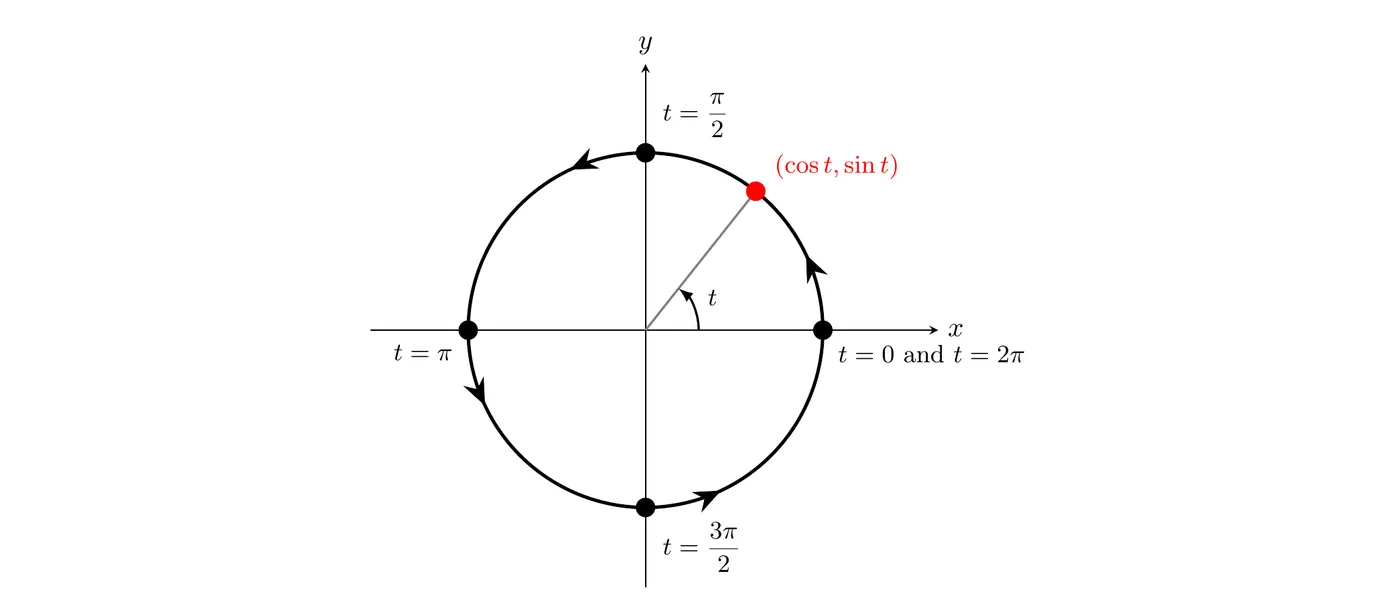
The parametric function
models one complete counterclockwise revolution around the unit circle (center at the origin, radius 1), starting and ending at .
- Why it's a circle: for every , , so every point is 1 unit from the origin.
- What is: the angle in radians, measured counterclockwise from the positive -axis. As increases, the point moves counterclockwise.
- Start and end: gives , and brings the point back to .
Transforming the circle
Transformations of can model any circular path. Each change to the formula does one job:
Change | Parametric function | Effect |
Radius | dilates the circle to radius | |
Center | translates the center to | |
Clockwise | reflects the motion so it goes clockwise | |
Speed | one revolution takes units of time | |
Starting point | starts at angle instead of angle | |
Part of a circle | restrict the domain | for example, traces only the top half |
Putting the first two together, the counterclockwise circle with center and radius is
Check: , which is the equation of that circle. (Stretching by different amounts in each direction, like , gives an ellipse instead. Topic 4.6 covers ellipses, and Topic 4.7 parametrizes them.)
Example 1: Writing a circle
Write a parametric function for a particle that travels once around the circle with center and radius , (a) counterclockwise, starting at the rightmost point, and (b) clockwise, starting at the top.
(a) Use , , and :
Check: gives , which is 4 units right of the center, the rightmost point.
(b) Swap cosine and sine:
Check: gives , the top. At the particle is at , the rightmost point. Going from the top to the right side is clockwise.
Answer: (a) and (b) , each for . Other correct answers exist, since one path can be parametrized many ways.
Example 2: A Ferris wheel
A Ferris wheel has a radius of 25 meters, and its center is 30 meters above the ground. Put the origin on the ground directly below the center, so the center is at . The wheel turns counterclockwise in this coordinate system and makes one full revolution every 8 minutes. A rider boards at the bottom at , where is in minutes.
(a) Write a parametric function for the rider's position. (b) Find the rider's position at . (c) When does the rider first reach a height of 42.5 meters?
(a) Set three things. Center and radius: and . Speed: one revolution ( radians) every 8 minutes gives . Start: the bottom of the circle is at angle , so shift the angle by .
Using and , this simplifies to
Check: gives , the bottom. gives , the rightmost point, so the rider moves counterclockwise. brings the rider back to .
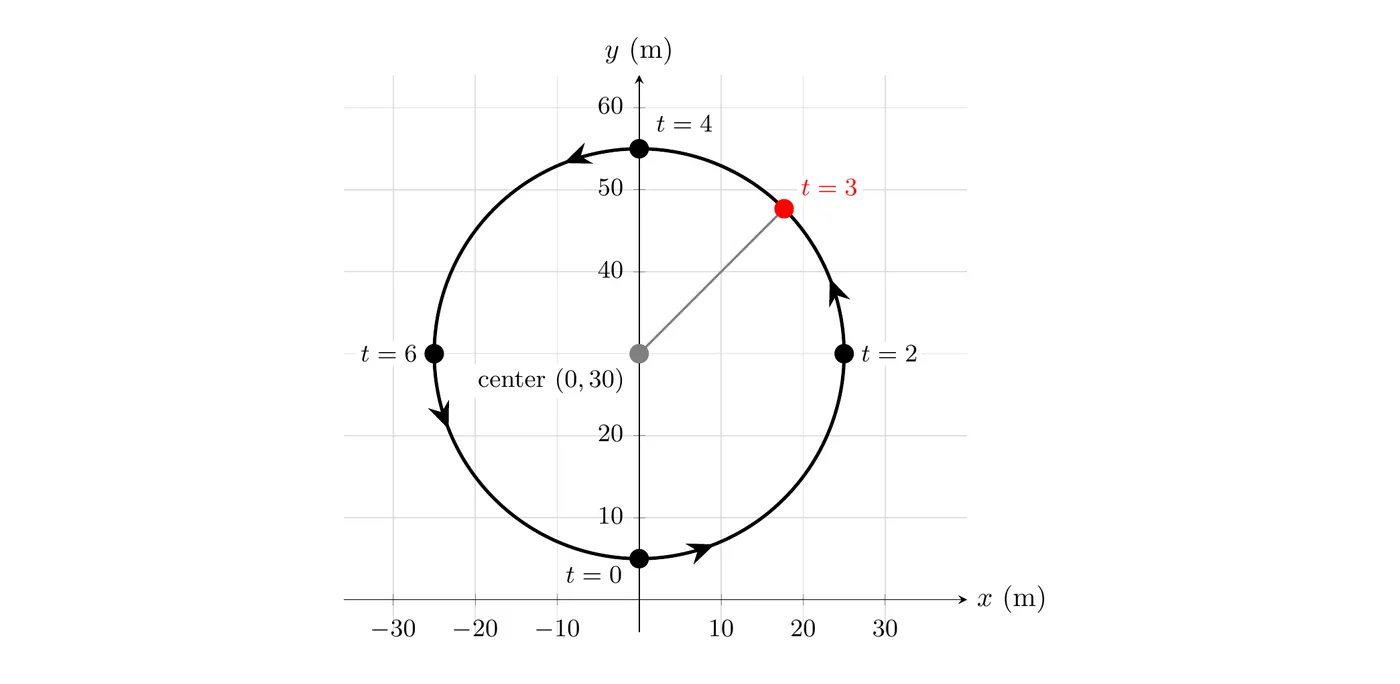
(b) At , the angle input is :
Answer: After 3 minutes, the rider is at about : about 47.68 meters above the ground and 17.68 meters to the right of the wheel's center.
(c) Set the height equal to 42.5:
During the first half turn, runs from to , and the first angle in that range with cosine is . So , which gives .
Answer: The rider first reaches 42.5 meters minutes (2 minutes 40 seconds) after boarding.
Line segments, parametrically
A linear path along the segment from to can be parametrized many ways. The most useful one starts at the initial position and adds a constant rate of change in each direction:
- Initial position: at you're at , and at you're at .
- Rates of change: changes at a constant per unit of , and changes at a constant per unit of . Constant rates in both directions are what make the path straight.
- Slope: the slope of the segment is the ratio of the rates, , just like in Topic 4.3.
More generally, a particle that starts at and moves with constant rates (horizontal) and (vertical) has and . Changing the rates changes how long the trip takes, swapping the endpoints reverses the direction, and dropping the domain restriction gives the whole line.
Example 3: A drone's flight
A drone flies at a constant speed in a straight line from to , with units in kilometers. The trip takes 2 hours. (a) Write a parametric function for the drone's position hours after it leaves. (b) Where is it after 30 minutes? (c) Give a different parametrization of the same segment that uses .
(a) Over 2 hours, changes by km and changes by km, so the rates are
Check: gives .
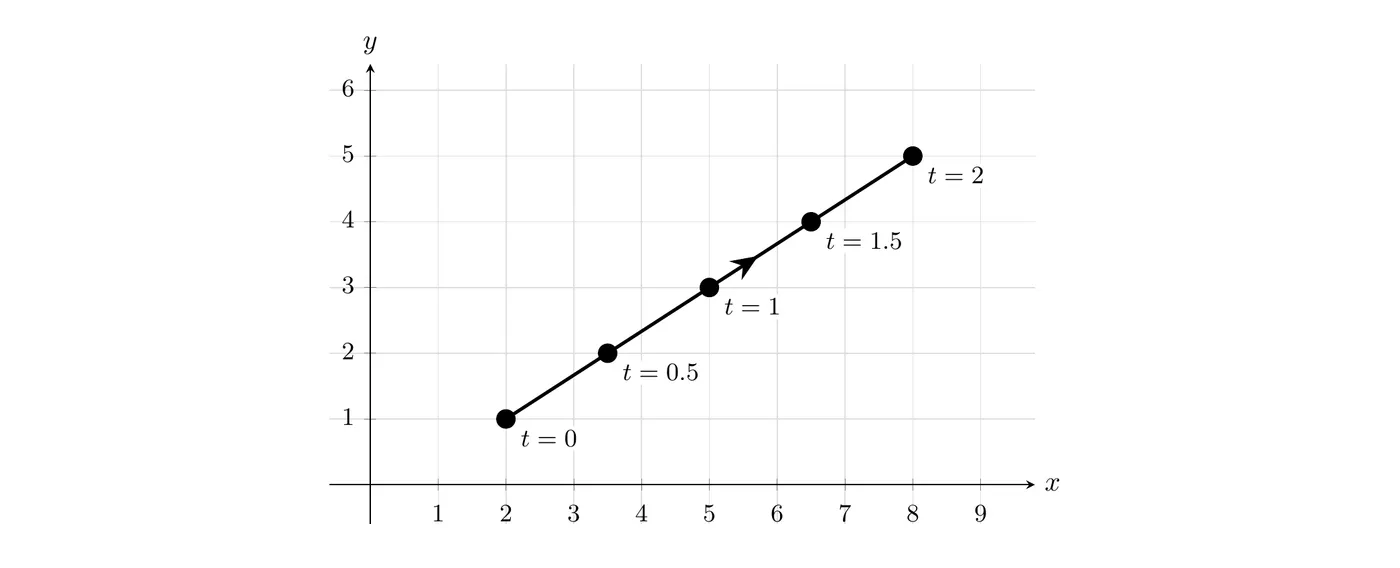
(b) 30 minutes is , so the position is .
Answer: After 30 minutes, the drone is at .
(c) Use the general formula: and for . Now changes 6 units and changes 4 units per unit of , so this version covers the segment in half as much .
Answer: for . Both versions trace the same segment with slope , which shows that one path can have many parametrizations.
Common mistakes
- Using degrees. The parameter is in radians. One revolution is , not 360.
- Forgetting the center. is centered at the origin. Add to and to .
- Mixing up cosine and sine. starts at the right and goes counterclockwise. starts at the top and goes clockwise.
- Wrong speed factor. If one revolution takes units of time, then , not .
- Wrong domain for a segment. With , use . A bigger domain runs past the endpoint.