

4.9 - Vector-Valued Functions
Overview
In Topics 4.2 and 4.3, a particle's motion was a parametric function . A vector-valued function describes the same motion with vectors: its output at each time is a vector instead of a point. Two vectors matter. The position vector points from the origin to the particle, and the velocity vector shows which way the particle is moving and how fast. Writing motion this way makes distance from the origin and speed quick to compute.
Position vectors
If a particle's position is given by the parametric function , the same motion can be written as a vector-valued function:
At each time , is the vector with its tail at the origin and its head at the particle. As changes, the head traces out the particle's path.
The magnitude of the position vector is the particle's distance from the origin:
Example 1: Where is the particle?
A particle moves in the plane with position for , where is in seconds and distances are in meters. (a) Make a table of positions for . (b) How far is the particle from the origin at and at ? (c) When is the particle on the -axis, and how far from the origin is it then?
(a) Substitute each . For example, .
(b) Find the magnitudes:
(c) On the -axis, : , so or . The positions are and .
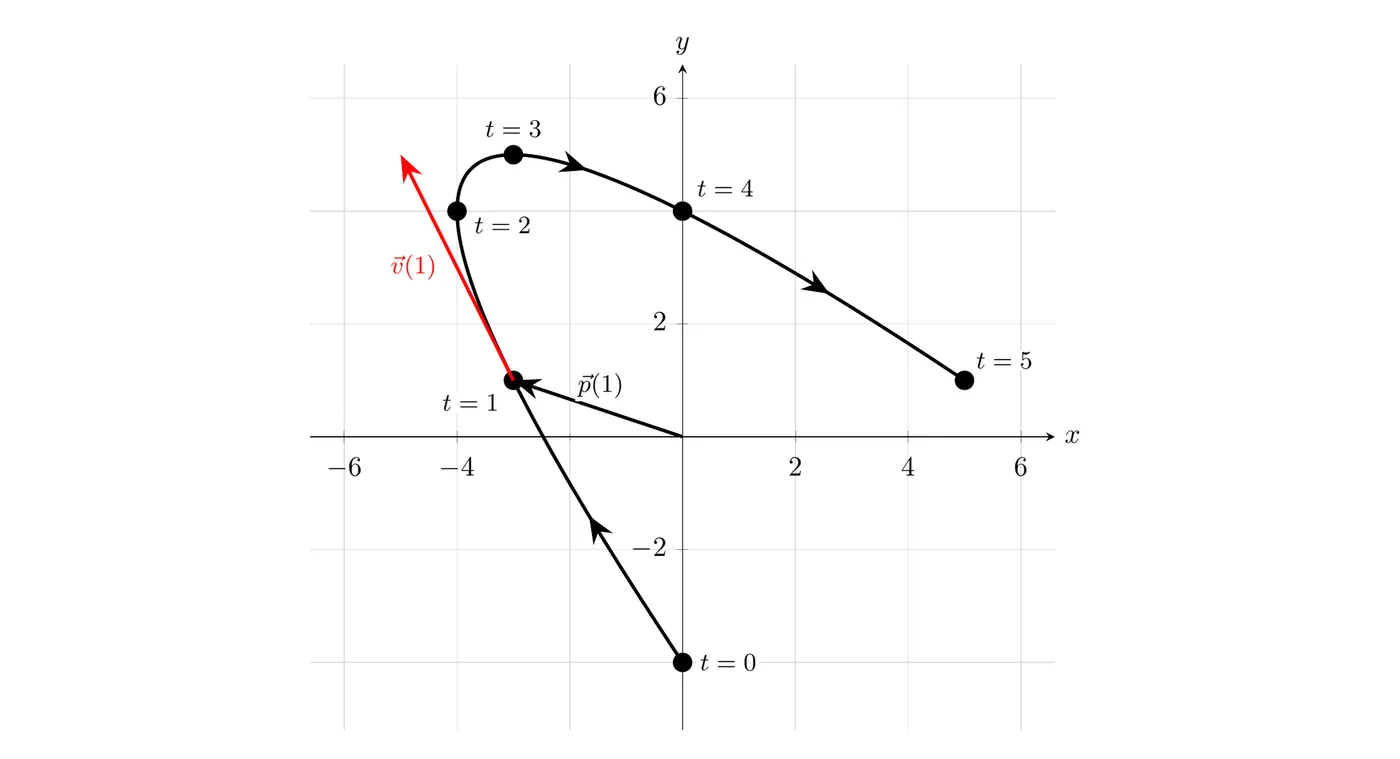
Answer: (b) The particle is about 3.16 meters from the origin at and about 5.10 meters away at . (c) It's on the -axis at , at , and at , at . Both times it's 4 meters from the origin.
Velocity vectors
The velocity vector describes how the position is changing at time . Its two components are rates of change with respect to :
- Horizontal component: how fast is changing, for example in meters per second to the right or left.
- Vertical component: how fast is changing.
Calculus writes these instantaneous rates as and (read "x prime of t"), so . You'll learn to find them from any position function in calculus. In precalculus, the velocity is usually given to you, or the motion is along a line (where the rates are constant), or you estimate the rates with average rates of change over a short time interval, as in Topic 4.3. When you draw it, the velocity vector starts at the particle and points along the path in the direction of motion.
Reading direction from the signs
Component of | Positive | Negative | Zero |
horizontal | moving right | moving left | not moving left or right at that instant |
vertical | moving up | moving down | not moving up or down at that instant |
This is the same idea as Topic 4.3: a positive horizontal rate means is increasing, so the particle moves right.
Speed
The magnitude of the velocity vector is the particle's speed:
Velocity has a direction and speed doesn't. Since it's a magnitude, speed is never negative.
Example 2: Direction and speed
The particle from Example 1 has velocity meters per second. (a) Describe the motion at and find the speed. (b) Do the same at . (c) During what time interval is the particle moving right and up at the same time?
(a) Substitute :
The horizontal component is negative and the vertical component is positive, so the particle is moving left and up. Its speed is
Check with Topic 4.3: from to , goes from to and goes from to . The average rates of change are and , which match .
(b) Substitute :
The horizontal component is positive and the vertical component is negative, so the particle is moving right and down.
(c) Moving right needs , so . Moving up needs , so . Both are true when .
Answer: (a) At the particle moves left and up at about 4.47 m/s. (b) At it moves right and down at about 7.21 m/s. (c) It moves right and up for . At , , so for an instant it moves straight up (at its leftmost point, ). At , , so for an instant it moves straight right (at its highest point, ).
Example 3: Straight-line motion
A robot moves at a constant velocity in a straight line from to , and the trip takes 2 seconds. Units are meters. Find its position vector, its velocity vector, and its speed, and find its distance from the origin at .
Step 1: Velocity. The change in position is , spread over 2 seconds:
Step 2: Position. Start at and add the velocity times , like the line segments in Topic 4.4:
Step 3: Speed. m/s. Check: the trip is meters long and takes 2 seconds, which is 5 m/s.
Step 4: Distance at . , so meters.
Answer: and , which is constant (always moving right and up). The speed is 5 m/s, and at the robot is about 4.47 meters from the origin.
Example 4: Moving around a circle
A particle has position and velocity , with in seconds and distances in meters. (a) Show that the particle is always 5 meters from the origin. (b) Show that its speed is always 5 m/s. (c) Describe the motion at the moment the particle is at . (d) Show that the velocity is always perpendicular to the position vector.
(a) Use :
(b) The same identity works for the velocity:
Sanity check: one lap around the circle is meters and takes one period, seconds. That's m/s.
(c) At , and , so and :
The particle is moving left and up at 5 m/s, which is counterclockwise around the circle.
(d) Take the dot product:
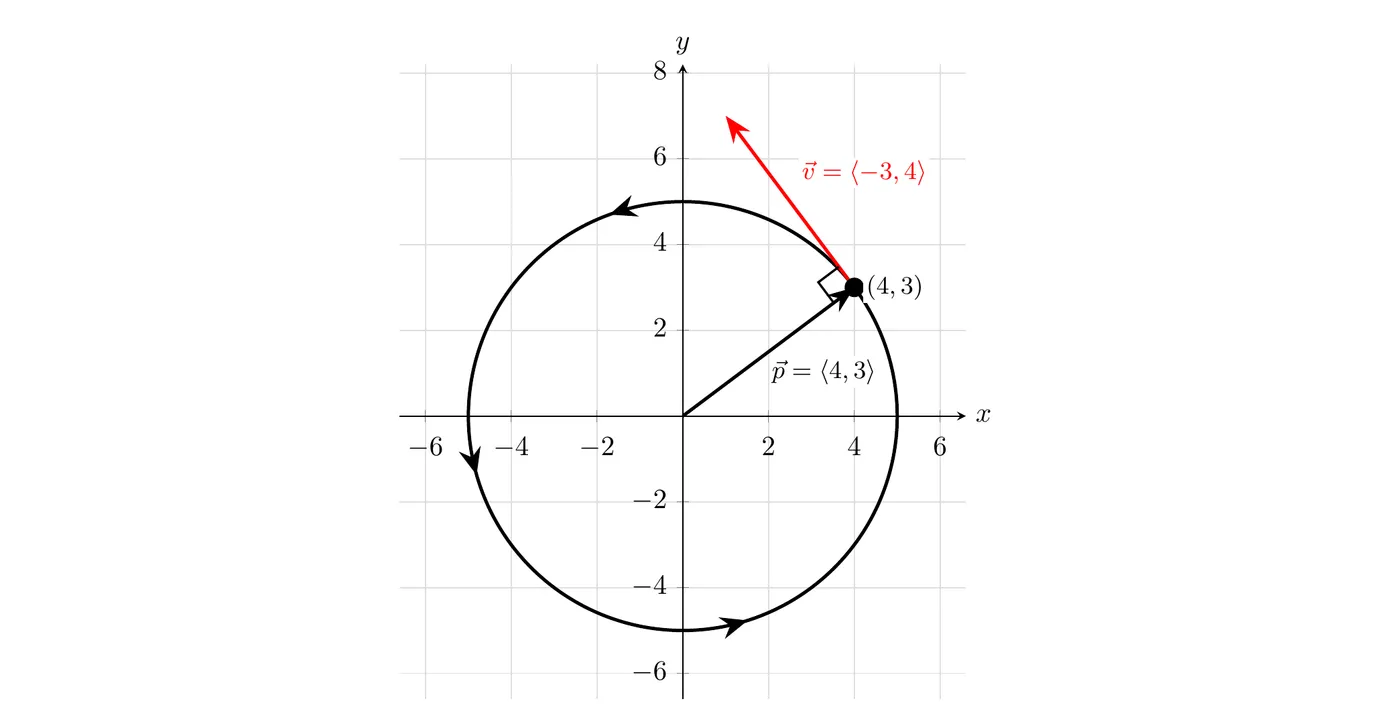
Answer: The dot product is 0 for every , so the velocity is always perpendicular to the position vector (Topic 4.8). The position vector is a radius of the circle, so the velocity is always tangent to the circle, which is exactly what motion around a circle should look like.
Position and velocity at a glance
Feature | Position | Velocity |
drawn from | the origin | the particle |
components | and | the rates of change of and |
magnitude | distance from the origin | speed |
signs of the components tell you | where the particle is (which quadrant) | which way it's moving |
Common mistakes
- Mixing up distance and speed. is the distance from the origin. is the speed.
- Reading direction from position. A negative means the particle is left of the -axis, not that it's moving left. Direction comes from the signs of the velocity components.
- Squaring a negative wrong. , so . On a calculator, type with parentheses; gives .
- Giving speed a sign. Speed is a magnitude, so it's never negative. A negative component means a direction, not a negative speed.
- Drawing velocity from the origin. The velocity vector starts at the particle's current position.