

4.6 - Conic Sections
Overview
Conic sections are the curves you get by slicing a double cone with a flat plane: parabolas, ellipses (including circles), and hyperbolas. Each one has a standard equation that shows its key features at a glance: where it's centered, which way it opens, and how wide it is. This topic covers those equations for conics with horizontal or vertical lines of symmetry, and how to get an equation into standard form by completing the square. These are the same curves you'll parametrize in Topic 4.7.
Parabolas
A parabola has a vertex and one line of symmetry. With vertex and a constant , there are two standard forms:
- The squared variable sets the direction. If is squared, the parabola opens up or down. If is squared, it opens left or right.
- The sign of picks the side. In , opens up and opens down. In , opens right and opens left.
- The size of sets the width. A bigger makes a narrower parabola. (If , the squared term disappears and you get a line, which is why .)
- Axis of symmetry: the vertical line for a parabola that opens up or down, and the horizontal line for one that opens left or right.
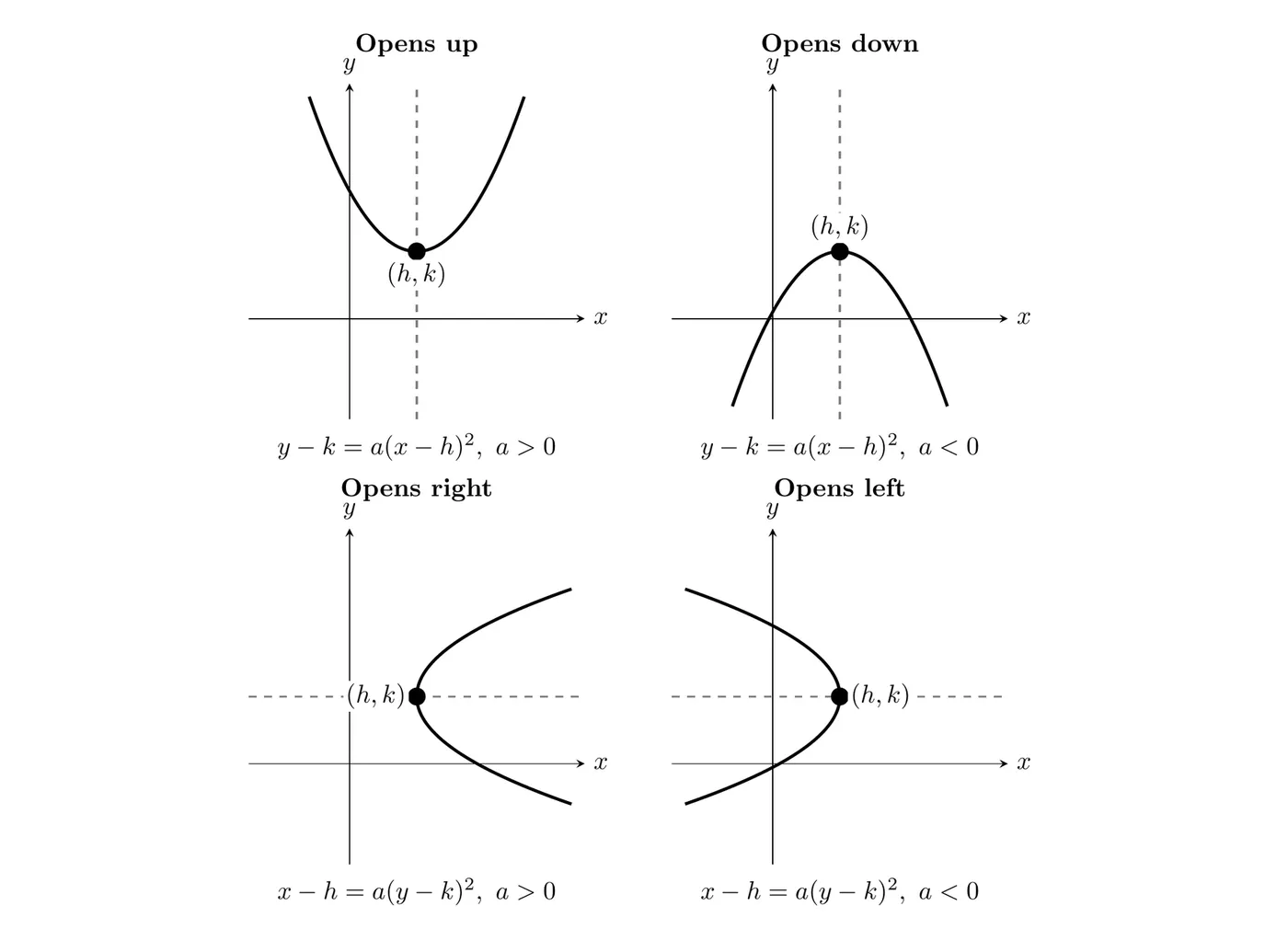
A parabola that opens left or right isn't a function of (it fails the vertical line test), but is a function of . It's one of the implicitly defined curves from Topic 4.5.
Example 1: A sideways parabola
Write in standard form. Find the vertex, the direction it opens, and the axis of symmetry, then sketch it.
Step 1: Factor the leading coefficient out of the terms.
Step 2: Complete the square. Half of is , and . Adding inside the parentheses really adds because of the in front, so subtract to keep the equation balanced:
Step 3: Read the features. This matches with , , and . Since is squared and , it opens right.
Step 4: Plot a few points. and both give . and both give . The points come in mirror-image pairs across .
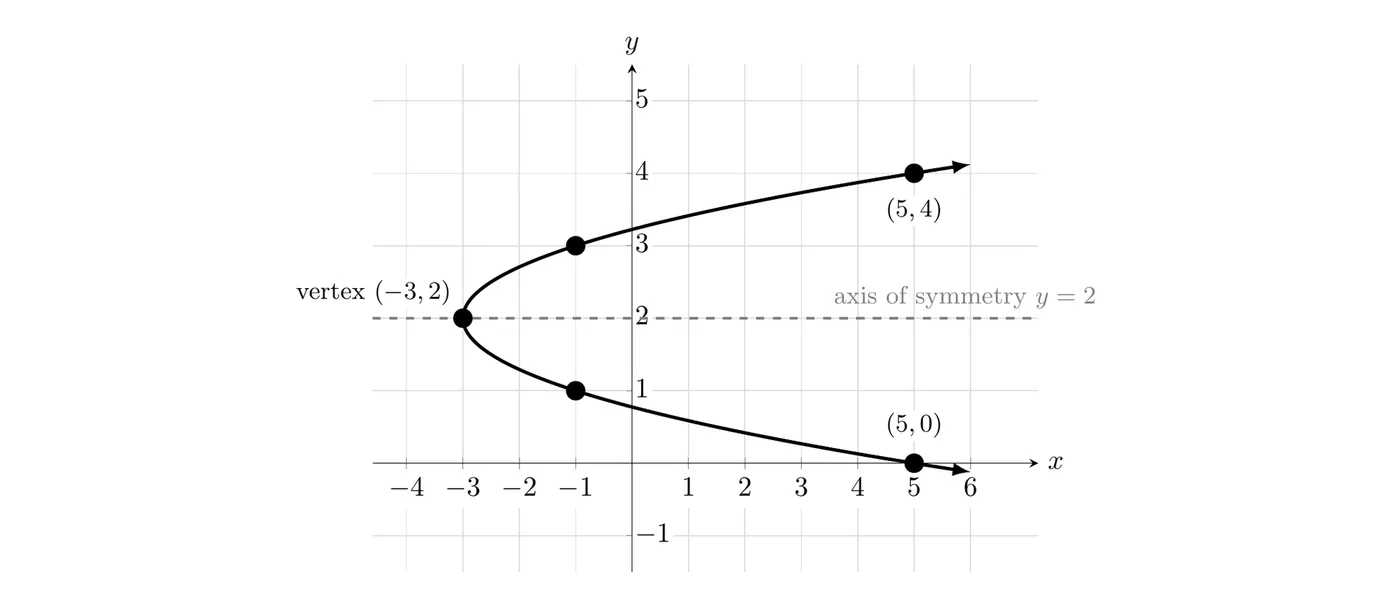
Answer: . The vertex is , the parabola opens to the right, and the axis of symmetry is .
Ellipses
An ellipse is an oval with a center and two lines of symmetry, one horizontal and one vertical. With center , horizontal radius , and vertical radius :
- Center: . Watch the signs: means .
- Horizontal radius : the distance from the center to the left and right ends, . It's the square root of the number under .
- Vertical radius : the distance from the center to the top and bottom, . It's the square root of the number under .
- Shape: if , the ellipse is wider than it is tall. If , it's taller than it is wide.
Where the equation comes from: start with the unit circle, . Stretch it horizontally by a factor of and vertically by a factor of , then move the center to . That replaces with and with , which gives the equation above. So an ellipse is just a stretched circle.
Circles
A circle is the special case of an ellipse where . Both radii equal the radius , and multiplying both sides by gives the familiar circle equation:
For example, is a circle with center and radius . If a circle's equation comes expanded, like , complete the square in and in to get back to this form, the same way as in Example 2 below.
Example 2: An ellipse from general form
Write in standard form. Find the center and both radii, and sketch the ellipse.
Step 1: Group the terms and the terms, and move the constant to the right.
Step 2: Factor out the leading coefficients.
Step 3: Complete both squares. Adding inside the first parentheses adds to the left side, and adding inside the second adds . Add the same amounts to the right side:
Step 4: Divide by 36 so the right side is 1.
Step 5: Read the features. The center is . Since , , and since , . The ends are and .
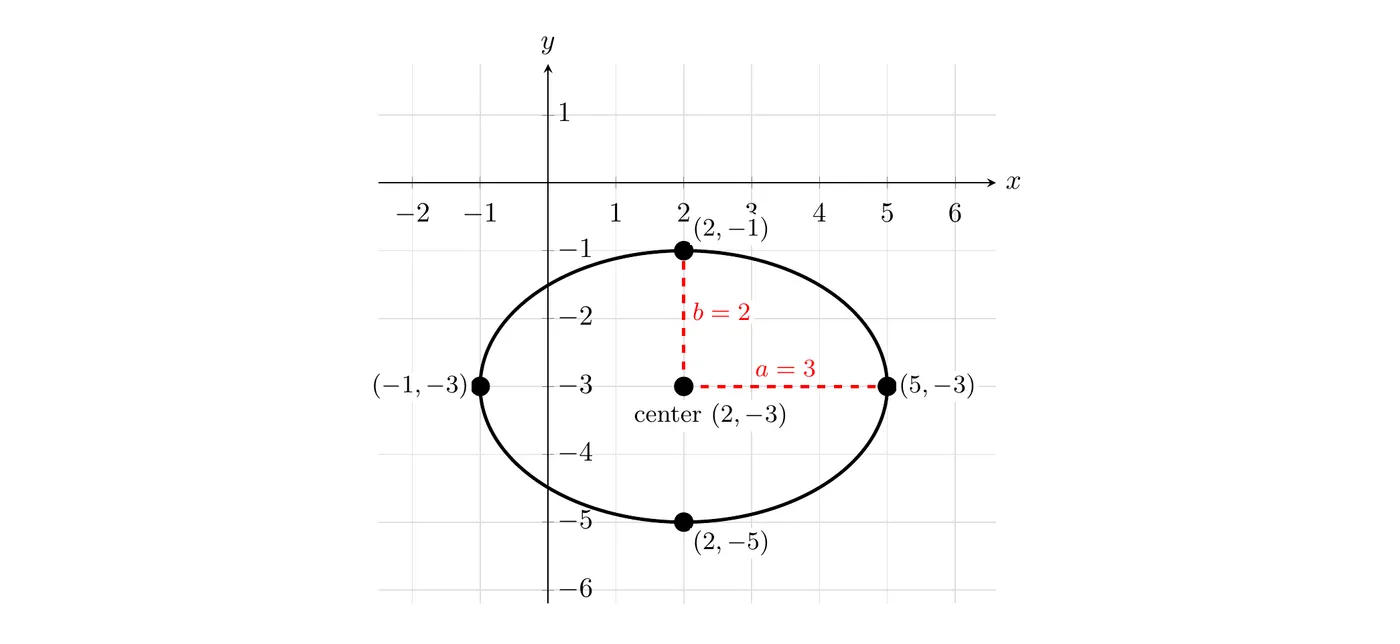
Answer: . The center is , the horizontal radius is 3, and the vertical radius is 2, so the ellipse is 6 units wide and 4 units tall, with ends at , , , and .
Hyperbolas
A hyperbola has two separate branches that open away from each other, a center halfway between them, and two asymptotes (lines the branches get closer and closer to). For a hyperbola centered at with horizontal and vertical lines of symmetry:
Both forms have the same asymptotes:
- The positive term sets the direction. If the term is positive, the hyperbola opens left and right. If the term is positive, it opens up and down.
- Vertices (the points where the branches turn): for a hyperbola that opens left and right, and for one that opens up and down.
- Same letters, same jobs as the ellipse: always goes with (horizontal) and always goes with (vertical). That's why the asymptote slopes are in both forms. (These notes follow the College Board's convention. Some textbooks always call the vertex distance instead.)
Sketching with the box
- Plot the center .
- Draw a rectangle centered there that reaches units left and right and units up and down. It's wide and tall.
- Draw the asymptotes through the center and the corners of the box. Their slopes are : rise over run .
- Draw the branches. Each starts at a vertex on the box (on the left and right sides, or on the top and bottom) and bends toward the asymptotes.
Why the asymptotes are there: far from the center, the squared terms are huge and the 1 on the right side barely matters. So the equation behaves like , which gives .
Example 3: Reading a hyperbola
For , find the center, the direction it opens, the vertices, and the asymptotes.
Step 1: Center and radii. The center is . Since , , and since , .
Step 2: Direction and vertices. The term is positive, so it opens left and right. The vertices are , which are and .
Step 3: Asymptotes. The slopes are :
Step 4: Sketch. The box runs from to and from to . Draw the asymptotes through its corners, then draw each branch from its vertex toward the asymptotes.
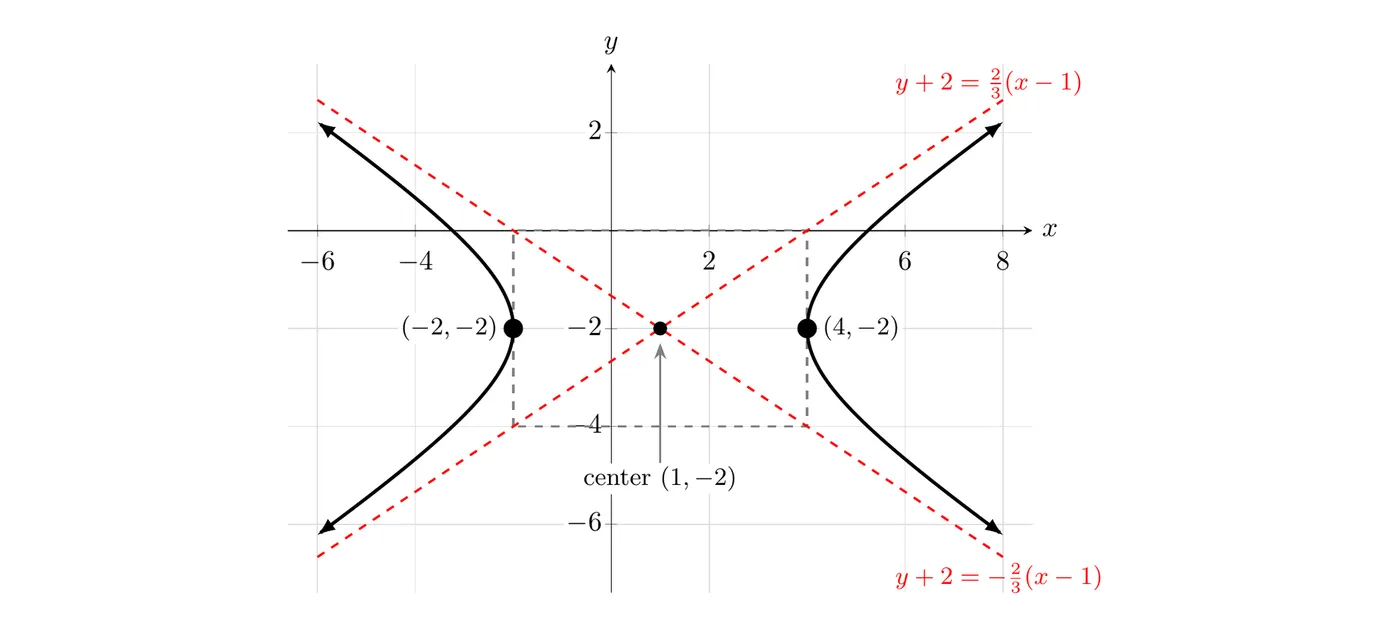
Answer: The center is , the hyperbola opens left and right, the vertices are and , and the asymptotes are .
Example 4: Building a hyperbola from its features
A hyperbola has center , vertices and , and asymptotes with slopes . (a) Write its equation. (b) Find the points on the hyperbola where .
(a) Step 1: Direction. The vertices are directly above and below the center, so the hyperbola opens up and down. Use the form with the term first.
Step 2: Find . The distance from the center to a vertex is , so .
Step 3: Find . The asymptote slopes are , so , which gives .
Answer: , with asymptotes .
(b) Substitute and solve for :
Answer: on the upper branch and on the lower branch. Two points make sense: a vertical line crosses a hyperbola that opens up and down once on each branch. (This hyperbola is graphed in Topic 4.7.)
Identifying a conic from its equation
When an equation has only , , , , and constant terms (no term), the squared terms usually tell you the type before you do any algebra:
Squared terms | Conic |
only one of or | parabola |
and with the same sign and the same coefficient | circle |
and with the same sign and different coefficients | ellipse |
and with opposite signs | hyperbola |
Then complete the square to get the standard form and read off the features. (A few equations break the pattern, like , which has no graph at all. Completing the square will show it.)
Example 5: Quick classification
Identify each conic.
- : same sign and same coefficient, so a circle. It simplifies to .
- : only is squared, so a parabola that opens left or right. It simplifies to , which opens right.
- : same sign, different coefficients, so an ellipse. Dividing by 4 gives .
- : opposite signs, so a hyperbola. It simplifies to , which opens left and right.
Summary
Conic | Standard form | Key features |
Parabola (up or down) | vertex , axis , up if | |
Parabola (left or right) | vertex , axis , right if | |
Ellipse | center , horizontal radius , vertical radius | |
Circle | center , radius | |
Hyperbola (left and right) | vertices , asymptotes | |
Hyperbola (up and down) | vertices , asymptotes |
Common mistakes
- Sign of the center. means , not .
- Using as the radius. In , the horizontal radius is , not . The same goes for circles: has radius .
- Completing the square with a coefficient out front. In , you added to the left side, not . Add to the right side too.
- Reading and before the right side is 1. Divide everything by the constant first.
- Choosing a hyperbola's direction by the bigger number. The positive squared term decides the direction, not the size of the denominators.
- Flipping the asymptote slope. The slopes are , where goes with and goes with .