

4.3 - Parametric Functions and Rates of Change
Overview
Topic 4.2 was about where a particle is. This topic is about which way it's moving and how fast its coordinates change. The key move is the same: look at and separately. The horizontal function tells you left or right, the vertical function tells you up or down, and dividing their average rates of change gives the slope of the path.
Direction of motion
As increases, analyze each coordinate on its own:
If... | then the particle moves... |
is increasing | to the right |
is decreasing | to the left |
is increasing | up |
is decreasing | down |
Put the two together to describe the motion. For example, if is decreasing while is increasing, the particle moves left and up. A max or min of inside the interval is where the particle switches between moving left and moving right, and a max or min of inside the interval is where it switches between moving up and moving down.
Example 1: Describing the direction
A particle's position is , where and for (the same particle as Example 1 in Topic 4.2). Describe the direction of motion over the whole time interval.
Step 1: Analyze . It's an upward parabola in with its vertex at , so decreases on and increases on .
Step 2: Analyze . It's a downward parabola in with its vertex at , so increases on and decreases on .
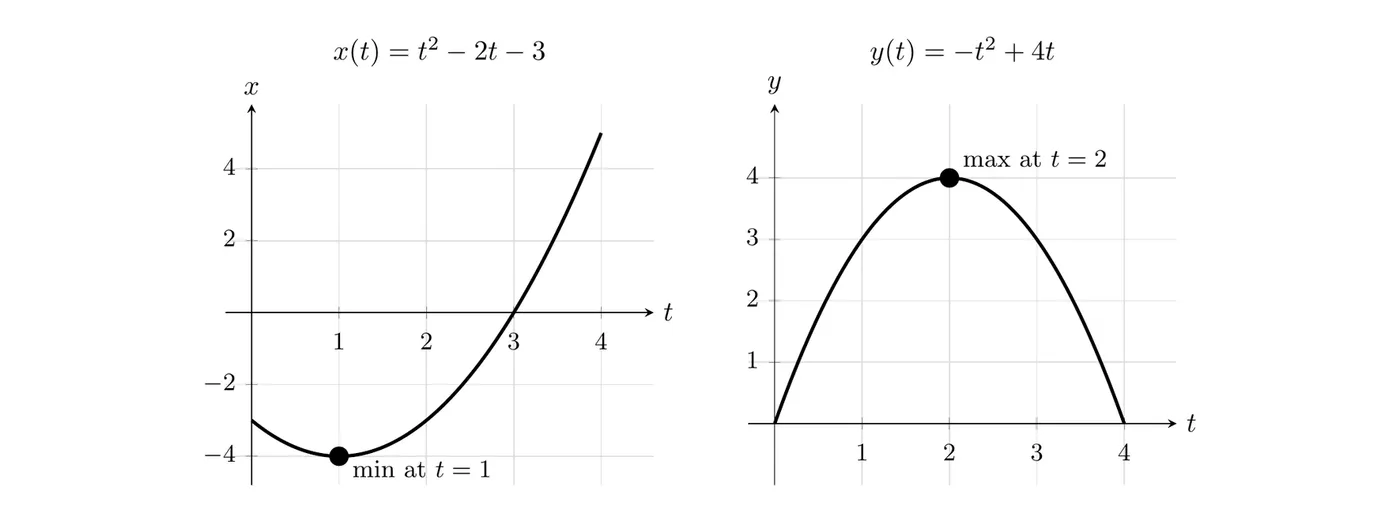
Step 3: Combine.
Interval | Direction | ||
decreasing | increasing | left and up | |
increasing | increasing | right and up | |
increasing | decreasing | right and down |
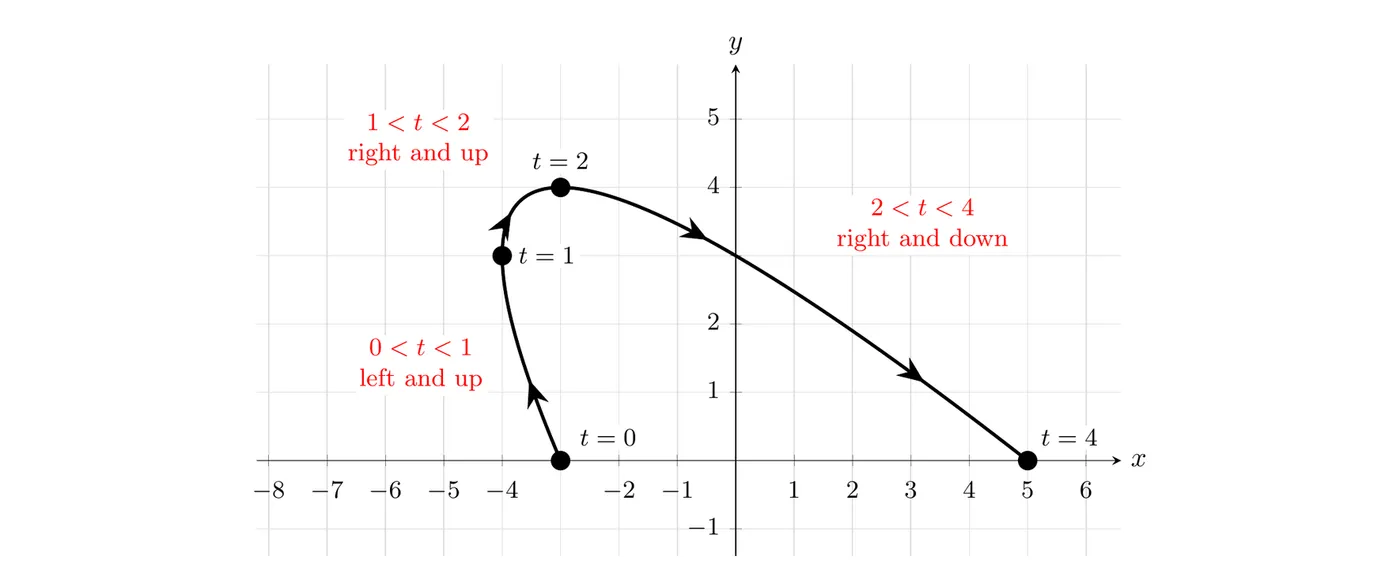
Answer: The particle moves left and up for , right and up for , and right and down for . At it switches from left to right (its leftmost point, ), and at it switches from up to down (its highest point, ).
Same point, different directions
A curve can pass through the same point more than once, and the particle doesn't have to move the same way each time. At a given point, the direction of motion can be different for different values of . So a point alone doesn't tell you the direction; you also need the time.
Example 2: Two passes through the origin
The curve from Topic 4.1 passes through at and at . Use the table to describe the direction of motion each time.
Near : from to , goes from to (decreasing) and goes from to (increasing). The particle moves left and up.
Near : from to , goes from to (increasing) and goes from to (increasing). The particle moves right and up.
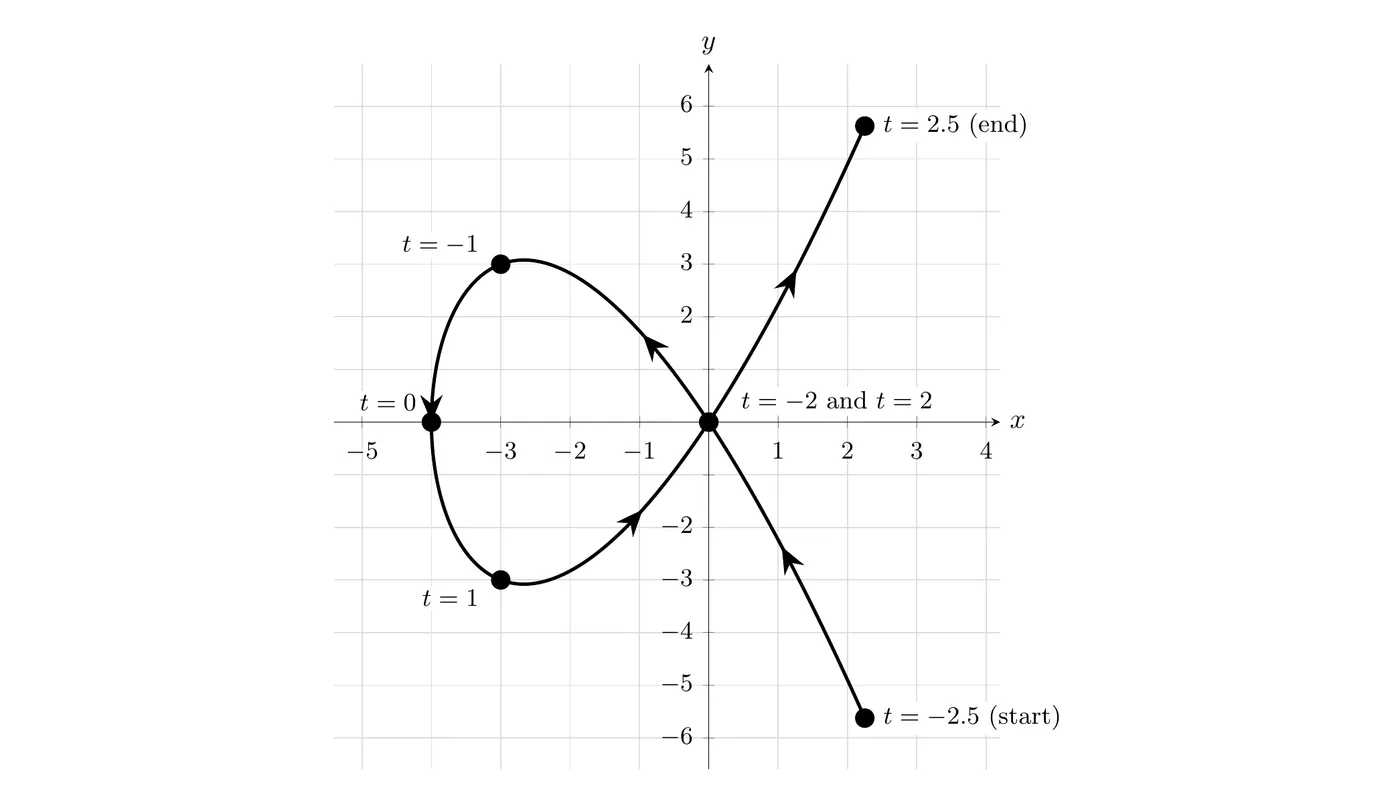
Answer: Both times the particle is at the origin, but at it's heading left and up (into the loop), and at it's heading right and up (out of the loop).
One curve, many parametrizations
The same curve can be parametrized (described by a parametric function) in many ways. Different parametrizations can trace the curve in different directions and at different speeds. For example, all three of these trace the part of the parabola from to :
Parametric function | Domain | Starts at | Direction |
left to right | |||
right to left | |||
left to right, in half the time |
Each one lies on . For , . For , .
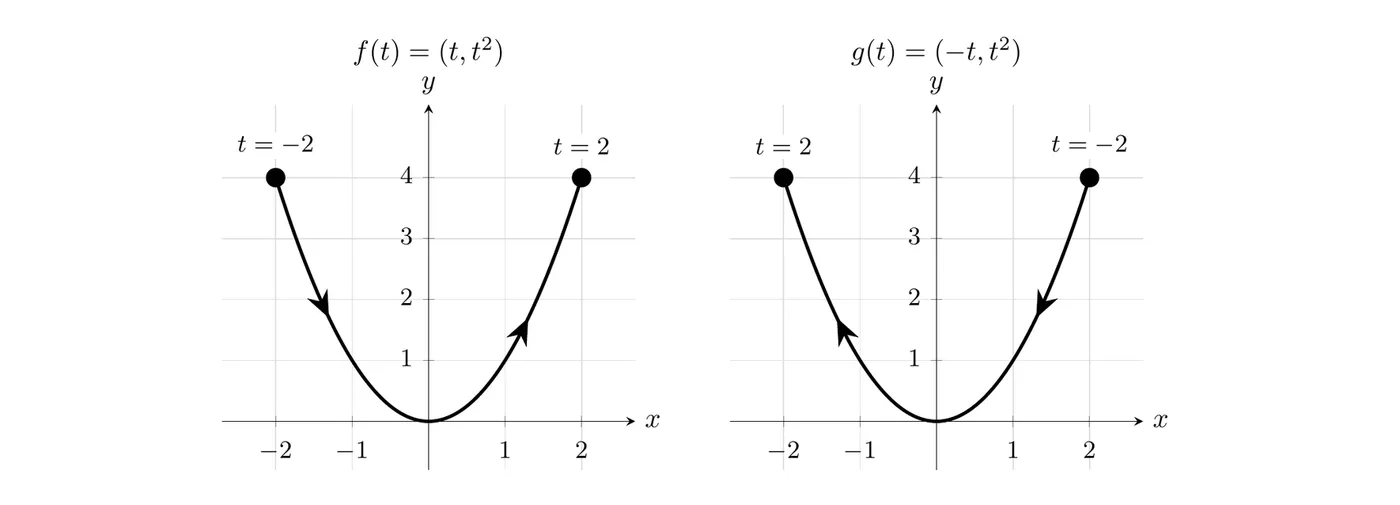
So a question about direction is a question about the parametric function, not just the curve.
Average rate of change and slope
Over an interval in the domain, you can compute the average rate of change (AROC) of each coordinate function on its own:
These are rates with respect to , like feet per second of horizontal motion and feet per second of vertical motion.
Divide the second by the first, and the cancels:
That's the slope of the segment between the points on the curve at and : change in over change in . It works as long as the average rate of change of isn't . If , the two points line up vertically and the slope is undefined.
The slope is a rate of with respect to (for example, feet of height per foot of horizontal distance), not a rate with respect to time.
Example 3: The thrown ball
A ball's position seconds after it's thrown is , in feet (the ball from Topic 4.2). Find the average rates of change of and , and the slope of the path, between and and between and .
Step 1: Positions. , , and .
Step 2: On .
Step 3: On .
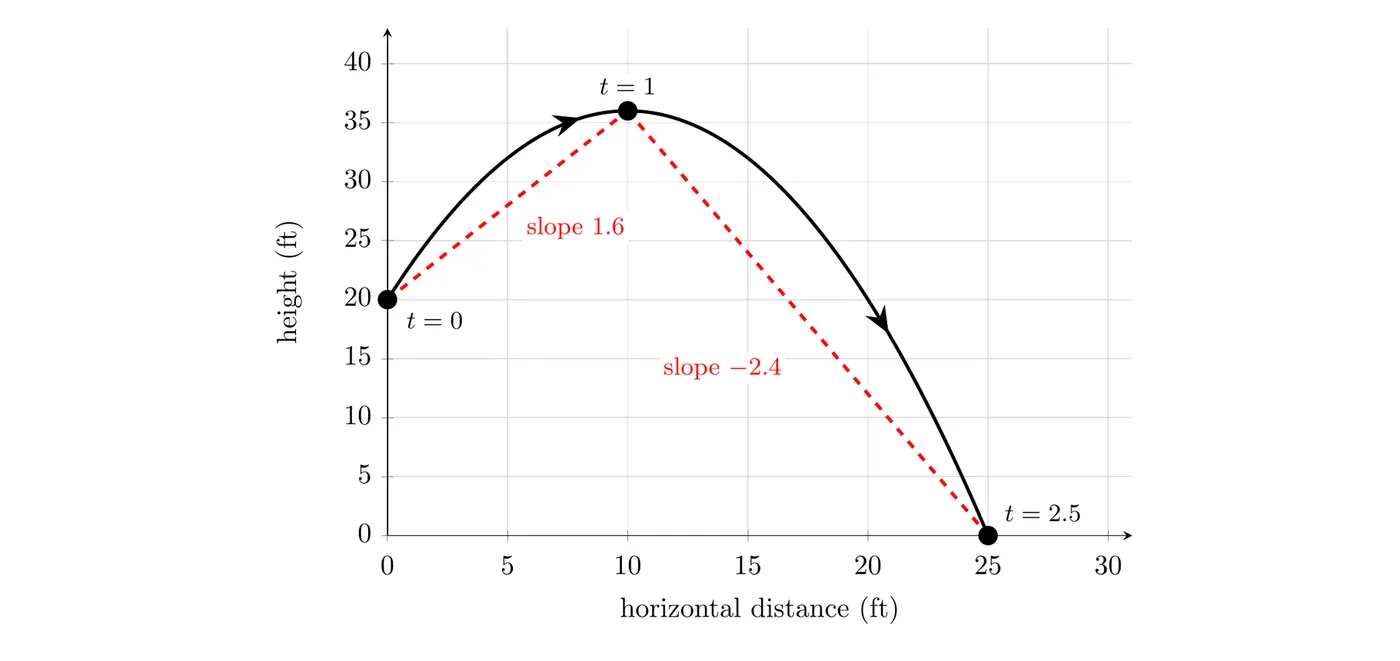
Answer: From to , the ball moves right at an average of 10 feet per second and up at an average of 16 feet per second, so the segment between those positions has slope : it rises 1.6 feet for every foot of horizontal travel. From to , it still moves right at 10 feet per second but drops at an average of 24 feet per second, so the slope is : it falls 2.4 feet for every foot of horizontal travel.
Example 4: Working from a table
A particle moves in the plane. Selected values of and are shown.
(a) Find the slope of the segment between the particle's positions at and . (b) What happens if you try the same thing on ? (c) Compare the particle's position at with its position at . Justify your answer.
(a) Average rates of change on :
Answer: The segment from to has slope .
(b) On , the average rate of change of is . You can't divide by .
Answer: The slope is undefined. The positions at and are and , which line up vertically, so the segment between them is vertical.
(c) On , the average rate of change of is and the average rate of change of is .
Answer: Both average rates of change are negative, so at the particle is to the left of and below where it was at . The table only gives a few times, so this describes the overall change, not the direction at every moment in between.
Common mistakes
- Flipping the slope. The slope is the rate for divided by the rate for , not the other way around.
- Calling a rate a slope. is the vertical rate with respect to time. You need both rates to get the slope of the path.
- Dividing by zero. If the average rate of change of is , the slope is undefined (a vertical segment).
- Reading direction from the curve alone. One curve can be traced either way. Use and , or the arrows.
- Assuming one direction per point. Where the curve passes through a point twice, the particle can move differently each time.