4.7 - Parametrization of Implicitly Defined Functions
Overview
In Topic 4.4 you parametrized circles and line segments. This topic extends the idea to curves described by equations: graphs of functions, inverse functions, and every conic section from Topic 4.6. A parametrization turns an equation into motion along the curve, one point for each value of t. It's how you graph a sideways parabola or a hyperbola on a calculator in parametric mode, and it's how calculus and physics describe paths.
What a parametrization has to do
A parametric function (x(t),y(t)) is a parametrization of a curve defined by an equation in x and y when this is true:
Substitutingx(t)forxandy(t)forymakes the equation true for every value oftin the domain.
"Every value" is the key phrase. Checking one or two points isn't enough. You need the equation to simplify to something that's always true, usually by algebra or by a Pythagorean identity like cos2t+sin2t=1. You also usually want the parametrization to cover the whole curve (or the part you care about) as t runs through its domain.
Example 1: Checking a parametrization
(a) Show that (x(t),y(t))=(2t,t2+1) is a parametrization of y=4x2+1. (b) Is (x(t),y(t))=(cost,2sint) a parametrization of the circle x2+y2=4?
(a) Substitute x=2t into the right side:
4(2t)2+1=44t2+1=t2+1=y(t)
Answer: The equation holds for every t, so this is a parametrization. As t runs through all real numbers, x=2t does too, so it covers the whole parabola.
(b) Substitute into the left side:
(cost)2+(2sint)2=cos2t+4sin2t=1+3sin2t
Answer: No. This equals 4 only when sin2t=1, not for every t. At t=0 the point is (1,0), which is 1 unit from the origin, not 2. (This function actually traces the ellipse x2+4y2=1.)
Graphs of functions and their inverses
Any function
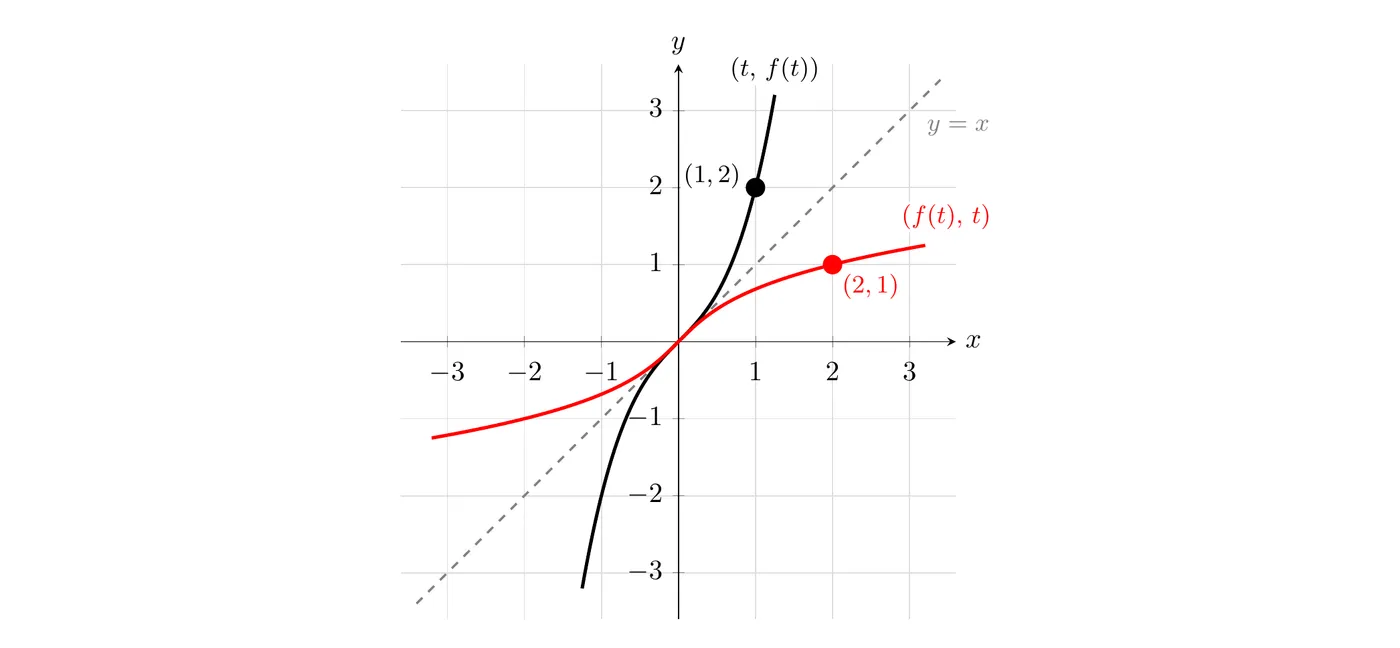
If f is a function of x, the graph of y=f(x) can be parametrized by letting x itself be the parameter:
(x(t),y(t))=(t,f(t))
Check: x=t, so y=f(t)=f(x) for every t. As t increases, the point moves left to right along the graph.
Inverses: Swap the coordinates
The graph of an inverse function is the graph of f reflected across the line y=x: every point (a,b) becomes (b,a). So if f is invertible, swap the two coordinates:
(x(t),y(t))=(f(t),t)
This works even when you can't solve forf−1(x)with algebra, so it's often the easiest way to graph an inverse.
Sometimes this only works on an appropriate interval of t. If f is only one-to-one on part of its domain, restrict t to that part. For example, f(x)=x2 isn't invertible on all real numbers, but it is for x≥0. Its inverse there, f−1(x)=x, is parametrized by (t2,t) for t≥0.
Example 2: An inverse you can't solve for
Let f(x)=x3+x. (a) Parametrize the graph of f. (b) Explain why f is invertible, and parametrize the graph of f−1. (c) Use the parametrization to find f−1(2) and f−1(10).
(a) Use (t,f(t)):
(x(t),y(t))=(t,t3+t)
(b) Both x3 and x are increasing for all x, so their sum is increasing too. An increasing function never repeats an output, so f is one-to-one and invertible on all real numbers. Swap the coordinates:
(x(t),y(t))=(t3+t,t)
To find a formula for f−1, you'd have to solve x=y3+y for y, a cubic equation with no easy algebra. The parametrization skips that step entirely.
(c)f−1(2) is the y-value on the inverse's graph where x=2. Set x(t)=2, so t3+t=2. Trying t=1 gives 1+1=2, and since t3+t is increasing, that's the only solution. The point is (2,1). In the same way, t3+t=10 at t=2 (since 8+2=10), giving the point (10,2).
Answer:f−1(2)=1 and f−1(10)=2. Check: f(1)=2 and f(2)=10.
Parametrizing parabolas
A parabola, like any equation you can solve for one variable, is parametrized the same way as a function graph:
If you can solve fory: write y=f(x), then use (x(t),y(t))=(t,f(t)). This replaces x with t.
If you can solve forx: write x=f(y), then use (x(t),y(t))=(f(t),t). This replaces y with t.
Example 3: Two parabolas
Parametrize (a) y−1=−2(x+3)2 and (b) x+3=2(y−2)2, the parabola from Example 1 in Topic 4.6.
(a) Solve for y: y=−2(x+3)2+1. Replace x with t:
(x(t),y(t))=(t,−2(t+3)2+1)
(b) Solve for x: x=2(y−2)2−3. Replace y with t:
(x(t),y(t))=(2(t−2)2−3,t)
Check (b): t=2 gives (−3,2), the vertex, and t=0 gives (2(4)−3,0)=(5,0), which matches the graph in Topic 4.6. Since y=t, the point moves up the parabola as t increases.
Answer: (a) (t,−2(t+3)2+1) and (b) (2(t−2)2−3,t), each for all real t.
Parametrizing ellipses
The ellipse with center (h,k), horizontal radius a, and vertical radius b is parametrized by
x(t)=h+acost,y(t)=k+bsint,0≤t≤2π
Why it works:ax−h=cost and by−k=sint, so a2(x−h)2+b2(y−k)2=cos2t+sin2t=1 for every t.
Start and direction:t=0 gives (h+a,k), the right end. As t goes from 0 to 2π, the point goes once around counterclockwise.
Connection to circles: this is the circle parametrization from Topic 4.4, stretched by a horizontally and by b vertically. When a=b=r, it's exactly the circle (h+rcost,k+rsint).
Heads up: unless the ellipse is a circle, t is not the angle from the center to the point. It's just the parameter.
Example 4: Tracing an ellipse
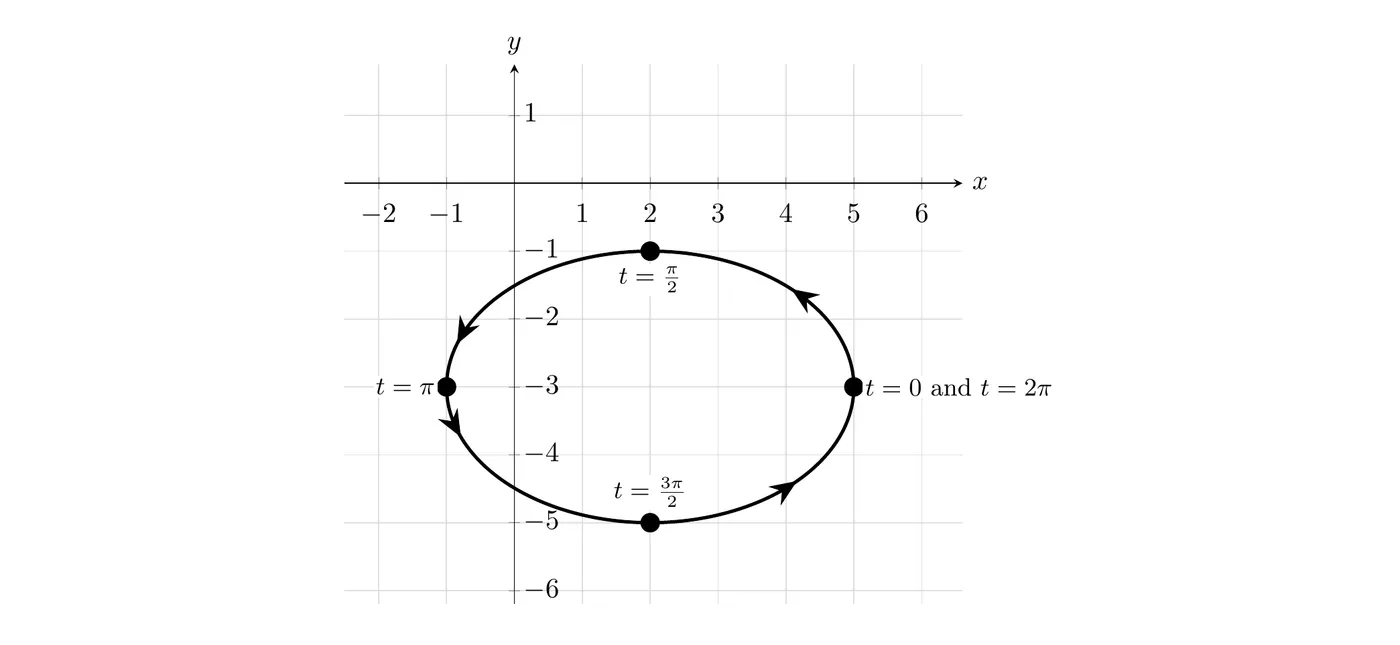
Parametrize the ellipse 9(x−2)2+4(y+3)2=1 (from Example 2 in Topic 4.6), make a table of points, and describe the motion.
Step 1: Read the center and radii. The center is (2,−3), a=3, and b=2:
Answer: The point starts at the right end, (5,−3), moves counterclockwise through the top (2,−1), the left end (−1,−3), and the bottom (2,−5), and returns to (5,−3) at t=2π. To trace it clockwise instead, use y(t)=−3−2sint.
Parametrizing hyperbolas
Hyperbolas use secant and tangent, because of the Pythagorean identity
sec2t−tan2t=1
which comes from dividing cos2t+sin2t=1 by cos2t to get 1+tan2t=sec2t. A minus sign between two squares is exactly what a hyperbola's equation has.
Hyperbola
Parametrization, 0≤t≤2π
opens left and right: a2(x−h)2−b2(y−k)2=1
x(t)=h+asect, y(t)=k+btant
opens up and down: b2(y−k)2−a2(x−h)2=1
x(t)=h+atant, y(t)=k+bsect
Secant goes with the positive term. The variable whose squared term is positive gets sect. Since ∣sect∣≥1, that coordinate never gets closer to the center than a vertex, which is exactly how a hyperbola behaves.
Check (left and right):a2(asect)2−b2(btant)2=sec2t−tan2t=1.
Two branches: when cost>0, sect≥1 and the point is on one branch (right or upper). When cost<0, sect≤−1 and the point is on the other branch (left or lower).
Gaps att=2πandt=23π:sect and tant are undefined there, so those two values are left out. As t gets close to them, the point runs off along an asymptote, then comes back on the other branch.
Example 5: Parametrizing a hyperbola
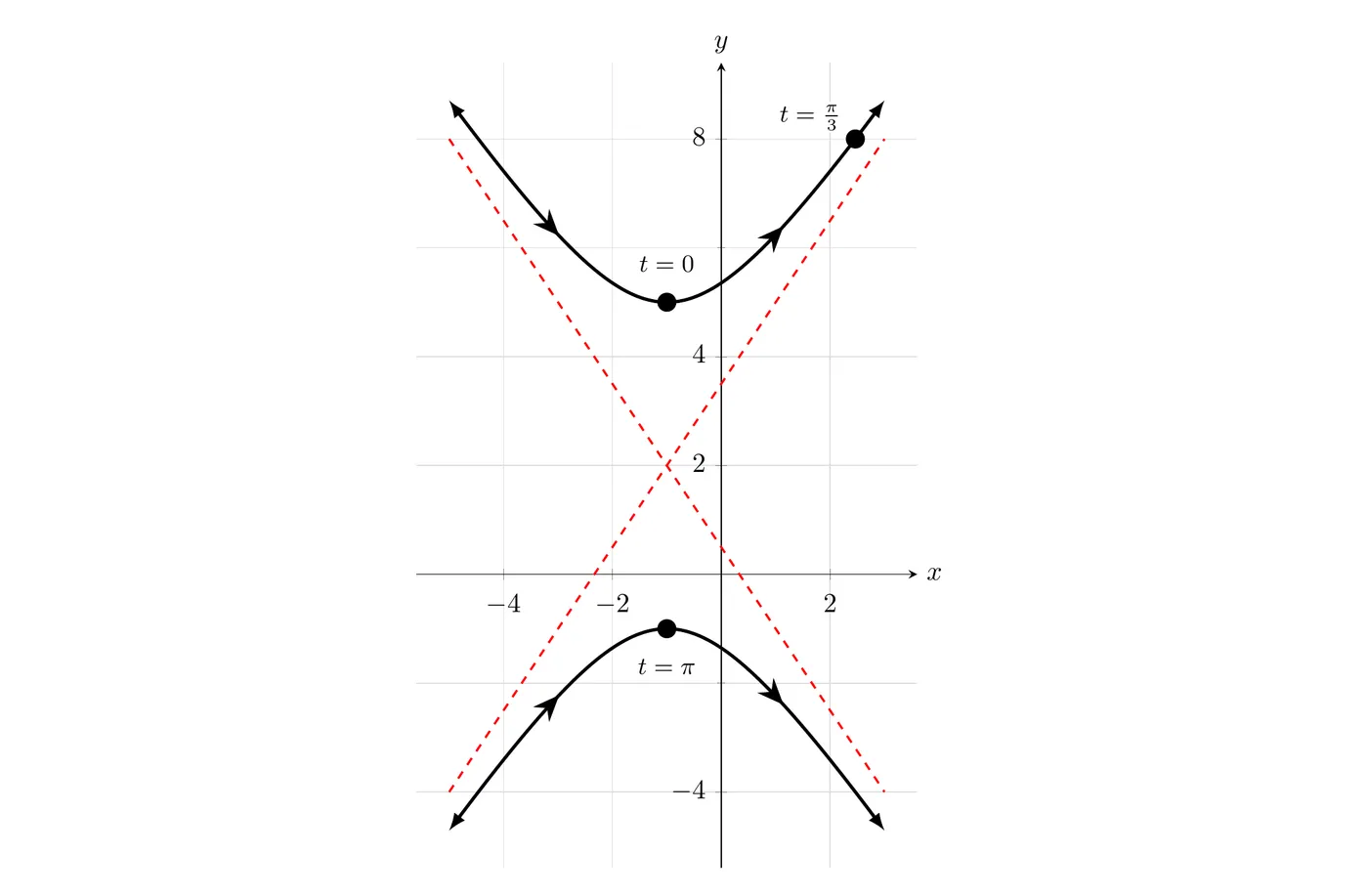
Parametrize the hyperbola 9(y−2)2−4(x+1)2=1 from Example 4 in Topic 4.6. Then find the points at t=0, t=π, and t=3π, and say which branch each is on.
Step 1: Set up. It opens up and down, with center (−1,2), a=2, and b=3. Secant goes with y:
x(t)=−1+2tant,y(t)=2+3sect,0≤t≤2π,t=2π,23π
Step 2: Check.
9(3sect)2−4(2tant)2=sec2t−tan2t=1
Step 3: Find the points.
t=0: tan0=0 and sec0=1, so the point is (−1,5), the upper vertex.
t=π: tanπ=0 and secπ=−1, so the point is (−1,−1), the lower vertex.
t=3π: tan3π=3 and sec3π=2, so the point is (−1+23,8)≈(2.46,8). Check: 9(8−2)2−4(23)2=4−3=1.
Answer:(x(t),y(t))=(−1+2tant,2+3sect). The points (−1,5) and (−1+23,8) are on the upper branch (where sect>0), and (−1,−1) is on the lower branch (where sect<0). On each branch the point moves left to right as t increases, because tant increases on every interval where it's defined.
Example 6: Going backward
Identify each curve and give its equation in standard form: (a) x(t)=−2+5cost, y(t)=4+5sint; (b) x(t)=1+2cost, y(t)=3sint; (c) x(t)=3+4sect, y(t)=−1+5tant.
Strategy: isolate the trig functions, then use a Pythagorean identity to eliminate t.
(a)cost=5x+2 and sint=5y−4. Since cos2t+sin2t=1:
25(x+2)2+25(y−4)2=1⇒(x+2)2+(y−4)2=25
Answer: a circle with center (−2,4) and radius 5.
(b)cost=2x−1 and sint=3y:
4(x−1)2+9y2=1
Answer: an ellipse with center (1,0), horizontal radius 2, and vertical radius 3, so it's taller than it is wide.
(c)sect=4x−3 and tant=5y+1. Since sec2t−tan2t=1:
16(x−3)2−25(y+1)2=1
Answer: a hyperbola with center (3,−1) that opens left and right, with vertices (7,−1) and (−1,−1) and asymptotes y+1=±45(x−3).
Summary
Curve
Parametrization
graph of y=f(x)
(t,f(t))
graph of f−1
(f(t),t), on an interval where f is one-to-one
parabola solved for x, x=f(y)
(f(t),t)
ellipse
(h+acost,k+bsint), 0≤t≤2π
hyperbola, left and right
(h+asect,k+btant), 0≤t≤2π
hyperbola, up and down
(h+atant,k+bsect), 0≤t≤2π
Common mistakes
Checking only a few points. A parametrization has to satisfy the equation for every t, not just at t=0.
Swapping secant and tangent. Secant goes with the variable whose squared term is positive.
Forgetting the center.acost alone is centered at 0. Add h to x and k to y.
Usinga2instead ofa. For 9(x−2)2, use 3cost, not 9cost.
Ignoring the domain of an inverse.(f(t),t) gives an inverse only where f is one-to-one. Restrict t if you need to.
Plugging int=2πfor a hyperbola. Secant and tangent are undefined there.