

5.1 - Reaction Rates
Overview
Chemical kinetics is the study of how fast reactions happen. A reaction rate tells you how quickly reactants turn into products, measured as a change in concentration per unit of time. This topic sets up the language for all of Unit 5: how to write a rate, how the balanced equation ties together the rates of different substances in the same reaction, and what you can change in the lab to make a reaction faster or slower.
What a reaction rate is
The kinetics of a reaction is the rate at which reactants are converted to products per unit of time. Reactions in solution or in the gas phase are tracked by concentration, so a rate is usually a change in molar concentration divided by a change in time:
Square brackets mean molar concentration, so is the concentration of in mol/L (M). With time in seconds, a rate has units of M/s, the same as . Minutes or hours work too, as long as you say which.
Reactant concentrations go down and product concentrations go up. A rate is always reported as a positive number, so the rate at which a reactant disappears gets a negative sign in front: .
Following a reaction over time
Take the decomposition of dinitrogen pentoxide:
The graph shows the concentrations of all three gases in a container that starts with 0.0200 M and no products.
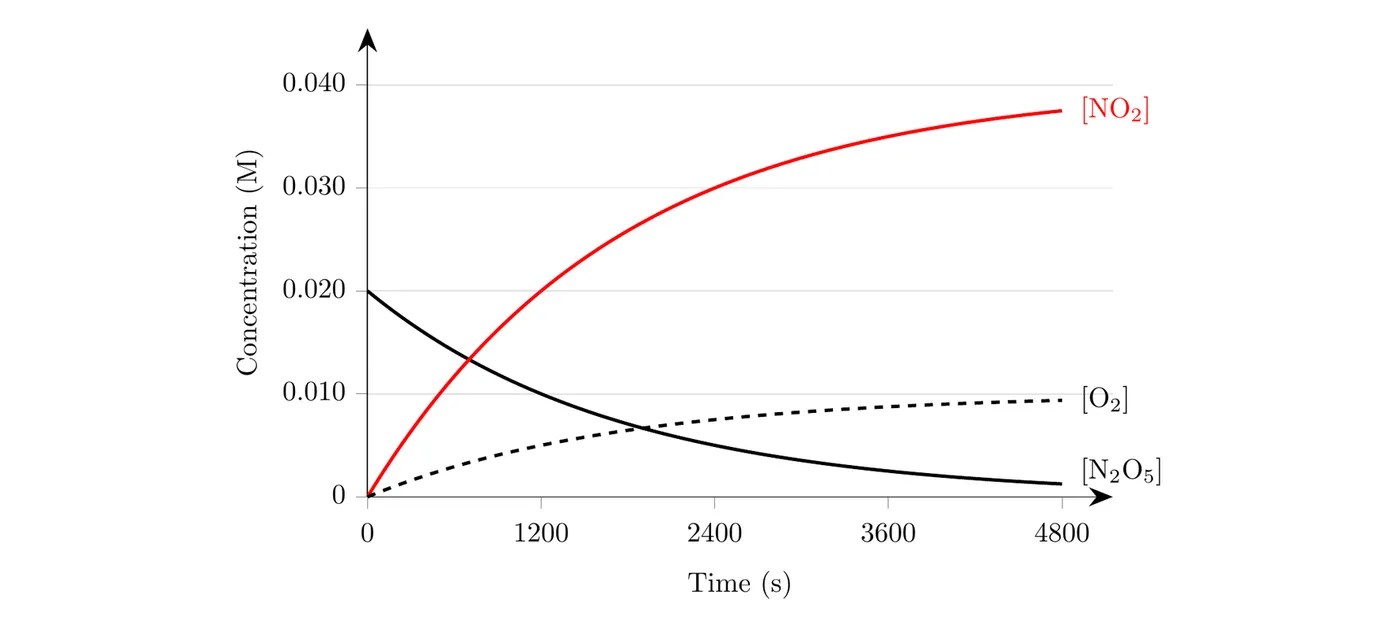
Three things to notice:
- falls while and rise.
- Every curve is steepest at the start and flattens out later. As the reactant is used up, the reaction slows down.
- The curves change at different speeds. heads toward 0.0400 M, twice the starting , while heads toward only 0.0100 M. The next section explains why.
Average rate and instantaneous rate
Because the rate keeps changing, there are two ways to describe it:
- Average rate: the change in concentration over a time interval, . On a graph of concentration vs. time, it's the slope of the secant line connecting two points.
- Instantaneous rate: the rate at one moment, the slope of the tangent line at that point. The instantaneous rate at is the initial rate, which Topic 5.2 uses to find rate laws.
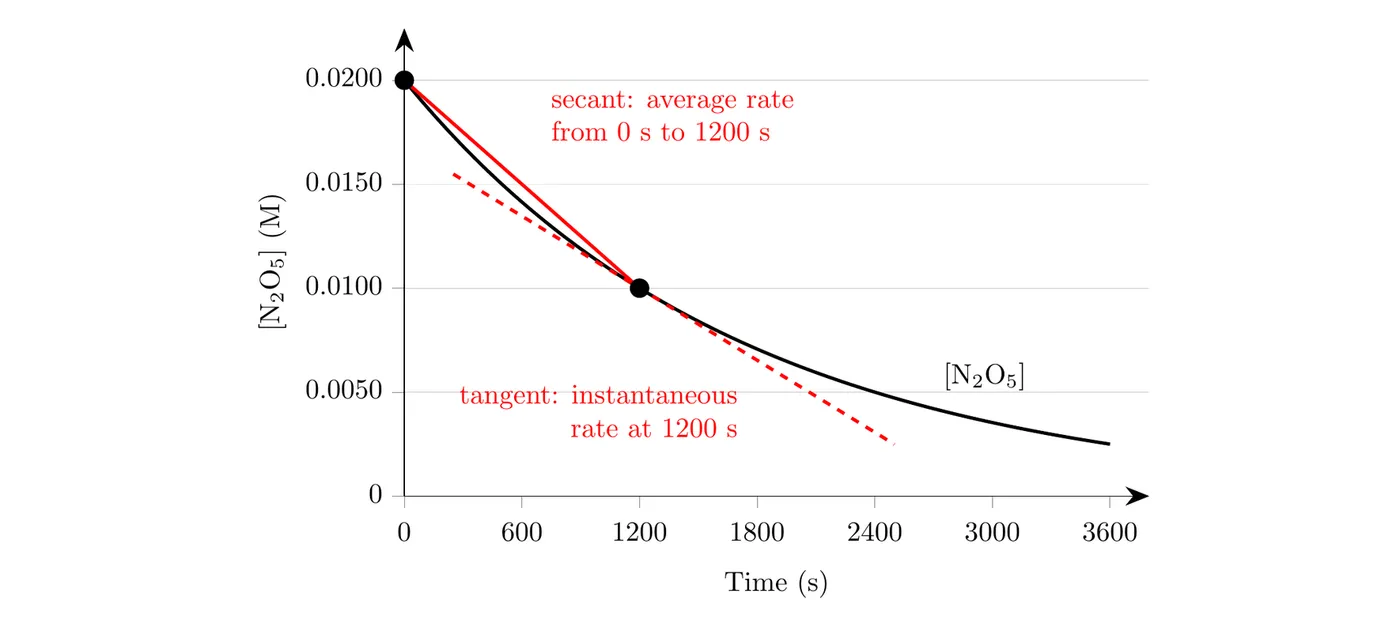
The secant from 0 s to 1200 s is steeper than the tangent at 1200 s, because the reaction was faster early on. The average rate over that interval is M/s (Example 1 works it out), while the instantaneous rate at 1200 s is only about M/s. To get an instantaneous rate from a graph, draw the tangent line and find its slope from two points on it.
Rates and stoichiometry
In , every 2 molecules of that react make 4 molecules of and 1 molecule of . So in any time interval, forms twice as fast as disappears, and forms half as fast. The rates of change of reactant and product concentrations are set by the coefficients in the balanced equation.
For a general reaction , dividing each species' rate by its coefficient gives one number, the rate of reaction, which is the same no matter which species you measure:
In practice, you'll mostly use the ratio of coefficients directly: the rates of two species are in the same ratio as their coefficients. Always say which species a rate refers to ("the rate of formation of "), because different species in the same reaction change at different rates.
What changes the rate
The rate of a reaction depends on the conditions. Each factor below has a particle-level explanation: particles react when they collide with enough energy (Topics 5.5 and 5.6 go deeper).
Factor | Change that speeds up the reaction | Why, at the particle level |
Reactant concentration | Higher concentration (or higher partial pressure of a gas) | More reactant particles in the same volume, so more collisions per second |
Temperature | Higher temperature | Particles move faster, so they collide more often and, more importantly, a larger fraction of collisions have enough energy to react |
Surface area | Smaller pieces of a solid (powder instead of one chunk) | Only particles on the surface of a solid can be hit by the other reactant, and smaller pieces expose more of them |
Catalyst | Adding a catalyst | It gives the reaction a different pathway with a lower energy barrier, so more collisions succeed (Topic 5.11) |
Other environmental factors | Depends on the reaction: the solvent, light, stirring a mixture | Each one changes how often reactant particles meet or how many have enough energy |
The pattern: anything that increases the number of collisions per second, or the fraction of collisions that succeed, speeds up the reaction.
Measuring rates in the lab
To measure a rate, you track the amount of a reactant or product over time. Common methods:
- Color: a spectrophotometer measures absorbance, which is proportional to concentration (Beer's law, Topic 3.13).
- Gas produced: collect the gas and measure its volume, or track the pressure in a sealed container.
- Mass: if a gas escapes from an open container, the mass of the container drops as the reaction goes.
- Other properties: pH or electrical conductivity, when the number or type of ions changes.
In the AP lab on how fast acid rain wears away a marble statue, students react calcium carbonate, the main compound in marble and limestone, with hydrochloric acid and measure how fast forms:
Students change one factor at a time (acid concentration, temperature, or the size of the pieces) and hold everything else constant, which is what makes the comparison fair.
Example 1: Average rates from data
The table gives during the decomposition . (The numbers are made up, but they follow the way this reaction really behaves.)
Time (s) | (M) |
0 | 0.0200 |
600 | 0.0141 |
1200 | 0.0100 |
1800 | 0.00707 |
2400 | 0.00500 |
(a) Find the average rate of disappearance of from 0 s to 1200 s. (b) Find the average rates of formation of and over the same interval. (c) Find the average rate of disappearance of from 1200 s to 2400 s, and explain why it's smaller.
(a) Divide the change in concentration by the change in time, with a negative sign since is a reactant:
(b) The coefficients are 2 for , 4 for , and 1 for :
Check: dividing each rate by its coefficient gives the same rate of reaction for all three species, M/s. The species with the biggest coefficient, , changes the fastest.
(c) Same method on the later interval:
The rate dropped by half. Less is left, so there are fewer molecules per liter, and fewer of them react each second.
Example 2: Marble chips vs. powder (AP-style)
A student runs two trials at 25.0 °C. Each uses 50.0 mL of 1.00 M HCl and a 0.500 g sample of pure : chips in Trial 1 and powder in Trial 2. The student collects the at 1.00 atm and records its volume over time.
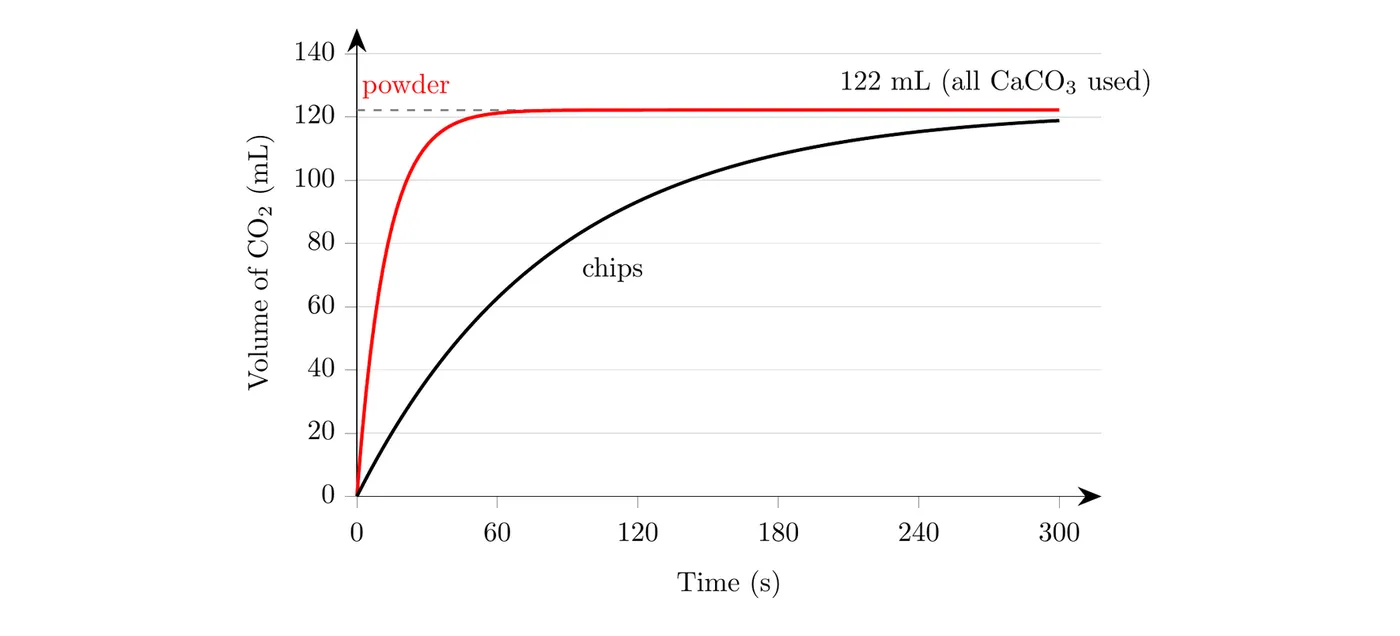
(a) Which trial has the greater initial rate? Justify your answer at the particle level. (b) Show that both trials end with about 122 mL of . (c) Predict how the initial rate of Trial 1 would change if 2.00 M HCl were used instead, and explain.
(a) Trial 2, the powder. Its curve is much steeper at the start. The reaction can only happen where ions from the acid hit the surface of the solid. Grinding the same mass into powder exposes far more at the surface, so there are more collisions between the acid and each second.
(b) Surface area changes how fast the forms, not how much. Find the limiting reactant:
Using up all of the takes mol HCl, far less than 0.0500 mol, so is limiting. One mole of forms per mole of :
Both curves level off at 122 mL, because the same amount of reacts in each trial.
(c) The initial rate increases. With 2.00 M HCl there are twice as many ions per liter, so ions hit the surface of the chips more often. The final volume is still 122 mL, since is still the limiting reactant.
Common mistakes
- Reporting a negative rate. A rate is positive. The negative sign in cancels the negative change in a reactant's concentration.
- Ignoring or flipping the coefficients. In , forms twice as fast as disappears, so multiply by 4/2, not 2/4. Check that the species with the bigger coefficient has the bigger rate, and say which species a rate is for.
- Assuming the rate stays constant. For most reactions the rate drops as reactants are used up, so an average rate over a long interval is smaller than the initial rate.
- Mixing up how fast with how much. Surface area, temperature, and catalysts change how fast products form, not how much product you end up with. The limiting reactant sets the amount.